
XHW(603888)

Search documents
数字媒体板块12月2日跌1.19%,芒果超媒领跌,主力资金净流入3875.61万元
Zheng Xing Xing Ye Ri Bao· 2025-12-02 09:09
Market Overview - The digital media sector experienced a decline of 1.19% on December 2, with Mango Super Media leading the drop [1] - The Shanghai Composite Index closed at 3897.71, down 0.42%, while the Shenzhen Component Index closed at 13056.7, down 0.68% [1] Stock Performance - Notable stock performances included: - 365 Network (300295) rose by 2.92% to close at 15.18 [1] - Mango Super Media (300413) fell by 2.91% to close at 24.73, with a trading volume of 242,800 shares and a transaction value of 603 million [2] - Visual China (000681) closed at 24.10, up 0.50% [1] - Worth Buying (300785) decreased by 0.95% to 43.66, with a transaction value of 1.071 billion [2] Capital Flow - The digital media sector saw a net inflow of 38.76 million from institutional investors and 67.02 million from retail investors, while retail investors had a net outflow of 106 million [2] - Key capital flows for specific stocks included: - Visual China (000681) had a net inflow of 1.08 billion from institutional investors [3] - Worth Buying (300785) attracted a net inflow of 59.35 million from institutional investors [3] - Mango Super Media (300413) experienced a net outflow of 1.21 billion from retail investors [3]


新华网视评|别让面具遮住了责任
Xin Hua Wang· 2025-12-02 03:42
Core Viewpoint - The incident involving community officials in Wenzhou, Zhejiang, who allegedly falsified attendance records, highlights issues of work attitude and governance at the grassroots level, emphasizing the need for accountability and genuine service to the public [1] Group 1: Governance Issues - The act of using facial masks for attendance fraud reflects a deeper problem of work ethics among community officials, who are expected to be reliable and present for their constituents [1] - Community workers are seen as the frontline of governance, directly impacting residents' sense of happiness and security, thus their integrity is crucial [1] Group 2: Call for Accountability - There is a strong public expectation for community officials to be diligent and responsible, and any form of deception undermines this trust [1] - Authorities are urged to investigate and address the issue promptly to restore faith in community governance and ensure that officials are genuinely fulfilling their duties [1]
新华网股份有限公司关于办公地址变更的公告
Shang Hai Zheng Quan Bao· 2025-12-01 19:16
Group 1 - The company has relocated its office to a new address, while other contact information remains unchanged [1] - The announcement emphasizes the accuracy and completeness of the information provided by the company's board of directors [1] Group 2 - The company’s wholly-owned subsidiary, Xinhua News Venture Capital Co., Ltd., has invested RMB 15 million to establish a partnership fund named Zhongbao Investment Think Tank (Jiaxing) Equity Investment Partnership [4] - The total subscribed capital of the partnership is RMB 221.05 million, with the subsidiary holding a 6.79% stake [4] - The partnership has completed the capital contribution of RMB 220.05 million as of the announcement date [5] Group 3 - The investment is aimed at leveraging the resources and advantages of professional institutions in the investment field to achieve medium to long-term returns [6] - The investment does not conflict with the company's main business and will not adversely affect its financial and operational status [6] - The company will monitor the partnership's management and investment projects closely to mitigate potential risks [6]
新华网:关于办公地址变更的公告
Zheng Quan Ri Bao· 2025-12-01 13:15
Group 1 - The company announced a change of its office address to National Financial Information Building, No. 22 Lize Road, Fengtai District, Beijing [2]
新华网(603888) - 新华网股份有限公司关于办公地址变更的公告
2025-12-01 09:30
特此公告。 证券代码:603888 证券简称:新华网 公告编号:2025-068 新华网股份有限公司关于办公地址变更的公告 本公司董事会及全体董事保证本公告内容不存在任何虚假记载、误导性陈述 或者重大遗漏,并对其内容的真实性、准确性和完整性承担法律责任。 新华网股份有限公司(以下简称"公司")于近日搬迁至新办公地址,现将 公司办公地址的变更情况公告如下: | 变更事项 | 变更前 | 变更后 | | --- | --- | --- | | 办公地址 | 北京市西城区宣武门西大街 | 北京市丰台区丽泽路 22 号院 | | | 129 号金隅大厦 | 国家金融信息大厦 | 公司董事会秘书和证券事务代表的联系地址、信息披露及备置地点同时变更。 除上述变更外,公司注册地址、公司网址、电子信箱、投资者联系电话等其他联 系方式均保持不变。敬请广大投资者注意上述变更事项。 新华网股份有限公司 董 事 会 2025 年 12 月 1 日 ...
新华网(603888) - 新华网股份有限公司关于全资子公司参与投资设立中保投信思创(嘉兴)股权投资合伙企业(有限合伙)的进展公告
2025-12-01 09:30
证券代码:603888 证券简称:新华网 公告编号:2025-069 新华网股份有限公司关于全资子公司 参与投资设立中保投信思创(嘉兴)股权投资合 伙企业(有限合伙)的进展公告 本公司董事会及全体董事保证本公告内容不存在任何虚假记载、误导性陈述 或者重大遗漏,并对其内容的真实性、准确性和完整性承担法律责任。 伙协议》。合伙企业总认缴出资额为人民币 22,105.050505 万元,创业投资作为 合伙企业的有限合伙人以自有资金认缴人民币 1,500 万元,占基金本次总认缴出 资金额的 6.79%。具体内容详见公司分别于 2025 年 11 月 21 日、2025 年 11 月 28 日披露于上海证券交易所网站(http://www.sse.com.cn)《新华网股份有限 公司关于全资子公司新华网创业投资有限公司参与投资设立中保投信思创(嘉兴) 股权投资合伙企业(有限合伙)的公告》(公告编号:2025-066)及《新华网股 份有限公司关于全资子公司参与投资设立中保投信思创(嘉兴)股权投资合伙企 业(有限合伙)进展暨完成基金备案的公告》(公告编号:2025-067)。 二、本次对外投资进展情况 近日,公司收到基金管 ...
新华网:2025年度水利科学技术研究五大前沿热点词发布
Shui Li Bu Wang Zhan· 2025-11-28 10:21
Core Insights - The National Science and Technology Terminology Approval Committee held its 2025 annual work meeting, announcing 68 frontier research hot terms across 11 disciplines, including five key terms related to water conservancy technology [1][3] Water Conservancy Technology Hot Terms - "National Water Network" refers to a comprehensive water conservancy engineering system that integrates water resource optimization, flood prevention, and ecological protection, utilizing natural rivers and lakes as a foundation [2] - "Smart Dam" represents the integration of new information technologies with traditional dam engineering, focusing on IoT, big data, AI, and digital twin technologies for enhanced management throughout the dam's lifecycle [2] - "Digital Twin Water Conservancy System" involves the digital mapping and intelligent simulation of physical water conservancy elements, enabling real-time interaction and optimization [2] - "Drought-Flood Transition" describes the extreme weather phenomenon where a region experiences severe drought followed by sudden heavy rainfall, necessitating urgent flood prevention measures [2] - "Happy Rivers and Lakes" emphasizes maintaining ecological stability and promoting high-quality development in river and lake systems, ensuring safety and satisfaction for local communities [2] Institutional Framework - The National Science and Technology Terminology Approval Committee, authorized by the State Council, is responsible for the authoritative approval and publication of scientific terminology, with a dedicated committee for water conservancy terminology [3] - Starting in 2024, the committee will regularly collect and publish annual frontier research hot terms to enhance the development of scientific disciplines and showcase advancements in science and technology [3]
数字媒体板块11月28日涨0.37%,*ST返利领涨,主力资金净流入3347.05万元





Zheng Xing Xing Ye Ri Bao· 2025-11-28 09:15
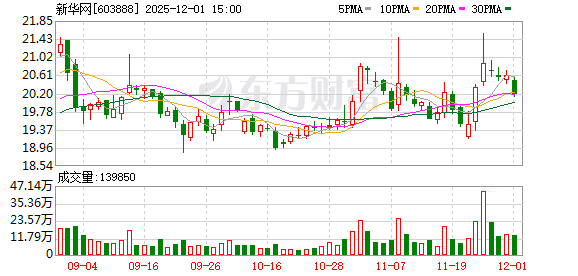
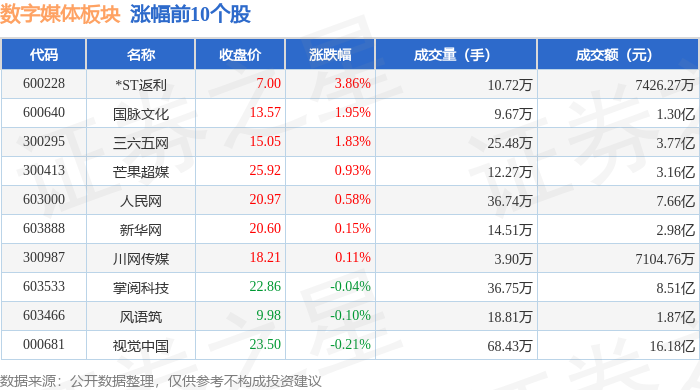
Market Overview - The digital media sector increased by 0.37% on November 28, with *ST Fanli leading the gains [1] - The Shanghai Composite Index closed at 3888.6, up 0.34%, while the Shenzhen Component Index closed at 12984.08, up 0.85% [1] Stock Performance - *ST Fanli (600228) closed at 7.00, up 3.86% with a trading volume of 107,200 shares and a turnover of 74.26 million yuan [1] - Guomai Culture (600640) closed at 13.57, up 1.95% with a trading volume of 96,700 shares and a turnover of 130 million yuan [1] - 365 Network (300295) closed at 15.05, up 1.83% with a trading volume of 254,800 shares and a turnover of 377 million yuan [1] - Mango Super Media (300413) closed at 25.92, up 0.93% with a trading volume of 122,700 shares and a turnover of 316 million yuan [1] - People's Daily Online (603000) closed at 20.97, up 0.58% with a trading volume of 367,400 shares and a turnover of 766 million yuan [1] - Xinhua Net (603888) closed at 20.60, up 0.15% with a trading volume of 145,100 shares and a turnover of 298 million yuan [1] - Other notable stocks include Chuanwang Media (300987) and Zhangyue Technology (603533) with minor fluctuations [1] Capital Flow - The digital media sector saw a net inflow of 33.47 million yuan from institutional investors, while retail investors experienced a net outflow of 11.33 million yuan [2] - Major stocks like People's Daily Online and Xinhua Net had significant capital movements, with People's Daily Online seeing a net inflow of 12 million yuan from institutional investors [3] - Xinhua Net had a net inflow of 27.84 million yuan from institutional investors, indicating strong interest [3]
新华网股份有限公司关于全资子公司参与投资设立中保投信思创 (嘉兴)股权投资合伙企业(有限合伙)进展暨完成基金备案的公告
Zhong Guo Zheng Quan Bao - Zhong Zheng Wang· 2025-11-28 00:42
Group 1 - The company, through its wholly-owned subsidiary, is investing RMB 15 million in a partnership to establish a private equity fund with a total subscribed capital of RMB 221.05 million, representing 6.79% of the total investment [1] - The partnership has completed the registration process with the Asset Management Association of China and obtained the private fund registration certificate [2] - The investment aims to leverage the resources and advantages of professional institutions in the investment field while controlling risks, and it does not conflict with the company's main business [2] Group 2 - The fund is managed by Zhongbao Investment Co., Ltd. and is custodied by Agricultural Bank of China [4] - The registration date for the fund was November 26, 2025 [4] - The company will monitor the partnership's operations and strengthen post-investment management to mitigate risks [2]
新华网股份有限公司关于全资子公司参与投资设立中保投信思创(嘉兴)股权投资合伙企业(有限合伙)进展暨完成基金备案的公告
Shang Hai Zheng Quan Bao· 2025-11-27 19:27
Group 1 - The company’s wholly-owned subsidiary, Xinhua News Venture Capital Co., Ltd., has invested RMB 15 million to establish a partnership fund named Zhongbao Investment Xinchao (Jiaxing) Equity Investment Partnership (Limited Partnership) with several other institutions, with a total subscribed capital of RMB 221.05 million, where the company holds a 6.79% stake [2][3] - The partnership fund has completed the private investment fund registration with the Asset Management Association of China and received the Private Investment Fund Registration Certificate on November 26, 2025 [3] - This investment is expected to leverage the resources and advantages of professional institutions in the investment field, aiming for medium to long-term investment returns without conflicting with the company's main business [3][5] Group 2 - The company will closely monitor the establishment and management of the partnership fund and strengthen post-investment management and risk control to mitigate investment risks [4][5] - The investment is not expected to adversely affect the company's financial and operational status, nor harm the interests of the company and its shareholders [3][5]