
weizhixiang(605089)

Search documents
味知香:门店拓展仍将是贯穿全年的核心战略
Zheng Quan Ri Bao Wang· 2026-02-09 12:47
证券日报网2月9日讯,味知香(605089)在接受调研者提问时表示,展望2026年,门店拓展仍将是贯穿 全年的核心战略。公司一方面推进"城市合伙人"计划,鼓励多店加盟,协助优秀店主实现门店规模化发 展;另一方面将进一步深化战略重心下沉,从以往集中的一二线城市,向三四线及乡镇市场拓展,同步 开展外围区域布局,公司划分了部分核心区域和次核心区域,分层布局,逐步扩大公司市场覆盖范围。 ...

味知香:公司多年深耕半成品菜行业
Zheng Quan Ri Bao Wang· 2026-02-09 12:47
证券日报网2月9日讯,味知香(605089)在接受调研者提问时表示,公司多年深耕半成品菜行业,甄选 全球优质食材,产品种类丰富。依托成熟的标准化生产工艺与核心调味配方,既打造丰富多元的口味体 系,又兼顾烹饪的便捷性与场景的适配性,可满足家庭日常、餐饮商用等多维度的需求。公司从食材采 购、生产加工到物流配送实现层层把关,在保障产品安全与稳定品质的基础上,持续优化产品口感与食 用体验。公司秉承为顾客提供"美味、不贵、健康、方便"的产品理念,从"单一产品"向"解决方案"升 级。一方面挖掘市场上的区域热销品类,进行精准的产品打造和迭代升级,另一方面以消费者的核心消 费需求出发反向推动产品创新。同时,深化产品的场景化开发,针对一人食、家庭日常、亲友聚会、节 日宴请等消费场景,从"满足需求"到"创造需求"。 ...
味知香:现炒门店选址以从下沉向高线市场进阶为核心思路开展测试,营收通过线上线下双渠道
Cai Jing Wang· 2026-02-09 10:11
2月9日,味知香发布投资者关系活动记录表。当中披露,关于公司现炒门店的模型,味知香介绍,公司 现炒门店选址以从下沉市场向高线市场进阶为核心思路开展市场测试,通过下沉市场的经营探索为后续 高线城市及区域的开拓打下基础。现炒门店营收通过线上线下的双渠道,当前首家现炒门店产品涵盖小 炒类、炖煮类、煎炸类、锅仔类等核心品类,搭配现制小食,同时配备自动炒菜机,实现产品标准化、 高效化出品。后续公司将持续丰富完善产品库,精准匹配不同区域、不同客群的消费偏好,进一步优化 产品和市场布局。 (企业公告) ...
味知香:今年门店拓展一方面推进“城市合伙人”计划,另一方面将深化战略重心下沉
Cai Jing Wang· 2026-02-09 10:11
(企业公告) 2月9日,味知香发布投资者关系活动记录表。当中披露,谈及未来加盟门店拓展规划,味知香称,展望 2026年,门店拓展仍将是贯穿全年的核心战略。公司一方面推进"城市合伙人"计划,鼓励多店加盟,协 助优秀店主实现门店规模化发展;另一方面将进一步深化战略重心下沉,从以往集中的一二线城市,向 三四线及乡镇市场拓展,同步开展外围区域布局,公司划分了部分核心区域和次核心区域,分层布局, 逐步扩大公司市场覆盖范围。 ...
味知香(605089) - 关于使用部分暂时闲置募集资金进行现金管理的进展公告
2026-02-05 10:30
证券代码:605089 证券简称:味知香 公告编号:2026-003 苏州市味知香食品股份有限公司 投资种类:结构性存款 投资金额:人民币 6,970 万元 已履行的审议程序 为提高暂时闲置募集资金使用效率、降低财务费用、增加股东回报,在确保 不影响募集资金投资项目建设和公司正常经营的前提下,合理利用部分暂时闲置 募集资金进行现金管理,可以增加现金资产收益,为公司及股东获取良好的投资 回报。 (二)投资金额 关于使用部分暂时闲置募集资金进行现金管理的 进展公告 本公司董事会及全体董事保证本公告内容不存在任何虚假记载、误导性陈述 或者重大遗漏,并对其内容的真实性、准确性和完整性承担法律责任。 重要内容提示: 苏州市味知香食品股份有限公司(以下简称"公司"或"味知香")于 2025 年 4 月 25 日召开了第三届董事会第六次会议及第三届监事会第六次会议,审 议通过了《关于使用部分暂时闲置募集资金进行现金管理的议案》,同意公司 使用不超过人民币 20,000 万元暂时闲置募集资金进行现金管理,投资的产品 品种为安全性较高、流动性较好、风险较低的保本型理财产品。上述议案已 经公司 2024 年年度股东大会审议通过。 ...
餐饮细分精耕效率,餐供定制扩容可期
ZHONGTAI SECURITIES· 2026-01-28 00:25
Investment Rating - The report maintains an "Overweight" rating for the industry [4] Core Insights - The restaurant industry is experiencing a slowdown in revenue growth, with a shift towards efficiency in operations and a focus on customized meal supply [6][32] - The report identifies three potential development paths for the restaurant industry: high-quality and affordable offerings, automation and smart technology, and a focus on niche markets to meet diverse consumer needs [32][33] Summary by Sections Macro Perspective on Restaurant Trends - China's residents primarily rely on wage income, leading to a lower consumption tendency compared to developed countries [9][13] - The overall consumption inclination is affected by significant income inequality, with the top 1% of the population holding a substantial share of wealth [13][15] - The restaurant industry's revenue growth is expected to slow down significantly by 2025, with a notable decline in average spending per customer [15][17] Population Dynamics - China's total population has entered a phase of negative growth, with a significant concentration of young people in economically vibrant cities [18][20] - The labor force participation rate is declining, while the dependency ratio is increasing, indicating demographic challenges for the industry [20][23] Opportunities in the Restaurant Sector - The report draws parallels with Japan's consumption evolution, suggesting that China's restaurant industry can learn from Japan's experiences [31] - The three identified paths for growth include offering high-quality products at lower prices, leveraging automation, and focusing on specific consumer segments such as single-person households and the elderly [32][33] Restaurant Supply Chain Insights - The restaurant supply chain is complex, involving multiple stages from raw material procurement to end-user sales [33] - The market for restaurant supply chains is projected to grow, with an expected market size of 2.6 trillion yuan in 2024, reflecting an 8.1% year-on-year increase [35][36] Market Structure and Competition - The restaurant market is characterized by high closure rates and a fragmented landscape, with many small-scale chains dominating the market [37][38] - The supply side is marked by a lack of concentration, leading to weak bargaining power for suppliers [38] Labor Market Challenges - The restaurant industry faces rising labor costs and high turnover rates, with significant implications for operational efficiency [43][46] - The introduction of smart devices and semi-finished products is seen as a strategy to mitigate labor challenges and enhance efficiency [46][48]




食品加工板块1月26日涨0.27%,味知香领涨,主力资金净流出1.04亿元
Zheng Xing Xing Ye Ri Bao· 2026-01-26 09:37
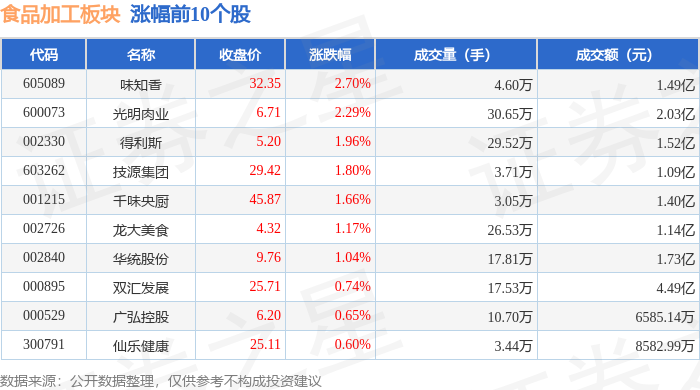
Core Viewpoint - The food processing sector experienced a slight increase of 0.27% on January 26, with major stocks like Weizhi Xiang leading the gains, while the overall market indices showed a decline [1]. Group 1: Market Performance - The Shanghai Composite Index closed at 4132.61, down 0.09%, and the Shenzhen Component Index closed at 14316.64, down 0.85% [1]. - The food processing sector's individual stock performance showed varied results, with Weizhi Xiang leading with a closing price of 32.35 and a gain of 2.70% [1]. Group 2: Stock Performance Details - The following stocks in the food processing sector showed notable gains: - Weizhi Xiang: Closing price 32.35, up 2.70%, with a trading volume of 46,000 and a turnover of 149 million [1]. - Guangming Meat Industry: Closing price 6.71, up 2.29%, with a trading volume of 306,500 and a turnover of 203 million [1]. - Delisi: Closing price 5.20, up 1.96%, with a trading volume of 295,200 and a turnover of 152 million [1]. - Conversely, several stocks faced declines, including: - ST Chuntian: Closing price 4.01, down 4.52%, with a trading volume of 130,200 and a turnover of 52.31 million [2]. - Kangbiter: Closing price 16.02, down 3.84%, with a trading volume of 20,400 and a turnover of 33.03 million [2]. Group 3: Capital Flow Analysis - The food processing sector saw a net outflow of 104 million from major funds, while retail investors contributed a net inflow of 114 million [2]. - Specific stocks experienced varied capital flows, with Guangming Meat Industry showing a net outflow of 33.27 million from major funds [3]. - Weizhi Xiang had a net outflow of 1.08 million from major funds but a net inflow of 7.84 million from retail investors [3].

味知香20260122
2026-01-23 15:35
Summary of the Conference Call for Wei Zhi Xiang Company Overview - **Company**: Wei Zhi Xiang - **Industry**: Food and Beverage, focusing on family and restaurant customer needs Key Points and Arguments Strategic Adjustments - Wei Zhi Xiang has redefined its strategic planning for the next three years, focusing on family and restaurant client needs, including franchise stores and supermarkets [3][4] - The company has restructured into three main clusters: sales, product, and supply chain, with the establishment of strategic and educational departments to enhance market responsiveness [3][4] Product and Service Innovations - The company is shifting from semi-finished products to comprehensive dining solutions, catering to various dining scenarios such as single meals and gatherings [5][9] - A new product strategy includes upgrading from single items to combo meals, aiming to enhance product value and streamline supply chain management [4][11] Channel Expansion - Wei Zhi Xiang has successfully partnered with major supermarkets like Fat Dong Lai and Da Run Fa, and has entered online grocery platforms to broaden its sales channels [6][16] - The company is establishing multiple Business Units (BUs) to quickly respond to customer demands in the supermarket channel [6] New Store Formats - The company is testing a new ready-to-eat store model, with plans to open dozens of locations by 2026, utilizing cooking robots to optimize operations [4][14][21] - The first store, located in a suburban area, is focused on stir-fried dishes and aims to expand into urban areas based on consumer preferences [7][8] Group Meal Business Growth - The group meal segment has seen significant growth, primarily serving educational institutions and corporate cafeterias, with a focus on high-quality ingredient supply [9][16] - The company plans to extend its reach into other educational systems and enterprises to build a robust supply chain [9] Financial Performance and Projections - In 2025, the B-end sales (group meals and supermarkets) reached approximately 200 million, with significant growth expected in the future [16] - The company is optimistic about achieving its equity management goals for 2026, supported by detailed planning [18] Operational Efficiency - The company is implementing a flexible supply chain to reduce raw material costs and improve delivery timeliness, with a focus on transparency in the supply chain [11][12] - Current production capacity is sufficient to meet demand, with minimal additional investment needed for small equipment [20] Community and Staffing Plans - As the business expands, Wei Zhi Xiang plans to increase front-line staff while reducing back-office personnel to enhance operational efficiency [19] Store Profitability and Expansion - The new store model does not require a daily sales target of 4,000 yuan to be profitable, with plans to recover investments within a year through cost optimization [22] - The company aims to establish a stable and replicable model before opening more franchise opportunities [23] Additional Important Insights - The company is focusing on enhancing customer experience through product variety and service improvements, including the integration of online and offline sales strategies [15] - Traditional store renovations are ongoing, with efforts to modernize and improve customer engagement [15]
食品加工板块1月22日涨0.41%,交大昂立领涨,主力资金净流出2882.63万元
Zheng Xing Xing Ye Ri Bao· 2026-01-22 09:01
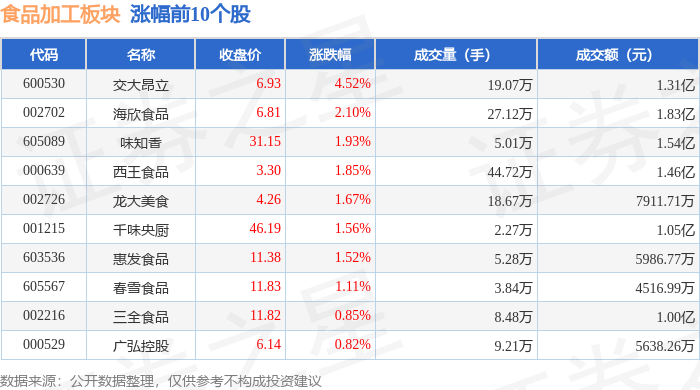
Group 1 - The food processing sector increased by 0.41% on January 22, with Jiaoda Onlly leading the gains [1] - The Shanghai Composite Index closed at 4122.58, up 0.14%, while the Shenzhen Component Index closed at 14327.05, up 0.5% [1] - Key stocks in the food processing sector showed various performance, with Jiaoda Onlly closing at 6.93, up 4.52%, and Hai Xin Food at 6.81, up 2.10% [1] Group 2 - The food processing sector experienced a net outflow of 28.83 million yuan from main funds, while retail investors saw a net inflow of 51.78 million yuan [2] - The trading volume and turnover for key stocks varied, with Jiaoda Onlly having a trading volume of 190,700 shares and a turnover of 131 million yuan [1][2] - The stock performance of several companies showed mixed results, with some stocks like ST Chuntian and Xianle Health declining by 1.39% and 1.27% respectively [2] Group 3 - Main fund inflows were observed in stocks like Jiaoda Onlly with a net inflow of 14.38 million yuan, while retail investors showed a net inflow of 11.80 million yuan [3] - Stocks such as Shuanghui Development and Jinzi Ham also saw significant main fund inflows of 11.39 million yuan and 10.64 million yuan respectively [3] - The overall sentiment in the food processing sector appears mixed, with some stocks attracting retail interest despite main fund outflows [3]


味知香20260121
2026-01-22 02:43
Q&A 请介绍一下味之香公司最近的新业务和战略调整情况。 味之香公司在 2025 年第四季度基于政策、市场环境、用户消费方式及公司自 身发展规划,重新制定了未来三年的战略方向,并确立了以家庭及餐饮客户核 心需求为导向的战略定位。家庭客户主要指 C 端,包括农贸市场加盟店、商超 以及新的金格格店型;餐饮客户则主要通过流程和组织变革来优化供应链与服 务效率。 在 2025 年 12 月,公司发布了组织架构调整公告,确立了销售业务 集群、产品业务集群和供应链业务集群三大集群,构建大前台、强中台、小后 台的扁平化组织架构。为了配套这一调整,公司还建立了十几条以产品和客户 为主导的流程,如开店成功流程、快返流程和交付流程等,以期为 B 端和 C 端 提供差异化产品和场景方案,通过客户结构改革、产品结构改革及供应链改革 占领多个细分市场。 味之香公司在新店型方面有哪些具体举措? 在新店型方面,味之香公司计划从农贸市场走出来,开设街边店或社区店,以 便年轻人下班后直接购买并带回家食用。此外,新店型将搭载代炒功能,用户 可以选择将购买的菜品现场加工,这样回家后即可食用。这种模式让顾客可以 看到所有食材,更加放心。 味知香 2 ...