
ZHONGYIN BABI FOOD CO.(605338)

Search documents
巴比食品(605338) - 关于部分董事及高级管理人员再次增持股份计划的公告
2025-09-23 10:18
本公司董事会、全体董事及相关股东保证本公告内容不存在任何虚假记载、 误导性陈述或者重大遗漏,并对其内容的真实性、准确性和完整性承担法律责任。 证券代码:605338 证券简称:巴比食品 公告编号:2025-028 中饮巴比食品股份有限公司 关于部分董事及高级管理人员再次增持股份计划的公告 重要内容提示: 中饮巴比食品股份有限公司(以下简称"公司")董事、副总裁李俊先生 和财务总监、董事会秘书苏爽先生基于对公司未来发展前景的坚定信心以及对公 司内在价值的高度认可,计划自本公告披露之日起 6 个月内,以其自有资金或自 筹资金通过上海证券交易所系统以集中竞价交易的方式再次增持公司 A 股股份, 合计增持金额不低于人民币 300 万元,不超过 450 万元(以下简称"本次增持计 划")。 本次增持计划不设定价格区间和比例区间,将根据公司股票价格波动情 况及资本市场整体趋势,择机逐步实施增持计划。 本次增持计划可能存在因资本市场情况发生变化或目前尚无法预判的其 他风险因素导致增持计划的实施无法达到预期的风险。如增持计划实施过程中出 现相关风险情形,公司将及时履行信息披露义务。敬请广大投资者注意投资风险。 | 增持主体名 ...

巴比食品:部分董事及高级管理人员拟增持300-450万元
Ge Long Hui A P P· 2025-09-23 10:16
Group 1 - The core viewpoint of the announcement is that the executives of Baba Foods express strong confidence in the company's future development and intrinsic value, leading to their decision to increase shareholding [1] - The executives plan to increase their holdings of the company's A-shares through the Shanghai Stock Exchange within six months from the announcement date [1] - The total amount of the planned share buyback is set to be no less than 3 million RMB and no more than 4.5 million RMB [1]
巴比食品:两高管拟增持300万-450万元
Xin Lang Cai Jing· 2025-09-23 10:16
Group 1 - The company announced that two directors and senior executives, Li Jun and Su Shuang, plan to increase their holdings of the company's unrestricted circulating A-shares within six months from the date of the announcement [1] - Li Jun intends to increase his holdings by an amount between 2 million to 2.5 million yuan, while Su Shuang plans to increase his holdings by an amount between 1 million to 2 million yuan [1] - The total amount of planned share purchases is not less than 3 million yuan and not more than 4.5 million yuan, with funding sourced from personal or self-raised funds [1]
预制菜国标加快制定中
Sou Hu Cai Jing· 2025-09-22 12:39
Core Viewpoint - The article emphasizes the urgent need for transparency in the pre-prepared food industry in China, highlighting the lack of internal motivation among companies and the necessity for mandatory national standards to protect consumer rights and choices [3][4][5]. Group 1: Current Situation and Standards - The State Council's Food Safety Office is accelerating the development of national standards for pre-prepared foods due to rising public concern, particularly following a public dispute involving a well-known figure and a restaurant chain [3][4]. - Currently, there are no national standards for pre-prepared foods in China, although various industry and local standards exist, which lack the enforcement power of national regulations [3][4][8]. - The definition of pre-prepared foods has been clarified by the National Market Supervision Administration, but there are no mandatory labeling requirements for restaurants regarding their use of such foods [4][8]. Group 2: Industry Dynamics and Consumer Perception - The restaurant industry in China is experiencing significant growth in chain operations, with the chain rate increasing from 12.8% in 2018 to 23% in 2024, driven by advancements in supply chain technologies [5]. - Consumers are increasingly confused about pre-prepared foods, often associating higher prices with freshly made dishes, leading to skepticism about the value of pre-prepared options [5][6]. - The blurred lines between "freshly made" and "pre-prepared" foods have created a need for clear national standards to restore consumer trust and address industry chaos [4][5]. Group 3: Challenges and Recommendations - There is a lack of proactive transparency among pre-prepared food companies, with few voluntarily disclosing their use of such products, as it is seen as a burden without clear consumer benefits [4][8]. - The complexity of the supply chain for pre-prepared foods, from sourcing to consumption, lacks unified management, complicating the establishment of standards [8]. - Experts suggest that third-party oversight and legislative measures are necessary to improve transparency and safety in the pre-prepared food sector, with a national standard expected to clarify the identity and usage of pre-prepared foods [8].


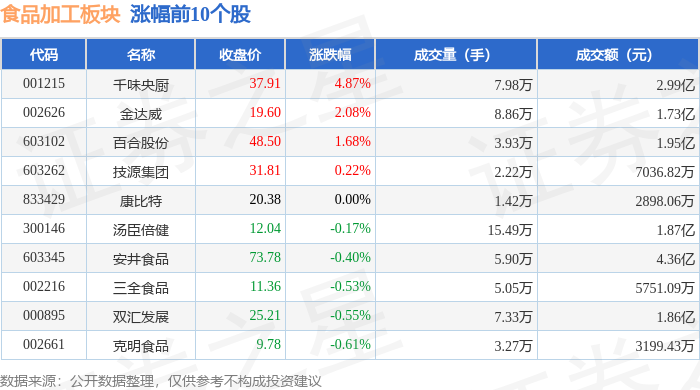
食品加工板块9月17日跌0.62%,巴比食品领跌,主力资金净流出1.32亿元
Zheng Xing Xing Ye Ri Bao· 2025-09-17 08:42
Market Overview - On September 17, the food processing sector declined by 0.62%, with Babi Foods leading the drop [1] - The Shanghai Composite Index closed at 3876.34, up 0.37%, while the Shenzhen Component Index closed at 13215.46, up 1.16% [1] Individual Stock Performance - Qianwei Yangchu (001215) saw a closing price of 37.91, with an increase of 4.87% and a trading volume of 79,800 shares, amounting to a transaction value of 299 million yuan [1] - Other notable performers included: - Quandawei (002626) with a closing price of 19.60, up 2.08% [1] - Zihua Co. (603102) at 48.50, up 1.68% [1] - Conversely, Babi Foods (605338) closed at 23.53, down 2.89% with a trading volume of 24,300 shares and a transaction value of 57.93 million yuan [2] Capital Flow Analysis - The food processing sector experienced a net outflow of 132 million yuan from institutional investors, while retail investors saw a net inflow of 48 million yuan [2] - The capital flow for individual stocks showed: - Qianwei Yangchu had a net inflow of 20.74 million yuan from institutional investors [3] - Babi Foods experienced a net outflow of 748,900 yuan from institutional investors [3]
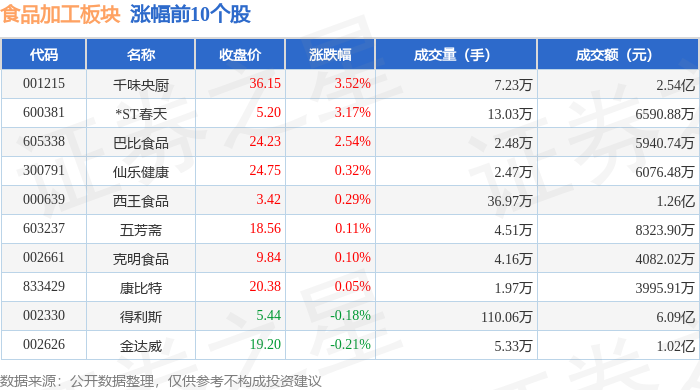
食品加工板块9月16日跌0.69%,盖世食品领跌,主力资金净流出2.51亿元
Zheng Xing Xing Ye Ri Bao· 2025-09-16 08:46
Market Overview - On September 16, the food processing sector declined by 0.69%, with Gais Food leading the drop [1] - The Shanghai Composite Index closed at 3861.87, up 0.04%, while the Shenzhen Component Index closed at 13063.97, up 0.45% [1] Stock Performance - Notable gainers in the food processing sector included: - Qianwei Yangchu (001215) with a closing price of 36.15, up 3.52% and a trading volume of 72,300 shares, totaling 254 million yuan [1] - ST Chuntian (600381) with a closing price of 5.20, up 3.17% and a trading volume of 130,300 shares, totaling 65.9 million yuan [1] - Baba Food (605338) with a closing price of 24.23, up 2.54% and a trading volume of 24,800 shares, totaling 59.4 million yuan [1] - Major decliners included: - Gais Food (836826) with a closing price of 14.35, down 4.52% and a trading volume of 155,500 shares, totaling 225 million yuan [2] - Huadong Shares (002840) with a closing price of 11.92, down 2.77% and a trading volume of 312,700 shares, totaling 373 million yuan [2] - Huifa Food (603536) with a closing price of 11.11, down 2.54% and a trading volume of 354,400 shares, totaling 394 million yuan [2] Capital Flow - The food processing sector experienced a net outflow of 251 million yuan from institutional investors, while retail investors saw a net inflow of 217 million yuan [2] - The detailed capital flow for selected stocks showed: - ST Chuntian (600381) had a net inflow of 10.68% from institutional investors [3] - Qianwei Yangchu (001215) had a net inflow of 2.25% from institutional investors [3] - Gais Food (836826) had a net outflow of 0.41% from institutional investors [3]



罗永浩称赞老乡鸡:餐饮企业用预制菜是合法的,老乡鸡就是表率
Xin Lang Ke Ji· 2025-09-12 13:24
Group 1 - The core viewpoint of the article revolves around the public dispute between Luo Yonghao and Xibei regarding the transparency of pre-made dishes in the restaurant industry [1] - Luo Yonghao emphasizes that using pre-made dishes is legal for restaurant businesses, citing Laoxiangji as an industry benchmark for clear labeling of dishes as either freshly made or pre-made [1] Group 2 - The controversy has gained significant attention, particularly due to Luo Yonghao's public comments and his offer of a reward of 100,000 yuan for further discussion on the matter [1]
罗永浩展示老乡鸡菜品划分公示牌 称以后准备去试试
Xin Lang Ke Ji· 2025-09-12 13:24
Core Viewpoint - Luo Yonghao has publicly criticized the lack of transparency in the pre-made food industry, specifically targeting the practices of Xibei, while promoting the example set by Laoxiangji in clearly labeling their food products [1] Group 1: Industry Practices - Luo Yonghao highlighted that Laoxiangji provides clear indications of whether dishes are freshly made or pre-made, setting a standard for transparency in the industry [1] - He emphasized that while pre-made food is not inherently negative, it is essential for businesses to disclose the nature of their food products to consumers [1] Group 2: Public Engagement - Luo Yonghao conducted a live stream on multiple platforms to address the ongoing debate regarding pre-made food, showcasing his commitment to engaging with the public on this issue [1] - During the live stream, he mentioned his intention to try Laoxiangji's offerings, indicating a personal interest in the quality and transparency of their food [1]
宋向前——头号玩家的从容和笃定,消费产业的价值守望者
投中网· 2025-09-10 06:33
Core Viewpoint - The article emphasizes the need for finance to return to its essence of serving the real economy, advocating for a "real industry over capital" approach in investment strategies [4][5]. Group 1: Resource Allocation - Capital should flow towards efficient sectors rather than short-term arbitrage opportunities, with a focus on consumer-driven economic growth as a stabilizing force [6][7]. - The investment landscape has been distorted by excessive capital inflow, leading to a focus on rapid expansion and market capture rather than sustainable business practices [8][9]. Group 2: Governance and Empowerment - The investment philosophy of the company is characterized by deep involvement in the operational aspects of the businesses it invests in, moving beyond mere financial support to strategic partnership [10][11]. - Successful case studies, such as the investment in Xiaocaiyuan, demonstrate the effectiveness of this approach, resulting in significant market achievements and returns [12][13]. Group 3: Brand Behind the Brand - The company seeks to invest in businesses with "real industry genes," focusing on consumer sectors that exhibit high-frequency demand and scalability [19][20]. - Notable investments include brands like Qiaqia Foods and Babimantou, which have become industry leaders due to their alignment with the company's investment philosophy [21][23]. Group 4: Capital's Mission - The company is positioned to play a crucial role in transitioning society towards a consumption-driven economy, emphasizing the importance of enhancing disposable income and improving living standards [28][30]. - The investment strategy aims to create social value that translates into stable economic returns, highlighting the need for a shift from being mere investors to becoming co-creators in the industries they support [31][33].



包子第一股”股价较低点翻倍,董事高管增持与员工持股平台减持“撞车
Mei Ri Jing Ji Xin Wen· 2025-09-03 11:26
Core Viewpoint - Babai Food (605338), known as the "first stock of steamed buns," reported a net profit growth of 18.08% year-on-year for the first half of 2025, showcasing resilience amid increasing competition in the restaurant industry [1] Financial Performance - The company's net profit increased by 18.08% compared to the previous year, indicating a positive trend in financial performance despite industry challenges [1] - The stock price of Babai Food has shown a significant recovery, rising from a low of 11.63 yuan in August 2024 to a high of 24.80 yuan by September 2, 2025, effectively doubling from its lowest point [1] Stock Activity - Following the announcement of the positive financial results, the stock price of Babai Food has been on a steady upward trajectory [1] - There was a notable divergence in stock activity, with board members and executives increasing their holdings while the employee stock ownership platform opted to reduce its holdings [1] - The company explained that employees had held their shares for 8 to 10 years prior to the IPO and had personal financial needs, which influenced their decision to sell [1]