
QingCloud(688316)

Search documents
青云科技(688316) - 关于变更公司名称、注册资本完成工商变更登记的公告
2026-02-11 08:15
近日,公司完成了工商变更登记手续并取得了北京市朝阳区市场监督管理局 换发的《营业执照》,具体登记信息如下: 证券代码:688316 证券简称:青云科技 公告编号:2026-003 青云科技集团股份有限公司 关于变更公司名称、注册资本完成工商变更登记的 公告 本公司董事会及全体董事保证本公告内容不存在任何虚假记载、误导性陈 述或者重大遗漏,并对其内容的真实性、准确性和完整性依法承担法律责任。 重要内容提示: 青云科技集团股份有限公司(以下简称"公司")分别于 2025 年 10 月 30 日、2025 年 11 月 17 日召开了公司第三届董事会第三次会议、2025 年第二次临 时股东会,同意将公司中文名称由"北京青云科技集团股份有限公司"变更为"青 云科技集团股份有限公司",英文名称由"Beijing QingCloud Technology Group Co., Ltd"变更为"QingCloud Technologies Corp.",注册资本由人民币 4,779.9688 万元变更为 4,789.8129 万元。具体内容详见公司分别于 2025 年 10 月 31 日、2025 年 11 月 18 日在 ...

青云科技-U股价异动上涨4.81%,算力板块走强与业绩减亏成主因
Jing Ji Guan Cha Wang· 2026-02-11 07:48
Market Environment - The stock price of Qingyun Technology-U (688316.SH) increased by 4.81% to 83.45 yuan, with a trading volume of 5.55 billion yuan and a turnover rate of 13.84% on February 11, 2026, driven by a favorable market environment [1] - The overall computing power leasing sector rose by 0.33%, outperforming the market, supported by expectations of increased demand for cloud services [1] - Omdia data indicates that the cloud infrastructure service market in mainland China is expected to grow by 24% year-on-year in Q3 2025, with AI demand driving a shift in cloud resource consumption towards production-level workloads [1] - There are market views suggesting that cloud computing may become the next link in the inflation transmission of the AI industry chain, leading to positive changes in the industry pricing environment [1] Company Fundamentals - The company is still in a loss position but shows a clear trend of reduced losses, with an expected net profit of -57.77 million yuan for 2025, a reduction of 37.99 million yuan compared to the previous year, representing a 39.67% decrease in losses [2] - The improvement in performance is attributed to systematic optimization of the business structure and cost reduction measures, particularly progress in the AI intelligent computing sector [2] Financial and Technical Aspects - On the day of the stock price movement, the net inflow of main funds was 3.39 million yuan, with large single fund inflows of 48.62 million yuan, indicating participation from major funds [3] - The stock price experienced a nearly 10% intraday fluctuation, reaching a high of 86.89 yuan, reflecting active market trading and intense bullish-bearish competition [3] Future Development - The company has indicated that a decline in future operating income or continued losses could lead to negative net assets, triggering a delisting risk warning [4] - The current price-to-earnings ratio (TTM) is negative, and the price-to-book ratio is relatively high, suggesting that investment should be assessed with caution regarding associated risks [4]
算力租赁概念午后再度拉升
Di Yi Cai Jing· 2026-02-03 13:09
Group 1 - Tianwei Video Technology saw a sharp increase, hitting the daily limit up [1] - Shunwang Technology rose over 15% [1] - Wangsu Science and Technology increased by more than 13% [1] - Other companies such as Nanling Technology, Qingyun Technology, Yuke Technology, Litong Electronics, and Guanghuan Xunwang also experienced significant gains [1]





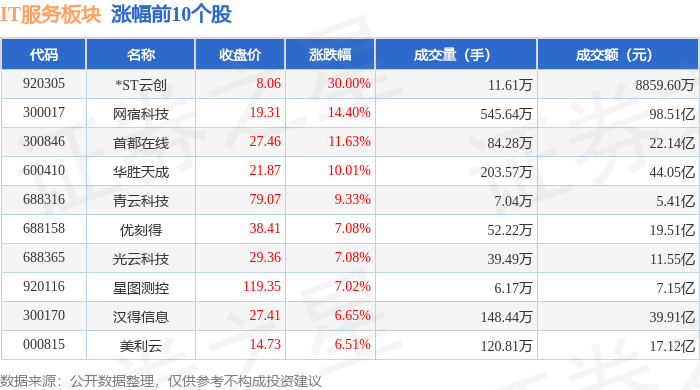
IT服务板块2月3日涨3.33%,*ST云创领涨,主力资金净流入30.64亿元
Zheng Xing Xing Ye Ri Bao· 2026-02-03 09:10
Market Performance - The IT services sector increased by 3.33% on February 3, with *ST Yunchuang leading the gains [1] - The Shanghai Composite Index closed at 4067.74, up 1.29%, while the Shenzhen Component Index closed at 14127.1, up 2.19% [1] Top Gainers in IT Services - *ST Yunchuang saw a closing price of 8.06, with a significant increase of 30.00% and a trading volume of 116,100 shares, totaling a transaction value of 88.596 million yuan [1] - Wangsu Science and Technology closed at 19.31, up 14.40%, with a trading volume of 5.4564 million shares and a transaction value of 9.851 billion yuan [1] - Capital Online closed at 27.46, up 11.63%, with a trading volume of 842,800 shares and a transaction value of 2.214 billion yuan [1] Market Capital Flow - The IT services sector experienced a net inflow of 3.064 billion yuan from institutional investors, while retail investors saw a net outflow of 466 million yuan [2] - The main funds showed a mixed trend, with some companies like Huasheng Tiancheng receiving significant net inflows, while others like Xiangyou Technology faced outflows [3] Notable Stocks with Net Inflows - Huasheng Tiancheng had a net inflow of 1.698 billion yuan, accounting for 38.55% of its trading volume [3] - Yanshan Technology recorded a net inflow of 863 million yuan, representing 11.85% of its trading volume [3] - Wangsu Science and Technology had a net inflow of 530 million yuan, making up 5.38% of its trading volume [3]



002238,午后直线涨停
Shang Hai Zheng Quan Bao· 2026-02-03 08:22
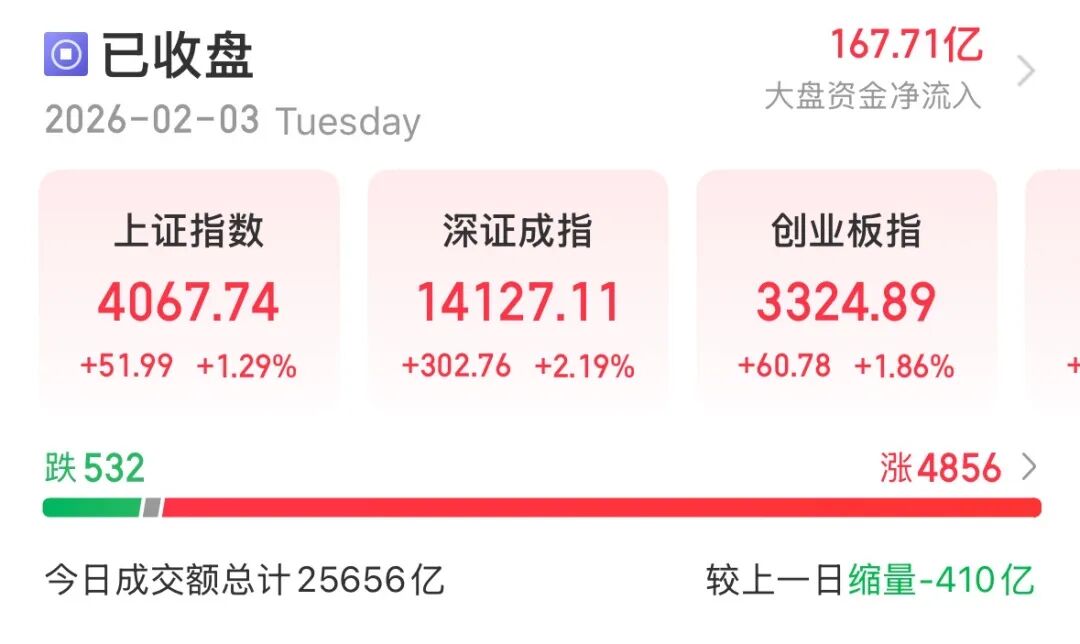
Market Overview - The A-share market experienced a significant upward trend on February 3, with the Shanghai Composite Index closing at 4067.74 points, up 1.29%. The Shenzhen Component rose by 2.19%, the ChiNext Index increased by 1.86%, the Sci-Tech Innovation Index gained 2.44%, and the Northbound 50 Index surged by 3.27%. The total trading volume across the Shanghai and Shenzhen markets reached 25,656 billion yuan [1]. Sector Performance - Over 4,800 stocks in the market saw gains, with the photovoltaic industry chain showing strong performance, particularly in the space photovoltaic sector, where companies like Aotewei and Zerun New Energy hit the daily limit with a 20% increase [3]. - The commercial aerospace sector rebounded, with stocks such as Jieli Suojin and Aerospace Development also reaching the daily limit [3]. - The chemical sector remained active, with Wanfeng shares achieving a four-day limit increase [3]. - The precious metals concept saw localized activity, with Hunan Gold hitting the daily limit [4][5]. Precious Metals Market - The precious metals market saw a sharp rebound, with Hunan Gold achieving a remarkable 7-day, 6-limit increase. Other notable performers included Xiaocheng Technology, which rose over 18%, and Zijin Mining, which increased by over 6% [5]. - On February 3, gold prices surged, with spot gold rising over 5% to surpass $4,900 per ounce, while silver also maintained an upward trend, increasing over 8% to break through $86 per ounce [6]. - According to China Galaxy Securities, the recent decline in precious metal prices can be viewed as a market-driven cooling following a period of rapid price increases, rather than a panic exit of funds. This price correction is seen as a normal phenomenon that helps release overheated market sentiment [6]. - Guotai Junan Securities indicated that the recent significant drop in precious metal prices is a technical adjustment to the irrational increases seen since the beginning of the year, rather than the end of a long-term upward trend for gold. The decline in speculative sentiment and leverage levels is expected to support a healthier upward trend for gold in the near term [6]. Computing Power Leasing Sector - The computing power leasing sector showed continued strength, with Tianwei Vision experiencing a direct limit increase [7][8]. - Other companies in this sector, such as Wangsu Technology and Capital Online, saw increases of over 10% [8]. - The CPO concept also performed actively, with Robotech hitting a 20% limit increase, and companies like Juguang Technology, Dekeli, and Tianfu Communication rising over 10% [8]. - According to Dongwu Securities, major overseas cloud providers have begun raising prices for their services, marking the first increase in years. This trend is expected to influence domestic cloud providers to follow suit, creating investment opportunities in the AI cloud industry as demand increases [8].


公司问答丨青云科技:公司旗下AI算力云服务——基石智算CoresHub大模型服务已接入Kimi K2.5
Ge Long Hui A P P· 2026-01-30 09:06
Core Insights - The company, Qingyun Technology, has confirmed its collaboration with the Kimi K2.5 model through its AI computing cloud service, CoresHub, which provides advanced and user-friendly AI model capabilities to drive innovation in intelligent applications [1] Company Developments - Qingyun Technology's AI computing cloud service, CoresHub, has integrated with the Kimi K2.5 model, enhancing its offerings in the AI space [1]
青云科技20260128
2026-01-29 02:43
Summary of QY Technology Conference Call Company Overview - **Company**: QY Technology - **Industry**: AI Intelligent Computing Key Points Business Performance and Strategy - QY Technology's revenue from the AI intelligent computing sector is currently small but growing rapidly, with orders exceeding last year's levels [2][5] - The company aims to integrate all capabilities to fully serve the AI era and collaborates with various enterprises and research institutions [2] - In 2025, revenue is expected to decline due to the abandonment of financing and hardware integration businesses, but gross margins are improving [7] - A revenue rebound is anticipated in 2026, driven by customer growth, increased product recognition, and a rapid increase in user numbers in the computing business [7] Product and Service Offerings - QY Technology positions itself as an AI intelligent computing or AI infrastructure provider, with core products including container platforms, a full range of storage products, and AI infrastructure products [4] - The company operates a globally ranked container platform community and offers public, private, and hybrid cloud services [4] - QY Technology has a limited number of self-owned computing cards, primarily providing virtualization services in collaboration with domestic supercomputing and intelligent computing centers [6] Market Trends and Demand - The demand for CPUs is increasing in the multi-agent era, with QY Technology's public cloud offering supercomputing and intelligent computing services to support rapid development and production environments [8][9] - Significant improvements in open-source model capabilities have driven sales growth for CPUs and GPUs, with future applications likely to be reshaped by large models, increasing demand for both [9][10] - The industry is currently facing price pressures due to energy costs, hardware costs, and service capability enhancements, but QY Technology has not yet decided to raise prices, opting to maintain current pricing to attract and retain customers [3][15] Future Outlook - GPU consumption is expected to remain high in 2026 and 2027, but CPU business volume is projected to grow exponentially around 2028 as applications are redesigned to utilize agents [12] - QY Technology employs a pay-as-you-go billing model, including second-level billing and hourly rates, to meet the needs of various business scenarios [13] - The company is closely monitoring industry pricing trends, particularly among large cloud vendors and similar mid-sized cloud platforms, to remain competitive [15] Additional Insights - There is potential for increased demand for cloud services during the Spring Festival, although no significant trends have been observed yet [17]
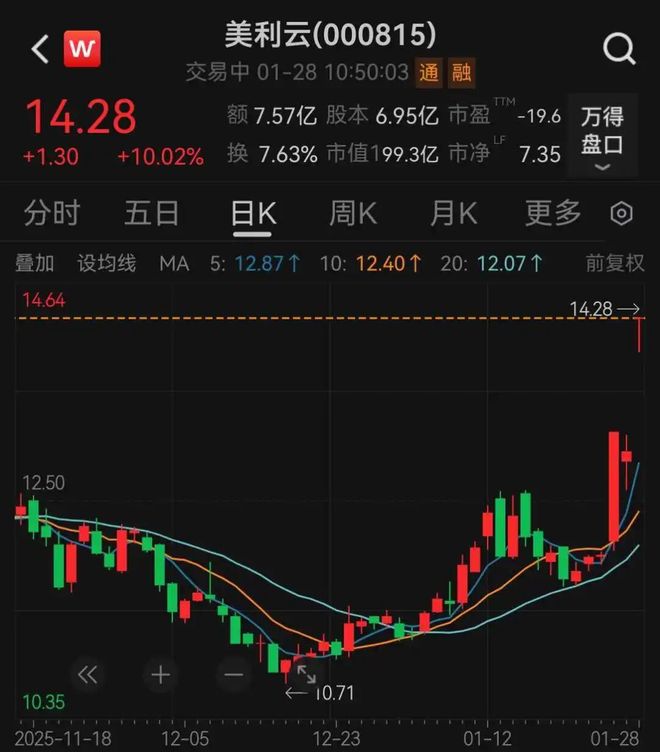
算力租赁概念活跃,美利云一字涨停
Di Yi Cai Jing Zi Xun· 2026-01-28 03:10
Group 1 - Naxing Co., Ltd. reached the daily limit increase, while Wangsu Technology surged by 16%, Oulutong rose by 13%, and Capital Online increased by nearly 8% [2] - Other companies such as Yunsai Zhili, Guanghuan Xinwang, and Qingyun Technology also experienced gains [2] Group 2 - The stock prices and percentage changes for several companies are as follows: - Wangsu Technology: 15.81, up 16.77% - Oulutong: 258.59, up 13.45% - Meili Cloud: 14.28, up 10.02% - Naxing Co., Ltd.: 22.72, up 10.02% - Capital Online: 29.02, up 7.92% - Yunsai Zhili: 23.21, up 4.69% - Guanghuan Xinwang: 15.78, up 4.09% - Qingyun Technology: 85.30, up 4.06% [3] Group 3 - Google announced a price adjustment for data transmission methods such as CDN Interconnect, Direct Peering, and Carrier Peering, effective May 1, 2026, with prices in North America doubling [2]




算力租赁概念活跃,美利云一字涨停
第一财经· 2026-01-28 03:00
Group 1 - Naxing Co., Ltd. (南兴股份) reached a limit-up, while Wangsu Science & Technology (网宿科技) increased by 16%, Oulu Tong (欧陆通) rose by 13%, and Capital Online (首都在线) gained nearly 8% [2] - Other companies such as Yunzhai Zhili (云寨智联), Guanghuan Xinwang (光环新网), and Qingyun Technology (青云科技) also experienced increases [2] - The stock price changes for notable companies include: Wangsu Science & Technology at 15.81 with a rise of 16.77%, Oulu Tong at 258.59 with a rise of 13.45%, and Naxing Co., Ltd. at 22.72 with a rise of 10.02% [3] Group 2 - Google announced a price adjustment for data transmission methods such as CDN Interconnect, Direct Peering, and Carrier Peering, effective May 1, 2026, with prices in North America doubling [4]


A股算力租赁概念震荡拉升
Ge Long Hui A P P· 2026-01-26 01:45
Core Viewpoint - The cloud computing sector, particularly the computing power leasing concept, is experiencing a significant upward trend, driven by recent price increases from major players like Amazon Web Services (AWS) [1] Group 1: Market Performance - The computing power leasing concept saw a notable surge, with companies such as UCloud and Dawai Technology hitting the daily limit up [1] - QCloud Technology and Capital Online both increased by over 10% [1] - Other companies like Guanghuan Xinwang, Wangsu Science and Technology, and Parallel Technology also experienced gains [1] Group 2: Price Changes - Amazon Web Services (AWS) has raised its EC2 machine learning capacity block prices by approximately 15% [1] - The hourly cost for the p5e.48xlarge instance increased from $34.61 to $39.80 [1]
