
贵金属价格调整

Search documents
贵金属高位巨震 牛市格局是否逆转
Qi Huo Ri Bao· 2026-02-11 03:26
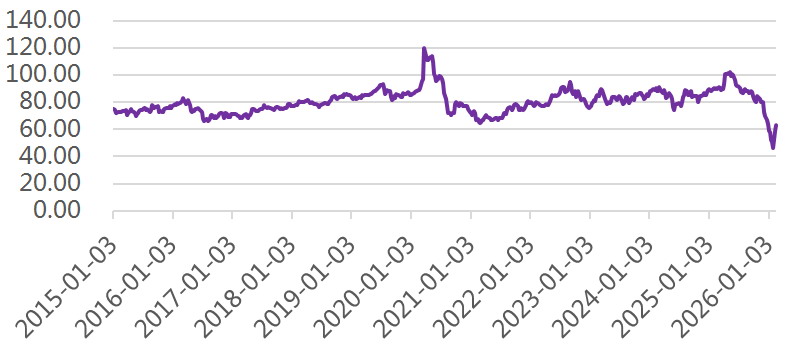
Core Viewpoint - The recent fluctuations in precious metal prices are attributed to a short-term deleveraging process rather than a fundamental trend reversal, emphasizing the importance of managing rhythm and structural opportunities in a high-volatility market environment [1][12]. Group 1: Precious Metal Price Trends - Since 2026, international precious metal prices have experienced significant volatility, with gold and silver reaching historical highs on January 29, 2026, at $5626.8 per ounce and $121.785 per ounce, respectively [1][2]. - Following these peaks, a sharp sell-off occurred, with gold prices dropping over 12% and silver prices falling more than 35% on January 30, marking the largest single-day declines since 1980 [1][2]. - The overall trend in precious metal prices has been characterized by a high slope upward trajectory, driven by macroeconomic uncertainties and geopolitical tensions [2]. Group 2: Market Dynamics and Participant Behavior - The recent price adjustments are seen as a result of high trading crowding and the subsequent need for deleveraging, rather than a fundamental shift in market conditions [4][12]. - The structure of market participants indicates that the recent sell-off resembles previous corrections, with high-leverage funds being forced to liquidate positions [4]. - The ability of the Asian market, particularly China and India, to absorb physical demand will be crucial for stabilizing prices and determining the pace of recovery [4]. Group 3: Gold Market Characteristics - Gold's pricing mechanism is fundamentally based on the redistribution of existing stock rather than supply and demand dynamics typical of other commodities, with annual new supply accounting for only about 1% of total stock [5][6]. - The dual drivers of gold pricing are identified as central bank purchases and ETF investment demand, with the former being a stable long-term marginal buyer [5][6]. - The sensitivity of global central bank demand to price changes is relatively low, indicating a sustained interest in gold as a hedge against geopolitical risks and currency diversification [6]. Group 4: Silver Market Characteristics - Silver's pricing is more sensitive to liquidity and physical supply disruptions due to its smaller market size and limited deliverable inventory [7][8]. - The industrial demand for silver has shown signs of slowing, particularly in the photovoltaic sector, which has reduced its long-term price support [7]. - The tightness in the physical silver market has been exacerbated by high ETF demand, leading to significant price volatility and a pronounced response to capital inflows [8]. Group 5: Gold-Silver Ratio Insights - The gold-silver ratio has experienced significant fluctuations, reflecting the relative performance of the two metals and underlying supply-demand dynamics [9][10]. - Historical patterns suggest that when the gold-silver ratio exceeds 80, silver tends to outperform gold in subsequent periods, driven by industrial demand recovery and broader asset allocation shifts [10][11]. - The recent contraction in the gold-silver ratio indicates a stronger narrative for silver, supported by tight supply conditions and speculative capital inflows [10][11]. Group 6: Future Outlook - The outlook for precious metals remains positive, with expectations of continued support from global fiscal expansion and a declining interest rate environment [12]. - Gold is positioned as a core defensive asset, while silver is viewed as a high-elasticity asset suitable for investment during capital inflow phases [12]. - Monitoring ETF holdings, available inventory levels, and the gold-silver ratio will be critical for navigating the high-volatility market landscape [12].

002238,午后直线涨停
Shang Hai Zheng Quan Bao· 2026-02-03 08:22
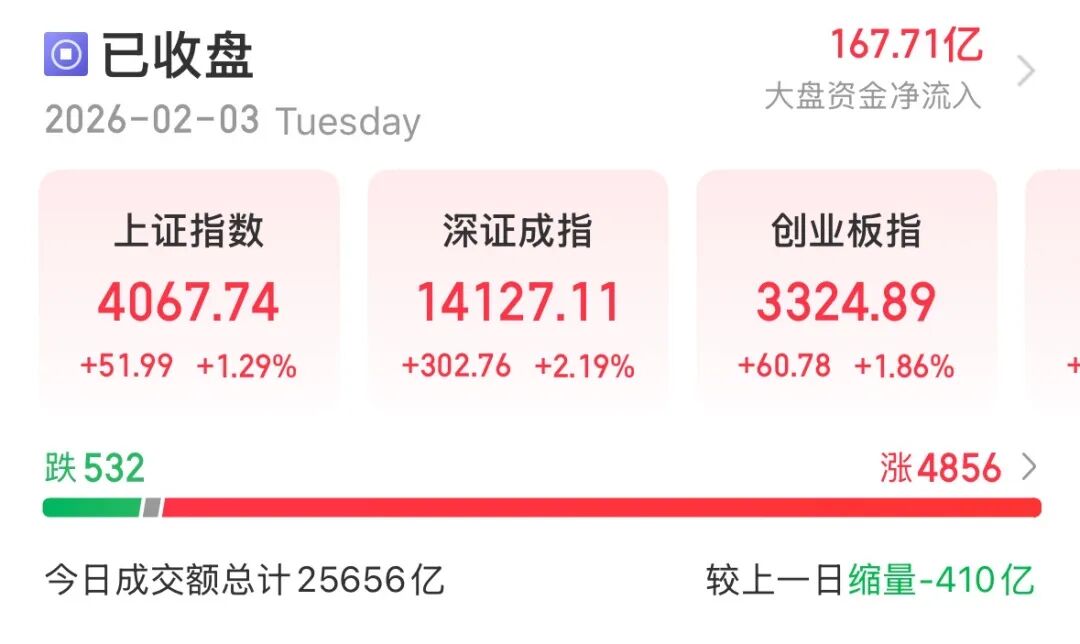
Market Overview - The A-share market experienced a significant upward trend on February 3, with the Shanghai Composite Index closing at 4067.74 points, up 1.29%. The Shenzhen Component rose by 2.19%, the ChiNext Index increased by 1.86%, the Sci-Tech Innovation Index gained 2.44%, and the Northbound 50 Index surged by 3.27%. The total trading volume across the Shanghai and Shenzhen markets reached 25,656 billion yuan [1]. Sector Performance - Over 4,800 stocks in the market saw gains, with the photovoltaic industry chain showing strong performance, particularly in the space photovoltaic sector, where companies like Aotewei and Zerun New Energy hit the daily limit with a 20% increase [3]. - The commercial aerospace sector rebounded, with stocks such as Jieli Suojin and Aerospace Development also reaching the daily limit [3]. - The chemical sector remained active, with Wanfeng shares achieving a four-day limit increase [3]. - The precious metals concept saw localized activity, with Hunan Gold hitting the daily limit [4][5]. Precious Metals Market - The precious metals market saw a sharp rebound, with Hunan Gold achieving a remarkable 7-day, 6-limit increase. Other notable performers included Xiaocheng Technology, which rose over 18%, and Zijin Mining, which increased by over 6% [5]. - On February 3, gold prices surged, with spot gold rising over 5% to surpass $4,900 per ounce, while silver also maintained an upward trend, increasing over 8% to break through $86 per ounce [6]. - According to China Galaxy Securities, the recent decline in precious metal prices can be viewed as a market-driven cooling following a period of rapid price increases, rather than a panic exit of funds. This price correction is seen as a normal phenomenon that helps release overheated market sentiment [6]. - Guotai Junan Securities indicated that the recent significant drop in precious metal prices is a technical adjustment to the irrational increases seen since the beginning of the year, rather than the end of a long-term upward trend for gold. The decline in speculative sentiment and leverage levels is expected to support a healthier upward trend for gold in the near term [6]. Computing Power Leasing Sector - The computing power leasing sector showed continued strength, with Tianwei Vision experiencing a direct limit increase [7][8]. - Other companies in this sector, such as Wangsu Technology and Capital Online, saw increases of over 10% [8]. - The CPO concept also performed actively, with Robotech hitting a 20% limit increase, and companies like Juguang Technology, Dekeli, and Tianfu Communication rising over 10% [8]. - According to Dongwu Securities, major overseas cloud providers have begun raising prices for their services, marking the first increase in years. This trend is expected to influence domestic cloud providers to follow suit, creating investment opportunities in the AI cloud industry as demand increases [8].





金银大反弹,白银基金跌停,A股黄金股重挫
Xin Lang Cai Jing· 2026-02-03 02:52
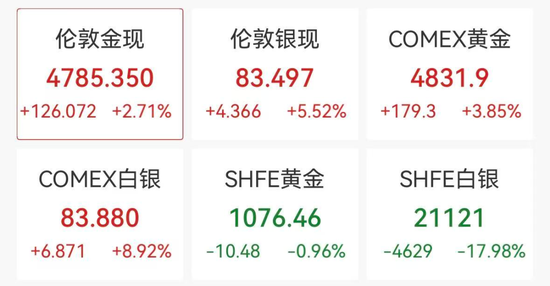
Market Overview - On February 3, gold and silver prices rebounded, with spot gold reaching nearly 4800 USD and spot silver touching 85 USD before narrowing gains [1][6] - As of 10:22 AM, both gold and silver saw a decrease in their price increases [1][6] Price Movements - Current prices include: - London Gold: 4785.350 USD (+126.072, +2.71%) - London Silver: 83.497 USD (+4.366, +5.52%) - COMEX Gold: 4831.9 USD (+179.3, +3.85%) - COMEX Silver: 83.880 USD (+6.871, +8.92%) - SHFE Gold: 1076.46 USD (-10.48, -0.96%) - SHFE Silver: 21121 (-4629, -17.98%) [2][7] Stock Market Reaction - Despite the rebound in gold and silver prices, A-share market gold concept stocks mostly declined, with several stocks including Yuguang Gold Lead, Sichuan Gold, and Zhaojin Gold hitting the daily limit down for three consecutive days [2][3][7] - In contrast, Hong Kong gold concept stocks collectively rebounded, with Zhaojin Mining up nearly 2%, Chifeng Jilong Gold over 2%, and Zijin Mining International over 3% [3][8] Fund Performance - The Guotou Silver LOF resumed trading on February 3 and hit the daily limit down at 4.25 CNY, with a premium rate of 88.94% [4][9] - The fund reported a single-day net value drop of 31.5%, marking a historical record for public funds [4][9] Market Analysis - According to Guotai Junan Securities, the recent significant drop in precious metal prices is a technical adjustment following irrational increases earlier in the year, rather than the end of a long-term bull market for gold [4][9] - Short-term factors include a cooling of speculative sentiment and a decrease in leverage levels, which may help gold return to a healthier upward trend [4][9] - Long-term, the ongoing restructuring of the global monetary system and declining trust in various currencies suggest that central bank gold purchases will continue, supporting a sustained bullish outlook for gold [4][9]


金银大反弹,白银基金跌停,A股黄金股重挫
21世纪经济报道· 2026-02-03 02:48
Core Viewpoint - The article discusses the recent fluctuations in gold and silver prices, highlighting a rebound in the market but a simultaneous decline in related A-share stocks, indicating a complex market sentiment towards precious metals [1][5]. Price Movements - On February 3, gold prices rebounded, with spot gold reaching approximately $4,800 and spot silver touching $85 during the day [1]. - Specific price data includes: - London Gold: $4,785.35 (+2.71%) - London Silver: $83.497 (+5.52%) - COMEX Gold: $4,831.9 (+3.85%) - COMEX Silver: $83.880 (+8.92%) - SHFE Gold: ¥1,076.46 (-0.96%) - SHFE Silver: ¥21,121 (-17.98%) [2]. A-Share Market Reaction - Despite the rebound in gold and silver prices, A-share market gold concept stocks mostly declined, with several stocks hitting the daily limit down for three consecutive days, including: - Yuguang Gold Lead: -10% - Sichuan Gold: -10% - Zhaojin Gold: -10% - Silver Nonferrous: -10% - Shengda Resources: -10% - China Gold: -10% - Hunan Silver: -9.98% [2][4]. Hong Kong Market Performance - In contrast, Hong Kong gold concept stocks experienced a collective rebound, with notable increases: - Zhaojin Mining: up nearly 2% - Chifeng Jilong Gold Mining: up over 2% - Zijin Mining International: up over 3% - WanGuo Gold Group: up over 4% [4]. Fund Performance - The Guotou Silver LOF fund faced a significant drop, hitting a limit down at ¥4.25, with a premium rate of 88.94%. The fund reported a single-day net value drop of 31.5%, marking a historical record for public funds [5]. - Guotai Junan Securities suggested that the recent sharp decline in precious metal prices is a technical adjustment following irrational increases earlier in the year, rather than the end of a long-term bull market for gold [5]. Long-term Outlook - The article indicates that despite short-term fluctuations, the long-term outlook for gold remains positive due to ongoing global monetary system restructuring and continued central bank purchases of gold [5].
港股异动 | 黄金股集体高开 招金矿业(01818)涨逾5% 黄金、白银暴跌后双双反弹
智通财经网· 2026-02-03 01:30
Group 1 - Gold stocks experienced a collective rebound, with notable increases in companies such as Zhaojin Mining (up 5.12% to HKD 34.9), Chifeng Jilong Gold (up 4.74% to HKD 36.7), Zijin Mining International (up 4.67% to HKD 210.8), and WanGuo Gold Group (up 4.26% to HKD 13.46) [1] - After a significant decline, both gold and silver prices rebounded, with spot gold increasing by 4% to USD 4846.78 per ounce and spot silver rising over 7% to surpass USD 84 per ounce [1] - Guotai Junan Securities suggests that the recent sharp decline in precious metal prices is a technical adjustment following irrational increases earlier in the year, rather than the end of a long-term bull market for gold [1] Group 2 - Short-term factors contributing to a healthier upward trend for gold include a cooling of previously overheated speculative sentiment and a decrease in funding leverage levels [1] - Long-term prospects for gold remain positive due to ongoing global monetary system restructuring and significant potential for central bank gold purchases amid declining trust in various currencies [1]
深夜!沪银一度跌停!COMEX白银,日内涨超6%
Sou Hu Cai Jing· 2026-02-02 14:00
Group 1 - The precious metals market is experiencing significant volatility, with a notable rebound observed in COMEX gold, COMEX silver, and spot palladium prices, particularly COMEX silver rising over 6% [1] - Recent trading days have seen drastic corrections in precious metals, with spot gold dropping over 9% and COMEX gold futures falling over 8% on January 30, while spot silver and COMEX silver experienced declines exceeding 26% and 25% respectively, marking rare historical fluctuations [1] - Despite the recent uptick in prices, COMEX gold and silver remain below their closing prices from the previous Friday, indicating ongoing market instability [1] Group 2 - Institutions maintain an optimistic outlook on the future of precious metals, with Everbright Futures suggesting that the recent price adjustments are a necessary "bubble-popping and deleveraging" response to extreme overbuying and crowded trades, while core long-term drivers remain intact [2] - Mark Wilson from Goldman Sachs emphasizes that the recent volatility should not be overinterpreted, as the fundamental drivers of the market have not changed, attributing the rapid correction to excessive investor positioning [2] - Michael Hartnett from Bank of America indicates that despite short-term fluctuations, the macroeconomic logic supporting the rise of gold and tangible assets remains strong, cautioning investors about potential liquidity deleveraging risks in the first half of the year [2]
黄金跌了价,26年1月3日,国内黄金新价格、人民币黄金新价格
Sou Hu Cai Jing· 2026-01-04 01:52
Group 1 - International gold prices have declined, with London gold quoted at $4,348.8 per ounce and domestic gold prices in China falling to 977.7 yuan per gram as of January 3, 2026 [1] - Major retail brands in the gold market, such as Chow Tai Fook and Luk Fook, have adjusted their gold prices to 1,357 yuan per gram, while others like Chow Sang Sang and Lao Feng Xiang are slightly higher at 1,360 yuan per gram, indicating a limited price drop and stable market sentiment [2] - The price of gold jewelry across different cities remains in the range of 1,340 to 1,360 yuan per gram, with variations based on brand and location, and the total price of gold jewelry significantly varies with weight [3] Group 2 - The gold recycling market has experienced notable price fluctuations, with the recycling price dropping to 967 yuan per gram from nearly 1,000 yuan per gram in late December 2025, while maintaining a purity level between 99.9% and 99.999% [4] - The domestic trading market has seen about a 2% adjustment in basic gold prices and other gold categories, with platinum prices experiencing a more significant decline of over 10% in a single day, indicating a period of adjustment following previous rapid price increases [4] - The Shenzhen Shui Bei jewelry market has seen increased foot traffic due to lower gold prices, with rising interest in silver investments as silver prices have surged, leading to a supply shortage for certain investment silver bars [6]
金价一度直线下跌 银价跳水!金融圈人士直言:有人在出货
Mei Ri Jing Ji Xin Wen· 2025-12-31 07:59
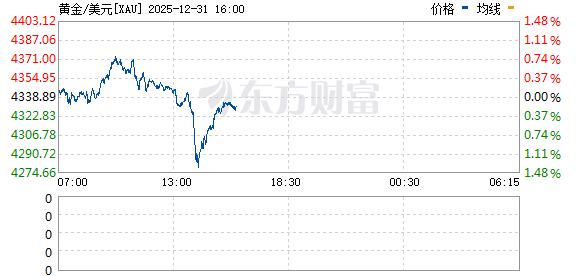
Core Viewpoint - The precious metals market is experiencing significant volatility, with gold, silver, and platinum prices declining sharply after a period of substantial gains, driven by profit-taking and reduced geopolitical risks [6][7][11]. Price Movements - Gold prices fell by 1.50% to below $4300 per ounce, while silver dropped over 7% at one point, currently down 5.02% [1] - The main silver futures contract fell over 5%, currently down 4.27%, priced at 17074 yuan per kilogram [3] - Platinum futures saw a decline of 14%, currently priced at 527.25 yuan per gram [3] Market Dynamics - The recent surge in precious metals prices, particularly silver, saw silver futures rise from around $50 to over $80 per ounce, marking a monthly increase of approximately 150% [6] - As of last week, gold had increased by about 70% for the year, while other precious metals like platinum and palladium saw gains exceeding 100% [6] - The gold-silver ratio has dropped from a high of 120 in 2020 to around 60, indicating potential undervaluation of gold or overvaluation of silver [6] Factors Influencing Price Changes - The decline in precious metal prices is attributed to profit-taking after previous gains, reduced geopolitical risks, and increased margin requirements by major exchanges [7][9] - Financial institutions are under pressure to settle accounts by year-end, leading to selling at high prices, which has put downward pressure on prices [7] - Analysts suggest that the recent price drop is more of a technical correction rather than a fundamental shift in market dynamics [9] Future Outlook - Despite short-term volatility, the long-term outlook for precious metals remains positive, with expectations of continued demand from central banks and a potential shift towards a weaker dollar [9][10] - Predictions for gold prices in 2026 are around $5000 per ounce, driven by structural demand from central banks and anticipated interest rate cuts by the Federal Reserve [9][10] - The demand for gold from emerging market central banks is at a historical high, with significant purchases expected to continue [10] Market Sentiment - The current market is characterized by high volatility, with investors advised to be cautious about chasing prices [11][12] - The perception of gold as a hard currency is evolving, with investors reassessing its value in light of rising U.S. debt and fiscal sustainability concerns [11] - The market is increasingly influenced by investor sentiment and liquidity, making it essential for participants to monitor emotional factors alongside traditional supply and demand dynamics [12]
贵金属日评:日本央行加息预期抽走便宜钱或使贵金属价格有所调整-20251202
Hong Yuan Qi Huo· 2025-12-02 03:28
1. Report Industry Investment Rating - Not mentioned in the report 2. Core Viewpoints - The strong signal of the Bank of Japan's interest rate hike in December may lead to an adjustment in precious metal prices due to the expected return of "cheap money" in yen, while the weak performance of some US economic and employment data and the dovish statements of some Fed officials have increased the expectation of a Fed rate cut in December [1] - The global supply - demand of platinum is expected to be tight in 2025 - 2026, but the expectation of the Fed's rate cut in December and the Bank of Japan's rate hike may lead to an adjustment in platinum prices [1] - The global supply - demand of palladium is expected to shift from tight to loose in 2025 - 2026, and similar to platinum, the Fed and Bank of Japan's policies may cause an adjustment in palladium prices [1] 3. Summary by Related Categories 3.1 Precious Metals Market Data - **Gold**: Shanghai gold futures' closing price on 2025 - 12 - 01 was 958.27 yuan/gram, with a daily change of 10.86 and a weekly change of 17.58; COMEX gold futures' closing price was 4265.00 dollars/ounce, with a daily change of 8.60 and a weekly change of 188.30 [1] - **Silver**: Shanghai silver futures' closing price on 2025 - 12 - 01 was 13261.00 yuan/kg, with a daily change of 592.00 and a weekly change of 1129.00; COMEX silver futures' closing price was 58.45 dollars/ounce, with a daily change of 1.37 and a weekly change of 8.10 [1] 3.2 Important Information - The contraction of the US ISM manufacturing PMI in November reached the largest in four months, with employment further contracting and prices rising [1] - The Bank of Japan's governor strongly hinted at an interest rate hike in December, aiming to raise the interest rate to 0.75% [1] 3.3 Multi - and Short - Term Logic - **Gold and Silver**: The expected return of "cheap money" yen may lead to an adjustment in precious metal prices, while the Fed's possible rate cut in December provides support [1] - **Platinum**: Supply is disturbed by high mining costs, unstable power supply, and aging equipment, while demand from multiple industries is expected to rise, but price adjustments may occur due to central bank policies [1] - **Palladium**: Supply may increase due to the global vehicle scrapping cycle, while demand from the automotive sector is expected to decline, and price adjustments may also be affected by central bank policies [1] 3.4 Trading Strategies - **Platinum**: Hold previous long positions cautiously or take profits at high levels, or consider the arbitrage opportunity of "long platinum, short palladium". Pay attention to support and resistance levels for London and domestic platinum prices [1] - **Palladium**: Hold previous long positions cautiously or take profits at high levels. Pay attention to support and resistance levels for London and domestic palladium prices [1]
贵金属日评20251117:多位美联储官员放鹰使贵金属价格承压-20251117
Hong Yuan Qi Huo· 2025-11-17 05:43
Report Industry Investment Rating - No relevant information provided. Core View - Multiple Fed officials' hawkish remarks have increased the uncertainty of future expectations, causing short - term adjustments in precious metal prices. However, factors such as global debt expansion, fiscal deficit, central bank gold - buying, and geopolitical risks may support precious metal prices in the medium - to - long term [1]. Summary by Relevant Catalogs 1. Market Data - **Shanghai Gold**: The closing price was 947.98 yuan/gram, with a daily change of - 10.69 yuan and a weekly change of 14.96 yuan. The trading volume was 45,922, with a daily decrease of 20,686 and a weekly decrease of 5,282. The open interest decreased by 16,690 [1]. - **Shanghai Silver**: The closing price of the futures active contract was 12,351 yuan/ten - gram, with a daily change of - 237 yuan and a weekly change of 632 yuan. The trading volume was 1,026,209, with a daily decrease of 104,492 and a weekly increase of 10,299 [1]. - **COMEX Gold Futures**: The closing price of the active contract was 4,174.50 dollars/ounce, with a daily change of 99.60 dollars and a weekly change of - 90.10 dollars. The trading volume was 332,490, with a daily increase of 30,017 and a weekly increase of 148,845 [1]. - **International Gold and Silver**: London gold spot price was 4,071.10 dollars/ounce, down 124.55 dollars from the previous day. SPDR Gold ETF holdings were 1,044 tons, an increase of 3.65 tons from the previous day [1]. 2. Important Information - Fed hawks oppose a December rate cut, and as of last Friday, the market's expectation of a December rate cut has dropped to 40%. The US will release important economic data on November 20 (September non - farm payrolls) and November 26 (Fed - preferred indicator PCB) [1]. 3. Trading Strategy - Wait for the price to fall before placing long orders. For London gold, focus on the support level around 3,850 - 3,950 dollars/ounce and the resistance level around 4,180 - 4,384 dollars/ounce. For Shanghai gold, focus on the support level around 870 - 890 yuan/gram and the resistance level around 960 - 1,000 yuan/gram [1].