Xiangyu Medical(688626)

Search documents
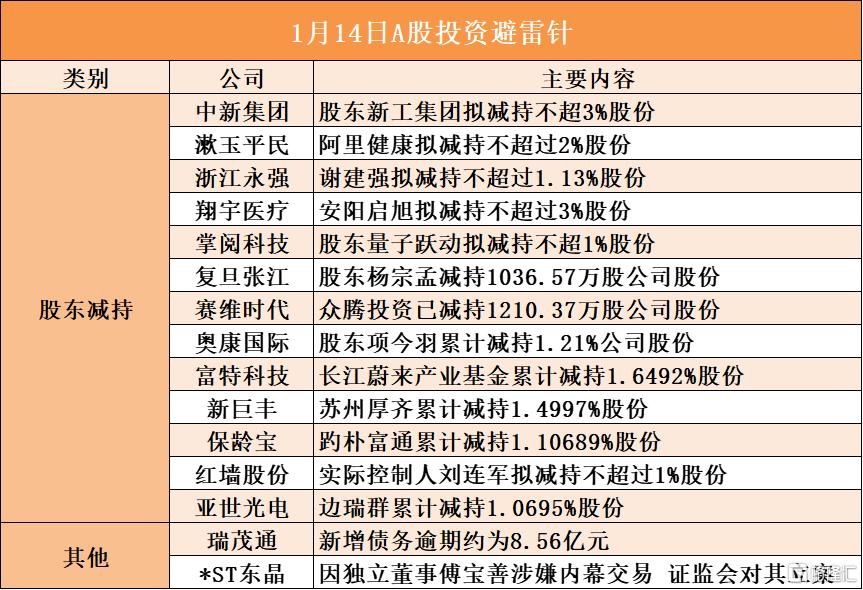
1月14日A股投资避雷针︱*ST东晶:因独立董事傅宝善涉嫌内幕交易 证监会对其立案



Ge Long Hui A P P· 2026-01-13 14:03
Shareholder Reduction - New China Group's shareholder, New Work Group, plans to reduce its stake by no more than 3% [1] - Shuyuan Pingmin's shareholder, Alibaba Health, intends to reduce its stake by no more than 2% [1] - Zhejiang Yongqiang's shareholder, Xie Jianqiang, plans to reduce his stake by no more than 1.13% [1] - Xiangyu Medical's shareholder, Anyang Qixu, intends to reduce his stake by no more than 3% [1] - Zhangyue Technology's shareholder, Quantum Leap, plans to reduce its stake by no more than 1% [1] - Fudan Zhangjiang's shareholder, Yang Zongmeng, has reduced 10.3657 million shares [1] - Saiwei Times' shareholder, Zhongteng Investment, has reduced 12.1037 million shares [1] - Aokang International's shareholder, Xiang Jinyu, has cumulatively reduced 1.21% of the company's shares [1] - Fute Technology's shareholder, Changjiang Weilai Industrial Fund, has cumulatively reduced 1.6492% of the shares [1] - New Giant's shareholder, Suzhou Houqi, has cumulatively reduced 1.4997% of the shares [1] - Baolingbao's shareholder, De Pufutong, has cumulatively reduced 1.10689% of the shares [1] - Hongqiang's actual controller, Liu Lianjun, plans to reduce his stake by no more than 1% [1] - Yashiguangdian's shareholder, Bian Ruiqun, has cumulatively reduced 1.0695% of the shares [1] Other Financial Issues - Ruimao Tong has reported overdue debts amounting to approximately 856 million yuan [1] - *ST Dongjing is under investigation by the Securities Regulatory Commission due to independent director Fu Baoshan's suspected insider trading [1]

翔宇医疗(688626.SH):安阳启旭拟减持不超3%股份
智通财经网· 2026-01-13 12:41
翔宇医疗(688626.SH)发布公告,因自身资金需求,安阳启旭拟通过集中竞价交易、大宗交易的方式减 持其所持有的公司股份合计不超过480万股,本次减持比例合计不超过公司总股本的3%,自减持计划公 告之日起15个交易日后的3个月内实施。 ...
翔宇医疗(688626.SH):安阳启旭拟减持不超过3%股份
Ge Long Hui A P P· 2026-01-13 12:09
格隆汇1月13日丨翔宇医疗(688626.SH)公布,因自身资金需求,安阳启旭拟通过集中竞价交易、大宗交 易的方式减持其所持有的公司股份合计不超过4,800,000股,本次减持比例合计不超过公司总股本的 3%,自本减持计划公告之日起15个交易日后的3个月内实施。 ...
翔宇医疗(688626) - 翔宇医疗关于股东减持股份计划公告
2026-01-13 11:47
证券代码:688626 证券简称:翔宇医疗 公告编号:2026-002 河南翔宇医疗设备股份有限公司 关于股东减持股份计划公告 本公司董事会、全体董事及相关股东保证本公告内容不存在任何虚假记载、 误导性陈述或者重大遗漏,并对其内容的真实性、准确性和完整性依法承担法律 责任。 重要内容提示: 一、减持主体的基本情况 | | | 1 大股东持股的基本情况 截至本公告披露日,河南翔宇医疗设备股份有限公司(以下简称"公司") 股东安阳启旭贸易咨询服务中心(有限合伙)(以下简称"安阳启旭")持有公司 股份 8,602,320 股,占公司总股本的 5.38%。上述股份为公司首次公开发行前取 得的股份,且已于 2024 年 3 月 31 日解除限售并上市流通。 减持计划的主要内容 因自身资金需求,安阳启旭拟通过集中竞价交易、大宗交易的方式减持其所 持有的公司股份合计不超过 4,800,000 股,本次减持比例合计不超过公司总股本 的 3%,自本减持计划公告之日起 15 个交易日后的 3 个月内实施。其中,通过集 中竞价方式减持不超过 1,600,000 股,占公司总股本的比例不超过 1%;通过大 宗交易方式减持不超过 3, ...
翔宇医疗:股东安阳启旭拟减持不超3%公司股份
Xin Lang Cai Jing· 2026-01-13 11:40
翔宇医疗公告称,股东安阳启旭持有公司860.23万股,占总股本5.38%,该部分股份已于2024年3月31日 解禁。因自身资金需求,其拟在2026年2月4日至5月3日,通过集中竞价、大宗交易方式合计减持不超 480万股,即不超总股本3%,其中集中竞价不超160万股(占比不超1%)、大宗交易不超320万股(占 比不超2%),减持价格按市场价确定,本次减持不会导致公司控制权变更。 ...
翔宇医疗股价涨5.08%,大成基金旗下1只基金重仓,持有9685股浮盈赚取4.07万元
Xin Lang Cai Jing· 2026-01-13 04:18
Group 1 - The core point of the news is that Xiangyu Medical has seen a stock price increase of 5.08%, reaching 86.90 CNY per share, with a trading volume of 5.23 billion CNY and a turnover rate of 3.96%, resulting in a total market capitalization of 139.04 billion CNY [1] - Xiangyu Medical, established on March 20, 2002, and listed on March 31, 2021, specializes in the research, production, and sales of rehabilitation medical devices [1] - The company's main business revenue composition includes rehabilitation therapy equipment at 67.79%, rehabilitation training equipment at 22.13%, operating and accessory products at 5.03%, rehabilitation assessment equipment at 3.72%, and other supplementary products at 1.33% [1] Group 2 - From the perspective of major fund holdings, Dachen Fund has a significant position in Xiangyu Medical, with the Dachen Zhihui Quantitative Multi-Strategy Mixed A Fund (004209) holding 9,685 shares, unchanged from the previous period, accounting for 3.76% of the fund's net value [2] - The Dachen Zhihui Quantitative Multi-Strategy Mixed A Fund was established on March 21, 2017, with a latest scale of 8.77 million CNY, and has achieved a year-to-date return of 4.31% [2] - The fund's one-year return stands at 33.84%, ranking 4,163 out of 8,091 in its category, while the cumulative return since inception is 6.82% [2]
光大证券:2025脑机接口行业发展现状、支持政策、临床情况及行业进展分析报告
Xin Lang Cai Jing· 2026-01-11 12:28
Industry Overview - Brain-Computer Interface (BCI) is a new cross-disciplinary technology that creates a communication channel between the brain and external devices, enabling direct information exchange [6] - BCIs can be classified into three types: invasive, semi-invasive, and non-invasive, with applications in medical rehabilitation, consumer interactions, and military fields [7] - The global BCI market is projected to reach $7.63 billion by 2029, growing from $1.2 billion in 2019 to nearly $2 billion in 2023, with a compound annual growth rate (CAGR) exceeding 13% from 2019 to 2023 [13][14] - Over 1,500 financing events in the global BCI sector have raised nearly $10 billion, with significant investments in both the U.S. and China [16] Policy Guidance - Major countries have launched brain initiatives to support BCI development, with the U.S. investing approximately $4.5 billion in its BRAIN Initiative since 2013 [37][40] - China has initiated its "Brain Science and Brain-Like Intelligence Technology" project, with funding expected to reach hundreds of billions of yuan [39][42] Clinical Situation - The medical demand for BCIs is driven by the need for rehabilitation in stroke and disabled populations, with significant clinical research already underway for various diseases [3][33] - Clinical trials for BCIs are accelerating globally, with a rapid increase in the number of trials in China [3][11] Industry Progress - Notable advancements include Neuralink's implantation of over 10 devices and Synchron's achievement of brain-controlled iPad functionality [4][4] - Key overseas companies like Neuralink and Synchron are leading in the invasive BCI field, focusing on treatment and human-computer interaction [4][4] - Domestic companies are also making strides, with clinical trials accelerating and real-time Chinese language decoding being achieved [4][4] Industry Chain Analysis - The BCI industry chain consists of upstream hardware and software supply, midstream BCI product supply, and downstream applications in various fields [18] - Upstream technology innovation barriers are high, with breakthroughs in flexible electrodes and chips being critical [20][21] - Downstream applications are primarily in the medical field, which is the most mature area for commercialization [30]


翔宇医疗:手功能热电治疗仪入选优秀国产医疗设备产品目录
Zheng Quan Shi Bao Wang· 2026-01-10 10:16
人民财讯1月10日电,据翔宇医疗消息,近日,由翔宇医疗研发生产的手功能热电治疗仪(型号:XY-K- SRD-I),成功入选第十一批《优秀国产医疗设备产品目录》。它不仅突破了传统手功能康复设备无法直 接作用于指神经的难题,并且创新性地融合了三种康复疗法,为广大康复医师与治疗师提供了一款融合 创新与实用的专业治疗工具。 ...
翔宇医疗股价跌5.01%,大成基金旗下1只基金重仓,持有9685股浮亏损失4.12万元
Xin Lang Cai Jing· 2026-01-09 01:54
Group 1 - The core point of the news is that Xiangyu Medical's stock price dropped by 5.01% to 80.50 yuan per share, with a total market capitalization of 12.88 billion yuan as of the report date [1] - Xiangyu Medical, established on March 20, 2002, specializes in the research, production, and sales of rehabilitation medical devices, with its main revenue sources being rehabilitation therapy equipment (67.79%), rehabilitation training equipment (22.13%), and other related products [1] Group 2 - From the perspective of major fund holdings, Dachen Fund has a significant position in Xiangyu Medical, with its Dachen Zhihui Quantitative Multi-Strategy Mixed A Fund holding 9,685 shares, unchanged from the previous period, representing 3.76% of the fund's net value [2] - The Dachen Zhihui Quantitative Multi-Strategy Mixed A Fund has a total asset size of 8.42 billion yuan, with a year-to-date return of 2.37% and a one-year return of 28.86% [2][3]
是风口还是泡沫? 多家公司提示风险
Shen Zhen Shang Bao· 2026-01-08 18:02
Group 1 - The core focus of the news is the surge in stock prices of companies involved in brain-computer interface (BCI) technology, reminiscent of the AI boom following AlphaGo's victory over Lee Sedol in 2016, with a notable increase in the sector's stock prices exceeding 12% on the first trading day of 2026 [1] - Companies like Sanbo Neuroscience and Xiangyu Medical have experienced consecutive trading halts, with Xiangyu Medical and Weisi Medical achieving two 20% trading halts in four trading days, indicating strong market interest [1] - The market's enthusiasm is driven by the perceived potential of the BCI sector, with Morgan Stanley predicting that the U.S. market for BCI implant devices could reach $80 billion by 2035 [1] Group 2 - Despite the excitement, experts caution that medical-grade applications of BCI are expected to take 3 to 5 years for approval, while consumer-grade products face challenges such as bulkiness, low user engagement, and high costs [2] - Historical precedents raise concerns about the sustainability of the current hype, with past instances like the metaverse index and AI stocks experiencing significant volatility [2] - Investment in the BCI sector has seen 16 financing events totaling 983 million yuan in 2025, but no products have been commercially launched yet, indicating that many startups are still in the concept validation stage [2] Group 3 - Sanbo Neuroscience clarified that it does not engage in the research, production, or sales of BCI products, and the revenue from neuro-regulation technology is minimal, having little impact on overall performance [3] - Xiangyu Medical acknowledged its investment in BCI technology but noted that related products have not achieved significant sales volume as of the end of 2025 [3] - Some companies, like Yahui Long, faced regulatory warnings for inaccurate disclosures related to BCI partnerships, highlighting the risks of speculative trading in this sector [3]