
BJCT(000802)

Search documents
北京文化:10月23日召开董事会会议
Mei Ri Jing Ji Xin Wen· 2025-10-24 12:40
Group 1 - Beijing Culture (SZ 000802) announced on October 24 that its 23rd meeting of the 8th board of directors was held on October 23, 2025, combining in-person and communication methods [1] - The meeting reviewed documents including the "2025 Q3 Report" [1] - For the first half of 2025, Beijing Culture's revenue composition was 100.0% from film and brokerage [1] Group 2 - As of the report, Beijing Culture's market capitalization is 3.3 billion yuan [1] - The Chinese innovative drug sector has sold overseas authorizations worth 80 billion USD this year [1] - The secondary market for biomedicine is thriving, while the primary market is facing fundraising challenges [1]

北京文化:前三季度归母净亏损3.05亿元
Xin Lang Cai Jing· 2025-10-24 12:20
Core Viewpoint - Beijing Culture reported a slight increase in revenue for Q3 2025, but continued to face significant net losses, indicating ongoing financial challenges despite revenue growth [1] Financial Performance - In Q3 2025, the company achieved operating revenue of 92.0862 million yuan, representing a year-on-year increase of 0.48% [1] - The net loss attributable to shareholders for Q3 2025 was 72.6981 million yuan, with a basic earnings per share of -0.1015 yuan [1] - For the first three quarters of 2025, the company reported operating revenue of 250 million yuan, showing a substantial year-on-year growth of 151.44% [1] - The net loss attributable to shareholders for the first three quarters was 305 million yuan, with a basic earnings per share of -0.4265 yuan [1]
北京文化(000802) - 第八届董事会第二十三次会议决议公告
2025-10-24 12:15
第八届董事会第二十三次会议决议公告 本公司及董事会全体成员保证信息披露的内容真实、准确、完整, 没有虚假记载、误导性陈述或重大遗漏。 一、董事会会议召开情况 北京京西文化旅游股份有限公司(以下简称"北京文化"或"公 司")第八届董事会第二十三次会议于 2025 年 10 月 17 日以电子邮件 等形式发出会议通知,于 2025 年 10 月 23 日以现场结合通讯的方式召 开,会议地点为公司总部会议室。本次会议应出席董事 9 人,实际出 席董事 9 人,其中以通讯表决的方式出席会议的董事有 6 人,分别为: 杜扬、郭庆胜、姚岚、吴长波、刘杰、陆群威。本次会议由董事长李 雳先生主持,公司高级管理人员列席。本次会议的召集、召开符合有 关法律法规和《公司章程》的规定。 二、 董事会会议审议情况 经与会董事认真审议、讨论,作出如下决议: 证券代码:000802 证券简称:北京文化 公告编号:2025-27 北京京西文化旅游股份有限公司 三、备查文件 北京京西文化旅游股份有限公司 董 事 会 二〇二五年十月二十三日 1、第八届董事会第二十三次会议决议。 2、审计委员会会议记录。 1、审议《关于 2025 年第三季度报告 ...
北京文化(000802) - 2025 Q3 - 季度财报
2025-10-24 12:10
Financial Performance - Total revenue for Q3 2025 was ¥92,086,221.30, an increase of 0.48% year-on-year, while year-to-date revenue reached ¥249,852,350.72, up 151.44% compared to the same period last year[5] - The net profit attributable to shareholders was -¥72,698,068.11 for Q3, representing a decrease of 915.56% year-on-year, and a year-to-date loss of -¥305,331,845.93, down 665.04%[5] - The basic earnings per share for Q3 was -¥0.1015, reflecting a decrease of 915.00% year-on-year[5] - Total operating revenue for the current period reached ¥249,852,350.72, a significant increase from ¥99,366,662.49 in the previous period, representing a growth of approximately 151.5%[21] - The net loss for the current period was ¥305,333,952.72, compared to a net loss of ¥39,911,971.76 in the previous period, reflecting a deterioration in financial performance[22] - Basic and diluted earnings per share for the current period were both -¥0.4265, compared to -¥0.0557 in the previous period, indicating a worsening in earnings per share[23] Cash Flow and Assets - The operating cash flow net amount for the year-to-date period was ¥85,857,289.47, an increase of 159.86% compared to the previous year[9] - The company reported a significant increase in cash and cash equivalents, reaching ¥119,455,700.10 compared to ¥62,411,495.78 at the beginning of the period, indicating a growth of approximately 91.3%[17] - Net cash flow from operating activities was ¥85,857,289.47, recovering from a negative cash flow of ¥143,420,543.76 in the previous period[25] - Total cash outflow from operating activities decreased to ¥367,461,321.90 from ¥454,363,361.83, indicating improved cash management[25] - The ending cash and cash equivalents balance increased to ¥119,455,700.10, up from ¥15,960,968.90 in the previous period[25] Operating Costs and Liabilities - The company reported a significant increase in operating costs, which rose by 494.54% year-on-year to ¥451,267,761.57, primarily due to increased costs in film and performance business[9] - Total operating costs amounted to ¥528,759,497.37, up from ¥150,984,562.21, indicating an increase of about 250.5%[21] - The company's total assets decreased by 25.39% from the end of the previous year, amounting to ¥1,985,174,446.86[5] - Total liabilities decreased to ¥1,226,395,395.33 from ¥1,596,679,920.82, representing a reduction of about 23.2%[19] Shareholder Information - The company had a total of 61,932 ordinary shareholders at the end of the reporting period[11] - The top shareholder, Fude Life Insurance Co., Ltd., held 15.60% of the shares, totaling 111,649,909 shares[12] Project Development and Strategy - The company is in the post-production phase for several projects, including "用武之地" and "愤怒的老虎," with expected release dates in 2025[14] - The company has multiple projects in development, including "微笑吧生活" and "玲珑," indicating ongoing investment in new content[15] - The company plans to adjust its operational strategies based on market conditions, highlighting a flexible approach to project management[14] - The company has a diverse portfolio of upcoming films and series, with various directors and actors involved, showcasing its commitment to expanding its content offerings[14] Financial Outlook - The financial outlook remains uncertain, with the company acknowledging that market changes could impact its ability to meet projected earnings for 2025[15] Other Financial Metrics - Government subsidies recognized in the current period amounted to ¥4,500,000.00, contributing to the overall financial performance[6] - The weighted average return on equity was -8.91% for the current period, a decline of 8.32% compared to the previous year[5] - Investment income for the current period was ¥230,945.08, a recovery from a loss of ¥769,260.39 in the previous period[22] - The company reported a credit impairment loss of ¥7,741,385.99, compared to ¥6,695,235.86 in the previous period, indicating an increase in credit risk[22] - Cash inflow from sales of goods and services was ¥429,749,939.79, compared to ¥298,902,568.13 in the previous period, marking a growth of approximately 43.8%[24] - Total cash outflow for employee compensation was ¥12,968,322.08, slightly higher than ¥12,575,561.48 in the previous period[24] - The company did not undergo an audit for the third quarter financial report[26]
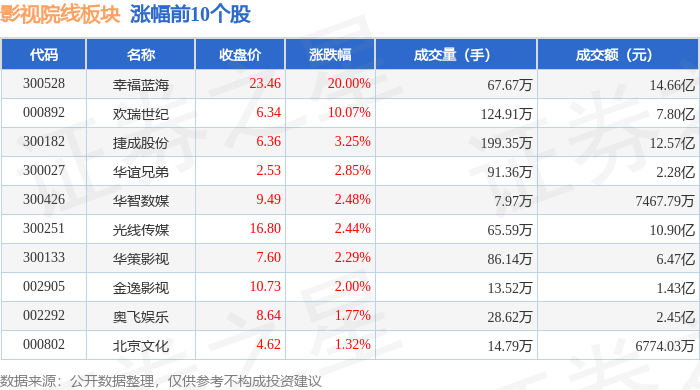
影视院线板块10月23日涨2.29%,幸福蓝海领涨,主力资金净流入7.84亿元
Zheng Xing Xing Ye Ri Bao· 2025-10-23 08:20
Market Overview - The film and cinema sector saw a rise of 2.29% on October 23, with Happiness Blue Sea leading the gains [1] - The Shanghai Composite Index closed at 3922.41, up 0.22%, while the Shenzhen Component Index closed at 13025.45, also up 0.22% [1] Individual Stock Performance - Happiness Blue Sea (300528) closed at 23.46, with a significant increase of 20.00% and a trading volume of 676,700 shares, amounting to a transaction value of 1.466 billion yuan [1] - Huanrui Century (000892) rose by 10.07% to close at 6.34, with a trading volume of 1,249,100 shares and a transaction value of 780 million yuan [1] - Jiecheng Co. (300182) increased by 3.25% to 6.36, with a trading volume of 1,993,500 shares and a transaction value of 1.257 billion yuan [1] - Other notable performers include Huayi Brothers (300027) up 2.85% to 2.53, and Light Media (300251) up 2.44% to 16.80 [1] Capital Flow Analysis - The film and cinema sector experienced a net inflow of 784 million yuan from institutional investors, while retail investors saw a net outflow of 596 million yuan [2] - The main stocks with significant net inflows include Happiness Blue Sea with 279 million yuan and Huanrui Century with 161 million yuan [3] - Conversely, retail investors showed notable outflows in stocks like Happiness Blue Sea and Huanrui Century, indicating a divergence in investment behavior [3]


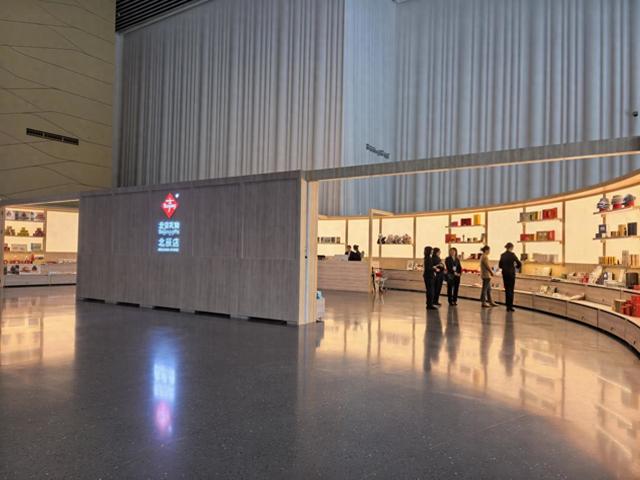
“北京礼物”北辰店亮相全球妇女峰会会展核心区,超3000件商品展示北京文化魅力
Bei Jing Ri Bao Ke Hu Duan· 2025-10-15 04:19
转自:北京日报客户端 2025年全球妇女峰会举办期间,位于国家会议中心二期的"北京礼物"北辰店亮相会展核心区。该店 以"礼遇京华 会聚天下"为定位,依托核心会展资源优势,通过"精准选品"与"便捷服务"双轮驱动,为与 会嘉宾打造沉浸式文化消费体验,成为展示北京文化魅力与服务温度的新窗口。 "北京礼物"北辰店 为精准服务国际嘉宾,门店重点升级了购物退税服务体系,全面开通离境退税与"即买即退"双模式。境 外参会代表凭有效证件即可在现场办理退税手续。其中,"即买即退"服务提供单日累计最高22万元的退 税额度,宾客通过信用卡预授权担保,可即时获取等额预付金,极大简化了流程,提升了购物便捷度, 充分展现了北京作为国际消费中心城市的服务效率与开放姿态。 在产品组织上,门店紧密围绕本次峰会参会代表以女性为主的特点,精心构建了涵盖非遗技艺、中华老 字号、时尚美妆与文化IP等领域的文创产品矩阵,精选商品总计超过3000件。其中,既有蕴含古都风韵 的天坛冰箱贴、故宫文创系列,也有备受青睐的毛绒熊猫挂饰、寓意美好的珐琅厂工艺礼品,以及国家 会议中心自主研发的"竹福"系列文创、京妆品牌甄然的美妆产品等,兼顾文化内涵、女性偏好与实用美 ...
影视院线板块10月14日跌1.29%,博纳影业领跌,主力资金净流出1.95亿元
Zheng Xing Xing Ye Ri Bao· 2025-10-14 08:46
Market Overview - The film and theater sector experienced a decline of 1.29% on October 14, with Bona Film Group leading the drop [1] - The Shanghai Composite Index closed at 3865.23, down 0.62%, while the Shenzhen Component Index closed at 12895.11, down 2.54% [1] Stock Performance - Key stocks in the film and theater sector showed varied performance, with notable declines in several companies: - Bona Film Group: closed at 5.39, down 2.71% with a trading volume of 403,400 shares and a turnover of 221 million [2] - Huace Film & TV: closed at 7.57, down 2.20% with a trading volume of 748,300 shares and a turnover of 576 million [2] - China Film: closed at 13.46, down 1.17% with a trading volume of 390,600 shares and a turnover of 532 million [2] Capital Flow - The film and theater sector saw a net outflow of 195 million from major funds, while retail investors contributed a net inflow of 113 million [2] - Specific stock capital flows indicated: - Jiecheng Co.: net inflow from major funds of 26.36 million, but a net outflow from retail investors of 35.61 million [3] - Bona Film Group: net outflow from major funds of 4.44 million, with a net inflow from retail investors of 15.21 million [3]


高炉音乐会已成北京文化“金名片”
Bei Jing Wan Bao· 2025-10-12 06:43
Core Insights - The 2025 Beijing Xishan Yongding River Cultural Festival has commenced at Shougang Park, showcasing the evolution of the High Furnace Concert from its inception in 2021 to a significant cultural event in Beijing [1] - The concert features a multi-dimensional immersive experience, highlighting themes of national spirit and contemporary development through innovative use of light and sound technology [1] Group 1: Cultural Development - Shougang Park has transformed into a new landmark for urban revival, evolving from industrial use to a cultural and recreational space, hosting various events and exhibitions [2] - The High Furnace has been upgraded to serve as a platform for premieres and exhibitions, while other furnaces have been repurposed for sci-fi attractions and international exhibitions [2] Group 2: Community Engagement - The "Mountain River Seeking Pulse Journey" series of live broadcasts will take place during the cultural festival, focusing on cultural heritage sites and promoting digital preservation and creative cultural initiatives [3] - Various districts along the cultural belt will host themed activities, including the establishment of a cultural space in Shijingshan Academy aimed at fostering cultural exchange and public reading [3]
北京文化大宗交易成交1700.00万股 成交额6970.00万元
Zheng Quan Shi Bao Wang· 2025-10-09 09:25
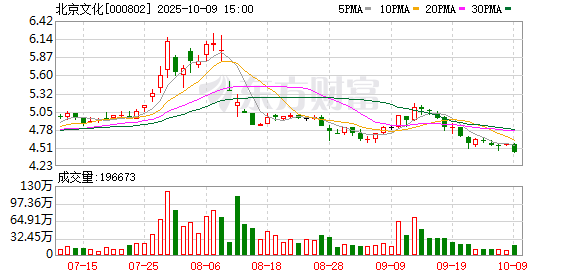
Summary of Key Points Core Viewpoint - Beijing Culture experienced a significant block trade on October 9, with a transaction volume of 17 million shares at a price of 4.10 yuan, representing a discount of 7.66% compared to the closing price of 4.44 yuan on the same day [2][3]. Group 1: Trading Activity - The block trade involved a total of 17 million shares, amounting to 69.7 million yuan [2][3]. - The buyer was Western Securities Co., Ltd. Shanghai Branch, while the seller was Guotai Junan Securities Co., Ltd. Beijing Workers' Stadium North Road Securities Branch [2][3]. - On the same day, Beijing Culture's stock closed at 4.44 yuan, down 2.63%, with a turnover rate of 2.75% and a total trading volume of 87.5 million yuan [2][3]. Group 2: Financial Metrics - The net outflow of funds for Beijing Culture was 10.33 million yuan, with a cumulative decline of 4.31% over the past five days [2][3]. - The latest margin financing balance for the stock is 239 million yuan, which has increased by 39.51 million yuan, reflecting a growth rate of 19.84% over the last five days [3]. - Beijing Jingxi Culture Tourism Co., Ltd. was established on November 18, 1997, with a registered capital of 7.159 billion yuan [3].
北京文化今日大宗交易折价成交1700万股,成交额6970万元
Xin Lang Cai Jing· 2025-10-09 08:47
10月9日,北京文化大宗交易成交1700万股,成交额6970万元,占当日总成交额的44.34%,成交价4.1 元,较市场收盘价4.44元折价7.66%。 ...