BJCT(000802)

Search documents
北京文化(000802) - 关于续聘2025年度会计师事务所的公告
2025-11-28 08:30
证券代码:000802 证券简称:北京文化 公告编号:2025-31 1.基本信息 (1)机构名称:中瑞诚会计师事务所(特殊普通合伙) 北京京西文化旅游股份有限公司 关于续聘 2025 年度会计师事务所的公告 本公司及董事会全体成员保证信息披露的内容真实、准确、完整, 没有虚假记载、误导性陈述或重大遗漏。 特别提示: 1、公司董事会审计委员会、董事会对本次续聘会计师事务所事项无异议。 2、本次续聘会计师事务所符合财政部、国务院国资委、证监会印发的《国 有企业、上市公司选聘会计师事务所管理办法》(财会〔2023〕4 号)的规定。 北京京西文化旅游股份有限公司(以下简称"北京文化"或"公司")于 2025 年 11 月 27 日召开第八届董事会第二十四次会议,审议通过了《关于续 聘 2025 年度会计师事务所》的议案,公司拟续聘中瑞诚会计师事务所(特殊 普通合伙)为公司 2025 年度审计机构,本议案尚需提交股东会审议,现将相 关事项公告如下: 一、拟续聘会计师事务所的基本情况 (一)机构信息 (8)2024 年度上市公司(2024 年报审计)审计客户 6 家,挂牌公司(2024 年报审计)审计客户 14 家。上 ...

北京文化(000802) - 北京京西文化旅游股份有限公司关于召开2025年第二次临时股东会的通知
2025-11-28 08:30
证券代码:000802 证券简称:北京文化 公告编号:2025-30 北京京西文化旅游股份有限公司 关于召开 2025 年第二次临时股东会的通知 本公司及董事会全体成员保证信息披露的内容真实、准确、完整,没有虚假记载、误导性陈述或 重大遗漏。 一、召开会议的基本情况 3、本次会议的召集、召开符合《中华人民共和国公司法》《深圳证券交易所股票上市规则》《深圳 证券交易所上市公司自律监管指引第 1 号——主板上市公司规范运作》等法律、行政法规、部门规章、 规范性文件及《公司章程》的有关规定。 4、会议时间: (1)现场会议时间:2025 年 12 月 15 日 14:30; (2)网络投票时间:通过深圳证券交易所系统进行网络投票的具体时间为 2025 年 12 月 15 日 9:15-9:25,9:30-11:30,13:00-15:00;通过深圳证券交易所互联网投票系统投票的具体时间为 2025 年 12 月 15 日 9:15 至 15:00 的任意时间。 5、会议的召开方式:现场表决与网络投票相结合。 6、会议的股权登记日:2025 年 12 月 10 日 7、出席对象: (1)在股权登记日持有公司股份的普通 ...
北京文化(000802) - 第八届董事会第二十四次会议决议公告
2025-11-28 08:30
北京京西文化旅游股份有限公司 证券代码:000802 证券简称:北京文化 公告编号:2025-29 第八届董事会第二十四次会议决议公告 本公司及董事会全体成员保证信息披露的内容真实、准确、完整, 没有虚假记载、误导性陈述或重大遗漏。 一、董事会会议召开情况 北京京西文化旅游股份有限公司(以下简称"北京文化"或"公 司")第八届董事会第二十四次会议于 2025 年 11 月 25 日以电子邮件 等形式发出会议通知,于 2025 年 11 月 27 日以现场结合通讯的方式召 开,会议地点为公司总部会议室。本次会议应出席董事 9 人,实际出 席董事 9 人,其中以通讯表决的方式出席会议的董事有 5 人,分别为: 杜扬、郭庆胜、姚岚、吴长波、刘杰。本次会议由董事长李雳先生主 持,公司高级管理人员列席。本次会议的召集、召开符合有关法律法 规和《公司章程》的规定。 二、董事会会议审议情况 经与会董事认真审议、讨论,作出如下决议: 1、审议《关于续聘 2025 年度会计师事务所》的议案 本议案已经公司董事会审计委员会审议通过。具体内容详见公司 同日披露于巨潮资讯网上的《关于续聘 2025 年度会计师事务所的公告》。 表决情 ...
文博为桥,中外学子与北京文化遗产“对话”
Zhong Guo Xin Wen Wang· 2025-11-21 11:17
Core Insights - The "Bridging Cultures" international exchange project aims to enhance understanding of Beijing's cultural heritage among Chinese and international students through various educational activities [1][3][5] Group 1: Project Overview - The project was initiated in 2024 and fully implemented in 2025, featuring a multi-layered knowledge dissemination and practice system that includes lectures, discussions, field trips, and exhibitions [1][3] - A total of 30 activities have been conducted, attracting nearly 3,000 participants both online and offline, contributing to the exchange of civilizations and storytelling about Beijing's cultural heritage [1][3] Group 2: Educational Approach - The project employs a dual mechanism of offline thematic lectures and online cultural courses, enhancing the depth of understanding of Chinese traditional culture among students [3] - Twelve lectures by renowned experts in the cultural heritage field were held, focusing on the universal value and protection principles of world heritage, as well as the unique value of Beijing as a historical and cultural city [3] Group 3: Academic and Practical Engagement - Five high-quality academic events were organized, fostering deep dialogue between young talents in cultural heritage and experts, establishing a regular and international academic exchange mechanism [3] - Eleven study activities were designed, involving nearly 600 students visiting museums and heritage sites, creating an immersive learning experience that combines knowledge with enjoyment [3] Group 4: Cultural Ambassador Initiative - The project launched a "Cultural Ambassador" recruitment plan, selecting 10 international students to deepen their understanding of Chinese culture through hands-on activities [5] - A comprehensive cooperation agreement was signed between Beijing Municipal Bureau of Cultural Heritage and Tsinghua University to enhance research collaboration and project development in the cultural heritage sector [5]


影视院线板块11月20日跌1.67%,幸福蓝海领跌,主力资金净流出4.05亿元
Zheng Xing Xing Ye Ri Bao· 2025-11-20 09:16
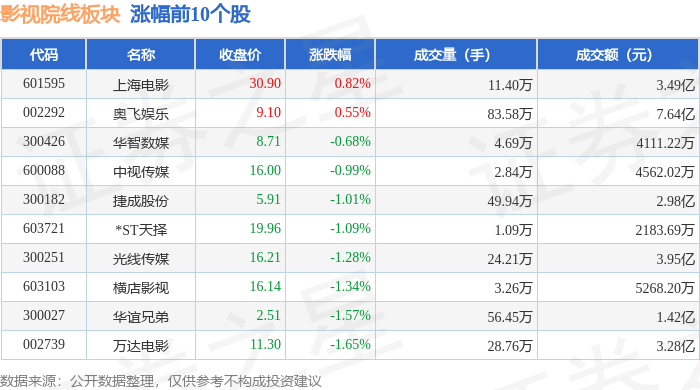
Market Overview - The film and theater sector declined by 1.67% on November 20, with Happiness Blue Sea leading the drop [1] - The Shanghai Composite Index closed at 3931.05, down 0.4%, while the Shenzhen Component Index closed at 12980.82, down 0.76% [1] Stock Performance - Shanghai Film (601595) closed at 30.90, up 0.82% with a trading volume of 114,000 shares and a turnover of 349 million [1] - AoFei Entertainment (002292) closed at 9.10, up 0.55% with a trading volume of 835,800 shares and a turnover of 764 million [1] - Happiness Blue Sea (300528) led the decline, closing at 21.15, down 5.58% with a trading volume of 241,300 shares and a turnover of 519 million [2] - China Film (600977) closed at 16.41, down 2.78% with a trading volume of 480,500 shares and a turnover of 797 million [2] Capital Flow - The film and theater sector experienced a net outflow of 405 million from institutional investors, while retail investors saw a net inflow of 468 million [2] - The data indicates that retail investors are more active in the sector despite the overall decline [2] Individual Stock Capital Flow - AoFei Entertainment had a net inflow of 48.85 million from institutional investors, while retail investors had a net outflow of 88.64 million [3] - Happiness Blue Sea saw a significant net outflow of 14.14 million from institutional investors, indicating weaker institutional interest [3] - Shanghai Film experienced a net outflow of 7.86 million from institutional investors, suggesting a cautious stance among larger investors [3]


打卡北京文化金名片!国家大剧院原创话剧《金中都》走进金中都公园
Bei Jing Qing Nian Bao· 2025-11-20 04:48
Core Viewpoint - The National Grand Theatre's original play "Jin Zhong Du" is set to showcase the historical evolution of Beijing from a northern stronghold to a capital city, with performances scheduled from December 13 to 22 [1] Group 1 - The play "Jin Zhong Du" is part of the National Grand Theatre's "Beijing Capital Trilogy," which will also include "Yuan Da Du" and "Forbidden City" [1] - The historical exhibition at the Jin Zhong Du Park highlights the period from 1153, when Jin Zhong Du was established, to 1215, when it fell [1] - The media preview event featured historical consultant Li Jianping, who provided insights into the play's historical context [1]
影视院线板块11月11日涨0.01%,幸福蓝海领涨,主力资金净流出2.51亿元
Zheng Xing Xing Ye Ri Bao· 2025-11-11 08:46
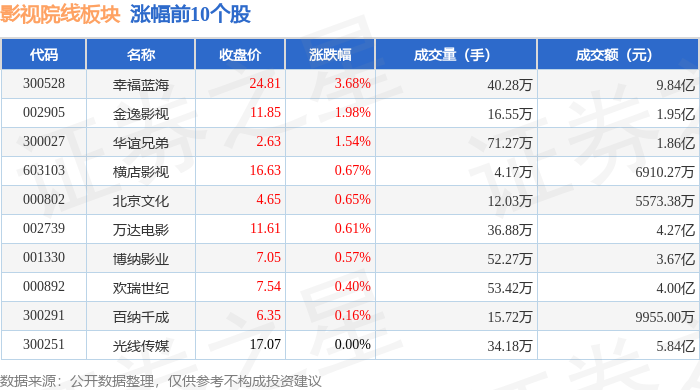
Market Overview - The film and cinema sector saw a slight increase of 0.01% on November 11, with Happiness Blue Sea leading the gains [1] - The Shanghai Composite Index closed at 4002.76, down 0.39%, while the Shenzhen Component Index closed at 13289.0, down 1.03% [1] Stock Performance - Happiness Blue Sea (300528) closed at 24.81, up 3.68% with a trading volume of 402,800 shares and a transaction value of 984 million [1] - Other notable performers included: - Golden Screen (002905) at 11.85, up 1.98% with a transaction value of 195 million [1] - Huayi Brothers (300027) at 2.63, up 1.54% with a transaction value of 186 million [1] - Conversely, several stocks experienced declines, such as: - Jiecheng Co. (300182) at 6.19, down 1.75% with a transaction value of 542 million [2] - Huace Film (300133) at 8.00, down 1.48% with a transaction value of 749 million [2] Capital Flow - The film and cinema sector experienced a net outflow of 251 million from institutional investors, while retail investors saw a net inflow of 224 million [2] - The capital flow for key stocks included: - Happiness Blue Sea with a net outflow of 26.70 million from institutional investors [3] - Light Media (300251) with a net inflow of 11.99 million from institutional investors [3] - China Film (600977) with a net inflow of 5.63 million from institutional investors [3]



电影行业三季报:北京文化“增收不增利” 净亏损3.05亿元 超过本期营收规模 毛利率-80.61%行业垫底
Xin Lang Zheng Quan· 2025-11-06 08:01
Industry Overview - The total box office revenue for films in China reached 41.952 billion yuan in the first three quarters of 2025, representing a year-on-year increase of 21.12%, with total audience attendance at 985 million [1] - Domestic films accounted for 89.21% of the total box office, while imported films made up 10.79% [1] - The National Day holiday box office was 1.835 billion yuan, with 50.07 million attendees, and an average ticket price of 36.64 yuan, down 9.28% year-on-year [1] Company Performance - The combined revenue of four listed companies in the film industry reached 7.010 billion yuan in the first three quarters, a year-on-year increase of 41.43%, with a total net profit of 1.983 billion yuan, up 233.77% [2] - In Q3 alone, these companies generated 1.740 billion yuan in revenue, a 46.96% increase, and a net profit of 171 million yuan, up 327.98% [2] Company-Specific Insights - **Light Media**: Achieved the highest revenue of 3.616 billion yuan in the first three quarters, a 150.81% increase, and a net profit of 2.336 billion yuan, up 406.78% [3] - **China Film**: Reported a revenue of 2.928 billion yuan, a decrease of 2.90%, and a net profit of 66 million yuan, down 69.22% [3] - **Beijing Culture**: Experienced significant growth in revenue to 250 million yuan, up 151.44%, but faced a net loss of 305 million yuan, widening by 865.04% [4] - **Huayi Brothers**: Reported a revenue of 215 million yuan, down 46.08%, and a net loss of 114 million yuan, increasing by 368.15% [5] Film Contributions - China Film produced or participated in 30 films, generating a total box office of 12.251 billion yuan, accounting for 32.79% of the domestic film box office [4] - The film "Nanjing Photo Studio" became the summer box office champion with over 3 billion yuan, while "Volunteer Army: Blood and Peace" topped the National Day box office [4] Profitability Metrics - Light Media led with a gross margin of 73.24%, significantly higher than Huayi Brothers at 29.67% and China Film at 15.98% [5] - Beijing Culture reported a gross margin of -80.61%, indicating a substantial decline [5]

电影行业三季报:光线传媒成最大赢家 营收、净利润分别激增150.81%、406.78% 毛利率73.24%行业登顶
Xin Lang Zheng Quan· 2025-11-06 07:55
Industry Overview - The total box office revenue for the first three quarters of 2025 reached 41.952 billion yuan, representing a year-on-year increase of 21.12%, with total audience attendance at 985 million [1] - Domestic films accounted for 37.359 billion yuan, or 89.21% of the total box office, while imported films contributed 4.52 billion yuan, or 10.79% [1] - The National Day holiday box office was 1.835 billion yuan, with 50.07 million attendees, and an average ticket price of 36.64 yuan, down 9.28% year-on-year [1] Company Performance - The combined revenue of four listed companies in the film industry reached 7.010 billion yuan, a year-on-year increase of 41.43%, with a total net profit of 1.983 billion yuan, up 233.77% [2] - In Q3, the companies generated a revenue of 1.740 billion yuan, up 46.96%, and a net profit of 171 million yuan, up 327.98% [2] Company-Specific Insights - **Light Media**: Achieved the highest revenue of 3.616 billion yuan, a 150.81% increase, and a net profit of 2.336 billion yuan, up 406.78%. In Q3, revenue was 374 million yuan, up 247.54%, and net profit was 106 million yuan, up 993.71% [3] - **China Film**: Experienced a decline in both revenue and net profit, with Q3 revenue at 1.912 billion yuan, a 35.61% increase, but a net profit of 66 million yuan, down 69.22% year-on-year [3][4] - **Beijing Culture**: Reported revenue of 250 million yuan, a significant increase of 151.44%, but a net loss of 305 million yuan, which is 865.04% worse than the previous year [4] - **Huayi Brothers**: Faced the most significant decline, with revenue of 215 million yuan, down 46.08%, and a net loss of 114 million yuan, an increase of 368.15% [5] Market Trends - The top five films during the National Day period included "The Volunteer Army: Blood and Peace" and "731," with the former generating 450 million yuan [1] - Light Media's films contributed significantly to its revenue, with total box office receipts reaching approximately 15.903 billion yuan [3] - Beijing Culture's involvement in major films was limited, affecting its financial performance despite high revenue growth [4]
北京文化产业蓝皮书:“北京模式”领跑全国
Bei Jing Ri Bao Ke Hu Duan· 2025-11-04 13:48
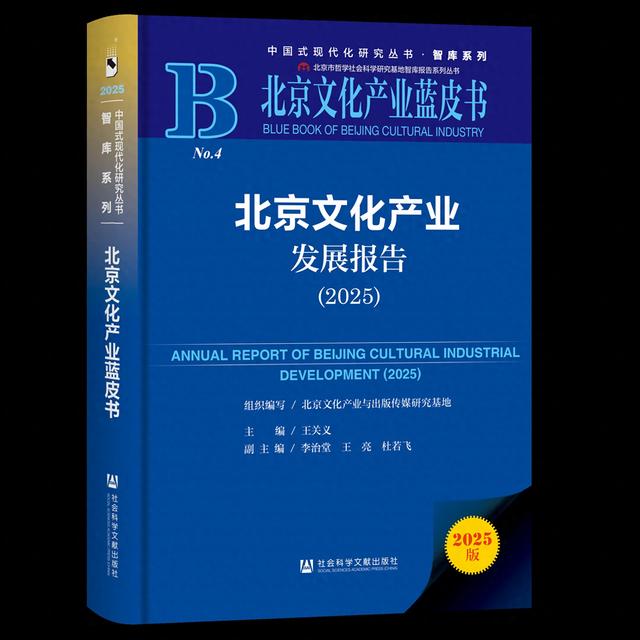
Core Insights - The "Beijing Cultural Industry Blue Book: Beijing Cultural Industry Development Report (2025)" highlights the successful "Beijing model" of cultural and financial integration, which is essential for the city's leadership in the national cultural industry [1] Group 1: Policy and Support Mechanisms - Beijing has actively demonstrated its role as a national cultural center, contributing to the development of the cultural industry through strategies like "Cultural+" and the integration of technology and digital communication [3] - The city has implemented a tiered support system to empower businesses at different stages, including initiatives like "Rent Relief" for small enterprises and the "Investment and Loan Award" program, which attracted debt investments of 38.282 billion and equity investments of nearly 360 million in 2023 [3] - The "Investment and Loan Award" program has effectively guided social capital into the cultural sector, with a financial leverage ratio of 415.51 [3] Group 2: Digital Transformation and Technological Integration - The Blue Book emphasizes the need for Beijing to adopt a development approach that integrates technology with culture, aiming to build a high-end cultural industry system [4] - It advocates for a comprehensive digital transformation of the cultural industry, from content production to consumption, creating a new model of coexistence between "Culture + Technology" [5] - The report suggests constructing a full-chain digital cultural dissemination system, leveraging the IP value of cultural heritage sites and developing immersive digital exhibitions and interactive games [5] Group 3: International Collaboration and Intellectual Property - Beijing is encouraged to enhance international cultural exchange and cooperation through multi-language intelligent translation systems and mainstream media platforms [5] - The Blue Book calls for the establishment of a robust digital cultural intellectual property protection system to support the international expansion of cultural products [5] - The vision is for Beijing to create a high-quality cultural industry landscape with national leadership and global influence, contributing to the creative transformation of traditional culture and the exchange of human civilizations [5]