
Giansun Precision Technology Group(001400)

Search documents
“制造强国”实干系列周报-20260323
Shenwan Hongyuan Securities· 2026-03-23 08:11
Group 1: Space Photovoltaics and Computing - The TERAFAB project aims to establish a chip manufacturing facility with a target annual capacity of 1 terawatt (1TW), with 80% of production dedicated to space missions[9] - The demand for solar power is expected to surge due to the deployment of AI satellites and the need for high-efficiency solar systems in space[10] - The transition of space photovoltaics from auxiliary power units to essential energy infrastructure for space computing is anticipated to drive significant growth in this sector[10] Group 2: 3D Printing Advancements - The 3D printing industry is experiencing growth due to improved equipment efficiency and reduced material costs, particularly in aerospace and consumer electronics[11] - Metal 3D printing is becoming a key technology for intelligent manufacturing, with applications expanding in various fields including AI computing and aerospace[11] - The price of titanium alloy powder for 3D printing has halved from 600 yuan/kg to below 300 yuan/kg, opening new application scenarios[33] Group 3: Home Products and AI Integration - Companies like Gujia Home and Mousse are focusing on smart and functional home products, with Gujia's new product line achieving over 15,000 orders within 24 hours of launch[44] - Mousse is collaborating with Huawei to create a comprehensive sleep solution, integrating AI technology into their product offerings[49] - The home furnishings sector is witnessing a shift towards smart, functional products that address consumer pain points, enhancing market competitiveness[44]




工业级3D打印行业点评:设备提效+材料降本,3D打印应用场景不断拓展
Shenwan Hongyuan Securities· 2026-03-20 08:44
Investment Rating - The report rates the industrial-grade 3D printing industry as "Overweight," indicating a positive outlook for the sector compared to the overall market performance [3][12]. Core Insights - The demand for large-scale, high-stability, and multi-laser collaborative metal additive manufacturing equipment is continuously growing as industrial manufacturing evolves towards larger, integrated, high-precision, and high-efficiency directions [6]. - Significant advancements in beam shaping technology, ultra-fine printing, multi-laser systems, and AI applications are enhancing the efficiency and capabilities of 3D printing [6]. - The cost of titanium alloy powder for 3D printing has halved since 2023, driven by process improvements and reduced sponge titanium costs, opening up new application scenarios for 3D printing [6]. - Key application areas for metal 3D printing include aerospace, consumer electronics, and AI computing, where it addresses the limitations of traditional manufacturing processes [6]. Summary by Sections Market Demand and Technology Advancements - The report highlights the increasing market demand for large, stable, and efficient metal additive manufacturing equipment, with specific advancements in beam shaping technology leading to efficiency improvements of 69%-100% for various materials [6]. - Ultra-fine printing technology achieves a precision of 0.03mm and a density of 99.99%, enabling the production of complex structures [6]. - Multi-laser systems, such as the EP-M3050, can achieve forming speeds of 1500-3500 cm³/h, balancing high efficiency with stability [6]. - AI applications in powder detection enhance defect recognition and reduce re-powdering time, significantly improving operational efficiency [6]. Cost Reduction and Application Expansion - The price of titanium alloy powder for 3D printing has decreased from 600 RMB/kg to below 300 RMB/kg, facilitating broader adoption in various industries [6]. - In aerospace, 3D printing supports the shift towards high-frequency launches and scalable networks, allowing for rapid design iterations and reduced manufacturing cycles [6]. - In consumer electronics, the technology enables lightweight and complex structures, addressing the challenges of traditional manufacturing methods [6]. - In AI computing, 3D printing expands the processing capabilities of copper materials, making complex structures more controllable under high thermal densities [6]. Key Companies and Valuations - Notable companies in the sector include: - Huazhu Gaoke (华曙高科) with a market cap of 350.47 billion and projected net profits increasing from 0.67 billion in 2024 to 1.73 billion in 2026 [7]. - Plittech (铂力特) with a market cap of 257.53 billion and projected net profits rising from 1.04 billion in 2024 to 3.28 billion in 2026 [7]. - Jiangshun Technology (江顺科技) with a market cap of 88 billion and projected net profits increasing from 1.55 billion in 2024 to 1.75 billion in 2026 [7].


江顺科技(001400) - 江苏江顺精密科技集团股份有限公司股票交易异常波动公告
2026-03-10 12:18
1、二级市场风险:江苏江顺精密科技集团股份有限公司(以下简称"公司") 股票价格短期波动较大,和业绩存在偏离,未来存在下跌风险,敬请广大投资者 注意二级市场交易风险,理性决策,审慎投资。 证券代码:001400 证券简称:江顺科技 公告编号:2026-005 江苏江顺精密科技集团股份有限公司 股票交易异常波动公告 本公司及董事会全体成员保证信息披露的内容真实、准确和完整,没有虚 假记载、误导性陈述或重大遗漏。 重要内容提示: 2、目前,公司无国内外数据中心液冷板产品销售,公司也未接触任何海外 客户;目前,公司亦无数据中心液冷铝板产品。敬请广大投资者谨慎决策,注意 投资风险。 3、公司主营业务之一为铝型材挤压模具及配件产品,其下游应用面向铝型 材制造厂商,不直接用于航空航天领域,且间接应用于航空航天产品占比及金 额极小。公司较少部分产品间接应用于航空航天领域,2025 年营业收入为约 630.00 万元,预计对 2025 年营业总收入影响不足 0.70%(前述数据未经审计), 占比极低,对公司经营业绩无重大影响。其中,2025 年间接应用于商业航天板 块产品的营业收入约为 25.00 万元(前述数据未经审计), ...
江顺科技(001400) - 江苏江顺精密科技集团股份有限公司股票交易异常波动公告
2026-03-02 13:32
1、二级市场风险:江苏江顺精密科技集团股份有限公司(以下简称"公司") 股票价格短期波动较大,和业绩存在偏离,未来存在下跌风险,敬请广大投资者 注意二级市场交易风险,理性决策,审慎投资。 2、业绩下滑风险:公司 2025 年前三季度归属于上市公司股东的净利润为 6,545.07 万元,同比下降 40.15%。公司将于 2026 年 4 月 28 日披露《2025 年年 度报告》,目前正在进行 2025 年度审计相关工作,具体财务数据将在《2025 年 年度报告》中详细披露。敬请广大投资者注意业绩下滑风险。 3、公司主营业务之一为铝型材挤压模具及配件产品,其下游应用面向铝型 材制造厂商,不直接用于航空航天领域,且间接应用于航空航天产品占比及金 额极小。公司较少部分产品间接应用于航空航天领域,2025 年营业收入为约 630.00 万元,预计对 2025 年营业总收入影响不足 0.70%(前述数据未经审计), 占比极低,对公司经营业绩无重大影响。其中,2025 年间接应用于商业航天板 块产品的营业收入约为 25.00 万元(前述数据未经审计),占比极低。敬请广大 投资者谨慎决策,注意投资风险。 证券代码:0014 ...
“制造强国”实干系列周报-20260302





Shenwan Hongyuan Securities· 2026-03-02 10:06
Group 1: Gas Turbine Sector - The gas turbine sector is emphasized due to deep penetration into overseas supply chains and the dual logic of domestic aviation reform, which is expected to resonate positively[3] - The North American AIDC demand expansion, coupled with aging power grids, is leading to a structural power supply gap that is continuously increasing[6] - The global gas turbine market is highly concentrated, with GE Vernova, Siemens Energy, and Mitsubishi Heavy Industries collectively holding about 85% market share[32] Group 2: Commercial Aerospace - The commercial aerospace sector is expected to see a new round of catalysts with the successful testing of reusable rocket technology, enhancing the prospects for commercial space ventures[38] - China's G60 satellite constellation plans to launch 1,296 satellites by the end of 2027 and 15,000 by 2030, indicating a significant demand for satellite launches[51] - The application end of the aerospace sector is focusing on core components such as communication terminal basebands, RF chips, and phased array antennas, which are expected to see stable or increasing value under cost reduction trends[55] Group 3: 3D Printing - The industrial-grade 3D printing sector is poised for a breakthrough due to material cost reductions and equipment efficiency improvements, marking a significant turning point for mass adoption[58] - The consumer-grade 3D printing market is accelerating towards a creative era, driven by AI empowerment, ecosystem strengthening, and supply chain cost reductions[68] - In 2025, the export value of 3D printers from China is projected to reach 11.355 billion yuan, reflecting a year-on-year growth of 39.1%[73] Group 4: Tungsten Market - The price of tungsten has surged significantly, with 65% black tungsten concentrate reaching 800,000 yuan per ton, up 73.91% since the beginning of 2026[80] - The increase in tungsten prices is driven by tightened supply and strategic pricing, with China's export controls on tungsten and other strategic metals contributing to this trend[79] - Companies with mining assets or expectations of asset injections, such as Zhongtung High-tech and Xiamen Tungsten, are expected to benefit directly from rising tungsten prices[81]
低空经济板块2月26日涨1.06%,江顺科技领涨,主力资金净流出8亿元
Sou Hu Cai Jing· 2026-02-26 09:15
Core Viewpoint - The low-altitude economy sector experienced a 1.06% increase on February 26, with Jiangshun Technology leading the gains, while the overall market showed mixed results with the Shanghai Composite Index slightly down by 0.01% and the Shenzhen Component Index up by 0.19% [1] Market Performance - On February 26, the Shanghai Composite Index closed at 4146.63, reflecting a decrease of 0.01% [1] - The Shenzhen Component Index closed at 14503.79, showing an increase of 0.19% [1] Capital Flow - The low-altitude economy sector saw a net outflow of 800 million yuan from major funds, while retail investors contributed a net inflow of 810 million yuan [1] - Retail investors experienced a net outflow of 996.74 thousand yuan [1]


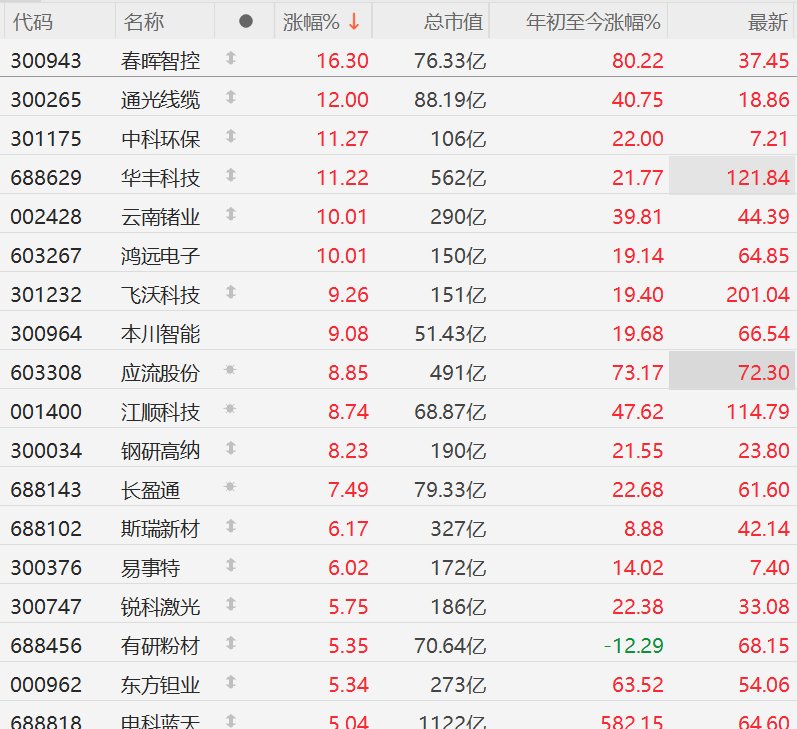
商业航天股集体走强,飞沃科技、本川智能涨超9%
Ge Long Hui· 2026-02-26 03:19
Core Viewpoint - The A-share market saw a significant rise in commercial aerospace stocks, driven by the upcoming launch of the reusable liquid rocket by China Aerospace, which is expected to enhance the commercial launch capabilities and frequency in the industry [1]. Group 1: Stock Performance - SpringHui Intelligent Control surged over 16%, with a total market value of 76.33 billion and a year-to-date increase of 80.22% [2]. - Tongguang Cable increased by 12%, with a market capitalization of 88.19 billion and a year-to-date rise of 40.75% [2]. - Zhongke Environmental Protection rose by 11.27%, with a market value of 106 billion and a year-to-date increase of 22% [2]. - Huafeng Technology saw an 11.22% increase, with a market capitalization of 562 billion and a year-to-date rise of 21.77% [2]. - Hongyuan Electronics and other companies also experienced significant gains, with increases ranging from 6% to 10% [2]. Group 2: Upcoming Launch Plans - China Aerospace's reusable liquid rocket, the Lijian-2, is scheduled for its maiden flight in late March 2023, carrying the initial sample of the Light Boat-1 cargo spacecraft [1]. - The company has planned four launches within the year, focusing on satellite internet networking and major national tasks [1]. - The solid rocket, Lijian-1, is set for at least eight launches this year, including two maritime launches, reinforcing its position in commercial launches [1]. - A proposal for 13 launches in 2026 has been submitted, with aspirations for an additional 1-2 missions, aiming for record-high launch frequency and task density [1].





江顺科技股价涨5.01%,兴证全球基金旗下1只基金位居十大流通股东,持有20.78万股浮盈赚取109.93万元
Xin Lang Ji Jin· 2026-02-26 02:55
Group 1 - Jiangshun Technology experienced a 5.01% increase in stock price, reaching 110.85 CNY per share, with a trading volume of 134 million CNY and a turnover rate of 8.30%, resulting in a total market capitalization of 6.651 billion CNY [1] - Jiangshun Technology, established on October 19, 2001, is located in Jiangyin City, Jiangsu Province, and specializes in the research, design, production, and sales of aluminum profile extrusion molds and accessories, supporting equipment, and precision mechanical components [1] - The main revenue composition of Jiangshun Technology includes: aluminum profile extrusion molds and accessories (41.78%), supporting equipment (37.87%), precision mechanical components (15.03%), and other businesses (5.31%) [1] Group 2 - Xingsheng Global Fund has a position among the top ten circulating shareholders of Jiangshun Technology, with its fund, Xinquan Heyuan Two-Year Holding Mixed A (011338), newly entering the top ten in the third quarter, holding 207,800 shares, which accounts for 1.39% of circulating shares [2] - The Xinquan Heyuan Two-Year Holding Mixed A fund was established on April 27, 2021, with a latest scale of 1.724 billion CNY, achieving a year-to-date return of 4.74% and a one-year return of 28.82% [2] - The fund manager of Xinquan Heyuan Two-Year Holding Mixed A is Wu Zhaohua, who has been in the position for 1 year and 324 days, with the fund's total asset scale at 1.796 billion CNY, achieving a best return of 63.13% and a worst return of 61.32% during his tenure [3]
江顺科技股价跌5.02%,兴证全球基金旗下1只基金位居十大流通股东,持有20.78万股浮亏损失113.46万元
Xin Lang Cai Jing· 2026-02-12 02:50
Group 1 - Jiangshun Technology experienced a decline of 5.02% on February 12, with a stock price of 103.40 yuan per share, a trading volume of 139 million yuan, a turnover rate of 8.83%, and a total market capitalization of 6.204 billion yuan [1] - Jiangshun Technology, established on October 19, 2001, is located in Jiangyin City, Jiangsu Province, and specializes in the research, design, production, and sales of aluminum profile extrusion molds and accessories, supporting equipment, and precision mechanical components [1] - The main business revenue composition includes: aluminum profile extrusion molds and accessories at 41.78%, supporting equipment at 37.87%, precision mechanical components at 15.03%, and other businesses at 5.31% [1] Group 2 - Xingsheng Global Fund has a position in Jiangshun Technology's top circulating shareholders, with the Xinqian Heyuan Two-Year Holding Mixed A Fund (011338) newly entering the top ten circulating shareholders in the third quarter, holding 207,800 shares, accounting for 1.39% of circulating shares [2] - The Xinqian Heyuan Two-Year Holding Mixed A Fund was established on April 27, 2021, with a latest scale of 1.724 billion yuan, and has a year-to-date return of 4.3%, ranking 4929 out of 8882 in its category; over the past year, it has achieved a return of 35.91%, ranking 2958 out of 8127 [2] Group 3 - The fund manager of Xinqian Heyuan Two-Year Holding Mixed A Fund is Wu Zhaohua, who has been in the position for 1 year and 310 days, managing a total fund asset scale of 1.796 billion yuan, with the best fund return during his tenure at 64.85% and the worst at 63.03% [3]
商业航天行业系列六:3D打印:柔性制造的引擎,重塑火箭价值链
GF SECURITIES· 2026-02-11 03:50
Investment Rating - The industry investment rating is "Buy" [2] Core Insights - 3D printing is highly compatible with commercial aerospace manufacturing, providing advantages in performance, cost, and time [6][15] - The main 3D printing technologies in aerospace are Powder Bed Fusion (PBF) and Directed Energy Deposition (DED), with a focus on metal materials [6][26] - There is significant growth potential in the 3D printing market for rockets, with an estimated market size of 79.7 billion yuan by 2030 under an 80% penetration rate [6][30] - Investment recommendations include Jiangshun Technology, Huazhu High-Tech, and Nanfeng Co., with specific advantages highlighted for each [6][7] Summary by Sections 1. 3D Printing as a Necessary Process in Rocket Manufacturing - 3D printing, or additive manufacturing, allows for the direct formation of complex components, overcoming traditional manufacturing limitations [15][21] - It significantly reduces delivery cycles and costs, with potential reductions of up to 72% in manufacturing time and 60% in costs for rocket engine components [21][22] 2. Complementary Roles of SLM and DED - SLM (Selective Laser Melting) is suited for high-precision, small components, while DED excels in large-scale parts and repairs [37][49] - Both technologies can utilize high-performance aerospace materials, fulfilling the industry's stringent requirements [37][56] 3. Growth Potential in Commercial Aerospace - The penetration of 3D printing in China's commercial aerospace sector is currently low, indicating substantial room for growth [6][30] - The demand for low-orbit satellite networks is expected to drive rapid growth in rocket launch capacity [6][30] 4. Investment Recommendations - Jiangshun Technology is positioned as a leader in industrial-grade 3D printing equipment, benefiting from the aerospace sector's growth [6][7] - Huazhu High-Tech has a strong presence in aerospace applications, while Nanfeng Co. is expanding into additive manufacturing [6][7]