SEPTWOLVES(002029)

Search documents
七 匹 狼(002029) - 七匹狼关于股票交易异常波动的公告
2025-09-25 09:48
证券代码:002029 证券简称:七匹狼 公告编号:2025-065 福建七匹狼实业股份有限公司 关于股票交易异常波动的公告 本公司及董事会全体成员保证信息披露内容真实、准确和完整,不存在虚假记载、误导性陈述或者 重大遗漏。 一、股票交易异常波动情况 福建七匹狼实业股份有限公司(以下简称"公司")股票(证券简称:七匹狼,证券 代码:002029)交易价格于2025年9月23日、2025年9月24日、2025年9月25日连续三个交易 日收盘价格涨幅偏离值累计达到23.91%,根据深圳证券交易所的有关规定,属于股票交易 异常波动的情况。 二、对重点问题的关注、核实情况说明 公司董事会对公司自身情况进行了核查并对公司控股股东及实际控制人就公司股票发 生异动的情况进行了核实,具体情况如下: 1、公司前期所披露的信息,不存在需要更正、补充之处。 2、公司未发现近期公共传媒报道了可能或已经对公司股票交易价格产生较大影响的未 公开重大信息。 3、公司已披露的经营情况、内外部经营环境未发生重大变化,内部生产经营活动正常 运行。 4、公司、控股股东和实际控制人不存在关于公司的应披露而未披露的重大事项,或处 于筹划阶段的重大事项 ...

七匹狼:公司将按照证监会及深交所的规定进行信息披露
Zheng Quan Ri Bao· 2025-09-25 09:45
证券日报网讯七匹狼9月25日在互动平台回答投资者提问时表示,公司将按照证监会及深交所的规定进 行信息披露,公司投资收益请以届时发布的相关公告数据为准,敬请投资者注意投资风险。 (文章来源:证券日报) ...

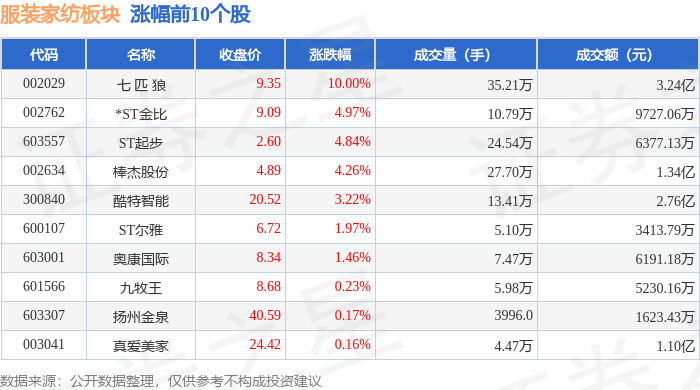
服装家纺板块9月25日跌1.12%,泰慕士领跌,主力资金净流出4.02亿元
Zheng Xing Xing Ye Ri Bao· 2025-09-25 08:37
Market Overview - The apparel and home textile sector declined by 1.12% on September 25, with Taimushi leading the drop [1] - The Shanghai Composite Index closed at 3853.3, down 0.01%, while the Shenzhen Component Index closed at 13445.9, up 0.67% [1] Stock Performance - Notable gainers included: - Qipilong (002029) with a closing price of 9.35, up 10.00% and a trading volume of 352,100 shares, totaling 324 million yuan [1] - ST Jinbi (002762) closed at 9.09, up 4.97% with a trading volume of 107,900 shares, totaling 97.27 million yuan [1] - ST Qibu (603557) closed at 2.60, up 4.84% with a trading volume of 245,400 shares, totaling 6.38 million yuan [1] - Major decliners included: - Taijing (001234) with a closing price of 32.20, down 10.01% and a trading volume of 47,000 shares, totaling 152 million yuan [2] - Hongdou (600400) closed at 3.61, down 5.74% with a trading volume of 3,849,700 shares, totaling 139.8 million yuan [2] - Tanluo (300005) closed at 8.70, down 4.81% with a trading volume of 511,700 shares, totaling 45.5 million yuan [2] Capital Flow - The apparel and home textile sector experienced a net outflow of 402 million yuan from institutional investors, while retail investors saw a net inflow of 373 million yuan [2] - The sector's overall capital flow indicates a mixed sentiment, with institutional investors pulling back while retail investors increased their positions [2] Individual Stock Capital Flow - Notable net inflows from institutional investors included: - Wanlima (300591) with a net inflow of 19.84 million yuan, representing 3.74% of total capital [3] - Zhiyaomeijia (003041) with a net inflow of 15.00 million yuan, representing 13.59% of total capital [3] - Kute Intelligent (300840) with a net inflow of 14.64 million yuan, representing 5.30% of total capital [3] - Conversely, significant net outflows from retail investors were observed in: - Zhiyaomeijia (003041) with a net outflow of 9.21 million yuan, representing -8.34% of total capital [3] - Kute Intelligent (300840) with a net outflow of 1.07 million yuan, representing -0.39% of total capital [3]



两连板后,七匹狼紧急澄清:未投资摩尔线程和宇树科技
2 1 Shi Ji Jing Ji Bao Dao· 2025-09-25 08:14
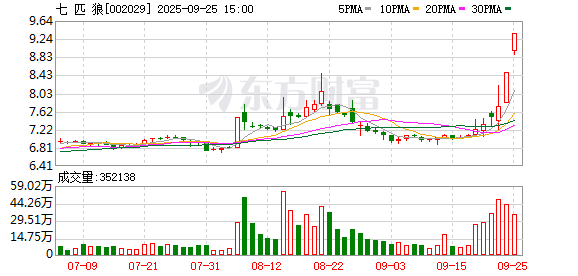
Core Viewpoint - The stock of Qipilang (七匹狼) has experienced a significant surge, reaching a limit-up on September 25, with a closing price of 9.35 yuan per share and a total market capitalization of 6.59 billion yuan, marking two consecutive days of limit-up trading [2] Group 1: Company Performance - Qipilang reported a revenue of 1.375 billion yuan for the first half of 2025, representing a year-on-year decline of 5.93% [3] - The company's net profit attributable to shareholders was 160 million yuan, down 13.93% year-on-year, with securities investment income contributing approximately 126 million yuan, while the clothing business generated only about 30 million yuan [3] Group 2: Investment Activities - Qipilang clarified that it has not directly invested in Moer Thread and Yushu Technology, but its parent company holds stakes in these companies through financial investments, which are not directly related to Qipilang's main business [2] - The parent company, Fujian Qipilang Group, has subsidiaries that participated in investments in Moer Thread and Yushu Technology, indicating a focus on financial investments rather than core business operations [2][3]
9月25日涨停分析
Xin Lang Cai Jing· 2025-09-25 07:37
Core Insights - A total of 41 stocks reached the daily limit up, with 10 stocks achieving consecutive limit ups, indicating strong market performance [1] - The overall limit-up rate for stocks, excluding ST and delisted stocks, was 68% [1] Company Highlights - Huasoft Technology achieved a limit up for the fifth consecutive day, showcasing significant investor interest [1] - Lianmei Holdings, a stock related to the Moer Thread concept, reached a limit up for four consecutive days, indicating strong momentum [1] - Seven Wolves, another notable stock, achieved a limit up for two consecutive days, reflecting positive market sentiment [1] - Lianwei Microelectronics, part of the silicon wafer sector, reached a limit up for three consecutive days, highlighting growth in this industry [1] - TCL Zhonghuan, also in the silicon wafer sector, achieved a limit up for two consecutive days, further emphasizing the sector's strength [1] - Weiyuan New Materials, associated with the intelligent robot concept, reached a 20% limit up for two consecutive days, indicating robust demand in this niche market [1]


七匹狼(002029.SZ):未投资沐曦股份
Ge Long Hui· 2025-09-25 07:17
Core Viewpoint - The company Qipilang (002029.SZ) clarified on the investor interaction platform that it has not invested in Muxi Co., Ltd [1] Company Summary - Qipilang has confirmed that there is no investment in Muxi Co., Ltd, addressing potential investor concerns [1]
七匹狼:未投资沐曦股份
Ge Long Hui· 2025-09-25 07:17
Core Viewpoint - The company Qipilang (002029.SZ) clarified on the investor interaction platform that it has not invested in Muxi Co., Ltd [1] Company Summary - Qipilang confirmed its non-investment in Muxi Co., Ltd, indicating a clear stance on its investment activities [1]
七匹狼(002029.SZ)未投资摩尔线程和宇树科技
Ge Long Hui A P P· 2025-09-25 06:40
Core Viewpoint - The company, Seven Wolves (002029.SZ), clarified that it has not invested in Moer Thread and Yushu Technology, despite its parent company holding partial equity in these firms. This investment is categorized as a financial investment by the controlling shareholder and does not directly relate to the company's main business operations, thus not impacting its operational performance [1]. Group 1 - The company confirmed it has no direct investments in Moer Thread and Yushu Technology [1] - The parent company holds indirect equity in Moer Thread and Yushu Technology [1] - The investments by the parent company are classified as financial investments and are not linked to the company's core business [1]
七匹狼:公司母公司间接持有摩尔线程和宇树科技的部分股权
Zheng Quan Shi Bao Wang· 2025-09-25 04:25
人民财讯9月25日电,七匹狼(002029)9月25日在互动平台表示,公司未投资摩尔线程和宇树科技。经 查询企查查,公司母公司间接持有摩尔线程和宇树科技的部分股权。公司母公司的投资属于控股股东层 面的财务投资行为,与公司主营业务无直接关联,不会对公司经营业绩造成影响。 ...
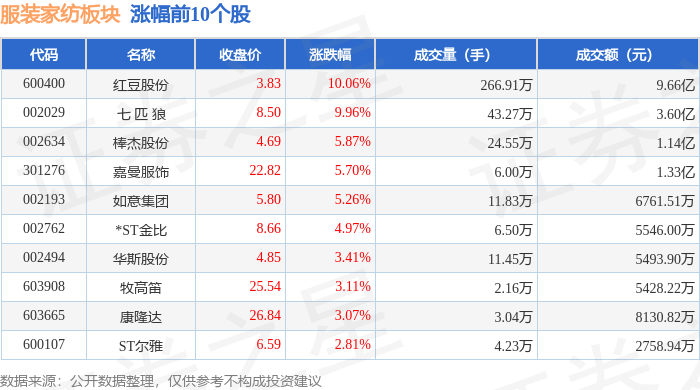
服装家纺板块9月24日跌0.1%,泰慕士领跌,主力资金净流出1.21亿元
Zheng Xing Xing Ye Ri Bao· 2025-09-24 08:39
Market Overview - The apparel and home textile sector experienced a slight decline of 0.1% on September 24, with Taimushi leading the drop [1] - The Shanghai Composite Index closed at 3853.64, up 0.83%, while the Shenzhen Component Index closed at 13356.14, up 1.8% [1] Top Gainers in the Sector - Hongdou Co., Ltd. (600400) saw a significant increase of 10.06%, closing at 3.83, with a trading volume of 2.6691 million shares and a turnover of 966 million yuan [1] - Qipilang (002029) rose by 9.96%, closing at 8.50, with a trading volume of 432,700 shares and a turnover of 360 million yuan [1] - Bangjie Co., Ltd. (002634) increased by 5.87%, closing at 4.69, with a trading volume of 245,500 shares and a turnover of 114 million yuan [1] Top Losers in the Sector - Taizunshi (001234) experienced a significant decline of 9.99%, closing at 35.78, with a trading volume of 234,800 shares and a turnover of 894 million yuan [2] - Baoxiniang (002154) fell by 5.45%, closing at 4.34, with a trading volume of 1.6605 million shares and a turnover of 739 million yuan [2] - Wanlima (300591) decreased by 4.96%, closing at 10.93, with a trading volume of 650,700 shares and a turnover of 716 million yuan [2] Capital Flow Analysis - The apparel and home textile sector saw a net outflow of 121 million yuan from institutional investors and 156 million yuan from speculative funds, while retail investors contributed a net inflow of 277 million yuan [2] - Hongdou Co., Ltd. (600400) had a net inflow of 41.54 million yuan from institutional investors, but a net outflow of 197 million yuan from speculative funds [3] - Qipilang (002029) recorded a net inflow of 82.1772 million yuan from institutional investors, with a net outflow of 49.6436 million yuan from speculative funds [3]