
SEPTWOLVES(002029)

Search documents
七匹狼涨2.01%,成交额2.05亿元,主力资金净流入2.49万元
Xin Lang Zheng Quan· 2025-09-30 02:37
Group 1 - The core viewpoint of the news is the performance and financial status of Fujian Seven Wolves Industrial Co., Ltd., highlighting its stock price movements and trading activities [1][2] - As of September 30, the stock price of Seven Wolves increased by 2.01%, reaching 8.13 yuan per share, with a total market capitalization of 5.732 billion yuan [1] - Year-to-date, Seven Wolves' stock price has risen by 26.16%, with notable increases of 5.17% in the last five trading days and 14.83% in the last 20 days [1] Group 2 - Seven Wolves' main business includes the design, manufacturing, and sales of men's casual clothing, with revenue composition as follows: 26.07% from other categories, 22.64% from T-shirts, 17.72% from outerwear, and 17.35% from pants [2] - As of June 30, the number of shareholders for Seven Wolves was 27,800, a decrease of 5.09% from the previous period, while the average circulating shares per person increased by 5.37% to 23,951 shares [2] - For the first half of 2025, Seven Wolves reported operating revenue of 1.375 billion yuan, a year-on-year decrease of 5.93%, and a net profit attributable to shareholders of 160 million yuan, down 13.93% year-on-year [2]

新股发行及今日交易提示-20250929




HWABAO SECURITIES· 2025-09-29 09:57
New Stock Issuance - New stock issuance for Daoshengtianhe (Code: 780026) priced at 5.98 RMB on September 29, 2025[1] - Offer period for the acquisition of Shangwei New Materials (Code: 688585) is from September 29, 2025, to October 28, 2025[1] Delisting and Trading Alerts - Zitian Tui (Code: 300280) is in the delisting preparation period with 4 trading days remaining until the last trading day[1] - Significant abnormal fluctuations reported for Kaipu Cloud (Code: 688228) on September 25, 2025[1] Recent Announcements - Multiple companies including Zhonghuan Hailu (Code: 301040) and Shenhuafa A (Code: 000020) have recent announcements regarding their stock activities[1] - A total of 30 companies have made announcements regarding stock fluctuations and trading activities in the past week[1]
7大福建服饰巨头集体开挂,上半年业绩狂飙
3 6 Ke· 2025-09-27 04:24
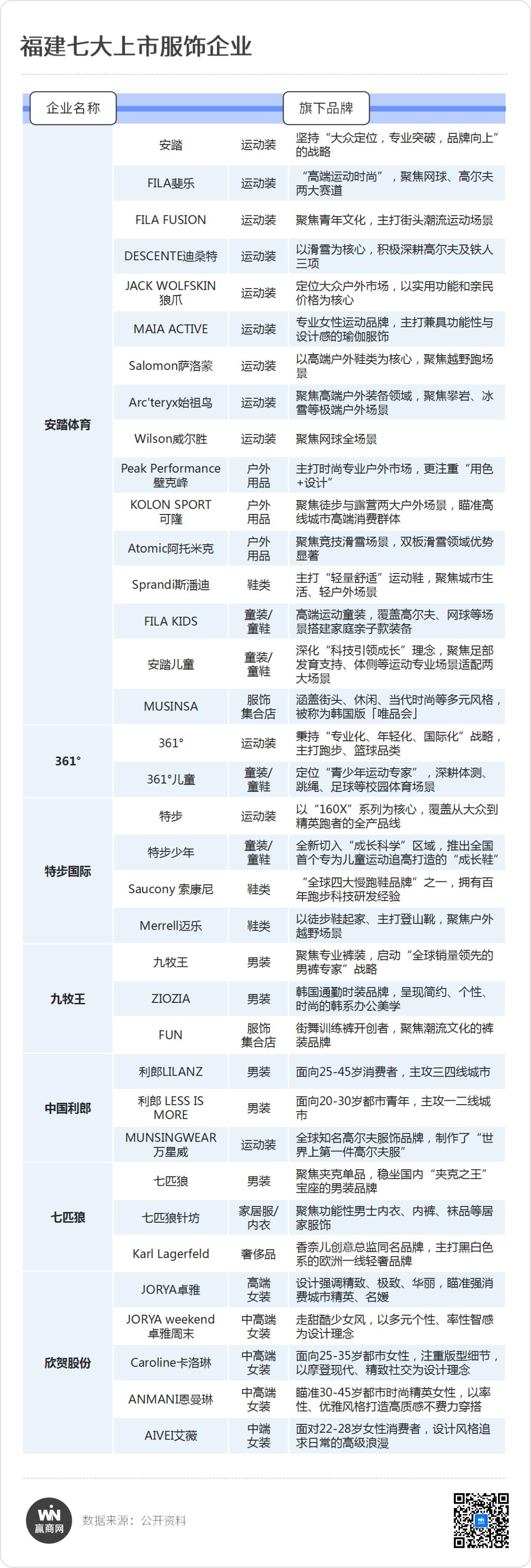
Core Insights - Fujian has become a significant base for the garment industry, leveraging its geographical advantages and the influx of overseas orders and capital from local expatriates [2][4] - The seven major listed apparel companies from Fujian have rapidly transformed from local brands to national brands, achieving explosive growth in recognition and market presence [2][4] - The apparel industry in Fujian is characterized by a strong focus on both sportswear and traditional menswear, with distinct development trajectories for different brands [3][4] Group 1: Performance of Major Brands - Anta Group has entered the "trillion club" with record-breaking performance, achieving continuous growth for 12 years and surpassing both Nike China and Adidas China in revenue [10][12] - Xtep International has focused on the running segment, achieving significant profit growth by divesting from underperforming fashion segments and enhancing its product offerings [15][16] - 361° has seen a nearly 50% increase in stock price, driven by strong performance in both international and children's markets, with a focus on high-quality and cost-effective products [16][17] Group 2: Market Strategies and Innovations - Anta Group's strategy includes acquiring brands to fill market gaps and expanding its retail presence, with a notable focus on high-end outdoor and fashion segments [12][14] - Xtep has transformed its stores into "running social centers" and launched a new line of children's shoes aimed at supporting growth, enhancing its market position [15][16] - 361° has expanded its international footprint and optimized its store formats, launching a new type of store that aims for high sales volumes [18] Group 3: Specialized Product Lines - Jiumuwang has established itself as a leading men's pants expert, achieving a 248.54% increase in net profit by focusing on a diverse range of men's pants products [20][21] - Lilang has maintained a high gross margin above 50% while expanding its direct-to-consumer (DTC) model and enhancing its online sales channels [24][25] - Seven Wolves has positioned itself as a "jacket expert," achieving significant revenue growth through innovative product offerings and strategic brand partnerships [28][29] Group 4: Trends and Future Directions - The apparel industry in Fujian is witnessing a trend towards DTC models, multi-brand collaboration, and international expansion, with a focus on functional and scenario-based product offerings [33] - Companies are encouraged to either build a comprehensive brand portfolio like Anta or specialize in niche markets like Xtep and Jiumuwang to maximize their strengths [33]



卖服装的“七匹狼”们,正在变成金融公司?
Sou Hu Cai Jing· 2025-09-27 03:24
Core Viewpoint - The public relations crisis surrounding the "noodle incident" has unexpectedly brought the company Seven Wolves back into the spotlight, highlighting the disparity between its declining core business and its financial market operations, which have become a significant profit driver [2][5]. Financial Performance - In 2024, Seven Wolves reported a net profit attributable to shareholders of 284.55 million yuan, a year-on-year increase of 5.35%, despite a decline in its main business [4]. - The company's revenue for 2024 was 3.14 billion yuan, down 8.84% from the previous year, indicating a challenging market environment [8]. - The net profit after deducting non-recurring gains and losses fell sharply by 60.86%, from 188 million yuan in 2023 to 73.47 million yuan in 2024 [8]. Business Environment - The men's clothing sector is experiencing intense competition and slow growth, with the overall industry showing only a 0.3% year-on-year increase in 2024 [3]. - The company’s main business is facing significant challenges, with a 5.93% decline in revenue in the first half of 2025 compared to the previous year [5]. Investment Strategy - A substantial 74% of the net profit is derived from non-core business activities, primarily from financial investments, including 236 million yuan from fair value changes of financial assets and nearly 45 million yuan from investment products [5]. - The investment portfolio includes significant holdings in major stocks such as Tencent, Kweichow Moutai, and China Ping An, indicating a shift from traditional business operations to reliance on financial markets for profit [7]. Market Positioning - The company is struggling to adapt to changing consumer preferences, particularly among the younger generation, who favor personalized and trendy brands, leading to a perception of brand aging [8]. - Despite efforts to rejuvenate the brand through social media marketing, the effectiveness of these strategies has been limited, as evidenced by declining sales and high return rates in online sales [8]. Broader Industry Trends - The trend of "financialization" in the apparel industry is not unique to Seven Wolves, as many traditional clothing companies are increasingly turning to financial markets for higher returns amid stagnant core business growth [10][11]. - Companies like Youngor have shifted their focus from apparel to investment, indicating a broader industry trend where investment activities overshadow core business operations [11]. Strategic Recommendations - For Seven Wolves, leveraging investment gains to support core business transformation could be a viable strategy, such as acquiring promising designer brands or investing in supply chain technologies [14]. - The company needs to clarify its identity and focus on enhancing its core business rather than becoming overly reliant on financial investments, which could lead to a loss of competitive edge [16].
七匹狼龙虎榜:营业部净卖出9320.49万元
Zheng Quan Shi Bao Wang· 2025-09-26 13:22
Core Viewpoint - The stock of Qipilang (七匹狼) experienced a significant decline, hitting the daily limit down with a trading volume of 1.035 billion yuan and a fluctuation of 18.76% on the trading day [2] Trading Activity - The stock had a turnover rate of 17.24% and a net selling amount of 93.2049 million yuan from brokerage seats [2] - The top five brokerage seats accounted for a total transaction of 206 million yuan, with a buying amount of 56.6185 million yuan and a selling amount of 150 million yuan, resulting in a net selling of 93.2049 million yuan [2] - The largest buying brokerage was Dongfang Caifu Securities, with a purchase amount of 10.2521 million yuan, while the largest selling brokerage was Kaiyuan Securities, with a selling amount of 41.5635 million yuan [2][3] Capital Flow - The stock saw a net outflow of 170 million yuan in main funds, with a significant outflow of 98.1577 million yuan from large orders and 71.6384 million yuan from big orders [2] - Over the past five days, the main funds experienced a net outflow of 104 million yuan [2] Margin Trading Data - As of September 25, the margin trading balance for the stock was 24.7 million yuan, with a financing balance of 24.7 million yuan and a securities lending balance of 935 yuan [3] - In the last five days, the financing balance decreased by 67.5775 million yuan, representing a decline of 21.49%, while the securities lending balance increased by 212 yuan, showing a growth of 29.32% [3]
服装家纺板块9月26日跌0.89%,泰慕士领跌,主力资金净流出3.86亿元
Zheng Xing Xing Ye Ri Bao· 2025-09-26 08:42
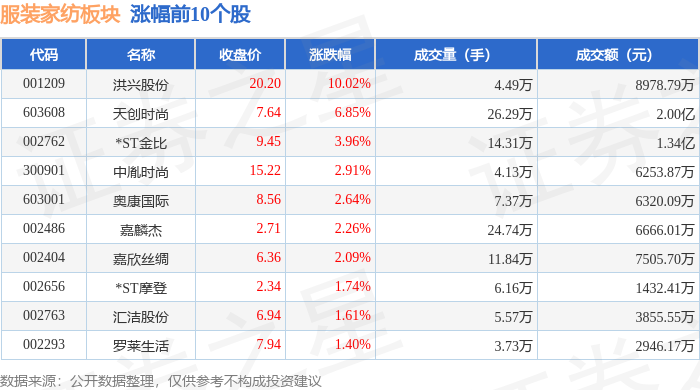
Market Overview - The apparel and home textile sector declined by 0.89% on September 26, with Taimushi leading the drop [1] - The Shanghai Composite Index closed at 3828.11, down 0.65%, while the Shenzhen Component Index closed at 13209.0, down 1.76% [1] Stock Performance - Notable gainers included: - Jinxing Co. (001209) with a closing price of 20.20, up 10.02% on a trading volume of 44,900 shares and a turnover of 89.79 million yuan [1] - Tianchuang Fashion (603608) closed at 7.64, up 6.85% with a trading volume of 262,900 shares and a turnover of 200 million yuan [1] - Significant losers included: - Taijing (001234) with a closing price of 28.98, down 10.00% on a trading volume of 150,300 shares and a turnover of 441 million yuan [2] - Hongdou Co. (600400) closed at 3.25, down 9.97% with a trading volume of 1,818,600 shares and a turnover of 597 million yuan [2] Capital Flow - The apparel and home textile sector experienced a net outflow of 386 million yuan from institutional investors, while retail investors saw a net inflow of 412 million yuan [2] - The capital flow for specific stocks showed: - Hongxing Co. (001209) had a net inflow of 43.66 million yuan from institutional investors, while retail investors had a net outflow of 19.37 million yuan [3] - Tianchuang Fashion (603608) saw a net inflow of 33.84 million yuan from institutional investors, with retail investors experiencing a net outflow of 2.26 million yuan [3]


股价两连板!七匹狼回应:未投资摩尔线程和宇树科技
Xin Lang Cai Jing· 2025-09-25 12:20
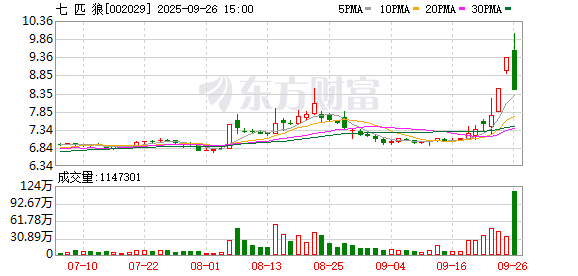
Core Viewpoint - Qipai Wolf (002029.SZ) has experienced a consecutive two-day limit-up in stock price, reaching 9.35 CNY per share, amid clarifications regarding its indirect investments in Moer Thread and Yushu Technology [1] Group 1: Company Investments - Qipai Wolf clarified that it has not directly invested in Moer Thread and Yushu Technology, but its parent company holds partial equity in these firms [1] - The investments made by Qipai Wolf's parent company are classified as financial investments at the controlling shareholder level and are not directly related to the company's main business operations [1] Group 2: Financial Performance - In the 2025 semi-annual report, Qipai Wolf reported a revenue of 1.375 billion CNY, a year-on-year decrease of 5.93%, and a net profit attributable to shareholders of 160 million CNY, down 13.93% [2] - The net profit, excluding non-recurring gains and losses, significantly dropped by 61.35% to 29.1 million CNY [2] - The company generated a fair value change gain of 97.4 million CNY from financial products and stock investments, along with government subsidies of 26.66 million CNY, contributing a total profit of 131 million CNY [2] - Operating cash flow turned negative with a net outflow of 22.59 million CNY during the reporting period [2] Group 3: Business Focus - Qipai Wolf continues to focus on its main business of designing, producing, and selling "Qipai Wolf" brand men's clothing and textile products, maintaining a business model that combines direct sales and franchising [2] - The company employs an omnichannel sales strategy, integrating both online and offline platforms [2]
七匹狼:关于股票交易异常波动的公告
Zheng Quan Ri Bao Zhi Sheng· 2025-09-25 12:11
Core Viewpoint - The company, Seven Wolves, announced that its stock price experienced an abnormal fluctuation, with a cumulative increase of 23.91% over three consecutive trading days from September 23 to September 25, 2025 [1] Summary by Relevant Sections - Stock Price Movement - The stock price of Seven Wolves showed a cumulative increase of 23.91% over three trading days, indicating significant volatility in trading activity [1] - Company Disclosure - The company confirmed that there are no corrections or supplements needed for previously disclosed information, and no undisclosed significant information has been found that could impact stock trading [1] - Operational Status - Seven Wolves stated that its internal production and operational activities are running normally, and there have been no significant changes in the disclosed operational situation or external business environment [1]
七匹狼:股票交易异常波动
2 1 Shi Ji Jing Ji Bao Dao· 2025-09-25 10:12
Core Points - The stock price of Qipilong has experienced a cumulative increase of 23.91% over three consecutive trading days from September 23 to September 25, 2025, indicating abnormal trading fluctuations [1][2] - The company has confirmed that there are no undisclosed significant matters that could have impacted the stock price, and previous disclosures were accurate [1][2] - The company's operational status remains stable, and there have been no stock trading activities by the controlling shareholder or actual controller [1][2] Summary by Categories - **Stock Performance** - Qipilong's stock price has shown a cumulative increase of 23.91% over three trading days [1][2] - **Disclosure and Compliance** - The company has verified that prior information disclosures are correct and found no undisclosed significant information affecting stock prices [1][2] - **Operational Status** - The company's business operations are stable, with no trading activities reported by the controlling shareholder or actual controller [1][2]
七匹狼:经营情况和内外部环境未变,不存在应披露未披露重大事项
Xin Lang Cai Jing· 2025-09-25 09:52
Core Viewpoint - The stock price of Seven Wolves (stock code: 002029) experienced an abnormal fluctuation, with a cumulative increase of 23.91% over three consecutive trading days from September 23 to 25, 2025 [1] Company Situation - The company's board of directors conducted an internal review and inquired with the controlling shareholder and actual controller, confirming that there was no need to correct or supplement previously disclosed information [1] - No significant undisclosed information was found in media reports, and the company's operational situation and external environment remained unchanged [1] - There were no stock trading activities by the controlling shareholder and actual controller during this period, and no violations of fair information disclosure were identified [1] Investor Advisory - The company reminded investors that the designated information disclosure media are "China Securities Journal" and others, and all information should be based on announcements from these media [1] - Investors are advised to pay attention to investment risks [1]