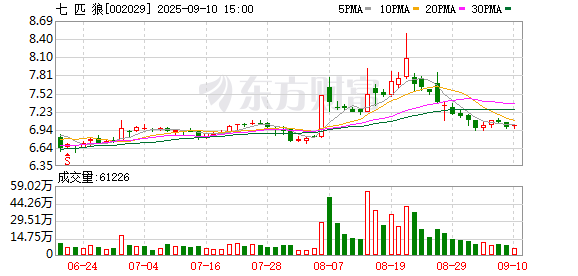
SEPTWOLVES(002029)

Search documents
四次上市失败,与安踏、七匹狼联姻攒出“亲家资本天团”:八马茶业的“另类”资本路
Sou Hu Cai Jing· 2025-09-23 10:34
Core Viewpoint - Baima Tea Industry has faced multiple failures in its attempts to go public, yet it has successfully leveraged strategic marriages to build a powerful network of connections in the business world [1] Group 1: Company Overview - Baima Tea Industry has made five attempts to list on the capital market, with previous attempts in 2013, 2015, 2019, and 2023 all resulting in failure [1] - The company operates 3,585 stores nationwide and reported over 200 million in profit last year, with a gross margin of 55% [1] Group 2: Strategic Marriages - The company's owner, Wang Wenbin, has strategically married off his children to heirs of wealthy families, including the daughter marrying into Anta Sports and the son marrying into the family of Seven Wolves [1] - These marriages have created a network of connections, with Seven Wolves directly holding 3% of Baima Tea through its investment arm [1] - The trend of inter-family marriages among wealthy families has been likened to a "relay race," further solidifying Baima Tea's position in the luxury market [1]

A股热浪催生“股神”公司:主业边缘化,炒股成新赛道
3 6 Ke· 2025-09-22 11:06
Core Viewpoint - The recent surge in A-share market has attracted numerous investors, with listed companies increasingly engaging in securities investments, utilizing significant idle funds to capitalize on market opportunities [1][2]. Group 1: Company Investments - At least 8 companies have invested over 1 billion yuan in securities or fund management activities this year, with Liou Co. leading at 3 billion yuan, followed by Fangda Carbon and Seven Wolves at 2.4 billion yuan and 2 billion yuan respectively [1]. - Seven Wolves reported a net profit of 160 million yuan in the first half of 2025, with 130 million yuan derived from stock investments, despite its main apparel business generating only 30 million yuan [2]. - Liou Co. achieved a net profit of 478 million yuan in the first half of 2025, largely due to gains from its investment in Li Auto, which increased its market value significantly since its initial investment of 350 million yuan in 2016 [3]. Group 2: Market Performance - As of September 10, the Shanghai Composite Index, Shenzhen Component Index, and ChiNext Index have risen by 11.33%, 21.00%, and 36.71% respectively, with the Shanghai Composite Index surpassing the significant 3,800-point mark [1]. - Jin Feng Investment, a subsidiary of Jin Feng Technology, has been actively reducing its holdings in the rapidly appreciating stock of Shangwei New Materials, with estimated cash proceeds exceeding 100 million yuan from recent sales [4]. Group 3: Financial Strategies - Companies like Jiangsu Guotai have announced plans to utilize idle funds for financial management and securities investments, with a total planned investment of 12 billion yuan, although they faced criticism from investors leading to a cancellation of part of the plan [6][7]. - Jilin Aodong reported a net profit of 1.28 billion yuan in the first half of 2025, significantly exceeding its revenue of 1.13 billion yuan, primarily due to substantial financial asset investments [5]. - Companies are increasingly using idle funds for securities investments as a strategy to supplement their financial performance when core business growth is stagnant, reflecting a common practice in the current market environment [14].





服装家纺板块9月18日跌1%,锦泓集团领跌,主力资金净流出9906.5万元
Zheng Xing Xing Ye Ri Bao· 2025-09-18 08:52
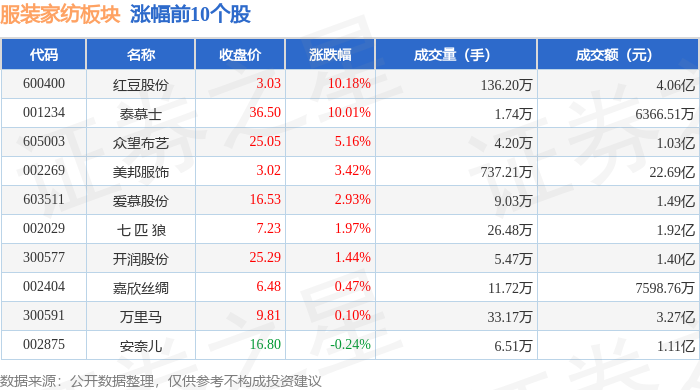
Market Overview - The apparel and home textile sector experienced a decline of 1.0% on September 18, with Jin Hong Group leading the drop [1] - The Shanghai Composite Index closed at 3831.66, down 1.15%, while the Shenzhen Component Index closed at 13075.66, down 1.06% [1] Stock Performance - Notable gainers included: - Hongdou Co., Ltd. (600400) with a closing price of 3.03, up 10.18% and a trading volume of 1.36 million shares [1] - Taicaoshi (001234) at 36.50, up 10.01% with a trading volume of 17,400 shares [1] - Zhongwang Fabric (605003) at 25.05, up 5.16% with a trading volume of 42,000 shares [1] - Major decliners included: - Jin Hong Group (603518) at 10.10, down 4.90% with a trading volume of 331,600 shares [2] - Bangjie Co., Ltd. (002634) at 4.50, down 3.85% with a trading volume of 135,700 shares [2] - Jiama Clothing (301276) at 21.81, down 3.75% with a trading volume of 25,000 shares [2] Capital Flow - The apparel and home textile sector saw a net outflow of 99.065 million yuan from institutional investors, while retail investors contributed a net inflow of 175 million yuan [2] - The detailed capital flow for selected stocks showed: - Hongdou Co., Ltd. had a net inflow of 1.60 million yuan from institutional investors, but a net outflow of 74.004 million yuan from retail investors [3] - Meibang Clothing (002269) had a net inflow of 48.389 million yuan from institutional investors, with a net outflow of 156.7 million yuan from retail investors [3] - Other stocks like Taicaoshi and Zhongwang Fabric also showed varied capital flows, indicating mixed investor sentiment [3]


产业观察|部分服装企业半年报现反差:主营承压,投资 “逆袭”
Mei Ri Jing Ji Xin Wen· 2025-09-13 06:51
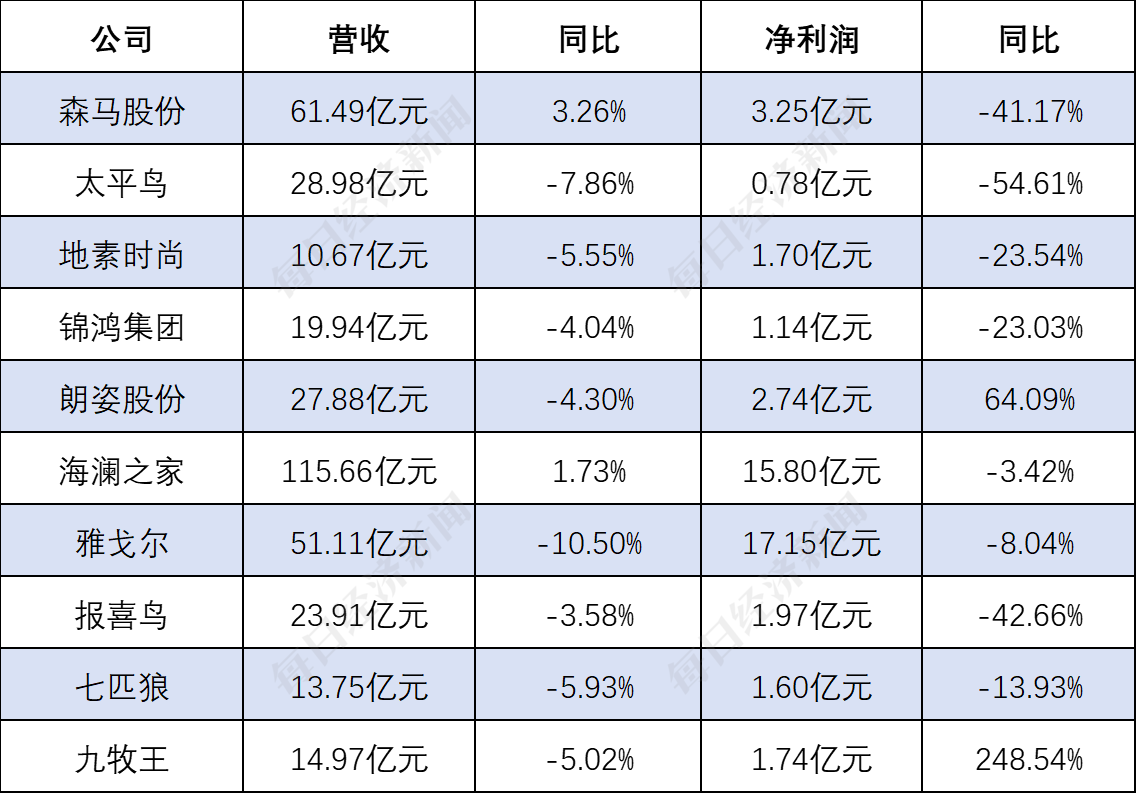
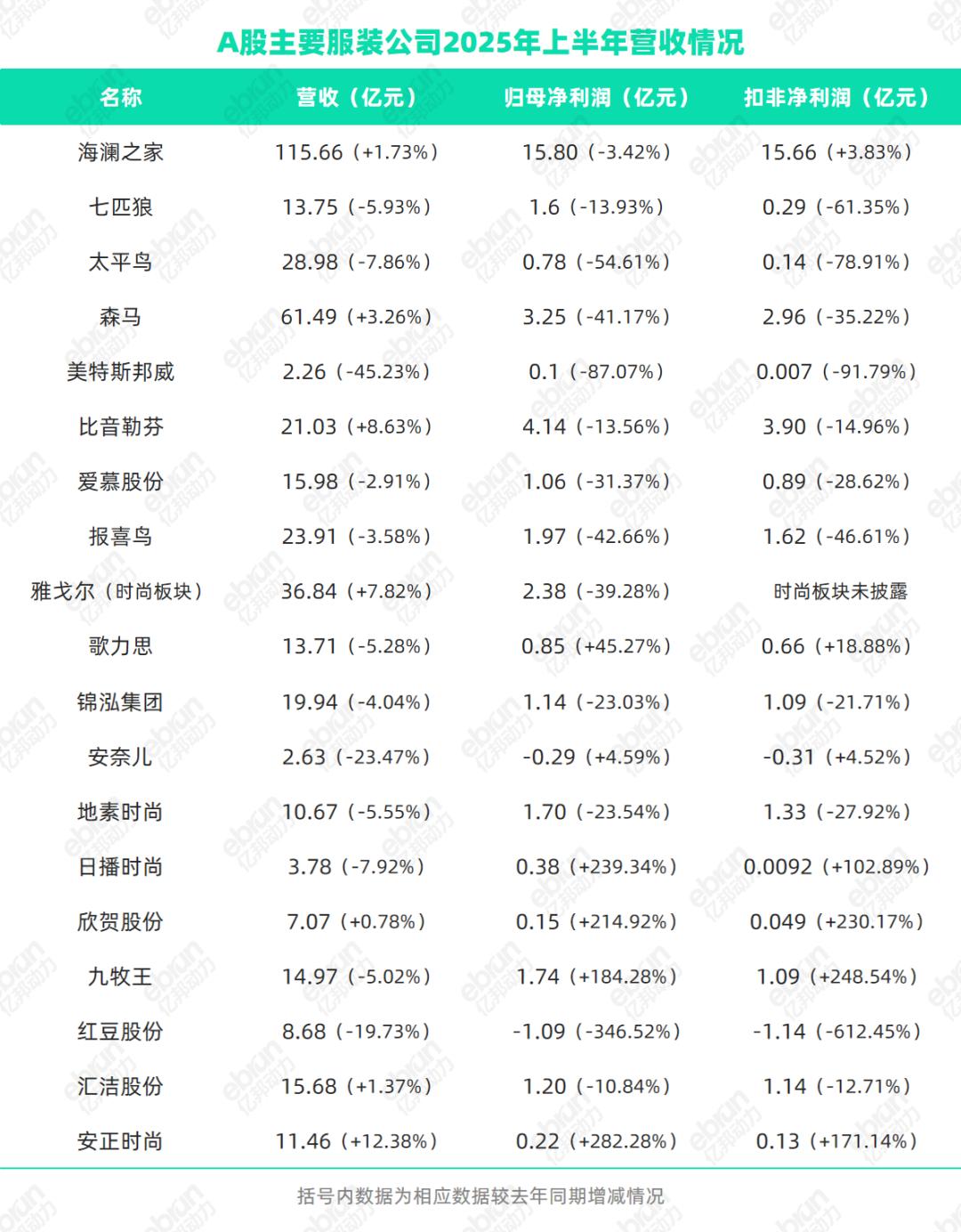
Core Insights - The traditional apparel industry in A-shares continues to face pressure, with many companies reporting declines in revenue and net profit, indicating a deep adjustment period [1][2][3] Industry Overview - The overall performance of the traditional apparel sector remains under pressure, with many companies experiencing a continuation of the revenue and net profit declines seen in 2024 [1] - The children's clothing segment shows relative stability, with leading company Semir achieving revenue growth, while the women's and men's clothing markets are relatively flat, with significant declines in fashion women's wear [1][4] - The industry is transitioning from "channel scale competition" to "user value competition," as companies increase direct-to-consumer (DTC) store openings while reducing franchise stores [1][6] Company Performance - Semir's revenue reached 6.149 billion yuan, a 3.26% increase, but net profit fell by 41.17% [2] - Taiping Bird's revenue decreased by 7.86% to 2.898 billion yuan, with net profit down 54.61% [2] - Other companies like YOUNGOR, Baoxini, and Qipilang also reported revenue declines, while Haizhu's revenue increased by 1.73% but net profit decreased by 3.42% [2][4] - The children's clothing market is performing better, with 45.9% of consumers indicating increased spending on children's clothing [4] Strategic Shifts - Many companies are focusing on opening flagship stores in key urban areas, moving away from the franchise model to enhance brand experience [5][6] - Taiping Bird is implementing a "super store" strategy, opening large flagship stores to integrate multiple brands [5] - YOUNGOR has strengthened its direct sales channels, with over 95% of sales coming from direct stores [6] Investment Trends - Several apparel companies are showing a preference for investment to boost profits, with Langzi Co. reporting a 64% increase in net profit due to stock sales [7] - Jiuzhou Wang's net profit surged by 248.54%, attributed to gains from financial asset valuations [7] - Baoxini's financial assets increased dramatically by 2072.73%, indicating a shift towards financial investments to offset core business pressures [8]


泉州即时零售市场热潮涌动!「百汇优淘」超市将进驻鲤城江南!朴朴、元初、大润发……
Sou Hu Cai Jing· 2025-09-13 00:16
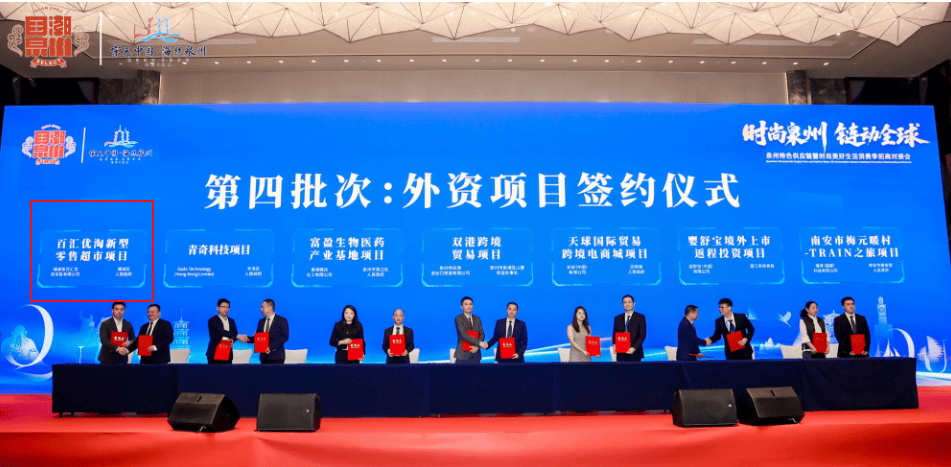
Group 1 - The core viewpoint of the article highlights the rapid growth and competition in the instant retail market in Quanzhou, driven by new projects like the Baihui YouTao supermarket and the increasing demand for fast delivery services [1][3] - Baihui YouTao, a new retail supermarket project, is set to invest $20 million in the renovation and management of the Baihui Building in Quanzhou, focusing on community discount supermarkets [1][3] - The Quanzhou area is experiencing a surge in instant retail, with major players like Meituan, Alibaba, and JD.com heavily investing in marketing and operational strategies to capture market share [5][8] Group 2 - Instant retail platforms like Pupu Supermarket have gained significant traction, achieving over 16,000 orders on its opening day in Quanzhou, showcasing the demand for quick delivery services [10] - Traditional supermarkets, such as RT-Mart, are also adapting to the instant retail trend by enhancing their online services and implementing efficient delivery systems [11] - The overall instant retail market in China is projected to reach a scale of 1.5 trillion yuan by 2025, with an annual growth rate of approximately 25% [12] Group 3 - Brands are increasingly leveraging instant retail to enhance customer experience, with companies like Anta and Aokang achieving rapid delivery times, thus transforming consumer purchasing habits [16][17] - The integration of logistics technology is crucial for the success of instant retail, allowing for efficient order processing and delivery [17] - The future of instant retail is expected to focus not only on speed but also on service quality, with innovations like AR for customer engagement and flexible return policies being tested [18]


国内头部男装上半年以产品场景化 + 渠道全域化构建行业增长韧性
Cai Jing Wang· 2025-09-12 08:34
Core Insights - The domestic men's clothing market is undergoing structural adjustments due to dual influences of consumption upgrading and rational consumption, with retail sales of clothing, shoes, and textiles reaching 742.6 billion yuan, a year-on-year increase of 3.1% in the first half of 2025 [1] - There is a clear divergence in industry performance, with leading brands adjusting strategies to meet the differentiated demands of younger consumers who prefer functional and personalized products, while mature consumers focus on quality and versatility [1][4] Financial Performance - HLA achieved revenue of 11.566 billion yuan, a slight increase of 1.73% year-on-year, with a net profit of 1.58 billion yuan [1] - Jiumuwang and Qipilang experienced revenue declines of 5.02% and 5.93% respectively, but Jiumuwang's net profit surged by 248.54%, indicating improved profitability [1] - Youngor's revenue and net profit decreased by 10.50% and 8.04% respectively due to challenges in its real estate and fashion segments [1] Product Innovation - Leading brands are increasing R&D investments to meet consumer demands for functionality and fashion, focusing on "technology fabrics + scenario-based design + cultural empowerment" [1][2] - Jiumuwang's "air conditioning pants" became a bestseller, selling over 90,000 units since its launch in April 2025, appealing to younger consumers [1] - Seven Wolves integrated cultural elements into product innovation, launching a multi-colored business travel series that incorporates local heritage designs and innovative materials [2] Channel Transformation - Brands are accelerating the integration of online and offline channels, enhancing retail efficiency and customer loyalty through structural optimization and experiential innovations [5][6] - HLA's online revenue reached 2.308 billion yuan, accounting for 20.54% of total revenue, with a year-on-year growth of 4.36% [6] - Seven Wolves' online business revenue reached 489 million yuan, making up over 30% of total revenue, supported by data-driven strategies and content innovation [6] Supply Chain Management - Brands are focusing on refining supply chain management to enhance efficiency, with Seven Wolves reducing product delivery cycles to 18 days, 25% faster than the industry average [9] - HLA established an "order sharing platform" with over 200 suppliers, improving inventory turnover and reducing stockout risks [9] Industry Challenges - Analysts suggest that Chinese men's clothing brands still have room for improvement in precise positioning and long-term development paths, with a need for enhanced brand management and differentiation strategies [10]

森马比音勒芬也快卖不动了,流量涌入折扣店和“微型社区”
3 6 Ke· 2025-09-11 08:28
Core Viewpoint - The apparel industry is facing significant challenges, with many brands experiencing declining revenues and profits, highlighting a broader trend of struggles within the sector [1][4][30]. Group 1: Company Performance - Metersbonwe's revenue for the first half of 2025 was 226 million yuan, a decrease of 45.23% year-on-year, with a net profit of 0.1 million yuan, down 87.07% [1][3]. - The overall revenue for 19 A-share apparel brands was 42.849 billion yuan, a decline of 1.37%, with a net profit of 3.708 billion yuan, down 19.11% from the previous year [1][4]. - Among the 19 brands, nearly 70% reported revenue declines, with Metersbonwe, Annil, and Hongdou experiencing drops exceeding 10% [4][6]. Group 2: Retail Trends - The apparel industry has seen a continuous decline in single-store performance, with nearly 90% of brands reporting a decrease in sales per square meter [6][8]. - The trend of store closures is prevalent, with over 5% of stores closed across various brands, and Annil having the highest closure rate at 14.33% [9][12]. - The shift towards Direct to Consumer (DTC) models is being adopted by several brands, including Anzheng Fashion and Hongdou, as they aim to improve profitability and customer engagement [12][13]. Group 3: Online Sales and Market Dynamics - More than half of the brands reported growth in online sales, with notable increases for brands like Bi Yin Le Fen, which saw a 71.82% rise in online revenue [19][21]. - The market is experiencing a K-shaped recovery, where high-end brands are thriving while mid-range and budget brands are struggling, leading to a focus on discount channels and essential goods [21][30]. - Brands are diversifying their product lines through acquisitions and partnerships, with examples including Yagor's acquisition of the French luxury children's brand Bonpoint [20][22]. Group 4: Strategic Shifts - Many brands are investing in "super stores" and discount formats to adapt to changing consumer preferences and enhance in-store experiences [14][15]. - The transition to DTC models is expected to increase operational costs, but it may also improve gross margins by eliminating intermediaries [13][30]. - The apparel sector is witnessing a trend towards multi-brand strategies, with companies like Song Li and Hongdou expanding their brand portfolios to capture diverse market segments [20][30].

七匹狼:公司以“夹克专家”战略为核心,通过品牌焕新驱动转型升级
Zheng Quan Ri Bao Zhi Sheng· 2025-09-10 13:43
Core Viewpoint - The company is focusing on a "jacket expert" strategy as the core of its transformation and upgrade, aiming to enhance brand strength, product quality, and channel effectiveness through brand rejuvenation [1] Group 1 - The company announced a new spokesperson as a significant step in its brand rejuvenation efforts [1] - The strategy includes integrated marketing to precisely reach target audiences, utilizing the spokesperson to materialize brand value [1] - The company aims to enhance its fashion perception, particularly among young consumers, to attract a more diverse consumer base and actively build a growth hub [1]
七匹狼:回应与同板块公司优劣势及强化弥补计划相关问题
Xin Lang Cai Jing· 2025-09-10 09:57
Group 1 - The company acknowledges that stock prices in the secondary market are influenced by various factors and refrains from commenting on specific market movements [1] - Different brands have unique differences in product services, brand positioning, and business models, which affect their competitive landscape [1] - The company focuses on a "Jacket Expert" strategy as its core, driving transformation and upgrading through brand renewal, emphasizing the construction of brand strength, product strength, and channel strength [1]
七 匹 狼:公司目前尚未收到服装下乡补贴细则通知
Mei Ri Jing Ji Xin Wen· 2025-09-10 08:53
Group 1 - The company has not yet received the detailed notification regarding the clothing subsidy for rural areas [1] - There is a potential for policy synergy between the clothing subsidy and the recent county-level commercial innovation development forum held in Anhui Province [3] - The company is currently inquiring about the status of its eligibility for the subsidy and when it might be included in the coverage [3]