
SEPTWOLVES(002029)

Search documents
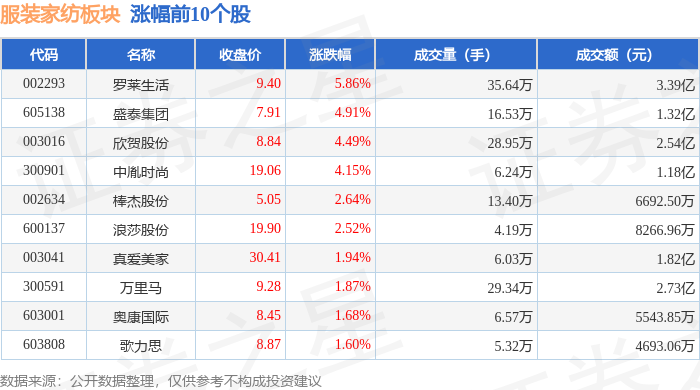
服装家纺板块10月28日涨0.03%,罗莱生活领涨,主力资金净流出1.47亿元
Zheng Xing Xing Ye Ri Bao· 2025-10-28 08:34
Market Overview - The apparel and home textile sector increased by 0.03% compared to the previous trading day, with Luolai Life leading the gains [1] - The Shanghai Composite Index closed at 3988.22, down 0.22%, while the Shenzhen Component Index closed at 13430.1, down 0.44% [1] Top Performers - Luolai Life (002293) closed at 9.40, up 5.86% with a trading volume of 356,400 shares and a turnover of 339 million yuan [1] - Shengtai Group (605138) closed at 7.91, up 4.91% with a trading volume of 165,300 shares and a turnover of 132 million yuan [1] - Xinhe Shares (003016) closed at 8.84, up 4.49% with a trading volume of 289,500 shares and a turnover of 254 million yuan [1] Underperformers - ST Erya (600107) closed at 8.77, down 4.98% with a trading volume of 160,200 shares and a turnover of 144 million yuan [2] - Ribo Fashion (603196) closed at 23.12, down 4.93% with a trading volume of 60,300 shares and a turnover of 141 million yuan [2] - Anzheng Fashion (603839) closed at 8.91, down 3.47% with a trading volume of 117,000 shares and a turnover of 106 million yuan [2] Capital Flow - The apparel and home textile sector experienced a net outflow of 147 million yuan from institutional investors, while retail investors saw a net inflow of 125 million yuan [2] - The sector's overall capital flow indicates a mixed sentiment, with institutional investors withdrawing funds while retail investors are actively buying [2][3] Individual Stock Capital Flow - Wanlima (300591) had a net inflow of 29.27 million yuan from institutional investors, while it saw a net outflow of 2.39 million yuan from retail investors [3] - Shengtai Group (605138) experienced a net inflow of 15.85 million yuan from institutional investors, but a net outflow of 23.59 million yuan from retail investors [3] - Seven Wolves (002029) had a net inflow of 18.53 million yuan from institutional investors, with a net outflow of 1.03 million yuan from retail investors [3]





服装、火腿、饮料企业集体跨界,七匹狼双线押注芯片,AI芯片成传统巨头“救命稻草”?
Sou Hu Cai Jing· 2025-10-27 09:22
Core Insights - Traditional companies are diversifying into AI chip investments as a strategic move to secure future growth while maintaining their core businesses [1][2] - The AI chip market has shown significant potential, with its market size exceeding one trillion yuan last year, making it an attractive sector for investment [1] Group 1: Company Strategies - Seven Wolves has invested in AI chip companies, holding 0.47% of Muxi Integrated Circuit and participating in funding for leading GPU firm Moore Threads through Shenzhen Innovation Investment Group [1] - Jinzi Ham has announced plans to acquire up to 20% of Zhongsheng Microelectronics for no more than 300 million yuan, focusing on high-speed optical communication and wireless access chips [1] - Yangyuan Beverage has invested 1.6 billion yuan to acquire 0.99% of the parent company of Yangtze Memory Technologies, a leading domestic storage chip manufacturer [1] Group 2: Industry Context - The traditional apparel industry is facing growth challenges, prompting companies to seek new avenues for expansion, such as AI chips [1] - The shift towards AI technology is seen as a proactive response to market pressures and a strategic move to build a second growth curve using stable cash flows from existing businesses [2] - The trend of traditional industries entering the semiconductor space reflects a deeper dialogue between established sectors and cutting-edge technology, indicating potential for unexpected cross-industry innovations in the future [2]

七匹狼跌2.03%,成交额1.23亿元,主力资金净流出1277.11万元
Xin Lang Cai Jing· 2025-10-24 02:04
Group 1 - The core viewpoint of the news is that Qipilang's stock has experienced fluctuations, with a recent decline of 2.03% and a year-to-date increase of 42.15% [1] - As of October 24, Qipilang's stock price is 9.16 yuan per share, with a total market capitalization of 6.458 billion yuan [1] - The company has seen a net outflow of main funds amounting to 12.77 million yuan, with significant selling activity [1] Group 2 - Qipilang, established on July 23, 2001, specializes in the design, manufacturing, and sales of men's casual clothing, with a diverse revenue composition [2] - The revenue breakdown includes: Other categories 26.07%, T-shirts 22.64%, outerwear 17.72%, pants 17.35%, shirts 5.99%, knitwear 4.59%, other businesses 3.63%, and suits 2.01% [2] - As of June 30, the number of shareholders is 27,800, a decrease of 5.09%, while the average circulating shares per person increased by 5.37% [2] Group 3 - For the first half of 2025, Qipilang reported operating revenue of 1.375 billion yuan, a year-on-year decrease of 5.93%, and a net profit attributable to shareholders of 160 million yuan, down 13.93% [2] - The company has distributed a total of 1.035 billion yuan in dividends since its A-share listing, with 152 million yuan distributed in the last three years [2]
阿迪达斯羽绒服被质疑为雪中飞代工
Bei Jing Shang Bao· 2025-10-21 11:25
Core Viewpoint - A consumer reported on social media that an Adidas down jacket purchased from a live-streaming platform was actually a product manufactured by a subcontractor, Xuezhongfei, raising concerns about brand authenticity and pricing strategies [1] Company Summary - The jacket in question was labeled as being distributed by Adidas Sports (China) Co., Ltd., with the manufacturer identified as Jiangsu Xuezhongfei Garment Co., Ltd. [1]

七匹狼成交额创2024年12月4日以来新高
Zheng Quan Shi Bao Wang· 2025-10-21 07:11
Group 1 - The core point of the article highlights that Qipai Wolf's trading volume reached 1.084 billion yuan, marking a new high since December 4, 2024 [2] - The latest stock price increased by 2.84%, with a turnover rate of 16.56% [2] - The previous trading day's total trading volume for the stock was 225 million yuan [2] Group 2 - Fujian Qipai Wolf Industrial Co., Ltd. was established on July 23, 2001, with a registered capital of 705.023537 million yuan [2]
八马茶业开启招股:最高募资4.5亿港元,10月28日上市,IDG与七匹狼是股东
3 6 Ke· 2025-10-20 13:06
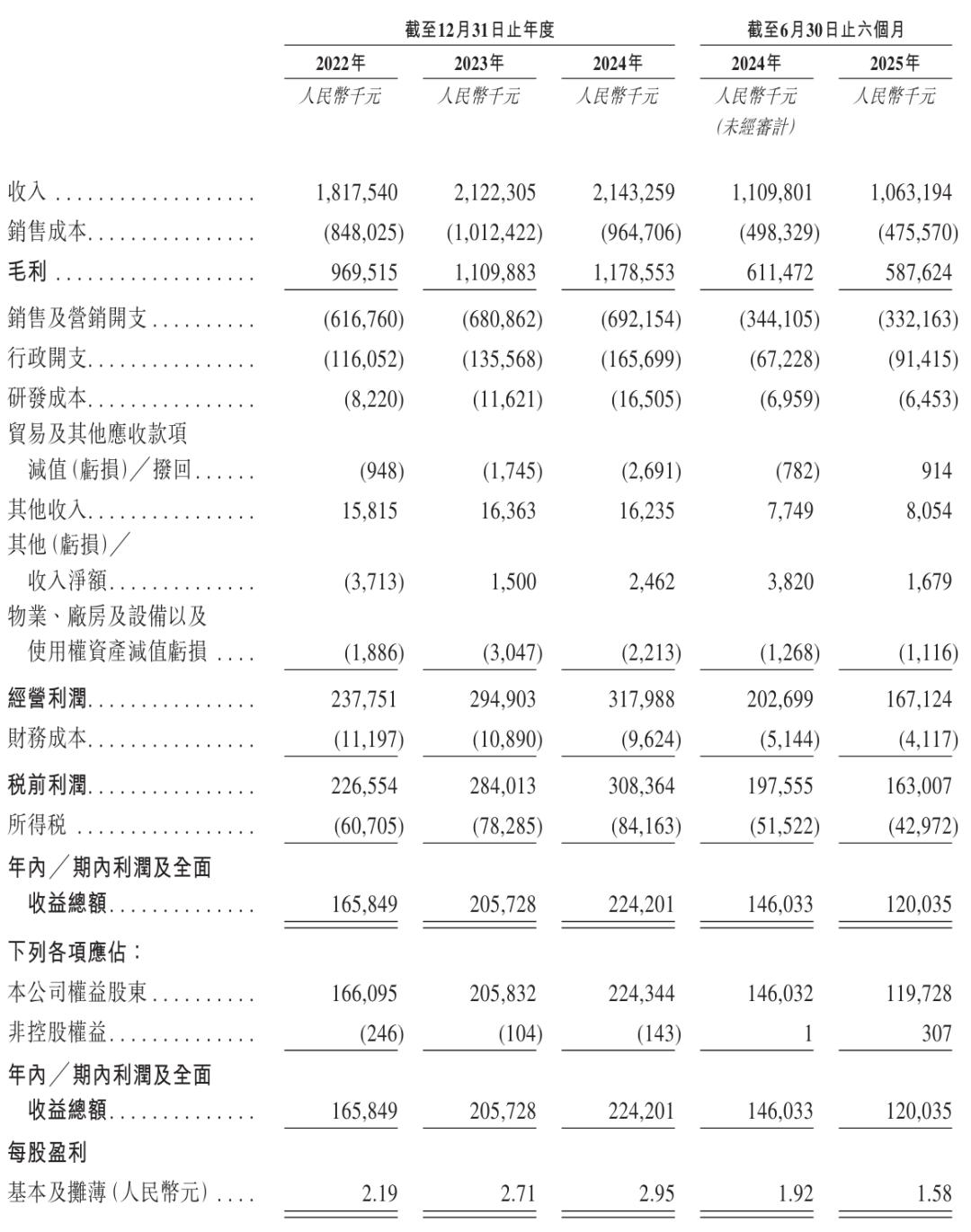
Core Viewpoint - Baima Tea Industry is preparing for its IPO on the Hong Kong Stock Exchange, aiming to raise up to HKD 450 million by offering 9 million shares at a price range of HKD 45 to 50 per share [1][2]. Financial Performance - For the first half of 2025, Baima Tea reported revenue of RMB 1.063 billion, a decrease of 4.2% from RMB 1.111 billion in the same period last year. Gross profit was RMB 587.6 million, down 3.8% from RMB 611.2 million, with a gross margin of 55.2% compared to 55.5% in the previous year [4][5]. - The company’s operating profit for the first half of 2025 was RMB 167.1 million, a decline of 17.73% from RMB 200 million year-on-year. Net profit for the same period was RMB 120 million, down 17.8% from RMB 146 million [5]. Business Overview - Baima Tea is a national chain brand engaged in the research, design, standard output, and retail of various tea products, including Oolong, black, red, green, and white teas, as well as tea utensils and food products [3]. - The number of offline stores increased from 2,613 as of January 1, 2022, to 3,585 by June 30, 2025, with franchise stores growing from 2,203 to 3,341 during the same period [3]. Historical Context - Baima Tea previously submitted IPO applications twice to the A-share market, both of which were terminated. The company shifted its focus to the Hong Kong Stock Exchange in January 2025 [2]. Shareholding Structure - The company has a strong family influence, with the controlling shareholders being members of the Wang family, who collectively hold 55.90% of the voting rights. Wang Wenbin directly holds 25.38% of the shares, while Wang Wenli holds 20.38% [11][13]. - Other significant shareholders include IDG Capital and several funds associated with Qipilang, holding 6.87% and 3% respectively [15][19]. Market Position - Baima Tea is positioned within a network of affluent families in the Quanzhou region, with connections to major brands such as Anta and Qipilang, enhancing its market presence and potential for growth [20][22].
服装家纺板块10月20日涨0.3%,七匹狼领涨,主力资金净流出9690.46万元
Zheng Xing Xing Ye Ri Bao· 2025-10-20 08:30
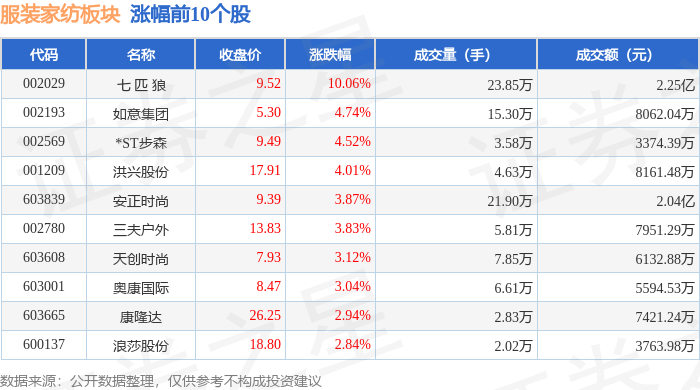
证券之星消息,10月20日服装家纺板块较上一交易日上涨0.3%,七 匹 狼领涨。当日上证指数报收于 3863.89,上涨0.63%。深证成指报收于12813.21,上涨0.98%。服装家纺板块个股涨跌见下表: | 代码 | 名称 | 收盘价 | 涨跌幅 | 成交量(手) | 成交额(元) | | | --- | --- | --- | --- | --- | --- | --- | | 002029 | 七匹狼 | 9.52 | 10.06% | 23.85万 | | 2.25亿 | | 002193 | 如意集团 | 5.30 | 4.74% | 15.30万 | | 8062.04万 | | 002569 | *ST步森 | 9.49 | 4.52% | 3.58万 | | 3374.39万 | | 001209 | 并示股份 | 17.91 | 4.01% | 4.63万 | 8161.48万 | | | 603839 | 安正时尚 | 9.39 | 3.87% | 21.90万 | | 2.04亿 | | 002780 | 三夫户外 | 13.83 | 3.83% | 5.81万 | 7951.29万 ...
“转型破局者”七匹狼:向投资开放 用夹克讲出“新”故事
Shang Hai Zheng Quan Bao· 2025-10-19 18:49
Core Viewpoint - The article discusses the transformation of Qipilang, a traditional men's clothing brand, emphasizing its dual approach of "real industry + investment" to adapt to changing consumer preferences and market dynamics [1][3]. Group 1: Transformation Strategy - Qipilang is undergoing a comprehensive transformation from brand, product to strategic orientation, driven by the need to adapt to structural changes in the men's clothing industry [1]. - The company aims to maintain its core in clothing manufacturing while leveraging capital to promote brand evolution [1][3]. - The chairman, Zhou Shaoxiong, emphasizes that true transformation involves using capital to support the main business rather than shifting entirely to the investment sector [1][3]. Group 2: Investment Logic - Qipilang's investment strategy focuses on building a brand matrix by acquiring businesses related to the fashion and consumer sectors, such as the acquisition of Karl Lagerfeld's Greater China operations [3]. - The company prioritizes risk control in its investment philosophy, aiming for long-term stability rather than short-term gains [3]. - Zhou addresses concerns about relying on investment for performance, clarifying that investment activities are designed to support the clothing business [3]. Group 3: Brand Core and Value - The brand transformation is a gradual process, with Qipilang focusing on productization, classicism, agelessness, and quality to appeal to both existing and new customers [4]. - The introduction of the "business travel jacket" series exemplifies the company's innovation, catering to modern consumer needs [5]. - The company emphasizes the importance of value co-creation between the brand and consumers, moving away from traditional advertising methods [5][6]. Group 4: Cultural and Technological Integration - Qipilang's renewed positioning as a "jacket expert" involves cultural heritage and technological upgrades, showcased by its participation in Milan Fashion Week [7]. - The company is investing in functional products and enhancing technological attributes in materials and craftsmanship [7]. - In the first half of the year, Qipilang's direct sales revenue reached 463 million yuan, a year-on-year increase of 17.12%, with a gross margin of 67.33% [7].
它们,同时押中宇树、摩尔
投中网· 2025-10-19 07:04
Core Viewpoint - The article discusses the rising interest in the IPOs of Moore Threads and Yushu Technology, highlighting the significant market movements and investment opportunities associated with these companies [3][4]. Group 1: Investment Opportunities - Moore Threads aims to break NVIDIA's monopoly with its domestic GPU, benefiting from the trend of domestic substitution [4]. - Yushu Technology has faced a challenging financing journey, with varying perceptions from venture capitalists over the years [4]. - Companies like Jinfa Technology are strategically positioned to benefit from both Moore Threads and Yushu Technology through direct collaborations and material supply agreements [6][7]. Group 2: Company Collaborations - Jinfa Technology has established a specialized team for humanoid robot material development and has signed strategic agreements with both Moore Threads and Yushu Technology [6]. - Other companies, such as Shuanghuan Transmission and Zhongdali De, have formed partnerships with Yushu Technology, providing essential components for their robotics projects [8]. - Companies like Jingxing Paper and Dazhong Public Utilities are more focused on financial investments, using indirect holdings to hedge against market fluctuations [9]. Group 3: Market Dynamics - The article notes that the excitement around IPOs leads to significant gains for related concept stocks, with direct shareholders benefiting the most [6]. - The investment landscape is characterized by a mix of strategic and financial investments, with some companies taking a more passive role in the emerging tech sectors [9][12]. - Major players like China Mobile and Tencent have entered the market later, focusing on financial investments rather than deep strategic partnerships [13][15].





1.55亿元资金今日流入纺织服饰股
Zheng Quan Shi Bao Wang· 2025-10-17 10:09
Core Viewpoint - The Shanghai Composite Index fell by 1.95% on October 17, with the power equipment and electronics sectors experiencing the largest declines of 4.99% and 4.17%, respectively. The textile and apparel sector also saw a decrease of 0.61% [1]. Textile and Apparel Sector Summary - The textile and apparel sector experienced a net inflow of 155 million yuan, with 105 stocks in the sector. Out of these, 34 stocks rose, including 5 that hit the daily limit, while 70 stocks fell, with 1 hitting the lower limit [1]. - The top three stocks with the highest net inflow were: - Jihua Group: 293 million yuan, up 9.97% - Furui Shares: 158 million yuan, up 10.02% - Cuihua Jewelry: 80.5 million yuan, up 4.20% [1]. - The sector also had 20 stocks with net outflows exceeding 10 million yuan, with the largest outflows from: - Wanlima: 67.1 million yuan, down 6.69% - Seven Wolves: 44.6 million yuan, down 7.68% - Semir Apparel: 42.9 million yuan, down 3.35% [2][3].


