supor(002032)

Search documents
苏 泊 尔(002032) - 第八届监事会第十九次会议决议公告
2025-12-12 12:15
浙江苏泊尔股份有限公司 经与会监事认真审议,会议通过了如下决议: 一、审议通过《关于公司与 SEB S.A.签署 2026 年日常关联交易协议的议案》 经监事投票表决,以 2 票同意、0 票反对、0 票弃权、1 票回避的表决结果予以审议通过。 证券代码:002032 证券简称:苏泊尔 公告编号:2025-070 浙江苏泊尔股份有限公司 第八届监事会第十九次会议决议公告 本公司及监事会全体成员保证信息披露的内容真实、准确、完整,没有虚假记载、误导性陈述 或重大遗漏。 浙江苏泊尔股份有限公司(以下简称"公司"、"本公司"或"苏泊尔")第八届监事会第十 九次会议通知已于2025年12月2日以电子邮件形式发出,会议于2025年12月12日以通讯表决的方式召 开。公司本次监事会应参与表决监事3名,实际参与表决监事3名。会议符合《公司法》和《公司章 程》的有关规定,会议由公司监事会主席Philippe SUMEIRE先生召集。 浙江苏泊尔股份有限公司监事会 二〇二五年十二月十三日 1 Philippe SUMEIRE 先生在实际控制人 SEB 集团任职,其作为关联监事在表决时进行了回避。 监事会发表如下审核意见: 监事会 ...

苏 泊 尔(002032) - 第八届董事会第十九次会议决议公告
2025-12-12 12:15
浙江苏泊尔股份有限公司 证券代码:002032 证券简称:苏泊尔 公告编号:2025-069 浙江苏泊尔股份有限公司 第八届董事会第十九次会议决议公告 本公司及董事会全体成员保证公告内容的真实、准确和完整,不存在虚假记载、误导性陈述或 者重大遗漏。 浙江苏泊尔股份有限公司(以下简称"公司"、"本公司"或"苏泊尔")第八届董事会第十九 次会议通知已于 2025 年 12 月 2 日以电子邮件形式发出,会议于 2025 年 12 月 12 日以通讯表决的方 式召开。公司本次董事会应参加表决董事 9 人,实际参加表决董事 9 人。会议符合《公司法》和《公 司章程》的有关规定,会议由董事长 Thierry de LA TOUR D'ARTAISE 先生召集。 经与会董事认真审议,形成以下决议: 一、 审议通过《关于公司与 SEB S.A.签署 2026 年日常关联交易协议的议案》 Thierry de LA TOUR D'ARTAISE 先生、Stanislas de GRAMONT 先生、Olivier CASANOVA 先生、 Rachel PAGET 女士及戴怀宗先生在实际控制人 SEB 集团任职,以上董事属于 ...
小家电板块12月12日涨1.14%,科沃斯领涨,主力资金净流出8012.58万元
Zheng Xing Xing Ye Ri Bao· 2025-12-12 09:06
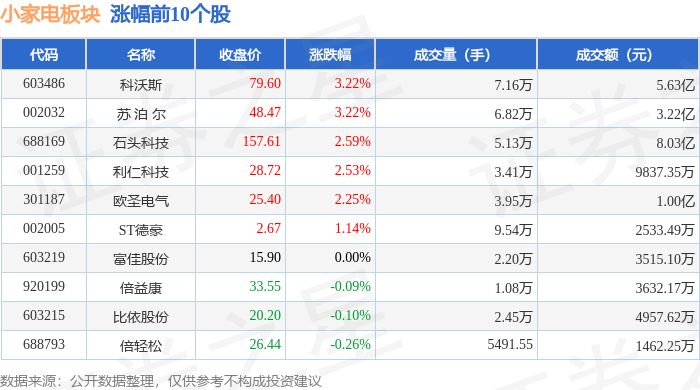
证券之星消息,12月12日小家电板块较上一交易日上涨1.14%,科沃斯领涨。当日上证指数报收于 3889.35,上涨0.41%。深证成指报收于13258.33,上涨0.84%。小家电板块个股涨跌见下表: 以上内容为证券之星据公开信息整理,由AI算法生成(网信算备310104345710301240019号),不构成投资建议。 | 代码 | 名称 | 收盘价 | 涨跌幅 | 成交量(手) | 成交额(元) | | --- | --- | --- | --- | --- | --- | | 003023 | 彩虹集团 | 23.68 | -3.35% | 7.41万 | 1.79亿 | | 603868 | 飞秒电器 | 33.18 | -2.95% | 1.98万 | 6630.68万 | | 603355 | 莱克电气 | 33.12 | -2.07% | 6.92万 | 2.32亿 | | 920926 | 鸿智科技 | 17.58 | -1.57% | 1.39万 | 2490.16万 | | 002403 | 爰仕达 | 12.82 | -0.93% | 4.61万 | 5908.46万 | | 002 ...


前三季度重返增长,空气炸锅逆势翻盘,全靠九阳苏泊尔们补短板
3 6 Ke· 2025-12-12 04:01
(图源:小熊) 换句话说,空气炸锅的确没有初上市时的火爆,但伴随着技术的革新和产品的重新定位,曾经的顶流产品也慢慢找回了自己在小家电市场的位置。 九阳苏泊尔们消灭痛点,空气炸锅起飞了 空气炸锅的爆火,核心逻辑就是简单、好上手,即便是完全不懂做饭的用户,也能轻松做出美食。但传统空气炸锅只能粗暴地完成"炸"、"烤"两个步骤,并 不能确保厨房小白能成功做出符合预期的美味。 比如,很多消费者将空气炸锅带回家后才发现,空气炸锅做出来的东西的确香,却经常干。鸡翅容易外焦里柴,薯条要么软塌要么太硬,肉类做不好就直接 变肉干了。实际上,空气炸锅的原理就是高速热风集中从外向内烘烤,天然地更容易带走食物中的水份。 更糟糕的是,传统空气炸锅锅腔风道设计简单,热风循环路径单一,用户必须定好时间将食材翻面,否则要么烤不熟,要么是食材单面烤糊。消费者对空气 炸锅的预期本就是"懒人神器",但动手的步骤一个也没减少。再加上前几年推崇健康饮食,不少用户对煎炸烤的食谱避而远之,多重因素加持下,空气炸锅 受欢迎程度直线下降。 提到那些曾经很火,但慢慢没人讨论的小家电,相信大家都会想到空气炸锅。在过去两年时间里,空气炸锅的热度一路下滑。社交平台上讨 ...

小家电板块12月9日跌1.01%,利仁科技领跌,主力资金净流出2458.3万元
Zheng Xing Xing Ye Ri Bao· 2025-12-09 09:05
| 代码 | 名称 | 收盘价 | 涨跌幅 | 成交量(手) | 成交额(元) | | --- | --- | --- | --- | --- | --- | | 001259 | 利仁科技 | 29.84 | -5.30% | 5.75万 | 1.84亿 | | 603486 | 科沃斯 | 78.39 | -3.07% | 5.30万 | 4.20亿 | | 920926 | 湾智科技 | 17.20 | -2.27% | 8923.77 | 1561.12万 | | 6610Z6 | 倍益康 | 33.47 | -2.11% | 8041.12 | 2720.27万 | | 688169 | 石头科技 | 154.80 | -1.43% | 2.43万 | 3.79亿 | | 301332 | 德尔玛 | 9.67 | -1.43% | 3.62万 | 3527.61万 | | 002403 | 爰仕达 | 12.93 | -1.30% | 3.64万 | 4764.07万 | | 002032 | 苏泊尔 | 47.85 | -1.28% | 2.70万 | 1.30亿 | | 688793 | 倍轻 ...
家电新生活,探索智能人居新体验|世研消费指数品牌榜Vol.88
3 6 Ke· 2025-12-04 06:17
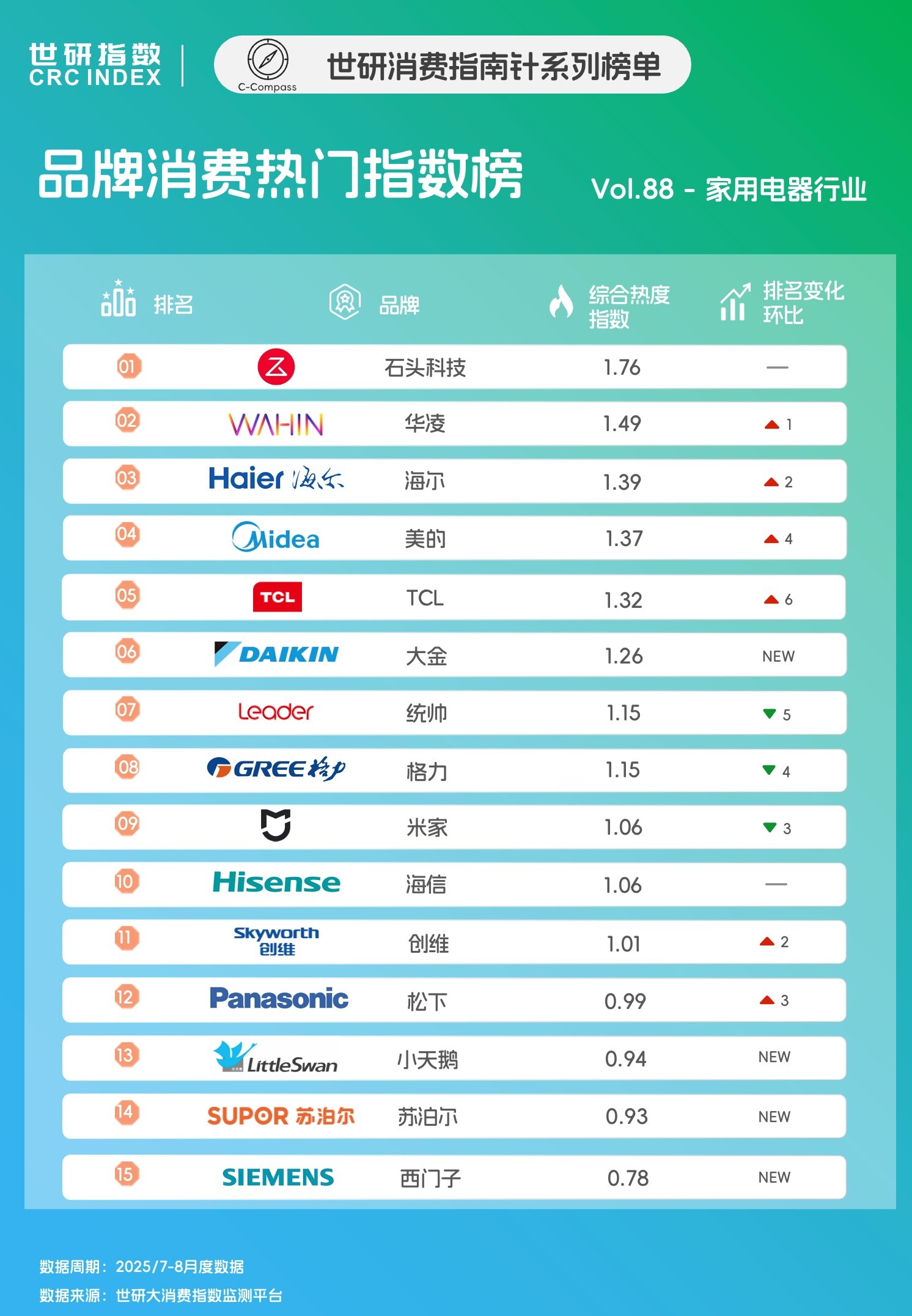
Core Insights - The home appliance industry is undergoing a transformation from hardware competition to a focus on "smart ecosystems" and "green low-carbon technology" as new competitive barriers are established [1] Group 1: Industry Trends - Leading brands are shifting from single product functionality to building comprehensive smart ecosystems and emphasizing green technology [1] - The industry is moving towards a competitive phase characterized by "ecosystem collaboration + green technology + global layout" [6] - Companies are leveraging smart ecosystems to break category boundaries and are focusing on sustainable growth through low-carbon technologies and global expansion [6] Group 2: Key Players - Midea is focusing on ecosystem collaboration, with its Midea Home app connecting over 118.6 million devices as of June this year [6] - Daikin is recognized as a foreign brand leader, emphasizing low-carbon technology and global expansion, having received CDP climate change A-level certification [6] - Stone Technology, Hualing, and Haier ranked as the top three brands in the latest consumer index with comprehensive heat index scores of 1.76, 1.49, and 1.39 respectively [5] Group 3: Product Innovations - The washing and display sectors are experiencing deep integration of technological iteration and demand upgrades, with a shift towards multi-tub washing machines and Mini LED technology [7] - Haier launched a four-tub washing machine that integrates AI features for enhanced user experience, while brands like Little Swan and Xiaomi are also entering the multi-tub market [7] - TCL reported a 176.1% year-on-year increase in Mini LED TV shipments, showcasing significant advancements in display technology [7]



小红日报 | A股震荡下行,标普红利ETF(562060)标的指数微跌0.03%显韧性
Xin Lang Cai Jing· 2025-12-04 01:05
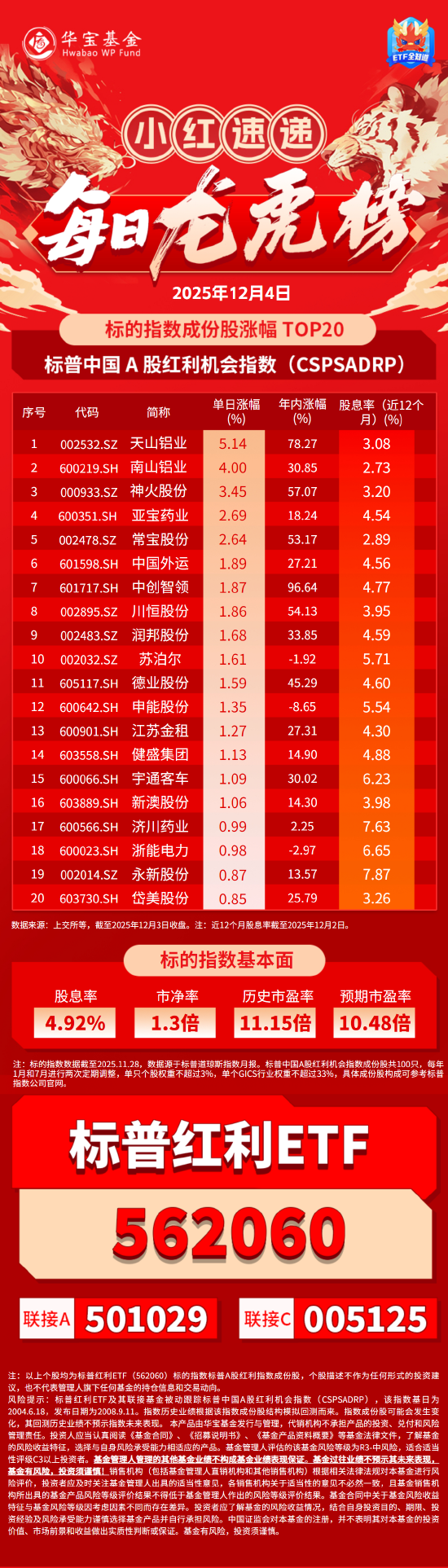
Group 1 - The article highlights the top 20 stocks in the S&P China A-Share Dividend Opportunity Index (CSPSADRP) based on their daily and year-to-date performance as of December 3, 2025 [1][4]. - Tianshan Aluminum (002532.SZ) leads with a daily increase of 5.14% and a year-to-date increase of 78.27%, with a dividend yield of 3.08% [1][4]. - Other notable performers include Nanshan Aluminum (600219.SH) with a daily increase of 4.00% and a year-to-date increase of 30.85%, and Shenhuo Co. (000933.SZ) with a daily increase of 3.45% and a year-to-date increase of 57.07% [1][4]. Group 2 - The article provides detailed performance metrics for each stock, including daily increase percentages, year-to-date performance, and dividend yields for the last 12 months [1][4]. - The data indicates a mix of industries represented in the top 20, including aluminum, pharmaceuticals, and logistics, showcasing diverse investment opportunities [1][4]. - The overall trend suggests a positive market sentiment towards these stocks, as indicated by the significant year-to-date increases for many of them [1][4].


小家电板块12月2日涨0.19%,莱克电气领涨,主力资金净流入6624.13万元
Zheng Xing Xing Ye Ri Bao· 2025-12-02 09:03
Market Overview - The small home appliance sector increased by 0.19% on December 2, with Lek Electric leading the gains [1] - The Shanghai Composite Index closed at 3897.71, down 0.42%, while the Shenzhen Component Index closed at 13056.7, down 0.68% [1] Stock Performance - Lek Electric (603355) closed at 33.52, up 6.75% with a trading volume of 95,800 shares and a turnover of 313 million yuan [1] - Other notable performers included Ousheng Electric (301187) with a 2.13% increase, and Kaineng Health (300272) with a 1.09% increase [1] - The overall performance of the small home appliance stocks showed mixed results, with some stocks experiencing declines [2] Capital Flow - The small home appliance sector saw a net inflow of 66.24 million yuan from institutional investors, while retail investors experienced a net outflow of 68.35 million yuan [2] - The capital flow data indicates that while institutional investors were net buyers, retail investors were net sellers in the sector [3] Individual Stock Capital Flow - Stone Technology (688169) had a net inflow of 32.78 million yuan from institutional investors, but a net outflow of 20.05 million yuan from retail investors [3] - Lek Electric (603355) also saw a net inflow of 22.14 million yuan from institutional investors, with retail investors withdrawing 16.42 million yuan [3] - Ousheng Electric (301187) had a significant net inflow of 13.99 million yuan from institutional investors, but a notable net outflow of 16.25 million yuan from retail investors [3]


小家电板块12月1日跌0.21%,苏泊尔领跌,主力资金净流出3503.82万元
Zheng Xing Xing Ye Ri Bao· 2025-12-01 09:03
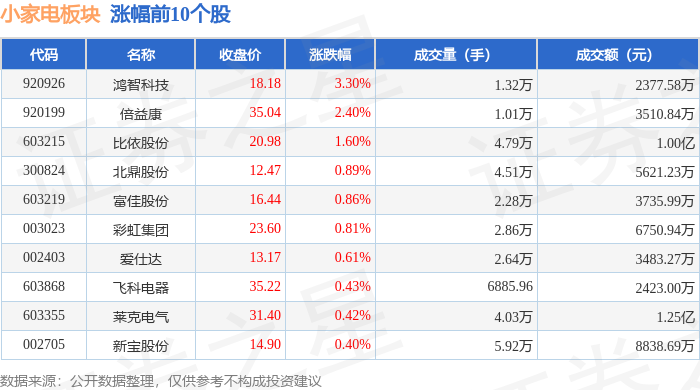
Market Overview - The small home appliance sector experienced a decline of 0.21% on December 1, with Supor leading the drop [1] - The Shanghai Composite Index closed at 3914.01, up 0.65%, while the Shenzhen Component Index closed at 13146.72, up 1.25% [1] Stock Performance - Notable gainers in the small appliance sector included: - Chicken Smart Technology (Code: 920926) with a closing price of 18.18, up 3.30% [1] - Bei Yi Co., Ltd. (Code: 6610Z6) with a closing price of 35.04, up 2.40% [1] - Bi Yi Co., Ltd. (Code: 603215) with a closing price of 20.98, up 1.60% [1] - Supor (Code: 002032) closed at 49.48, down 2.17%, with a trading volume of 37,200 shares and a transaction value of 184 million [2] Capital Flow - The small home appliance sector saw a net outflow of 35.04 million from main funds, while retail funds had a net inflow of 15.88 million [2] - Key stocks with significant capital flow included: - Supor with a main fund net inflow of 12.76 million and a retail net outflow of 29.83 million [3] - Stone Technology (Code: 688169) with a main fund net inflow of 28.26 million [3] - Lek Electric (Code: 603355) with a main fund net inflow of 9.55 million [3]
餐饮、潮玩及家电行业周报-20251130
Haitong Securities International· 2025-11-30 14:04
Investment Rating - The report assigns an "Outperform" rating to several companies in the discretionary consumption sector, including Pop Mart, Anta Sports, Huazhu Group, Miniso, Li Ning, Atour Group, New Oriental Online, and Xtep International [1][5]. Core Insights - The report highlights the stable long-term growth of Luckin Coffee despite facing short-term margin pressures, indicating resilience in the F&B sector [2]. - The introduction of new children's meal sets by Taier emphasizes the trend towards fresh and healthy dining options, reflecting consumer preferences [2]. - The report notes the expansion of Midea's automotive parts production in Mexico, which supports local manufacturing for North American electric vehicle clients [2]. - The implementation of new national standards for smart home appliances starting May 1, 2026, is expected to enhance product quality and consumer trust in the home appliances sector [2]. Summary by Sections Company Performance - Guming and Pop Mart were the top performers this week, with stock price increases of 12.6% and 12.8% respectively [3][7]. - SuperHi International reported a revenue of $21 million for Q3 2025, a year-on-year increase of 7.8%, but faced a significant drop in net profit due to increased foreign exchange losses [2][5]. - Chagee's Q3 results showed a revenue decline of 9%, with adjusted net profit down 22% [2][5]. Market Trends - The report indicates a growing trend in the F&B sector towards fresh and healthy meal options, as seen with Taier's new children's meal offerings [2]. - The smart home appliance market is set to evolve with the introduction of new standards, which will likely drive innovation and consumer adoption [2].