
TZE(002129)

Search documents
光伏概念震荡反弹 隆基绿能等多股涨停
Mei Ri Jing Ji Xin Wen· 2025-10-14 02:37
Core Viewpoint - The solar energy sector experienced a rebound on October 14, with significant gains in stock prices for several companies, indicating a positive market sentiment towards the industry [1] Group 1: Company Performance - Longi Green Energy, Yaopi Glass, and Hongyuan Green Energy reached their daily price limit increase [1] - Other companies such as Dongfang Risen, Aiko Solar, and TCL Zhonghuan also saw their stock prices rise, reflecting a broader trend of recovery in the solar sector [1]


A股异动丨传闻刺激!光伏股集体走强,隆基绿能、亿晶光电涨停
Ge Long Hui A P P· 2025-10-14 02:34
Group 1 - The core viewpoint of the news is that the photovoltaic sector in the A-share market is experiencing a significant rally, with multiple stocks reaching their daily limit up due to anticipated important policy announcements aimed at regulating production capacity in the industry [1][2] - Major companies such as Longi Green Energy and Yicheng Photovoltaic have seen their stock prices hit the daily limit, indicating strong investor confidence and market momentum [1][2] - The news suggests that there will be new developments in the industry's efforts to combat internal competition, which could further influence market dynamics [1] Group 2 - Longi Green Energy (601012) has a market capitalization of 151.1 billion with a year-to-date increase of 26.93% and a daily increase of 9.98% [2] - Yicheng Photovoltaic (600537) has a market capitalization of 4.853 billion with a year-to-date increase of 33.55% and a daily increase of 9.92% [2] - Other notable companies include Dongfang Risheng (300118) with a daily increase of 9.00% and a market cap of 12.8 billion, and Jingyuntong (601908) with a daily increase of 7.93% and a market cap of 10.8 billion [2]


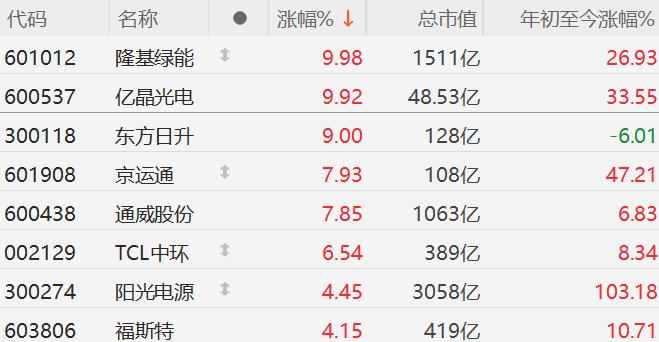
光伏概念股早盘大涨,光伏相关ETF涨约5%
Sou Hu Cai Jing· 2025-10-14 02:20
Core Viewpoint - The photovoltaic sector is experiencing significant stock price increases, with leading companies like Longi Green Energy and TCL Zhonghuan seeing substantial gains, while related ETFs also show strong performance [1][2]. Group 1: Stock Performance - Longi Green Energy reached the daily limit increase, while TCL Zhonghuan rose over 9%, and both JinkoSolar and JA Solar increased by more than 7% [1]. - Photovoltaic-related ETFs saw an approximate 5% rise [1]. Group 2: Industry Outlook - In 2024, the photovoltaic industry is expected to experience a dual scenario of growth and decline, with significant increases in production capacity and output, but a decrease in overall industry scale due to falling product prices [2]. - The global photovoltaic industry scale is projected to be $273.08 billion, reflecting a year-on-year decline of 20.5% [2]. - The global newly installed photovoltaic capacity is expected to reach 451.9 GW in 2024, marking a year-on-year increase of 30.8%, with China contributing 277.6 GW, the largest share globally [2]. - The industry is anticipated to benefit from increasing energy demand, decreasing manufacturing costs, and continuous technological advancements, leading to improved efficiency in photovoltaic cells and components [2].

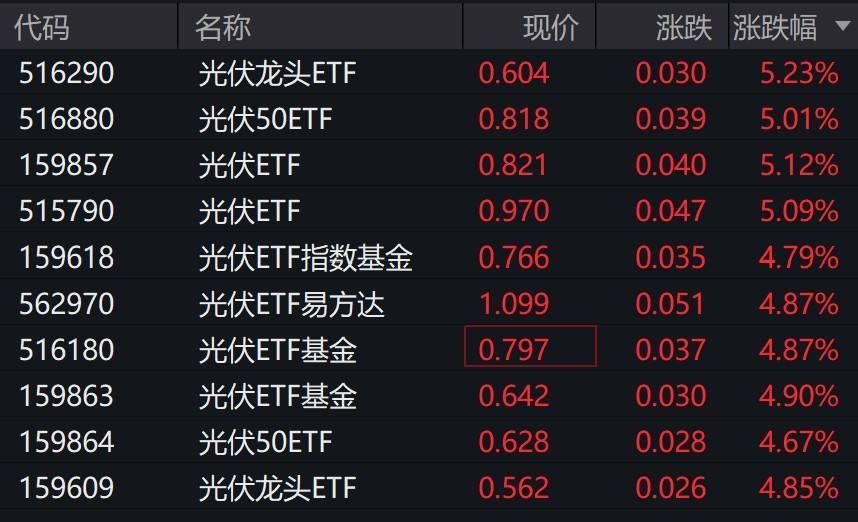
光伏设备板块震荡走强,隆基绿能冲击涨停



Xin Lang Cai Jing· 2025-10-14 01:48
Core Viewpoint - The photovoltaic equipment sector is experiencing a strong rebound, with notable stock performance from several key companies [1] Company Performance - Longi Green Energy is approaching a trading limit increase [1] - Trina Solar has seen its stock rise by over 8% [1] - Aiko Solar, JA Solar, and TCL Zhonghuan are among the top performers in terms of stock price increase [1]
光伏ETF基金(516180)降幅收窄,日内最大反弹超2.0%
Xin Lang Cai Jing· 2025-10-13 06:36
Group 1 - The core viewpoint is that the photovoltaic industry chain has reached a price and profit bottom, with significant effects from the "anti-involution" initiative, leading to an expansion of participants and recovery in product prices [1] - The photovoltaic industry is expected to achieve supply-side improvements through a combination of top-level support, market-driven elimination, and technological iteration, with policies related to capacity and product quality expected to be implemented [1] - As of October 13, 2025, the CSI Photovoltaic Industry Index (931151) has decreased by 2.17%, with mixed performance among constituent stocks [1] Group 2 - As of September 30, 2025, the top ten weighted stocks in the CSI Photovoltaic Industry Index (931151) include Yangguang Electric (300274), Longi Green Energy (601012), and TBEA (600089), collectively accounting for 58.02% of the index [2]



TCL中环股价涨5.75%,南方基金旗下1只基金重仓,持有11万股浮盈赚取5.72万元
Xin Lang Cai Jing· 2025-10-09 03:06
Group 1 - TCL Zhonghuan's stock price increased by 5.75%, reaching 9.57 CNY per share, with a trading volume of 1.316 billion CNY and a turnover rate of 3.51%, resulting in a total market capitalization of 38.693 billion CNY [1] - The company, established on December 21, 1988, and listed on April 20, 2007, operates in the semiconductor electronic information, semiconductor energy-saving, and new energy industries [1] - The revenue composition of TCL Zhonghuan includes photovoltaic silicon wafers (43.12%), photovoltaic modules (28.70%), other silicon materials (20.46%), others (6.95%), and photovoltaic power stations (0.76%) [1] Group 2 - Southern Fund's Southern CSI Photovoltaic Industry Index Fund A (019531) increased its holdings in TCL Zhonghuan by 7,000 shares, bringing the total to 110,000 shares, which represents 2.77% of the fund's net value, making it the sixth-largest holding [2] - The fund has a current size of 12.3833 million CNY and has achieved a year-to-date return of 24.84%, ranking 2379 out of 4221 in its category [2] - The fund manager, Li Jialiang, has been in position for 9 years and 68 days, with the fund's total assets amounting to 5.328 billion CNY, achieving a best return of 188.1% and a worst return of -29.58% during his tenure [2]
TCL中环涨2.10%,成交额3.94亿元,主力资金净流出2461.90万元
Xin Lang Cai Jing· 2025-10-09 01:59
Core Insights - TCL Zhonghuan's stock price increased by 2.10% on October 9, reaching 9.24 CNY per share, with a total market capitalization of 37.358 billion CNY [1] Financial Performance - For the first half of 2025, TCL Zhonghuan reported a revenue of 13.398 billion CNY, a year-on-year decrease of 17.36%, and a net profit attributable to shareholders of -4.242 billion CNY, down 38.48% year-on-year [2] - The company has cumulatively distributed dividends of 2.338 billion CNY since its A-share listing, with 1.373 billion CNY distributed over the past three years [3] Shareholder Information - As of June 30, 2025, the number of shareholders decreased by 5.25% to 242,400, while the average circulating shares per person increased by 5.54% to 16,666 shares [2] - Major shareholders include Hong Kong Central Clearing Limited, holding 113 million shares, and various ETFs such as Huatai-PB CSI 300 ETF and E Fund CSI 300 ETF, with notable changes in their holdings [3] Market Activity - TCL Zhonghuan's stock has seen a year-to-date increase of 4.17%, with significant gains of 8.07% over the last five trading days and 12.82% over the last 20 days [1] - The company appeared on the "Dragon and Tiger List" once this year, with a net purchase of 229 million CNY on September 25 [1]
2025年1-7月中国太阳能电池(光伏电池)产量为47396.4万千瓦 累计增长19.6%
Chan Ye Xin Xi Wang· 2025-10-01 02:27
Group 1 - The core viewpoint of the article highlights the growth in China's solar cell production, with a reported output of 66.38 million kilowatts in July 2025, representing a year-on-year increase of 16% [1] - Cumulative production from January to July 2025 reached 473.964 million kilowatts, showing a cumulative growth of 19.6% [1] - The article references a report by Zhiyan Consulting, which provides insights into the competitive landscape and investment recommendations for the solar cell industry in China from 2025 to 2031 [1] Group 2 - Listed companies in the solar energy sector include Longi Green Energy, Tongwei Co., Sunshine Power, JA Solar, Trina Solar, TBEA, Chint Electric, and TCL Zhonghuan [1] - Zhiyan Consulting is recognized as a leading industry consulting firm in China, specializing in in-depth industry research reports and tailored consulting services [2]



TCL中环涨2.33%,成交额7.43亿元,主力资金净流入1473.81万元
Xin Lang Cai Jing· 2025-09-30 02:56
Core Viewpoint - TCL Zhonghuan's stock has shown significant upward movement recently, with a notable increase in trading volume and market capitalization, indicating strong investor interest and potential growth in the photovoltaic sector [1][2]. Company Overview - TCL Zhonghuan is located in Tianjin and was established on December 21, 1988, with its stock listed on April 20, 2007. The company operates in the semiconductor electronic information, semiconductor energy-saving, and new energy industries [1]. - The main revenue sources for TCL Zhonghuan are photovoltaic silicon wafers (43.12%), photovoltaic modules (28.70%), other silicon materials (20.46%), and other sources (6.95%), with a minor contribution from photovoltaic power stations (0.76%) [1]. Financial Performance - For the first half of 2025, TCL Zhonghuan reported a revenue of 13.398 billion yuan, a year-on-year decrease of 17.36%, and a net profit attributable to shareholders of -4.242 billion yuan, down 38.48% year-on-year [2]. - The company has distributed a total of 2.338 billion yuan in dividends since its A-share listing, with 1.373 billion yuan distributed over the past three years [3]. Shareholder Structure - As of June 30, 2025, TCL Zhonghuan had 242,400 shareholders, a decrease of 5.25% from the previous period, with an average of 16,666 shares held per shareholder, an increase of 5.54% [2]. - The top shareholders include Hong Kong Central Clearing Limited, holding 113 million shares, and various ETFs such as Huatai-PB CSI 300 ETF and E Fund CSI 300 ETF, with notable changes in their holdings [3].
TCL中环跌2.09%,成交额11.38亿元,主力资金净流出1.27亿元
Xin Lang Cai Jing· 2025-09-29 05:54
Core Viewpoint - TCL Zhonghuan's stock price has shown fluctuations with a recent decline, while the company continues to operate in the semiconductor and renewable energy sectors, primarily focusing on photovoltaic products [1][2]. Financial Performance - As of June 30, 2025, TCL Zhonghuan reported a revenue of 13.398 billion yuan, a year-on-year decrease of 17.36%, and a net profit attributable to shareholders of -4.242 billion yuan, down 38.48% year-on-year [2]. - The company has cumulatively distributed 2.338 billion yuan in dividends since its A-share listing, with 1.373 billion yuan distributed over the past three years [3]. Stock Market Activity - On September 29, 2023, TCL Zhonghuan's stock price fell by 2.09% to 8.92 yuan per share, with a trading volume of 1.138 billion yuan and a turnover rate of 3.11% [1]. - The stock has seen a year-to-date increase of 0.56%, with a 12.63% rise over the last five trading days and a 14.07% increase over the past 60 days [1]. Shareholder Information - As of June 30, 2025, the number of shareholders decreased by 5.25% to 242,400, while the average number of circulating shares per person increased by 5.54% to 16,666 shares [2]. - Major shareholders include Hong Kong Central Clearing Limited, holding 113 million shares, and various ETFs such as Huatai-PB CSI 300 ETF and E Fund CSI 300 ETF, with notable changes in their holdings [3]. Business Overview - TCL Zhonghuan operates in the semiconductor electronic information industry, semiconductor energy-saving industry, and renewable energy industry, with its main revenue sources being photovoltaic silicon wafers (43.12%), photovoltaic modules (28.70%), and other silicon materials (20.46%) [1][2].