LEO(002131)

Search documents
通用设备板块1月14日涨0.56%,七丰精工领涨,主力资金净流出43.09亿元
Zheng Xing Xing Ye Ri Bao· 2026-01-14 08:58
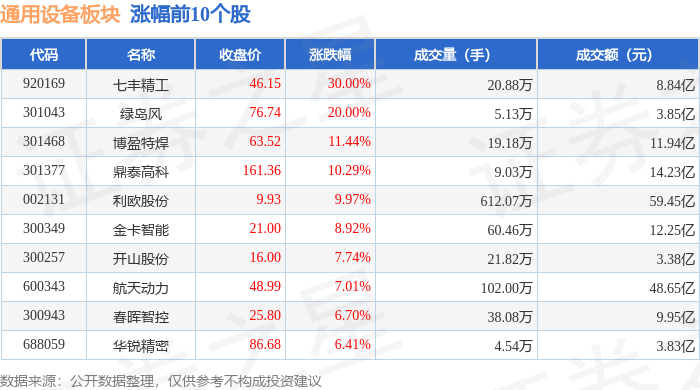
Market Overview - The general equipment sector increased by 0.56% on January 14, with Qiheng Precision leading the gains [1] - The Shanghai Composite Index closed at 4126.09, down 0.31%, while the Shenzhen Component Index closed at 14248.6, up 0.56% [1] Top Performers - Qiheng Precision (code: 920169) closed at 46.15, up 30.00% with a trading volume of 208,800 shares and a transaction value of 884 million [1] - Green Island Wind (code: 301043) closed at 76.74, up 20.00% with a trading volume of 51,300 shares and a transaction value of 385 million [1] - Boying Special Welding (code: 301468) closed at 63.52, up 11.44% with a trading volume of 191,800 shares and a transaction value of 1.194 billion [1] Underperformers - Luxin Investment (code: 600783) closed at 35.50, down 9.99% with a trading volume of 964,400 shares [2] - Daye Co., Ltd. (code: 603278) closed at 14.36, down 9.97% with a trading volume of 673,100 shares [2] - Wuzhou New Spring (code: 603667) closed at 76.54, down 7.39% with a trading volume of 712,800 shares [2] Capital Flow - The general equipment sector experienced a net outflow of 4.309 billion in main funds, while retail investors saw a net inflow of 4.096 billion [2] - The sector's capital flow indicates a mixed sentiment, with institutional investors withdrawing while retail investors are actively buying [2] Individual Stock Capital Flow - Lio Co., Ltd. (code: 002131) had a main fund net inflow of 369 million, but a net outflow from retail investors of 56.9 million [3] - Qiheng Precision (code: 920169) saw a main fund net inflow of 323 million, with a small net inflow from retail investors of 3.24 million [3] - Green Island Wind (code: 301043) had a main fund net inflow of 606 million, but a net outflow from retail investors of 2.34 million [3]


满屏涨停再现!AI应用概念24股涨停,省广集团4连板
2 1 Shi Ji Jing Ji Bao Dao· 2026-01-14 08:43
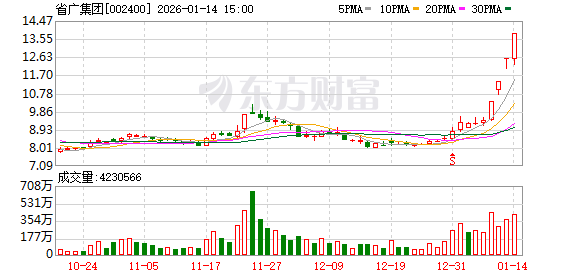
Group 1 - The A-share market experienced a rise and then a decline, with the Shanghai Composite Index briefly increasing over 1% before turning negative in the afternoon [2] - The AI application sector saw significant growth, with companies like Liou Co., Ltd. achieving six consecutive trading limits in nine days, and others like Shengguang Group and Youyou Network also performing strongly [2] - The Ministry of Industry and Information Technology released a plan for the high-quality development of industrial internet platforms from 2026 to 2028, aiming for over 450 influential platforms and a connection of over 120 million industrial devices by 2028 [2] Group 2 - Huayuan Securities' report emphasizes that AI remains a crucial direction in global industry narratives, focusing on product implementation with revenue-generating applications [3] - Generative AI products are becoming core entry points for information acquisition, leading to a new marketing paradigm that enhances brand visibility and authority in AI-generated responses [3] - The current AI application model is still in its early stages, and companies that are rapidly advancing their strategies should be closely monitored [3]


指数2连跌“凉凉”!“AI元素”霸屏拉升,还有哪些投资机会?
Sou Hu Cai Jing· 2026-01-14 07:35
Group 1 - The core viewpoint is that traditional manufacturing companies in China are the ones realizing performance amidst the global tech market surge, with the future bull market in China relying on physical assets and manufacturing capacity value [1] - Recommended investment sectors include upstream resources (copper, aluminum, lithium, oil, coal) benefiting from potential increases in physical asset consumption and midstream industries like basic chemicals and steel as PPI rebounds [1] - Domestic sectors such as food and beverage, aviation, and apparel are expected to benefit from price stabilization and recovery in domestic demand [1] Group 2 - The introduction of commercial real estate REITs is expected to accelerate market expansion, with 12 consumer REITs currently listed, benefiting from ample inventory and simplified regulations [3] - AI PCB copper powder materials are entering a prosperous cycle, with the copper powder industry expected to see rapid profit growth due to increased usage in PCB production [3] - The copper powder's processing fee is projected to significantly increase, as its usage in PCB production is expected to rise from 15% to over 27% by 2029 [3] Group 3 - Insurance capital has shown a strong interest in equity stakes, with 39 instances of shareholding this year, primarily favoring high-dividend stocks in banking, infrastructure, and logistics [5] - The liquid cooling market for data centers is projected to reach $21.8 billion by 2027, driven by increased efficiency and lower power usage effectiveness (PUE) [5] - Domestic manufacturers are expected to benefit from the rising demand for liquid cooling solutions in AI servers, with a focus on those capable of mass production of core components [5] Group 4 - The Shanghai Composite Index is experiencing a primary upward trend, with financial stocks driving market gains and trading volumes exceeding 3 trillion yuan [11] - Various style indices have adjusted, with cyclical and growth sectors experiencing notable corrections due to recent rapid increases and external market influences [11] - The growth sector is seeing a reduction in momentum for further adjustments, with a focus on sectors benefiting from domestic demand policies such as machinery, home appliances, and consumer electronics [11]






A股收评:调整融资保证金比例三大指数冲高回落,沪指跌0.31%创指涨0.82%,AI应用走高!超2700股上涨,成交3.99万亿创新高放量2880亿
Ge Long Hui· 2026-01-14 07:33
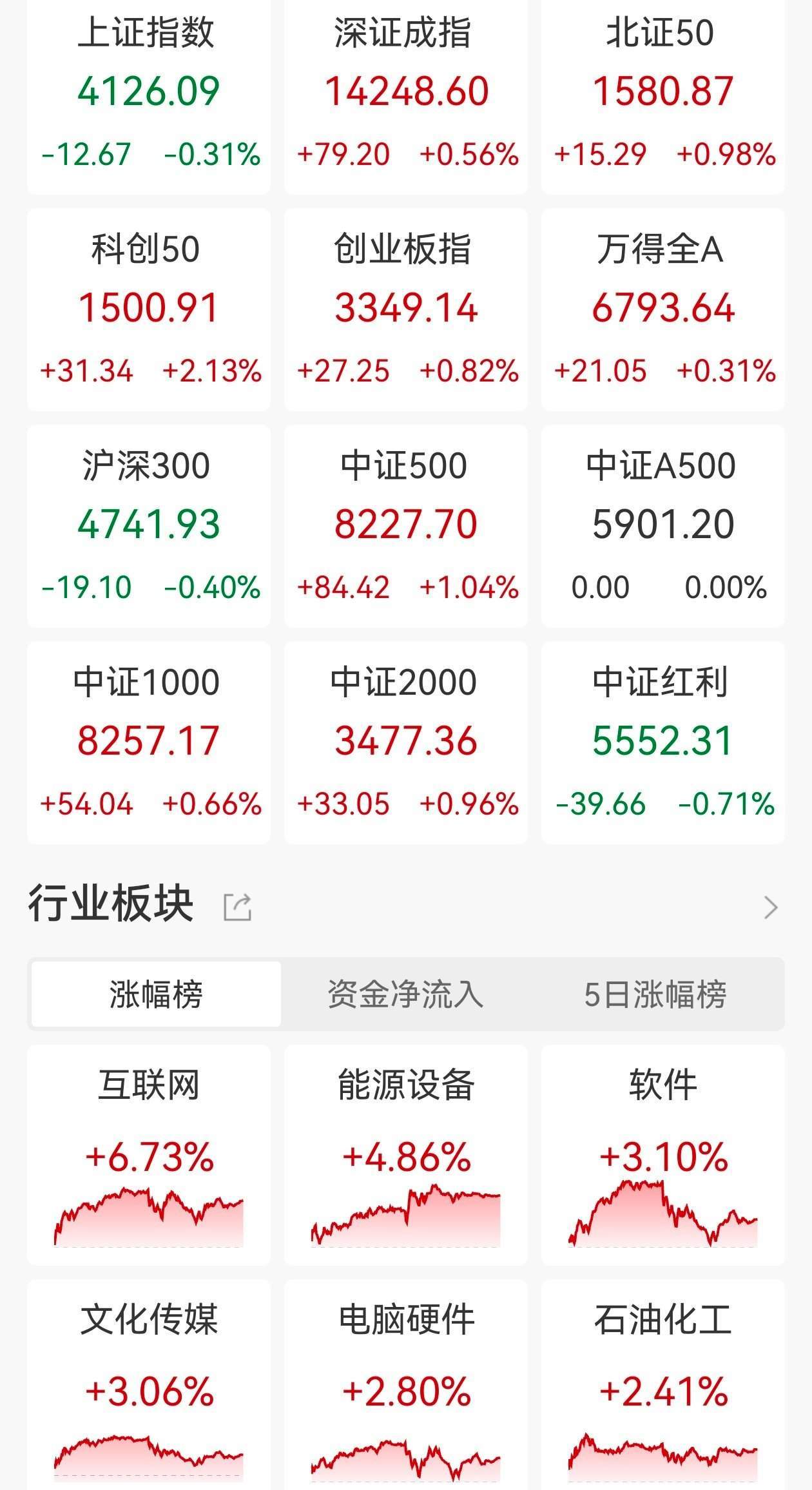
Market Overview - The Shanghai and Shenzhen stock exchanges announced adjustments to the financing margin ratio, leading to a mixed performance in the A-share market, with the Shanghai Composite Index down by 0.31% to 4126 points, while the Shenzhen Component Index rose by 0.56% and the ChiNext Index increased by 0.82% [1] - The total market turnover reached a record high of 3.99 trillion yuan, an increase of 288 billion yuan compared to the previous trading day, with over 2700 stocks rising and nearly 2600 stocks falling [1] Index Performance - Shanghai Composite Index: 4126.09, down 12.67 points (-0.31%) [2] - Shenzhen Component Index: 14248.60, up 79.20 points (+0.56%) [2] - ChiNext Index: 3349.14, up 27.25 points (+0.82%) [2] - Total A-shares Index: 6793.64, up 21.05 points (+0.31%) [2] Sector Performance - The internet sector saw significant gains, with notable stocks like Pinduoduo testing a "100 billion supermarket" concept, leading to a rise in related stocks such as Zhidao and Xinhua [3] - AI application stocks continued to surge, with Kimi concept, AI corpus, and other AI-related stocks leading the gains, resulting in multiple stocks hitting the daily limit [3] - The insurance sector declined, with China Pacific Insurance leading the losses [3] - Lithium mining stocks fell sharply, with Zhongmin Resources dropping over 7% [3] - Other sectors such as banks, robotics actuators, and aviation airports also experienced notable declines [3]




1月14日午间涨停分析




Xin Lang Cai Jing· 2026-01-14 03:57
AI and Digital Marketing - Company launched AI marketing tool eGenius, generating initial AI marketing revenue [2] - Liou Co. introduced a large model in marketing, providing a one-stop intelligent platform for advertising clients [2] - Company developed HochiGEO AI tool for monitoring AI search platforms, offering strategies for content distribution [2] - Company created "Lingxi AI" to assist in marketing processes, integrating various AI services [2] - Company partnered with universities to explore AI applications in intelligent communication [2] Healthcare and Medical Technology - Company implemented AI report interpretation in hospitals, enhancing patient experience and improving medical record quality [4] - Company collaborated with Huawei to develop a health management AI robot, aiming to lead the industry [4] - Company integrated advanced medical management experience with AI products to enhance healthcare information systems [4] Satellite and Communication Technology - Company is a major player in satellite internet, providing integrated baseband and RF chips [5] - Company launched innovative products for smart shipping and satellite internet platforms [4] - Company is involved in low-orbit satellite communication, developing relevant products [4] Financial Technology - Company is a leading provider of smart banking solutions, exploring AI applications in finance [7] - Company is a major shareholder in Tianhong Fund, enhancing its financial service capabilities [7] - Company utilizes blockchain technology to create a digital bill system [7] Consumer Goods and Retail - Company is a leading retail chain in Zhejiang, focusing on prepared food sales [8] - Company is a major player in outbound tourism, exploring "tourism + shopping" business models [8] - Company is a leading e-commerce platform for alcoholic beverages, managing various well-known brands [8]

超百股涨停
财联社· 2026-01-14 03:43
Market Overview - The A-share market experienced a collective rebound, with the Shanghai Composite Index rising over 1%, the ChiNext Index increasing by over 2%, and the Sci-Tech 50 Index gaining more than 4% [1] - The total trading volume in the Shanghai and Shenzhen markets reached 2.22 trillion yuan, a decrease of 215.5 billion yuan compared to the previous trading day [1] Sector Performance - The AI application concept saw a continuous surge, with over twenty constituent stocks hitting the daily limit, including Liou Co., which achieved six consecutive limit-ups in nine days, and Xinhua Net and Sanjiang Shopping, both with three consecutive limit-ups [2] - The semiconductor sector also performed well, with Yaxiang Integration hitting the daily limit and reaching a historical high [2] - The commercial aerospace concept remained active, with Haige Communication achieving three consecutive limit-ups and new highs, alongside multiple stocks like Sanwei Tiandi, Jiayuan Technology, and Datang Telecom hitting the daily limit [2] - The Alibaba Cloud concept continued to rise, with Hangang Co. and Data Port both hitting the daily limit [2] Closing Summary - By the end of the trading session, the Shanghai Composite Index rose by 1.2%, the Shenzhen Component Index increased by 1.98%, and the ChiNext Index gained 2.24% [2]




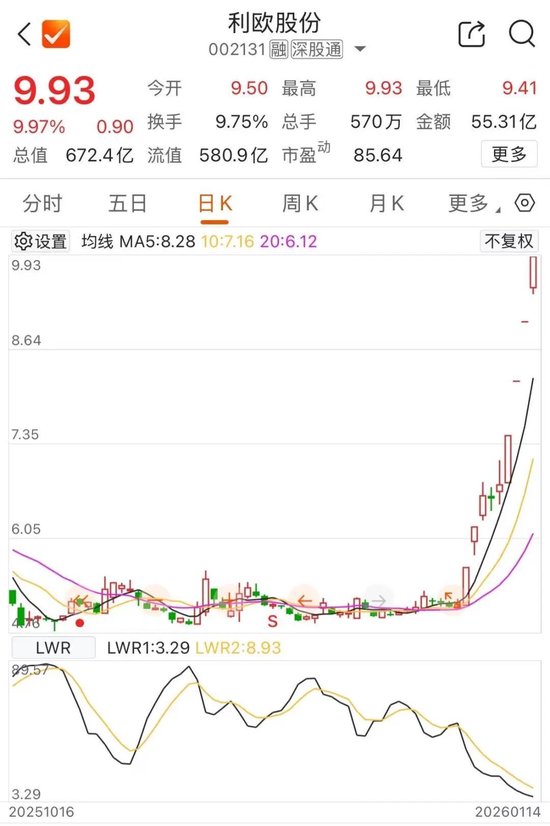
利欧股份连收4个涨停板
Zheng Quan Shi Bao Wang· 2026-01-14 03:09
Core Viewpoint - Liou Co., Ltd. has experienced a significant stock price increase, reaching a limit-up for four consecutive trading days, with a total increase of 46.46% during this period [2] Trading Performance - As of January 13, 2026, the stock price is reported at 9.93 yuan, with a turnover rate of 9.37% and a trading volume of 548 million shares, amounting to a total transaction value of 5.311 billion yuan [2] - The stock's total market capitalization in the A-share market is 67.244 billion yuan, with a circulating market capitalization of 58.088 billion yuan [2] Margin Trading Data - The latest margin trading balance for the stock is 2.068 billion yuan, with a financing balance of 2.058 billion yuan, which has decreased by 182 million yuan compared to the previous trading day, reflecting a decline of 8.13% [2] - Over the past four days, the margin trading balance has cumulatively decreased by 379 million yuan, representing a decline of 15.56% [2] Institutional Activity - The stock has been listed on the Dragon and Tiger list due to a cumulative price deviation of 20% over three trading days and a daily price deviation of 7% [2] - Among the leading trading departments, institutional investors have net bought 309 million yuan, while the Shenzhen Stock Connect has seen a cumulative net purchase of 93.2 million yuan, with total net selling by trading departments amounting to 279 million yuan [2] Recent Trading Data - Recent trading data shows daily price changes, turnover rates, and net inflows of main funds, indicating fluctuating investor sentiment and trading activity [2]
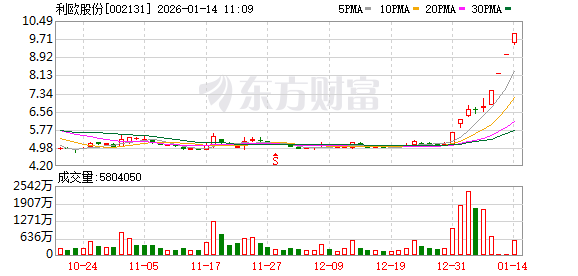
传媒概念股再度爆发,传媒ETF涨超5%
Mei Ri Jing Ji Xin Wen· 2026-01-14 02:52
Group 1 - Media concept stocks have surged again, with Yanshan Technology and Leo Holdings hitting the daily limit, and Kunlun Wanwei rising over 5% [1] - The Media ETF has increased by over 5% due to market influences [1] Group 2 - According to a brokerage, the media industry is expected to recover in terms of prosperity in the medium to long term, driven by the gradual restoration of content supply, deepening AI technology empowerment, policy support, and expectations of consumer recovery [2] - Companies with strong performance in sectors such as film and television theaters, gaming, and advertising marketing are recommended for attention, along with those involved in digital assets and AIGC-related technologies [2]



A股超4500股飘红,AI电商大涨,多股涨停,贵金属再创新高,沪银拉升8%
21世纪经济报道· 2026-01-14 02:45
Core Viewpoint - The article discusses the recent surge in the A-share market, particularly focusing on the "New Easy Zhongtian" concept stocks driven by the emergence of Generative Engine Optimization (GEO) technology, which is reshaping how businesses engage with users through AI-driven search and recommendations [7][9]. Market Performance - On January 14, the A-share market saw all three major indices rise, with the Shanghai Composite Index at 4177.86 (+39.10, +0.94%) and the Shenzhen Component Index at 14430.20 (+260.80, +1.84%) [2]. - The total trading volume in the market exceeded 1 trillion yuan within the first 27 minutes, with a predicted total of 3.39 trillion yuan for the day, reflecting a decrease of over 309.8 billion yuan compared to the previous day [2]. AI and E-commerce Stocks - AI e-commerce stocks experienced significant gains, with companies like Guangyun Technology and Zhidema reaching the daily limit of 20% increase, while others like Tianlong Group and Yidian Tianxia saw increases of over 15% [5][6]. - The "New Easy Zhongtian" trio, including Yidian Tianxia, Zhongwen Online, and Tianlong Group, has seen stock prices rise over 47% since the beginning of the year [5][8]. Generative Engine Optimization (GEO) - GEO is identified as a key driver of the current market rally, as it represents a shift from traditional search engines to AI-generated search, positioning itself as a crucial tool for businesses to capture user traffic [7]. - Despite the hype, there are concerns regarding the actual business value of GEO, with many companies not yet demonstrating a clear link between their revenues and GEO-related activities [7][9]. Company Performance Analysis - Yidian Tianxia reported a revenue of 2.717 billion yuan for the first three quarters of 2025, a year-on-year increase of 54.94%, while Tianlong Group's revenue decreased by 5.84% to 5.459 billion yuan, although its net profit increased significantly [8]. - Zhongwen Online continues to report losses, with a revenue of 1.011 billion yuan and a net loss of 520 million yuan, indicating a widening loss primarily due to overseas operations [8]. Valuation Concerns - The valuation of stocks related to the "New Easy Zhongtian" concept has significantly increased, with some companies showing a disconnect between their market valuations and actual performance [8]. - For instance, BlueFocus has a TTM price-to-earnings ratio of -343.15, indicating severe losses, while the "New Easy Zhongtian" stocks have seen short-term price increases exceeding 47% [8]. Market Sentiment and Risks - Recent announcements from several companies highlight the disconnect between market speculation and actual business performance, with firms like Yidian Tianxia and BlueFocus acknowledging that their AI-driven revenues are still minimal [9]. - The article suggests that while the GEO concept may be subject to speculation, the underlying trend of AI applications in business is expected to be a significant driver in the industry moving forward [9].



002131,4连板
Xin Lang Cai Jing· 2026-01-14 02:21
Market Overview - On January 14, the A-share major indices rose in early trading, with the Shanghai Composite Index up by 0.77%, the Shenzhen Component Index and the ChiNext Index both increasing by over 1%, and the Sci-Tech Innovation Board Index rising by over 2% [1][6] - The precious metals sector led the gains, while the commercial aerospace sector experienced the largest declines [1][6] Sector Performance - The AI e-commerce and GEO concepts showed strong performance, with Liou Co., Ltd. (002131) achieving a four-day consecutive rise, Sanjiang Shopping (three-day consecutive rise), and both Guangyun Technology and Zhidema reaching the daily limit [1][6] - The storage chip sector saw significant fluctuations, with Baiwei Storage rising over 10% during trading, and companies like Guokai Microelectronics, Jiangbolong, Demingli, and Lankai Technology also experiencing gains [4][8] Notable Stocks - Baiwei Storage (佰维存储) rose by 9.93% to 148.82, Guokai Microelectronics (国科微) increased by 9.29% to 133.44, and Jiangbolong (江波龙) rose by 3.77% to 286.90 [5][9] - Other notable stocks included Blue Arrow Electronics (蓝箭电子) up by 9.14%, and Demingli (德明利) up by 3.56% [5][9] Strategic Partnerships - Google announced a collaboration with Walmart and other major retailers to introduce AI shopping features on its Gemini platform [3][8]