
SUNSEA(002313)

Search documents
趋势研判!2025年中国抗代谢药行业整体发展趋势分析:市场需求增长,销售品牌越来越多,行业发展正呈现出多元化趋势[图]
Chan Ye Xin Xi Wang· 2025-09-23 01:39
Core Insights - The article discusses the increasing trend of antimetabolite drugs in China, highlighting the growth in the number of brands and sales volume in recent years [1][5][11] Antimetabolite Drug Industry Definition and Classification - Antimetabolite drugs interfere with normal cellular metabolism to inhibit cell growth and proliferation, primarily used in cancer treatment [4][6] - These drugs are classified into five categories based on their target mechanisms, including thymidylate synthase inhibitors and dihydrofolate reductase inhibitors [2][6] Current Development Status of Antimetabolite Drugs - The number of antimetabolite drug brands in China has increased to 121 in 2024, with a projected rise to 130 by the first quarter of 2025 [5] - The primary product in the market is capecitabine tablets, which accounted for 51.55% of the market share in 2024, with sales of 41,478 million tablets [5][9] Sales and Market Share of Antimetabolite Drugs - In 2024, the sales volume of capecitabine tablets was 41,478 million tablets, while methotrexate tablets and tegafur capsules had sales of 15,343 million tablets and 15,566 million capsules, respectively [5] - By the first quarter of 2025, capecitabine sales were 11,409 million tablets, maintaining a market share of 54.99% [5] Industry Chain of Antimetabolite Drugs - The upstream of the antimetabolite drug industry includes raw materials like methotrexate and fluorouracil, while the midstream focuses on drug development and production [6][8] - The downstream consists of sales and distribution channels, primarily through medical institutions and pharmacies [6] Competitive Landscape of the Antimetabolite Drug Industry - Major companies in the antimetabolite drug market include Qilu Pharmaceutical, Jiangsu Hengrui Medicine, and Shanghai Pharmaceutical, with Qilu holding a market share of 40.67% in 2024 [8][9] - Sales figures for Qilu Pharmaceutical in 2024 included 22,315 million capecitabine tablets and 10,415 million tegafur capsules [8] Development Trends in the Antimetabolite Drug Industry - The demand for antimetabolite drugs is expected to grow due to an aging population and rising chronic disease rates [11] - The industry is characterized by continuous innovation supported by advancements in biotechnology and molecular biology [11]



9月22日这些公告有看头
Di Yi Cai Jing Zi Xun· 2025-09-22 15:00
Major Events - Shengxin Lithium Energy plans to acquire 21% stake in Qicheng Mining for 1.456 billion yuan, increasing its ownership to 70% [3] - Tianpu Co. has seen its stock rise 279.73% over 14 consecutive trading days, but the acquirer Zhonghao Xinying has no asset injection plans [4] - Hangdian Co. reports losses in its optical communication business while its copper foil business is still in the early stages [5] Shareholder Activities - Tianchuang Fashion is launching a shareholder reward event, offering 30% discount coupons to shareholders [6] - Beiliang Co. is collaborating with Tonghuashun for a "Shareholder Festival" event for past investors [7] Production and Operational Changes - Xinxiang Chemical Fiber will halt its biomass cellulose filament production line for 90 days starting October 1, affecting an annual capacity of 31,200 tons and expected revenue loss of approximately 185 million yuan [8] - Baijun Precision plans to transfer 18.29% of its stake in Suzhou Linghou Robotics for 64 million yuan [9] New Contracts and Projects - Tiancheng Self-Control has received a project designation from a leading domestic new energy vehicle company for seat assembly, expected to start production in June 2026 [10] - Huazi Industrial's subsidiary plans to sell dairy farm assets for 38.5 million yuan, impacting current profits by approximately 11.7 million yuan [11] - Oriental Pearl is participating in a special fund to acquire equity in Chaoyuan Digital Technology, with a total investment of 244 million yuan [12] Financial Performance - Changchuan Technology expects a net profit increase of 131.39% to 145.38% year-on-year for the first three quarters of 2025, driven by strong demand in the semiconductor industry [17] Major Contracts - Guangdong Construction has won a construction contract worth 1.924 billion yuan for a property reconstruction project in Guangzhou [18] - Youxunda anticipates winning a procurement project from the State Grid worth approximately 107 million yuan [19] - Samsung Medical is a candidate for multiple procurement projects from the State Grid, with a total expected value of about 193 million yuan [20] Share Buybacks and Financing - Sanfu New Science plans to repurchase shares worth between 10 million and 15 million yuan for employee stock incentives [39] - Guiyan Platinum plans to raise up to 1.291 billion yuan through a private placement for industrial upgrades and working capital [40] - Zhongjing Electronics intends to raise up to 700 million yuan, with the controlling shareholder participating in the subscription [41]


9月22日增减持汇总:中炬高新等3股增持 德明利等29股减持(表)


Xin Lang Zheng Quan· 2025-09-22 14:26
Summary of Key Points Core Viewpoint - On September 22, a total of 29 A-share listed companies disclosed share reduction plans, indicating a trend of insider selling in the market [1]. Group 1: Companies with Share Reduction Plans - Kaidi Co., Ltd. plans to reduce its shares by no more than 380,300 shares [3]. - Rihai Intelligent's largest shareholder intends to reduce its stake by no more than 2.77% [3]. - Xilong Science's controlling shareholders plan to collectively reduce their shares by no more than 3% [3]. - Aopu Optoelectronics' controlling shareholder has completed its reduction plan [3]. - Rijiu Optoelectronics' controlling shareholder, Chen Xiaoli, plans to reduce no more than 3% of the company's shares [3]. - Demingli's controlling shareholder has completed its reduction plan [3]. - Zhongshe Co., Ltd.'s shareholder Chen Fengjun intends to reduce no more than 1% of the company's shares [3]. - Henghui Security's shareholders plan to collectively reduce no more than 2.34% of the company's shares [3]. - Debang Technology's National Integrated Circuit Industry Investment Fund recently reduced its stake by 0.65% [3]. - Chuangli Group's director and deputy general manager, Geng Weidong, plans to reduce no more than 0.6956% of the company's shares [3]. - Zhongdian Electric's shareholder Wang Jiankai intends to reduce no more than 3% of the company's shares [3]. - SF Express' shareholder Liu Jilu plans to transfer no more than 7 million A-shares to his son-in-law [3]. - Tianqin Equipment's shareholder Zhang Peng plans to reduce no more than 1% of the company's shares [3]. - Shuijing Optoelectronics' shareholder Shen Gai Zhen intends to reduce no more than 0.99% of the company's shares [3]. - Yingfite's controlling shareholder plans to reduce no more than 2.82% of the company's shares [3]. - Baicheng Medical's part of the board and supervisors plan to reduce their shares [3]. - Guangting Information's SAIC Venture Capital plans to transfer 3.16% of the company's shares to SAIC Group [3]. - Sihui Fushi's controlling shareholder and its concerted parties recently reduced a total of 385,200 shares [3]. - Baolong Technology's director Wang Shengquan plans to reduce no more than 0.11% of the company's shares [3]. - Saiwei Electronics' National Integrated Circuit Industry Investment Fund recently reduced a total of 6.3481 million shares [3]. - Rizhao Port's Shandong Energy plans to reduce no more than 3% of the company's shares [3]. - Xuelong Group's shareholder Ningbo Lianzhan plans to reduce no more than 1.95% of the company's shares [3]. - China Electric Research's shareholder Kaitian Investment plans to transfer 8.09 million shares [3]. - Lianxiang Co., Ltd.'s shareholders plan to reduce no more than 2.58% and 1.16% of the company's shares [3]. - Yingnuo Laser's shareholder reduction plan has been completed [3]. - Zhejiang Pharmaceutical's shareholder Guotou Gaoke plans to reduce no more than 1% of the company's shares [3]. - Dingyang Technology's shareholders plan to transfer 3.184 million shares, accounting for 2% of the total share capital [3]. - Sanyou Medical's shareholder QM5 LIMITED plans to transfer 6.67 million shares, accounting for 2% of the total share capital [3].
9月22日这些公告有看头
第一财经· 2025-09-22 14:09
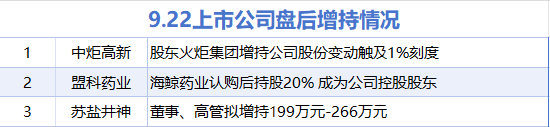
Group 1 - Shengxin Lithium Energy plans to acquire 21% stake in Qicheng Mining for 1.456 billion yuan, increasing its ownership to 70% [4] - Tianpu Co. has seen its stock rise 279.73% over 14 consecutive trading days, but the acquirer Zhonghao Xinying has no asset injection plan [5] - Hangdian Co. reports losses in its optical communication business while its copper foil business is still in the early stages [6][7] Group 2 - Tianchuang Fashion is launching a shareholder reward activity, offering 70% discount coupons to shareholders [8] - Beiliang Co. is collaborating with Tonghuashun to host a "Shareholder Festival" for past investors [9] - Xinxiang Chemical Fiber will undergo a 90-day orderly shutdown for equipment upgrades, affecting 31,200 tons/year capacity and expected revenue loss of approximately 185 million yuan [10] Group 3 - Bozhong Precision plans to transfer 18.29% stake in Suzhou Linghou Robotics for 64 million yuan [11] - Tiancai Self-Control has received a project confirmation from a leading domestic new energy vehicle company for seat assembly, expected to start production in June 2026 [12] - Huazi Industrial's subsidiary plans to sell dairy farm assets for 38.5 million yuan, impacting current profits by approximately 11.7 million yuan [13] Group 4 - Oriental Pearl plans to invest in a special fund to acquire equity in Chaoyuan Digital Technology, committing 244 million yuan [14] - Daotong Technology intends to transfer 46% stake in Shenzhen Saifang Technology for 109 million yuan, focusing on core business development [15] - Lepu Medical has signed a strategic cooperation agreement with Hanhai Information to enhance online sales channels for its aesthetic medicine segment [16] Group 5 - Dingxin Communications clarifies that its technology authorization from Pingtouge is unrelated to AI chip development [17] - Changchuan Technology expects a net profit increase of 131.39% to 145.38% year-on-year for the first three quarters of 2025, driven by strong semiconductor demand [18] Group 6 - Guangdong Construction has won a construction contract worth 1.924 billion yuan for a property reconstruction project [19] - Youxunda is expected to win a procurement project from the State Grid worth approximately 107 million yuan, representing 10.55% of its 2024 revenue [20] - Samsung Medical anticipates winning procurement projects from the State Grid totaling about 193 million yuan [21] Group 7 - Baiyun Electric is a candidate for multiple procurement projects from the State Grid, with a total expected amount of 162 million yuan [22] - *ST Weihe is a candidate for a 141 million yuan engineering project [23] - Plad has signed a strategic cooperation agreement with a well-known international power tool brand for over 700 million yuan in purchases over five years [25] Group 8 - Lanhua Kecai has signed a strategic cooperation agreement with Panhu Power for joint development of axial flux motors [26] - Zhixiang Jintai has entered into commercialization agreements for two monoclonal antibody injections, gaining exclusive rights in various regions [27] - Honggong Technology plans to invest up to 450 million yuan in a project with the Changsha Economic Development Zone [28] Group 9 - Zhejiang Medicine's major shareholder plans to reduce its stake by up to 1% [29] - Su Yan Jingshen's directors plan to collectively increase their holdings by 1.9 to 2.66 million yuan [30] - Zhongdian Electric's shareholder intends to reduce its stake by up to 3% [32] Group 10 - Sanfu New Science plans to repurchase shares worth 10 to 15 million yuan for employee stock incentives [41] - Guiyan Platinum plans to raise up to 1.291 billion yuan for technology innovation and industry upgrades [42] - Zhongjing Electronics plans to raise up to 700 million yuan, with the controlling shareholder participating in the subscription [43]



日海智能:第一大股东拟减持公司不超2.7744%股份
Mei Ri Jing Ji Xin Wen· 2025-09-22 12:45
Group 1 - The major shareholder Zhuhai Runda Tai Investment Partnership plans to reduce its stake in the company by up to 10.3873 million shares, which represents 2.7744% of the total share capital [1]
日海智能:第一大股东拟减持公司不超2.77%股份
Zheng Quan Shi Bao Wang· 2025-09-22 12:40
Group 1 - The largest shareholder of Rihai Intelligent, Zhuhai Rundatai Investment Partnership, plans to reduce its stake by up to 10.3873 million shares, representing 2.77% of the company's total equity [1]
日海智能(002313.SZ):润达泰拟减持不超过2.7744%股份
Ge Long Hui A P P· 2025-09-22 12:34
Group 1 - The core point of the article is that Zhuhai Rundatai Investment Partnership plans to reduce its stake in Rihai Intelligent by selling 10,387,255 shares, which represents 2.7744% of the company's total share capital [1] - The reduction will occur within three months after the announcement, starting 15 trading days from the date of the announcement [1] - The shares will be sold through two methods: a maximum of 1% of the total share capital via centralized bidding and up to 1.7744% through block trading [1]
日海智能:润达泰拟减持不超2.7744%股份
Zhi Tong Cai Jing· 2025-09-22 12:32
Group 1 - The core point of the article is that Zhuhai Rundatai Investment Partnership (Limited Partnership), a shareholder holding 27.7437% of the shares in Rihai Intelligent (002313.SZ), plans to reduce its stake by selling 10.3873 million shares, which accounts for 2.7744% of the company's total share capital [1] Group 2 - The reduction will occur within three months after the announcement, starting 15 trading days from the disclosure date [1] - The shares will be sold through two methods: a maximum of 1% of the total share capital via centralized bidding and up to 1.7744% through block trading [1]
日海智能:润达泰拟减持2.7744%
Xin Lang Cai Jing· 2025-09-22 12:28
Group 1 - The core point of the announcement is that Zhuhai Rundatai, a shareholder holding 27.7437% of the shares, plans to reduce its stake in the company by selling up to 10.3873 million shares between October 22, 2025, and January 21, 2026, which represents 2.7744% of the total shares [1] - The planned reduction includes a maximum of 3.744 million shares to be sold through centralized bidding, accounting for 1% of the total shares [1] - Additionally, up to 6.6433 million shares will be sold through block trading, representing 1.7744% of the total shares [1]
日海智能:润达泰拟减持不超过2.7744%股份
Ge Long Hui· 2025-09-22 12:27
Group 1 - The core point of the article is that Zhuhai Rundatai Investment Partnership plans to reduce its stake in Rihai Intelligent by selling 10,387,255 shares, which represents 2.7744% of the company's total share capital [1] - The reduction will occur within three months after the announcement, starting from 15 trading days post-announcement [1] - The shares will be sold through two methods: a maximum of 1% of the total share capital via centralized bidding and up to 1.7744% through block trading [1]