
OFILM(002456)

Search documents
有色金属行业、石化化工行业稳增长工作方案印发丨盘前情报
2 1 Shi Ji Jing Ji Bao Dao· 2025-09-29 00:29
A-share Market Performance - A-shares saw collective gains across the three major indices from September 22 to September 26, with the Shanghai Composite Index closing at 3828.11 points, up 0.21% for the week [2][3] - The Shenzhen Component Index closed at 13209.00 points, up 1.06%, while the ChiNext Index ended at 3151.53 points, up 1.96% [2][3] - Over 30% of stocks experienced gains during the week, with 126 stocks rising over 15% and 50 stocks declining over 15% [2] Sector Performance - According to the Shenwan industry classification, sectors such as electric equipment, non-ferrous metals, electronics, environmental protection, media, and public utilities saw increases [2] - Conversely, sectors including social services, comprehensive, retail, light industry manufacturing, and textiles and apparel experienced declines [2] International Market Overview - The New York stock market indices rose on September 26, with the Dow Jones Industrial Average increasing by 299.97 points to close at 46247.29 points, a gain of 0.65% [4][5] - The S&P 500 index rose by 38.98 points to 6643.70 points, up 0.59%, and the Nasdaq Composite increased by 99.37 points to 22484.07 points, up 0.44% [4][5] - European indices also saw gains, with the FTSE 100 rising by 70.85 points to 9284.83 points, up 0.77%, and the CAC 40 increasing by 75.26 points to 7870.68 points, up 0.97% [4][5] Commodity Prices - International oil prices increased, with light crude oil futures for November delivery rising by $0.74 to $65.72 per barrel, a gain of 1.14% [4][5] Economic Policies and Initiatives - The State-owned Assets Supervision and Administration Commission (SASAC) held a meeting to discuss the economic operation of state-owned enterprises, focusing on stabilizing electricity and coal prices and preventing excessive competition [6] - The Ministry of Commerce announced that starting January 1, 2026, export licenses will be required for pure electric passenger vehicles to promote healthy trade in new energy vehicles [6] - The People's Bank of China suggested enhancing monetary policy regulation to improve effectiveness and match monetary supply growth with economic growth [7][8] Industry Growth Plans - The Ministry of Industry and Information Technology (MIIT) and other departments issued a growth plan for the non-ferrous metals industry, targeting an average annual growth of around 5% in value added from 2025 to 2026 [9] - A similar plan for the petrochemical industry was also released, emphasizing policy support and financial backing for technological innovation and equipment upgrades [9] Industrial Profit Trends - From January to August, profits of large-scale industrial enterprises in China grew by 0.9%, reversing a previous decline, with significant growth observed in August [10] Market Outlook - Analysts from Everbright Securities expect the A-share market to continue rising post-holiday, with a focus on the TMT sector as a key driver [11] - Open-source Securities suggests a dual-driven market with technology leading, and recommends focusing on high P/E stocks as the market transitions [11][12]





欧菲光:无逾期担保事项和担保诉讼
Zheng Quan Ri Bao· 2025-09-26 14:05
Core Points - O-Film announced on the evening of September 26 that the company has no overdue guarantee matters or guarantee litigation [2] Group 1 - The company confirmed the absence of overdue guarantee matters [2] - The company stated there are no ongoing guarantee litigations [2]
欧菲光(002456) - 关于对外担保事项的进展公告
2025-09-26 10:01
证券代码:002456 证券简称:欧菲光 公告编号:2025-093 欧菲光集团股份有限公司 关于对外担保事项的进展公告 本公司及董事会全体成员保证信息披露的内容真实、准确、完整,没有虚 假记载、误导性陈述或重大遗漏。 特别风险提示: 1、公司分别于2025年2月24日、2025年3月14日召开第六届董事会第三次(临 时)会议、2025年第一次临时股东大会,审议通过了《关于2025年度为合并报表 范围内公司提供担保额度预计的议案》,同意公司及合并报表范围内子公司为合 并报表范围内子公司及公司提供担保,预计总担保额度为不超过人民币724,000 万元(或等值外币),其中为资产负债率低于70%的公司提供担保的额度不超过 人民币154,000万元(或等值外币),为资产负债率70%以上的公司提供担保的额 度不超过人民币570,000万元(或等值外币)。担保额度的有效期为股东大会审议 通过之日起12个月内有效,担保额度生效后,公司过往经批准但尚未使用的为合 并报表范围内公司提供担保的额度自然失效。如单笔担保的存续期超过了决议的 有效期,则决议的有效期自动顺延至单笔担保终止时止,具体的担保期限以最终 签订的合同约定为准。 ...
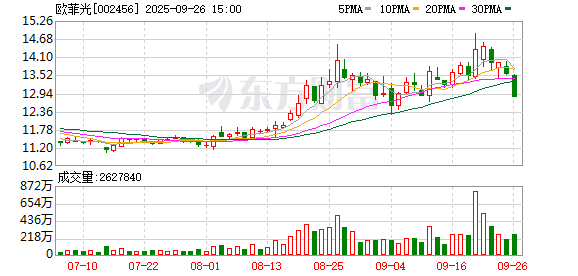
欧菲光跌5.53% 近22个月仅华龙证券一家发研报
Zhong Guo Jing Ji Wang· 2025-09-26 09:51
欧菲光近22个月仅有华龙证券股份有限公司一家券商发布研报,分别为研究员景丹阳2024年8月29日发 布的《欧菲光2024年半年报点评报告:行业复苏+产品升级推动业绩增长现金流大幅改善》,以及研究 员景丹阳2025年4月27日发布的《欧菲光:经营性利润显著提升长期受益国产高端制造》。 中国经济网北京9月26日讯欧菲光(002456)(002456.SZ)今日股价下跌,收报12.81元,跌幅5.53%。 ...
欧菲光:2025年上半年,公司国外销售收入为12.70亿元
Zheng Quan Ri Bao Wang· 2025-09-26 08:15
证券日报网讯欧菲光(002456)9月26日在互动平台回答投资者提问时表示,公司拥有全球化研发团 队,在中国、美国、日本、韩国等地均建立了创新研发中心,并积极与国内外院校、科研机构建立紧密 的合作关系,持续关注市场动态获取行业前沿信息,研发驱动创新,不断实现关键技术突破与产品应 用,加快进口替代。2025年上半年,公司国外销售收入为12.70亿元,占营业收入比重为12.91%。公司 将以全球视野参与国际竞争,积极开拓新市场,寻找新机遇,完善全球销售网络,依托技术创新精准匹 配客户需求,突破关键海外客户,把握海外资本市场的多元化机会,为高质量发展注入新动能。 ...
欧菲光:公司拟通过发行股份的方式购买欧菲微电子的28.2461%股份
Zheng Quan Ri Bao Wang· 2025-09-26 08:15
证券日报网讯欧菲光(002456)9月26日在互动平台回答投资者提问时表示,公司拟通过发行股份的方 式购买欧菲微电子的28.2461%股份,并向不超过35名特定投资者发行股份募集配套资金,交易价格为 179080.5266万元。本次交易拟向南昌产盟发行168467099股股份,占发行后上市公司总股本的比例为 4.78%。具体情况请查阅公司于9月8日发布的《欧菲光集团股份有限公司发行股份购买资产并募集配套 资金报告书(草案)》等公告信息。本次收购事项相关工作正在有序推进中,公司将严格按照相关法律法 规的规定和要求履行信息披露义务。 ...
欧菲光:公司拥有智能手机、智能汽车、新领域三大业务体系
Zheng Quan Ri Bao Wang· 2025-09-26 08:15
Group 1 - The company, O-Film (002456), has been deeply engaged in the optical and optoelectronic field for over 20 years [1] - O-Film has three main business systems: smartphones, smart vehicles, and new fields, providing one-stop optical and optoelectronic product technology services to customers [1] - The main products of the company include optical camera modules, optical lenses, fingerprint recognition modules, machine vision depth cameras, driving domain, cockpit domain, body electronics, and smart locks, covering research, design, production, and sales [1]
欧菲光:公司是国内领先的机器视觉深度相机系统解决方案提供商
Zheng Quan Ri Bao Wang· 2025-09-26 08:12
Core Viewpoint - O-Film is a leading provider of machine vision depth camera system solutions in China, with a strong focus on 3D ToF (Time of Flight) technology and a comprehensive 3D visual perception technology system [1] Company Overview - O-Film has established vertical integration capabilities from chip-level devices, module manufacturing to system integration, leveraging years of expertise in core technologies such as optoelectronic components, optical design, depth algorithms, and advanced manufacturing [1] - The company's technology solutions have been commercially deployed at scale in various fields including smartphones, smart cars, service robots, AR/VR, and IoT (Internet of Things) [1] Robotics Sector - In the robotics sector, O-Film's products are primarily used in vacuum cleaning robots and service robots [1] - The microelectronics team entered the robotics field in 2019 and plans to launch a dual-light source ToF patented architecture solution in 2024, featuring advantages such as "obstacle avoidance + positioning navigation technology," a detection range of 10 meters, low power consumption, high sampling rate, and low computing power [1] - The company aims to continue deepening its focus on the robotics sector, driving innovation and providing cost-effective, high-performance smart product solutions to support industry upgrades [1] Client Relationships - O-Film has established long-term and stable deep cooperation relationships with numerous brand clients [1]
欧菲光:截至9月19日公司股东总户数为535585户
Zheng Quan Ri Bao Wang· 2025-09-26 08:11
证券日报网讯欧菲光(002456)9月26日在互动平台回答投资者提问时表示,截至2025年9月19日,公司 股东总户数(合并普通账户和融资融券信用账户)为535585户。 ...
欧菲光:3D视觉技术商业落地多领域,深耕机器人赛道持续创新
Xin Lang Cai Jing· 2025-09-26 01:15
Core Viewpoint - The company is a leading provider of machine vision depth camera system solutions in China, with a strong focus on 3D ToF (Time of Flight) technology, and aims to enhance its presence in the robotics sector through innovative product offerings [1] Group 1: Company Overview - The company has established a comprehensive 3D visual perception technology system, leveraging years of expertise in core technologies such as optoelectronic components, optical design, depth algorithms, and advanced manufacturing [1] - It has developed vertical integration capabilities from chip-level components to module manufacturing and system integration, enabling large-scale commercial applications in various fields including smartphones, smart cars, service robots, AR/VR, and IoT [1] Group 2: Robotics Sector - The company's products are primarily used in cleaning robots and service robots, with its microelectronics team entering the robotics field in 2019 [1] - In 2024, the company plans to launch a dual-light source ToF patented architecture solution that offers advantages such as obstacle avoidance and positioning navigation technology, a detection range of 10 meters, low power consumption, high sampling rate, and low computational requirements [1] - The company aims to continue deepening its focus on the robotics sector, investing in research and development to provide cost-effective and high-performance smart product solutions to support industry upgrades [1] Group 3: Partnerships and Client Relationships - The company has established long-term and stable collaborative relationships with numerous brand clients, indicating a strong market presence and reliability in its offerings [1]