STO(002468)

Search documents
交通运输行业 10 月投资策略:快递“反内卷”有望带来业绩修复,中美互征港口费有望带动航运运价上行
Guoxin Securities· 2025-10-14 02:13
Investment Rating - The report maintains an "Outperform" rating for the transportation industry [3][5]. Core Views - The express delivery sector is expected to see performance recovery due to the "anti-involution" policies, while the mutual port fees imposed by China and the U.S. are likely to drive shipping rates upward [1][2]. - The shipping industry is facing mixed impacts from the U.S. port fee measures, with over 40% of shipping capacity affected by U.S. fees, while the impact on Chinese shipping capacity is significantly lower [1][20]. - The aviation sector is projected to experience a gradual recovery in ticket prices and profitability as the domestic passenger market continues to optimize supply and demand dynamics [2][34]. - The express delivery industry is witnessing a significant price increase across major production areas, with expectations for this trend to continue through the end of the year [2][43]. Shipping Sector Summary - The implementation of mutual port fees between China and the U.S. is expected to create short-term price volatility, particularly affecting oil and dry bulk shipping more than container shipping [1][20]. - The oil shipping rates have shown a significant increase recently, with VLCC shipping rates rising due to concerns over port congestion and supply chain efficiency [1][20]. - The overall impact of the mutual port fees on shipping rates is limited, but initial chaos from policy implementation may lead to fluctuations [20][21]. Aviation Sector Summary - Domestic passenger flight volumes have decreased slightly post-holiday, but overall traffic remains above 2019 levels [2][33]. - The average domestic ticket price has remained stable, with a slight year-on-year increase [2][34]. - The aviation market is expected to see continued improvement in profitability as supply-demand gaps narrow [34]. Express Delivery Sector Summary - The "anti-involution" policy has led to price increases across approximately 90% of the express delivery volume in China, with expectations for sustained price stability [2][43]. - The report highlights the potential for improved profitability in the express delivery sector during the fourth quarter due to seasonal demand [2][43]. - Major express companies are expected to benefit from the "anti-involution" policies, with specific recommendations for companies like SF Express and ZTO Express [5][54]. Key Company Ratings and Predictions - COSCO Shipping Energy: Outperform, 2025E PE of 12.2 [6]. - SF Express: Outperform, 2025E PE of 17.4, with expected growth of 15-20% in 2026 [6][54]. - ZTO Express: Outperform, with a focus on long-term value and stable returns [5][54].




全球多资产大跌,周期如何看?
2025-10-13 01:00
Summary of Key Points from Conference Call Records Industry Overview - **Global Market Impact**: The global multi-asset market has experienced significant declines due to rising risk aversion stemming from U.S. export controls on Boeing aircraft parts and increased tariffs on Chinese goods, leading to the largest single-day and weekly drops in the Nasdaq and S&P 500 indices since April [1][2][4]. - **Oil Price Decline**: Oil prices have plummeted, with Brent crude and WTI reaching their lowest levels since May, at $62 and $58 respectively, primarily due to improved expectations of oil supply stability following a ceasefire agreement between Israel and Hamas [1][5][4]. Company-Specific Insights - **Boeing and Chinese Airlines**: The U.S.-China trade war may position Boeing aircraft and parts as key negotiation points, potentially leading to delays in deliveries to Chinese airlines, which currently hold at least 222 Boeing aircraft orders [1][6][7]. - **Airline Sector Performance**: The increase in passenger load factors during the National Day holiday and the drop in oil prices are favorable for airline stocks, with recommendations for Huaxia Airlines and major Hong Kong banks [1][6][7]. - **Shipping Industry**: The initial impacts of the U.S.-China trade war on goods trade may paradoxically benefit shipping rates due to potential stockpiling after a short-term decline in imports, with COSCO Shipping recommended as a core investment [1][8]. Sector Analysis - **Express Delivery Industry**: A price increase in express delivery services in Henan signals the start of a second wave of price hikes, with expectations for similar increases in other regions ahead of the Double Eleven shopping festival. Companies like YTO Express and Shentong Express are recommended [3][10]. - **Chemical Industry**: Chemical product prices have slightly decreased due to the trade war, with a focus on resource-based fertilizers and agricultural chemicals for growth opportunities. Berkshire Hathaway's acquisition of a chemical division indicates investment potential in leading chemical firms [3][11]. - **Coal Industry**: Coal demand has exceeded expectations, with long-term contracts priced higher than spot prices, indicating strong winter replenishment demand. Companies like China Shenhua and Shaanxi Coal are highlighted for their high dividend yields [3][19]. Additional Insights - **Trade War Effects on Logistics**: The trade war's impact on logistics and shipping may create volatility, but it also presents opportunities for investment in companies less affected by U.S.-China tensions, such as JIAYOU International and Jitu Express [1][9]. - **Chemical Sector Recovery**: The chemical sector is expected to see a recovery in profitability, with price increases anticipated in October. Key players like Sanyou Chemical and Zhongtai Chemical are recommended for investment [11][13][17]. - **Agricultural Chemicals**: The market for agricultural chemicals is showing signs of recovery, with price increases expected for glyphosate and potassium fertilizers, suggesting investment in leading firms like Xingfa Group and Jiangshan Chemical [15]. This summary encapsulates the critical insights and recommendations from the conference call records, providing a comprehensive overview of the current market dynamics and investment opportunities across various sectors.




中方港口费反制航运造船再迎历史机会,滞港效率损失油散运费受益,关注中国制造船舶是否豁免
Shenwan Hongyuan Securities· 2025-10-12 11:51
Investment Rating - The report does not explicitly state an investment rating for the industry Core Views - The shipping and shipbuilding industry is poised for historical opportunities due to China's countermeasures against the U.S. shipping fees, which may lead to non-linear price increases in the short term and a reduction in available vessels in the medium term [19][20] - The report highlights the potential for a surge in shipbuilding orders if U.S. investments in Chinese shipbuilding are exempted from tariffs, and the implications of U.S.-China negotiations on the industry [19][20] Summary by Sections 1. Industry Market Performance - The transportation index increased by 1.09%, outperforming the CSI 300 index by 1.60 percentage points, with the road freight sector showing the highest increase of 3.04% [4][5] - Shipping data indicates that the coastal dry bulk freight index in China remained stable, while the Shanghai export container freight index rose by 4.12% [4][5] 2. Sub-industry Weekly Insights - The shipping and shipbuilding sector is expected to benefit from China's recent regulatory changes, which impose special port fees on U.S. vessels, potentially leading to increased operational costs for U.S. shipping companies [20][21] - The report identifies key companies to watch, including China Shipping and China State Shipbuilding, as they may benefit from these developments [19] 3. High Dividend Stocks in Transportation - The report lists high dividend stocks in the transportation sector, including China Shipping (603167.SH) with a projected dividend yield of 10.92% and Daqin Railway (601006.SH) with a yield of 3.75% [17] - The report emphasizes the importance of dividend yields as a factor for investment decisions in the transportation sector [17] 4. ETF Size Changes - The report provides data on the changes in the size of various ETFs related to the transportation sector, indicating a general trend of growth in assets under management [13][14] 5. Potential Investment Opportunities - The report suggests that the shipping sector, particularly oil tankers and dry bulk carriers, may present significant investment opportunities due to the ongoing geopolitical tensions and regulatory changes [19][20] - Companies such as China Shipping and China State Shipbuilding are highlighted as potential beneficiaries of these market dynamics [19]


交运行业2025Q3业绩前瞻:快递三季报验证利润修复弹性,造船进入业绩释放,把握油运造船上行机会
Shenwan Hongyuan Securities· 2025-10-10 13:49
Investment Rating - The report maintains an "Overweight" rating for the transportation industry, indicating a positive outlook compared to the overall market performance [12]. Core Insights - The report highlights a recovery in profits for the express delivery sector driven by anti-competition policies, with an expected increase in prices leading to improved profitability for companies like Shentong Express and YTO Express [5][6]. - The shipping sector is experiencing strong demand, particularly for oil tankers, with historical high freight rates observed in August and September 2025. The report anticipates continued demand growth due to OPEC+ production increases and a release of pent-up inventory demand [5]. - The shipbuilding industry is in a phase of profit release as high-priced orders are being delivered, with a strong demand for replacing old vessels. The report notes that the implementation of the 301 policy is expected to stimulate order volumes and ship prices [5]. - The airline sector is projected to see significant improvements in operational performance due to increased capacity and a recovery in international travel, with major airlines like China Eastern Airlines and Southern Airlines expected to benefit [5][6]. - The report also indicates that the highway and railway sectors are likely to maintain growth in traffic volumes, with improvements in railway freight performance anticipated due to the retraction of previous freight rate reductions [5]. Summary by Sections Shipping - Oil tanker freight rates reached historical highs in August and September 2025, with a projected 14% decline in VLCC market rates for Q3, while Cape-sized bulk carriers are expected to see a 19% increase in rates [5]. - The report recommends companies such as China Merchants Energy Shipping and China Merchants Heavy Industry, highlighting the strong demand and supply constraints in the sector [5]. Shipbuilding - The shipbuilding industry is characterized by a tight supply-demand balance, with ongoing demand for replacing old vessels. The report suggests that the implementation of the 301 policy will positively impact order volumes and ship prices [5]. - Recommended companies include China Shipbuilding Industry Corporation and China State Shipbuilding Corporation, which are expected to benefit from the current market dynamics [5]. Airlines - The airline sector is entering a peak travel season with increased capacity and improved passenger flow. The report anticipates significant operational improvements for major airlines due to favorable external factors such as lower oil prices [5][6]. - Companies like China Eastern Airlines and Spring Airlines are highlighted as key beneficiaries of this trend [5]. Express Delivery - The express delivery sector is expected to see a recovery in profits due to rising prices and reduced competition. The report notes a 12.3% year-on-year growth in express delivery volume in August 2025 [5]. - Recommended companies include Shentong Express and YTO Express, which are expected to benefit from the ongoing price increases [5]. Highway and Railway - The report forecasts growth in highway traffic and railway passenger and freight volumes, with a notable increase in railway freight performance expected in Q3 2025 [5]. - Recommended companies include Zhejiang Huhangyong and Beijing-Shanghai High-Speed Railway, which are expected to perform well in the current environment [5].




东莞证券2025年四季度股票组合
Dongguan Securities· 2025-10-10 10:59
Investment Themes - Recommended stocks include Huaxin Cement, China State Construction, and Ningde Times in the cyclical sector[2] - In the consumer sector, recommended stocks include Hengrui Medicine and Shanxi Fenjiu[2] - In the power equipment and new energy vehicle sector, recommended stocks include Ningde Times and Goldwind Technology[2] - In the TMT sector, recommended stocks include Longi Green Energy and Luxshare Precision[2] Market Performance - As of September 30, 2025, the Shanghai Composite Index rose by 12.73%, the Shenzhen Component Index by 29.25%, and the ChiNext Index by 50.40%[4] - The average gain of the recommended stock portfolio was 33.11%, significantly outperforming the CSI 300 Index's gain of 17.90%[4] - Key outperformers included Huaxin Cement and Ningde Times, with quarterly gains exceeding 50%[4] Economic Outlook - The macroeconomic environment remains stable, with a focus on "appropriate easing" in monetary policy to support growth[4] - The manufacturing PMI showed signs of recovery but remained in contraction territory as of September[4] - The report anticipates continued inflow of foreign capital due to the Federal Reserve's interest rate cuts, enhancing the attractiveness of equity assets[4] Company Highlights - Huaxin Cement's projected EPS for 2025 is 1.30, with a PE ratio of 14.27[6] - China State Construction's projected EPS for 2025 is 1.16, with a PE ratio of 4.68[12] - China Rare Earth's projected EPS for 2025 is 0.34, with a PE ratio of 150.92[25] - Hengrui Medicine's projected EPS for 2025 is 1.26, with a PE ratio of 56.90[33]





申通快递9月30日获融资买入5188.02万元,融资余额5.00亿元
Xin Lang Cai Jing· 2025-10-09 01:26
Core Insights - Shentong Express experienced a slight decline of 0.06% in stock price on September 30, with a trading volume of 378 million yuan [1] - The company reported a financing buy-in amount of 51.88 million yuan and a net financing buy of 15.10 million yuan on the same day [1][2] - As of June 30, Shentong Express achieved a revenue of 25.02 billion yuan, marking a year-on-year growth of 16.02% [2] Financing Overview - On September 30, the total financing and securities lending balance for Shentong Express reached 501 million yuan, which is 1.85% of its circulating market value [1] - The financing balance is above the 90th percentile of the past year, indicating a high level of financing activity [1] - The securities lending data shows a repayment of 47,700 shares and a remaining balance of 128,520 yuan, also above the 70th percentile of the past year [1] Shareholder and Dividend Information - As of June 30, the number of shareholders increased by 11.27% to 42,500, while the average circulating shares per person decreased by 10.13% [2] - Since its A-share listing, Shentong Express has distributed a total of 1.614 billion yuan in dividends, with 131 million yuan distributed in the last three years [2] - The top ten circulating shareholders include Hong Kong Central Clearing Limited, which reduced its holdings by 19.72 million shares [2]
快递涨价潮继续 快递公司8月单票收入环比增长
Di Yi Cai Jing· 2025-09-30 10:12
Core Viewpoint - The recent wave of express delivery price increases is primarily aimed at e-commerce shipments, with various regions in China implementing price hikes to improve market competition and service quality [1][2]. Group 1: Price Increases Overview - Starting from October 1, express delivery fees in Sichuan will be raised, following similar increases in multiple provinces and cities across the country [1]. - Zhejiang province was the first to raise express delivery fees in mid-July, with the base price increasing from 1.1 yuan to 1.2 yuan per order [1]. - In August, express delivery companies in Guangdong collectively raised their base prices to an average of over 1.4 yuan per order, with other regions like Fujian and Jiangsu also announcing price hikes [1]. Group 2: Impact on Different Customer Segments - The current price adjustments mainly affect large e-commerce clients, particularly those sending over 500 packages a day, with increases ranging from 0.2 yuan to 0.4 yuan [2]. - Personal and small clients are less affected, as their pricing is not significantly low [2]. - Some clients have started to shift to other locations for shipping due to the price increases, raising questions about customer retention [2]. Group 3: Industry Insights and Expectations - Industry experts indicate that the price hikes are policy-driven, aimed at curbing unhealthy competition and enhancing service quality [2]. - There is optimism among delivery points regarding the price increases, as they believe it will lead to profitability despite potentially handling fewer packages [2]. - Data from several express companies show an increase in average revenue per package in August compared to July, with Shentong reporting 2.06 yuan per package (up 4.6%), Yunda at 1.92 yuan (up from 1.91 yuan), and Yuantong at 2.15 yuan (up 3.4%) [2].

快递涨价潮继续,快递公司8月单票收入环比增长
Di Yi Cai Jing· 2025-09-30 09:40
Core Viewpoint - The recent increase in express delivery fees primarily targets low-priced e-commerce orders, with minimal impact on individual shipments [1][5]. Group 1: Price Adjustments - A wave of express delivery fee increases is ongoing, with several provinces and cities in China raising prices, particularly for e-commerce collection fees [2]. - The earliest price increase occurred in Zhejiang Province, where the base price rose from 1.1 yuan to 1.2 yuan per order in mid-July [2]. - In August, express companies in Guangdong collectively raised their base prices to over 1.4 yuan per order, with other regions like Fujian and Jiangsu following suit [2]. Group 2: Impact on Companies - Major express companies, including Yunda, Yuantong, and Zhongtong, announced price increases in Shanghai, with increments ranging from 0.2 yuan to 0.4 yuan [3]. - The price adjustments are driven by policies aimed at curbing vicious competition in the industry and improving service quality [5]. - Some express companies reported an increase in average revenue per order in August compared to July, with Shentong's revenue at 2.06 yuan (up 4.6%), Yunda at 1.92 yuan, and Yuantong at 2.15 yuan (up 3.4%) [5]. Group 3: Customer Behavior - The price increases have led to fluctuations in customer behavior, with some clients opting for alternative shipping methods after the price hikes [5]. - The return of customers to express services may take time, depending on the price adjustments in other provinces [5].


物流板块9月30日跌0.09%,福然德领跌,主力资金净流出1.11亿元
Zheng Xing Xing Ye Ri Bao· 2025-09-30 08:44
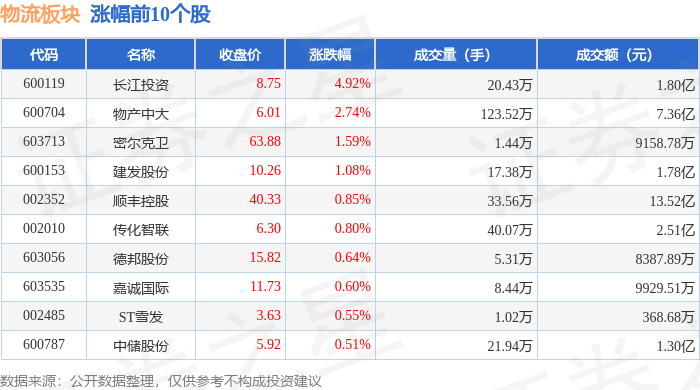
Core Insights - The logistics sector experienced a slight decline of 0.09% on September 30, with Furan De leading the drop [1] - The Shanghai Composite Index closed at 3882.78, up 0.52%, while the Shenzhen Component Index closed at 13526.51, up 0.35% [1] Stock Performance - Jiangsu Investment (600119) saw a significant increase of 4.92%, closing at 8.75 with a trading volume of 204,300 shares and a turnover of 180 million [1] - Other notable gainers included Wuchan Zhongda (600704) up 2.74% and Milkway (603713) up 1.59% [1] - Furan De (605050) led the declines with a drop of 3.95%, closing at 17.00 with a trading volume of 158,000 shares and a turnover of 273 million [2] Capital Flow - The logistics sector experienced a net outflow of 111 million from institutional investors, while retail investors saw a net inflow of 126 million [2] - Major stocks like Wuchan Zhongda and SF Holding had mixed capital flows, with Wuchan Zhongda seeing a net inflow of 43.38 million from institutional investors [3] - SF Holding (002352) had a net inflow of 40.77 million from institutional investors but faced outflows from retail investors [3]


快递集体涨价,到底是谁扛不住啊?
3 6 Ke· 2025-09-29 23:28
Core Viewpoint - The recent collective price increase in the express delivery industry is expected to impact consumer prices, as the costs will ultimately be passed on to consumers [1][4][19]. Group 1: Price Increase Factors - The price increase in express delivery services is attributed to multiple factors, including rising operational costs and a competitive pricing environment [5][12]. - Major express companies such as Zhongtong, Yuantong, and Shentong have raised their prices by approximately 0.2 to 0.4 yuan per package [5]. - The express delivery industry has seen a significant increase in volume, with a total of 95.64 billion packages delivered in the first half of the year, representing a year-on-year growth of 19.3% [10]. Group 2: Impact on Companies - Despite the increase in delivery volume, the average price per package has decreased from 8.15 yuan to 7.52 yuan, leading to compressed profit margins for express companies [12]. - The financial performance of major express companies shows varied results, with SF Holding reporting a revenue of 146.86 billion yuan, a year-on-year increase of 9.26%, while Yunda's net profit dropped by 49.19% [12]. - The price increase is seen as a necessary step to alleviate the pressure of intense competition and improve the financial health of express companies [13][26]. Group 3: Implications for Delivery Personnel - The increase in delivery prices raises questions about whether it will lead to improved wages for delivery personnel, who number around 4.5 million and handle a substantial volume of packages [14][17]. - There are concerns that if delivery personnel do not see a corresponding increase in income, service quality may continue to decline due to low motivation [16][17]. Group 4: Effects on E-commerce and Consumers - E-commerce businesses are likely to feel the impact of increased delivery costs, which may lead to higher prices for consumers as merchants adjust to maintain profitability [19][21]. - The ongoing pressure on e-commerce platforms to keep prices low may result in merchants either raising prices or finding ways to cut costs, further complicating the balance between profitability and consumer pricing [22][24]. Group 5: Industry Transformation - The price increase is viewed as a first step towards transforming the express delivery industry from a focus on scale to one of high-quality development [26][27]. - Regulatory bodies are emphasizing the need to curb excessive price competition, indicating that the industry must adapt to ensure sustainable growth in the long term [27][28].