
速冻米面制品

Search documents
安井食品(603345):主业表现积极,25Q4净利率改善
EBSCN· 2026-03-31 14:31
Investment Rating - The report maintains a "Buy" rating for the company [6] Core Views - The company achieved total revenue of 16.193 billion yuan in 2025, a year-on-year increase of 7.05%, while the net profit attributable to shareholders decreased by 8.46% to 1.359 billion yuan [1] - In Q4 2025, the company reported a revenue of 4.822 billion yuan, representing a year-on-year growth of 19.05%, with a net profit of 410 million yuan, down 6.34% [1][2] - The company plans to distribute a cash dividend of 1.44 yuan per share, totaling 478 million yuan [1] Revenue Performance - Revenue from frozen prepared foods, frozen dishes, frozen rice and noodle products, and baked goods for 2025 was 8.45 billion, 4.82 billion, 2.4 billion, and 0.68 billion yuan respectively, with year-on-year growth rates of 7.8%, 10.8%, -2.6%, and NA [2] - In Q4 2025, revenue from frozen prepared foods, frozen dishes, and frozen rice and noodle products grew by 25.8%, 16.3%, and 5.3% year-on-year [2] Profitability Analysis - The gross margin for 2025 was 21.6%, a decrease of 1.7 percentage points year-on-year, attributed to lower capacity utilization and increased raw material costs [3] - The company recorded a net profit margin of 8.69% in Q4 2025, showing improvement due to enhanced sales and reduced promotional efforts [3] Profit Forecast and Valuation - The net profit forecasts for 2026 and 2027 have been raised to 1.72 billion and 1.86 billion yuan, respectively, reflecting increases of 13.7% and 11.2% from previous estimates [4] - The current stock price corresponds to a P/E ratio of 17, 16, and 15 for 2026, 2027, and 2028 respectively [4]

2025-2026年中国速冻食品行业趋势洞察白皮书-艾媒咨询
Sou Hu Cai Jing· 2026-02-13 08:23
Industry Overview - The Chinese quick-frozen food industry is entering a golden development period from 2025 to 2026, with a market size expected to reach 213.09 billion yuan in 2025 and 290.14 billion yuan by 2030, driven by a compound annual growth rate (CAGR) of 6.4% [1][11] - The frozen snack segment is particularly promising, projected to grow to 35.3 billion yuan in 2025 and 69.76 billion yuan by 2030 [1][58] - Southeast Asia is emerging as a new market for Chinese quick-frozen food exports, leveraging cost and supply chain advantages [1] Market Drivers - The industry is supported by favorable national policies focusing on standardized development frameworks for prepared dishes and cold chain logistics [1][21] - Stable raw material supply and comprehensive cold chain logistics are foundational for industry growth [1][21] - Changes in family structure, increased employment among urban women, and rising demand for standardized dining experiences are contributing to market expansion [1][29] Consumer Insights - The primary consumer demographic for quick-frozen foods consists of married individuals aged 25-44 with middle to high incomes, primarily in new first-tier and second-tier cities [2] - Consumer preferences are shifting from basic convenience to quality and personalization, with popular products including dumplings, grilled sausages, and hand-held pancakes [2] - There is a growing concern among consumers regarding excessive additives and hygiene issues, leading to a demand for cleaner labels and enhanced safety in product formulations [2][11] Product Trends - The industry is witnessing a transformation towards healthier, emotional, and distinctive products, with a rise in clean label and low glycemic index (GI) offerings [2][3] - New product iterations are extending from home dining to diverse scenarios such as hot pot and fast food [2] - Leading companies like Chunxue Foods and Meiliangfang are excelling through comprehensive supply chain management and product innovation [2] Competitive Landscape - The current competitive landscape shows low concentration, with the top three companies holding less than 40% market share [1] - While leading firms maintain stable growth, they face profit pressures, and there is a noticeable divergence among small and medium-sized enterprises [1] - Traditional product categories are losing market share, while items like hot pot meatballs and frozen sausages continue to grow [1] Industry Challenges - The industry faces challenges such as high cold chain costs, consumer misconceptions, raw material price fluctuations, and intensified cross-industry competition [3] - Companies need to accurately understand consumer demands and leverage technological innovations and supply chain optimizations to gain a competitive edge [3]


安井食品午后一度涨近4% 股价刷新上市以来新高
Xin Lang Cai Jing· 2026-02-06 06:48
Core Viewpoint - Anjuke Foods (02648) has seen its stock price rise nearly 4% during trading, reaching a new high of 80.80 HKD since its listing, indicating strong market performance and investor confidence [1] Company Performance - As of the latest report, Anjuke Foods' stock price increased by 2.77%, currently trading at 79.80 HKD with a transaction volume of 96.45 million HKD [1] - The company is transitioning from a channel-oriented approach to a product-oriented strategy, which is expected to help capture industry growth opportunities and gain market share [1] Product Segments - Frozen prepared products, which form the company's core business, are anticipated to see a recovery in both volume and price driven by innovations like "fresh-lock packaging" [1] - The frozen rice and noodle products are expected to gradually recover growth supported by product transformation and channel enhancements [1] - The frozen dishes segment is projected to maintain a growth rate faster than the overall market, bolstered by the introduction of new products such as shrimp rolls, small crispy meat, grilled sausages, and beef and lamb rolls [1]
港股异动 | 安井食品(02648)涨近4% 股价刷新上市以来新高 机构看好公司市场份额进一步增长
智通财经网· 2026-02-06 05:47
Group 1 - The core viewpoint of the article highlights that Anjuke Foods (02648) has seen a nearly 4% increase in stock price, reaching a new high of 80.8 HKD since its listing, with a trading volume of 78.6 million HKD [1] Group 2 - According to Donghai Securities, the overall performance of the food and beverage categories is expected to improve by Q4 2025, with frozen food sales projected to increase by 6.5% year-on-year and show quarter-on-quarter improvement [1] - Specific product categories such as hot pot meatballs, frozen sausages, and shrimp slides have seen significant sales growth, with year-on-year increases of approximately 15%, 45%, and 55% respectively [1] - Sales of pizzas and frozen prepared beef are expected to grow year-on-year by over 35% and 25%, while small crispy meat sales are projected to increase by about 20% [1] Group 3 - Caixin Securities notes that Anjuke Foods is transitioning from a channel-oriented approach to a product-oriented strategy, which is expected to help the company recapture industry growth opportunities and gain market share [1] - The company's core frozen prepared products are anticipated to see a recovery in both volume and price, driven by innovations such as "fresh-lock packaging" [1] - Frozen rice and noodle products are expected to gradually recover growth supported by product transformation and channel backing, while frozen dishes are projected to maintain a growth rate faster than the overall market due to the introduction of products like shrimp slides, small crispy meat, grilled sausages, and beef and lamb rolls [1]
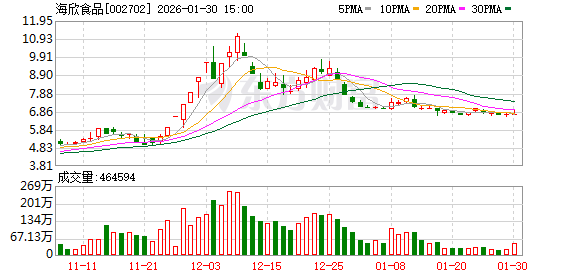
海欣食品:预计2025年亏损3700万元-5200万元
Zhong Guo Zheng Quan Bao· 2026-01-30 09:56
Core Viewpoint - Company Haixin Food (002702) expects a net loss attributable to shareholders of 37 million to 52 million yuan for the year 2025, indicating a similar loss compared to the previous year [4] Financial Performance - The expected net profit loss for 2025 is between 37 million and 52 million yuan, compared to a loss of 36.94 million yuan in the same period last year [4] - The expected non-recurring net profit loss is projected to be between 45 million and 62 million yuan, compared to a loss of 43.58 million yuan in the previous year [4] - Basic earnings per share are estimated to be between -0.0666 yuan and -0.0936 yuan [4] Valuation Metrics - The company's price-to-book ratio (LF) is approximately 3.57 times, and the price-to-sales ratio (TTM) is about 2.43 times based on the latest closing price [4] - Historical price-to-earnings ratio trends indicate significant fluctuations, with the company experiencing negative earnings in recent years [5][6][19] Business Operations - The primary business activities of the company include the production and sale of frozen fish and meat products, frozen rice and noodle products, frozen dishes, and ambient fish and meat products [13] - The anticipated performance decline is attributed to several factors, including the ramp-up phase of its subsidiary Fujian Changheng Food Co., Ltd., which began production in the second half of 2024, leading to high fixed cost amortization [13] - The company is also investing in channel development and brand promotion, while new product categories have not yet achieved expected sales volumes [13]

血泪教训,2025供应链行业的“生死局”
3 6 Ke· 2025-12-23 01:20
Group 1 - The supply chain industry is undergoing significant turmoil, with both successful and failed companies facing unique challenges and lessons learned from the past year [1] - Companies like Huangshi Group have faced severe penalties for financial misconduct, highlighting the risks associated with concealing financial information [2][3] - Huangshi Group's diversification into unrelated sectors has led to a dilution of its core business and financial instability, resulting in substantial losses [4][6] Group 2 - ST Jiajia has lost its controlling shareholder and is facing governance issues, which may hinder its strategic decision-making and future opportunities [7][10] - The founder of ST Jiajia has accumulated significant personal debt, leading to legal troubles and further complicating the company's situation [8][12] - The case of Green Earth highlights the risks of heavy asset reliance in the agricultural sector, where poor cash flow management can lead to severe consequences [13][16] Group 3 - Furen Food has entered a state of crisis, with multiple executives leaving and the company halting operations due to financial difficulties [17][19] - The decline of Furen Food reflects broader challenges in the frozen food industry, particularly the impact of e-commerce and changing consumer preferences [19] - Jiangsu Hongjiu's financial collapse illustrates the dangers of overexpansion and reliance on a single market segment, leading to unsustainable debt levels [20][22] Group 4 - Xiwang Food has seen a significant drop in its stock holdings by its major shareholder, raising concerns about the company's governance and financial stability [21][23] - The decline in revenue for Xiwang Food is attributed to increased competition and a lack of brand recognition in a crowded market [25][26] - Tianrun Dairy has reported its first loss in a decade, driven by market price wars and operational challenges, prompting strategic adjustments [27][30] Group 5 - Qianhe Flavor Industry has faced a crisis due to product quality issues, leading to a decline in consumer trust and financial performance [33][35] - The company's struggles underscore the importance of maintaining transparency and quality in the supply chain to build consumer confidence [36] - The experiences of these eight companies collectively highlight critical survival principles in the supply chain sector, such as focusing on core business, maintaining cash flow, and ensuring strong governance [37]


机器设备成了海欣食品募投项目的“卡脖子”难题?
Zhong Guo Jing Ying Bao· 2025-12-22 11:41
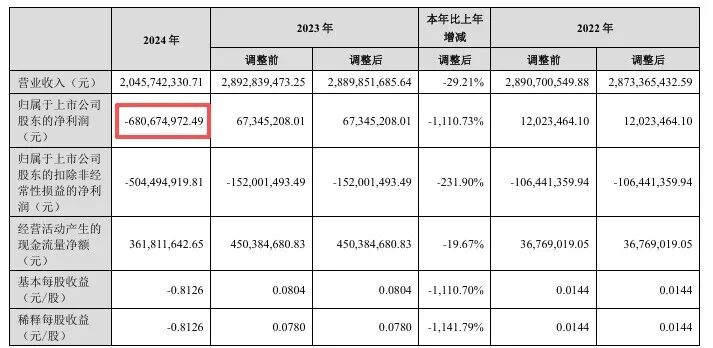
Core Viewpoint - Haixin Food has postponed its fundraising project for deep processing of aquatic products and frozen dishes due to equipment installation delays, extending the completion date from December 2025 to June 2026 [1][2]. Group 1: Project Delay and Financials - The fundraising project was initially planned to raise 376 million yuan (net amount of 365 million yuan) for the deep processing of aquatic products and to supplement working capital [1]. - As of now, 310 million yuan has been utilized from the raised funds, with the project experiencing delays attributed to equipment procurement and installation issues [1][2]. - The project had previously been postponed in November 2024 for similar reasons, indicating ongoing challenges in the construction process [1][2]. Group 2: Business Performance - In 2024, Haixin Food's revenue from frozen fish and meat products declined by 18.17%, while revenue from frozen dishes increased by 61.11% to 483 million yuan [3]. - However, in the first half of this year, sales and production volumes for frozen fish and meat products dropped by over 20%, and for frozen dishes, the decline exceeded 30% [3]. - For the first three quarters of this year, the company reported a revenue of 970 million yuan, a decrease of 15.05%, and a net loss of 28.19 million yuan, down 17.94% year-on-year [3]. Group 3: Market and Industry Trends - The pre-made dish market is facing challenges, with consumer skepticism regarding safety and nutrition due to a lack of national standards [3]. - Many companies in the pre-made dish sector, including Guolian Aquatic Products and Huifa Foods, have reported declines in net profit, indicating a broader industry trend [6]. - The domestic consumption market remains stable, with many companies still in the process of digesting previously invested capacities, leading to delays or cancellations of expansion projects [5][6]. Group 4: Future Strategies - Haixin Food plans to optimize its product structure, focusing on high-margin and high-demand core categories while expanding sales channels [6]. - The company aims to enhance cost control across the entire process, from raw material procurement to logistics, to improve overall profitability [6].
6天6涨停!又一爆火大妖股,崩了?
Xin Lang Cai Jing· 2025-12-04 11:27
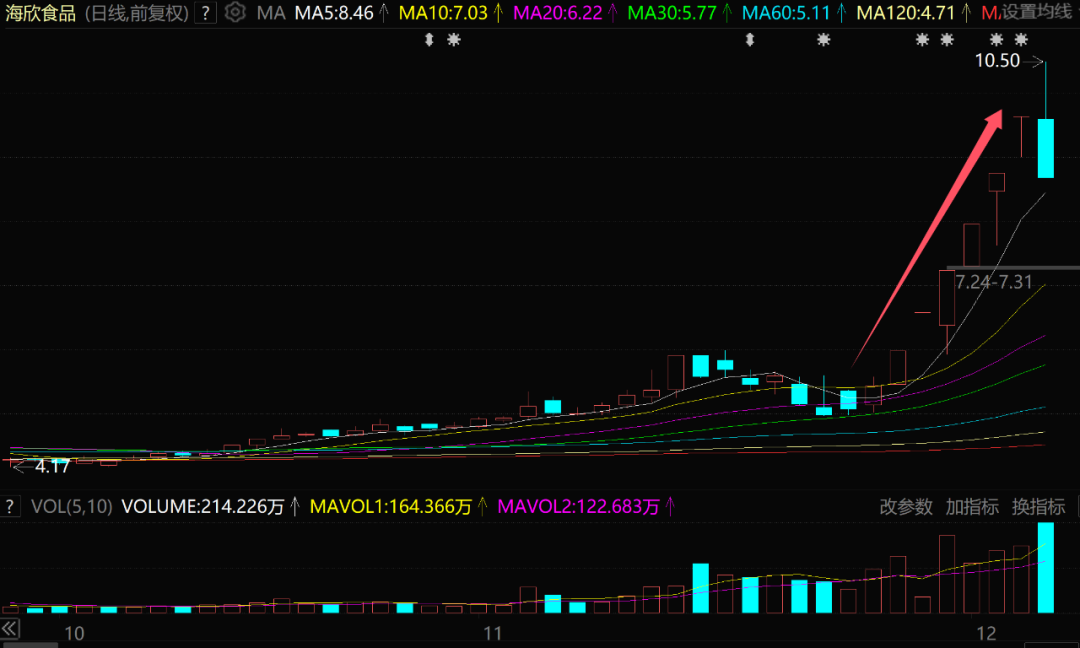
Core Viewpoint - The recent surge in the stock price of Haixin Food is attributed to its entry into the high-end Sam's Club supermarket chain, which has significantly boosted its market visibility and investor interest [4][33]. Group 1: Stock Performance - Haixin Food experienced six consecutive trading days of price increases, achieving six limit-ups from November 26 to December 3, 2025 [2][28]. - The stock's rapid rise has drawn attention from institutional investors, leading to a research meeting with China International Capital Corporation (CICC) on December 2, 2025 [34]. Group 2: Business Developments - Haixin Food successfully entered the Sam's Club supply chain, which is known for its stringent quality requirements, enhancing the brand's reputation and pricing power [6][34]. - The company reported a revenue of 970 million yuan for the first three quarters of 2025, a year-on-year decrease of 15.05%, and a net loss of 28.18 million yuan, down 17.94% year-on-year [12][38]. Group 3: Market Context - Sam's Club, a subsidiary of Walmart, has been expanding rapidly in China, with expectations to exceed 1.3 billion yuan in sales for 2025, significantly contributing to the overall performance of its suppliers [4][31]. - The membership base of Sam's Club in China has reached nearly 9 million, with a high retention rate of over 90%, indicating strong consumer loyalty and purchasing power [5][31]. Group 4: Competitive Landscape - The frozen food sector in China is highly competitive, with several players including Anjuke Food, Sanquan Food, and others, but Anjuke Food leads the market with a 6.6% share and revenue of 15.127 billion yuan in 2024 [40][41]. - Haixin Food's stock performance has been volatile, with a significant decline in value over the past few years, including a 30% drop in 2024 [20][47].
利好来了!直线涨停,封单超17万手
Zhong Guo Zheng Quan Bao· 2025-11-26 08:40
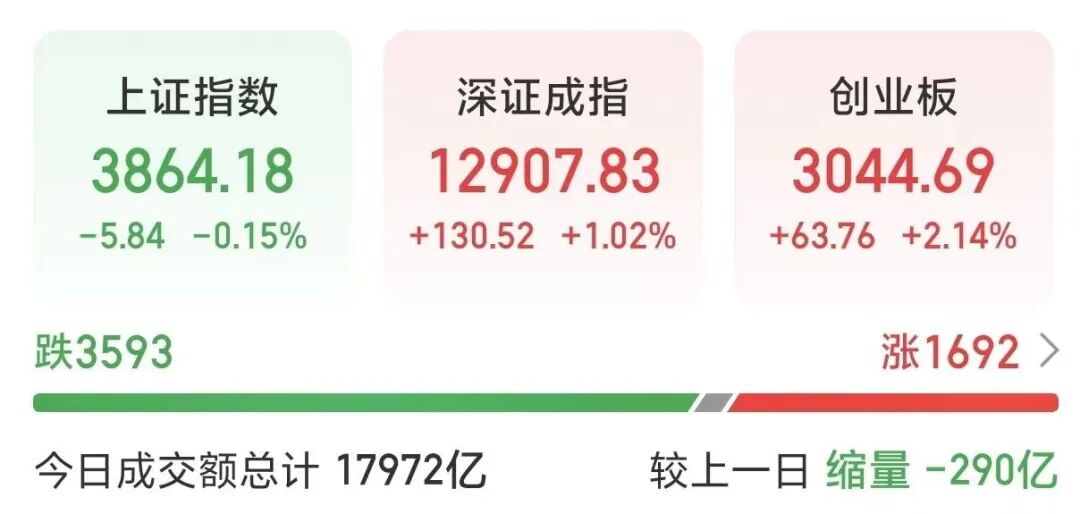
Market Overview - The A-share market showed mixed performance with the Shanghai Composite Index down by 0.15%, while the Shenzhen Component Index rose by 1.02% and the ChiNext Index increased by 2.14% [1] - The total trading volume exceeded 1.79 trillion yuan [1] Consumer Sector - The consumer sector experienced a late-afternoon surge, with Hai Xin Food (002702) hitting the daily limit and closing with over 170,000 buy orders [4][5] - The Ministry of Industry and Information Technology and other departments released a plan to enhance the adaptability of supply and demand in consumer goods, aiming to boost consumption [4][7] CPO Concept Stocks - CPO (Co-packaged Optics) concept stocks continued to perform strongly, with Zhongji Xuchuang (300308) reaching a historical high and Yongding Co. (600105) hitting the daily limit [4][9] - Longguang Huaxin's stock surged by 20%, while Saiwei Electronics (300456) increased by over 16% [9] Healthcare Sector - Anti-influenza concept stocks were active, with Guangji Pharmaceutical (000952) achieving three consecutive limits and Peking University Medicine (000788) achieving two consecutive limits [4] Real Estate and Military Industry - The real estate sector saw a pullback, with China Wuyi (000797) dropping over 6% and Vanke A falling over 2% [4] - The military industry also faced a downturn, with Aerospace Development (000547) hitting the daily limit down [4] AI Industry Outlook - Alibaba's CEO indicated that the demand for GPUs is currently at full capacity, suggesting that an AI bubble is unlikely in the next three years [12] - Daitong Securities maintains an optimistic outlook on the AI industry, highlighting the growth potential driven by demand for computing power [12]
利群股份:公司食品目前研发产品包含豆制品、鲜米面制品等500余种
Zheng Quan Ri Bao Wang· 2025-11-17 14:13
Core Viewpoint - The company, Li Qun Co., Ltd. (601366), has a diverse range of food products under development, showcasing its commitment to expanding its product portfolio in the food industry [1] Product Development - The company is currently developing over 500 food products, which include tofu products, fresh rice noodle products, frozen rice noodle products, baked bread, Chinese pastries, marinated cooked foods, pickled and prepared products, boxed meals, sushi, pre-prepared dishes, and sea cucumbers [1] - Li Qun Co., Ltd. owns several proprietary food brands, including Fu Xing, Mai Gu Qian Qian, Li Ke Mai, Zhen Zhen You, Xiang You, Qian Fu Zhen, Gu Ren Zhuang, and Fu Xing Aquatic Products [1]
