
JRCB(002807)

Search documents
中期分红队伍持续壮大
Jin Rong Shi Bao· 2025-09-04 03:03
Core Viewpoint - The recent announcements of interim dividend plans by A-share listed banks highlight a trend towards increased shareholder returns, with a total proposed dividend amount exceeding 200 billion yuan from major state-owned banks and several joint-stock banks [1][4]. Group 1: State-Owned Banks - Six major state-owned banks have announced their interim dividend plans for 2025, with a total proposed dividend amount exceeding 200 billion yuan [1]. - Industrial and Commercial Bank of China leads with a proposed dividend of 1.414 yuan per 10 shares, totaling 503.96 billion yuan [1]. - Other state-owned banks, including Agricultural Bank of China, Bank of China, China Construction Bank, Bank of Communications, and Postal Savings Bank, have proposed dividends of 418.23 billion yuan, 352.50 billion yuan, 486.05 billion yuan, 138.11 billion yuan, and 147.72 billion yuan respectively [1]. Group 2: Joint-Stock Banks - Several joint-stock banks, including China Merchants Bank, CITIC Bank, Minsheng Bank, Ping An Bank, and Huaxia Bank, have confirmed their interim dividend plans for 2025 [1][2]. - China Merchants Bank announced its first interim profit distribution plan since its listing, with a cash dividend amounting to 35% of its net profit attributable to ordinary shareholders for the first half of 2025 [1][2]. - CITIC Bank plans to increase its interim dividend payout ratio to 30.7%, enhancing investor return expectations [2]. Group 3: New Participants in Interim Dividends - New entrants to the interim dividend group include Ningbo Bank, Changsha Bank, Su Nong Bank, and Jiangyin Bank, indicating a growing trend among listed banks to adopt interim dividends [2][4]. - Su Nong Bank announced its first interim dividend plan, proposing a cash dividend of 0.9 yuan per 10 shares, totaling 1.82 billion yuan [2][3]. Group 4: Overall Market Trends - A total of 23 A-share listed banks implemented interim dividends in 2024, distributing over 250 billion yuan, with the number of banks participating expected to increase in 2025 [4]. - The push for interim dividends is seen as a response to regulatory guidance aimed at enhancing shareholder returns and stabilizing market expectations [5].



不靠利息靠投资?透视A股农商行中期业绩:营收持续分化,非利息收入扛起增长“大旗”
Mei Ri Jing Ji Xin Wen· 2025-09-03 13:08
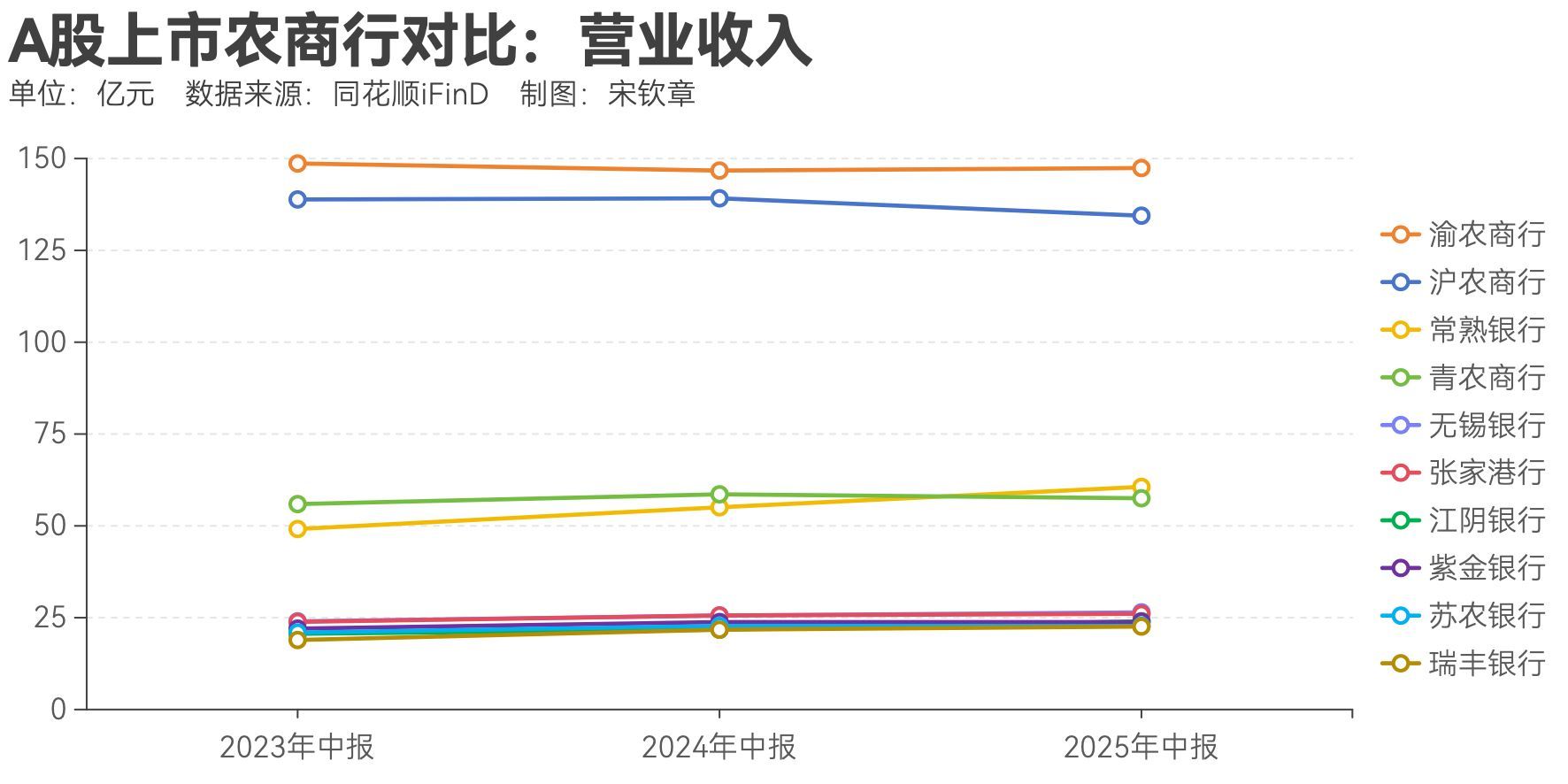
Core Viewpoint - The financial performance of listed rural commercial banks in China is showing a trend of increasing differentiation, with significant revenue growth observed in certain banks while others lag behind [1][4]. Group 1: Revenue Performance - In the first half of 2025, Chongqing Rural Commercial Bank (渝农商行) and Shanghai Rural Commercial Bank (沪农商行) reported revenues of 14.741 billion and 13.444 billion yuan respectively, both nearing 15 billion yuan [4]. - Changshu Bank (常熟银行) and Qingdao Rural Commercial Bank (青农商行) achieved revenues of 6.062 billion and 5.752 billion yuan, exceeding 5 billion yuan [4]. - Other banks such as Wuxi Bank (无锡银行), Zhangjiagang Bank (张家港行), Jiangyin Bank (江阴银行), Zijin Bank (紫金银行), Sunan Bank (苏农银行), and Ruifeng Bank (瑞丰银行) reported revenues below 3 billion yuan [4]. Group 2: Year-on-Year Growth - Changshu Bank and Jiangyin Bank experienced significant year-on-year revenue growth, both exceeding 10%, with net profit growth also surpassing 12% [4][5]. - The revenue growth for these banks is attributed to non-interest income, particularly investment income, with Changshu Bank reporting a 637.77% increase in net commission income [5]. Group 3: Interest Income and Net Interest Margin - The net interest margin for listed rural commercial banks collectively declined compared to the previous year, impacting interest income for many banks [5]. - Chongqing Rural Commercial Bank reported a net interest income of 11.744 billion yuan, a year-on-year increase of 5.98%, despite a 2.47% decline in interest income due to lower market rates [8]. Group 4: Investment Income - Investment income is a crucial component of non-interest income, with most listed rural commercial banks showing significant increases compared to the previous year [6]. - Zijin Bank and Jiangyin Bank reported year-on-year increases in investment income of 95.41% and 81.44% respectively [6]. Group 5: Dividend Distribution - Several banks, including Changshu Bank and Jiangyin Bank, announced their first interim dividend distributions, aiming to enhance investor returns and boost long-term holding confidence [9]. - Shanghai Rural Commercial Bank proposed a cash dividend of 2.41 yuan per 10 shares, totaling 2.324 billion yuan, with a distribution ratio of 33.14% [9].



农商行板块9月2日涨2.83%,渝农商行领涨,主力资金净流出653.88万元
Zheng Xing Xing Ye Ri Bao· 2025-09-02 08:59
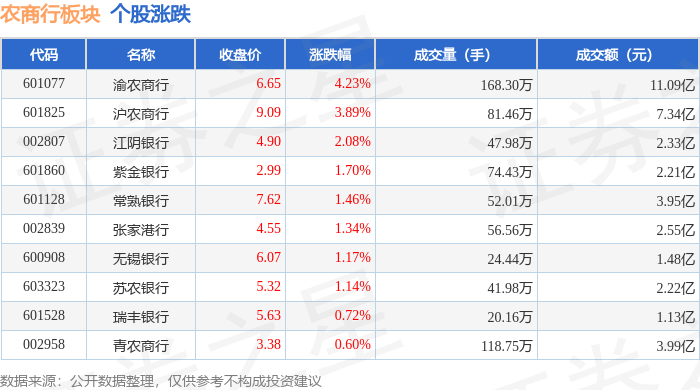
Core Insights - The rural commercial bank sector experienced a rise of 2.83% on September 2, with Chongqing Rural Commercial Bank leading the gains [1] - The Shanghai Composite Index closed at 3858.13, down 0.45%, while the Shenzhen Component Index closed at 12553.84, down 2.14% [1] Stock Performance - Chongqing Rural Commercial Bank (601077) closed at 6.65, up 4.23%, with a trading volume of 1.68 million shares and a transaction value of 1.11 billion [1] - Shanghai Rural Commercial Bank (601825) closed at 60.6, up 3.89%, with a trading volume of 814,600 shares and a transaction value of 734 million [1] - Jiangyin Bank (002807) closed at 4.90, up 2.08%, with a trading volume of 479,800 shares and a transaction value of 233 million [1] - Other notable performances include Zijin Bank (601860) up 1.70%, Changshu Bank (601128) up 1.46%, and Zhangjiagang Bank (002839) up 1.34% [1] Fund Flow Analysis - The rural commercial bank sector saw a net outflow of 6.54 million from institutional investors, while retail investors experienced a net outflow of 102 million [1] - Speculative funds recorded a net inflow of 109 million [1] - Detailed fund flow for Chongqing Rural Commercial Bank shows a net inflow of 11.57 million from institutional investors, but a net outflow of 88.18 million from retail investors [2] - Shanghai Rural Commercial Bank had a net inflow of 14.69 million from institutional investors and a net inflow of 49.14 million from speculative funds [2] - Other banks like Zijin Bank and Su Nong Bank experienced significant net outflows from institutional investors, indicating a mixed sentiment in the sector [2]
非息收入成重要“抓手”,上市银行中报业绩透露这些信号
Zhong Guo Zheng Quan Bao· 2025-09-01 15:16
Group 1 - The core viewpoint is that the performance of listed banks has significantly improved in the first half of 2025, with total operating income exceeding 2.9 trillion yuan and net profit exceeding 1.1 trillion yuan [1][2] - Non-interest income has played a crucial role in supporting the improvement of bank performance, with notable growth in banks like Jiangyin Bank and Changshu Bank, which achieved double-digit year-on-year growth in both operating income and net profit [1][2][3] - The net interest margin (NIM) remains a concern for the banking sector, with management from various banks indicating that while there is still downward pressure on NIM, the rate of decline is expected to gradually stabilize [1][4] Group 2 - Major banks such as Industrial and Commercial Bank of China, China Construction Bank, Agricultural Bank of China, Bank of China, and Postal Savings Bank of China reported the highest operating incomes in the first half of the year, with figures of 427.09 billion yuan, 394.27 billion yuan, 369.94 billion yuan, 329.00 billion yuan, and 179.45 billion yuan respectively [2] - In terms of net profit, the top five banks were also led by Industrial and Commercial Bank of China, with a net profit of 168.10 billion yuan, followed by China Construction Bank at 162.08 billion yuan, Agricultural Bank of China at 139.51 billion yuan, Bank of China at 117.59 billion yuan, and China Merchants Bank at 74.93 billion yuan [2] - Jiangyin Bank and Changshu Bank reported impressive growth rates in their financial performance, with Jiangyin Bank's operating income growing by 10.45% and net profit by 16.63%, while Changshu Bank's operating income increased by 10.10% and net profit by 13.51% [2][3] Group 3 - The "anti-involution" policy is seen as an opportunity for banks, with expectations that it will help stabilize the decline in net interest margins [4] - The policy is expected to alleviate the downward pressure on asset yields in the banking sector, although it may also present challenges due to varying implementation across different regions and banks [4] - Long-term, the "anti-involution" policy is anticipated to improve supply-demand relationships, benefiting corporate profitability and driving financial resources towards high-end manufacturing and green economy sectors, which could help banks optimize their asset and client structures [4]

银行分红热情高涨,这7家上市以来首次中期分红
Xin Lang Cai Jing· 2025-09-01 08:51
Core Viewpoint - Nearly half of the 42 listed banks in A-shares will implement mid-term dividends for 2025, with 17 banks already disclosing their dividend plans, marking a significant trend in the banking sector [1][4]. Group 1: Dividend Announcements - China Merchants Bank plans to distribute a cash dividend amounting to 35% of its net profit attributable to ordinary shareholders for the first half of 2025, with distribution scheduled between January and February 2026 [1]. - Changsha Bank's board approved a mid-term dividend plan, proposing a cash dividend of 2.00 yuan (including tax) per 10 shares, totaling 804 million yuan [1]. - Ningbo Bank announced a cash dividend of 3 yuan (including tax) per 10 shares, amounting to 1.981 billion yuan, which represents 13.41% of its net profit attributable to the parent company [1]. - Su Nong Bank plans to distribute a cash dividend of 0.09 yuan (including tax) per share, totaling 182 million yuan, which is 15.42% of its net profit for the first half of 2025 [2]. - Zhangjiagang Bank intends to distribute a cash dividend of 1.0 yuan (including tax) per 10 shares, with the total amount dependent on the total share capital at the time of distribution [4]. - Jiangyin Bank's mid-term dividend proposal was approved by its board, with details disclosed alongside its half-year report [4]. - Changshu Bank's mid-term dividend plan includes a cash dividend of 0.15 yuan (including tax) per share, totaling 497 million yuan, which is 25.27% of its net profit for the first half of 2025 [4]. Group 2: Market Analysis - Analysts believe that high dividends, low valuations, and stable Return on Equity (ROE) are key factors attracting long-term capital to bank stocks [4]. - Increasing dividend ratios or frequencies can effectively enhance investor confidence and promote valuation recovery for banks [4]. - Banks' dividend policies must balance regulatory capital adequacy requirements with their own business expansion needs [4].



“红包群”扩大!超20家上市银行预告中期分红,7位新成员加入
券商中国· 2025-08-31 07:39
Core Viewpoint - The article highlights the significant increase in mid-term dividends announced by various A-share listed banks, reflecting their commitment to returning value to investors amid a strong performance in the banking sector in the first half of the year [1][2]. Summary by Sections Mid-term Dividends Announcement - As of August 30, at least 21 A-share listed banks have announced plans for mid-term dividends for 2025, with 17 banks disclosing specific dividend proposals [2]. - Notably, seven banks, including China Merchants Bank and Changshu Bank, are implementing mid-term dividends for the first time since their listings [2][4]. Dividend Details - The total cash dividend amount from the major state-owned banks (ICBC, ABC, CCB, BOC, CMB, and PSBC) is 204.657 billion yuan [2]. - ICBC leads with a dividend of 1.414 yuan per 10 shares, totaling 50.396 billion yuan [2]. - China Merchants Bank, known as the "King of Retail," has a dividend payout ratio of 35%, amounting to 26.226 billion yuan [2][5]. - Other banks like CITIC Bank and Ping An Bank have also confirmed their mid-term dividends, with CITIC Bank's total reaching 10.46 billion yuan and a payout ratio of 30.7% [2]. Implications of Mid-term Dividends - The implementation of mid-term dividends is seen as a response to the new "National Nine Articles" and related requirements from the China Securities Regulatory Commission, aimed at enhancing investor confidence and stabilizing stock prices [5]. - Experts emphasize that while increasing the frequency of dividends is beneficial, the focus should be on maintaining a balance between short-term payouts and long-term growth [5]. Market Outlook - Analysts from CITIC Securities note that the banking sector is experiencing a gradual improvement in performance, with expectations for continued positive trends in subsequent quarters [6]. - The sector is undergoing a net asset revaluation process, and while there is potential for recovery, the market may experience volatility without sustained inflows of investment funds [6].

上市银行探路转型新增长极:扩资产规模 增非息收入
Zhong Guo Jing Ying Bao· 2025-08-29 19:36
Core Viewpoint - The 2025 A-share banking mid-year report reveals significant profit differentiation among banks, with some city commercial banks achieving double-digit profit growth while others face negative growth due to narrowing interest margins and market volatility [1] Group 1: Profit Growth of City Commercial Banks - City commercial banks have emerged as the main contributors to profit growth among listed banks in the first half of 2025, with Hangzhou Bank reporting a net profit of 11.662 billion yuan, a year-on-year increase of 16.66% [2] - Factors contributing to the rapid profit growth of city commercial banks include stable asset scale growth, continuous optimization of asset-liability structure, and a recovery in fee and commission income driven by low base and wealth management growth [2][3] - Other city commercial banks such as Jiangyin Bank, Qilu Bank, and Qingdao Bank reported net profit growth rates of 16.63%, 16.48%, and 16.05% respectively [2] Group 2: Challenges Faced by Some Banks - In contrast, some banks like Guiyang Bank experienced negative profit growth, with a net profit of 2.474 billion yuan, a decrease of 7.20% year-on-year, attributed to declining interest income and weaker bond market performance [4] - The differentiation in profit performance among banks is largely due to variations in customer base, financing capabilities, risk preferences, and asset quality [4] Group 3: Interest Income and Margin Trends - The net interest margin for commercial banks narrowed to 1.42% in the first half of 2025, reflecting ongoing pressure on interest margins [7] - Strategies to manage interest margins include increasing the proportion of low-cost deposits and optimizing asset-liability management to improve net interest income [8][9] Group 4: Non-Interest Income and Business Diversification - Expanding non-interest income is seen as a crucial strategy for banks to mitigate the impact of declining interest margins, with a focus on enhancing middle business services such as custody, agency sales, and settlement [9] - Currently, non-interest income accounts for less than 30% of major listed banks in China, which is significantly lower than that of large international banks [9]



信用卡“缩量”背后:加速出清不良谋转型
Zhong Guo Jing Ying Bao· 2025-08-29 19:16
Core Insights - The credit card business of banks is undergoing a significant contraction, with a shift from expansion to value reconstruction, indicating a transformation in the industry [1][5][7] Group 1: Industry Trends - The overall credit card loan scale is declining across multiple banks, despite some growth in personal loan business [1][2] - Many banks are closing credit card centers, signaling a move towards a more refined and high-value development phase [1][4] - The total number of credit cards and combined credit and loan cards has decreased, with a notable drop of 6 million cards in Q2 compared to the previous quarter [4][9] Group 2: Bank Performance - CITIC Bank reported a credit card issuance of 126 million cards, with a loan balance of 458.45 billion yuan, but a 12.54% decline in transaction volume and a 14.61% drop in business revenue [2] - Ping An Bank's credit card receivables decreased by 9.2% to 394.87 billion yuan, with a significant drop in the number of active credit card users [3] - Smaller banks like Jiangsu Bank and Chongqing Bank also reported declines in credit card loan scales, with reductions of 7.51% and 10.23% respectively [3][4] Group 3: Strategic Shifts - Banks are focusing on improving asset quality and risk management, with CITIC Bank emphasizing a shift from scale to quality in its credit card business [5][6] - The trend of integrating credit card and consumer loan products is emerging, with banks like Chongqing Bank adapting their strategies to maintain competitiveness [6][9] - Experts suggest that the future of credit card business will focus on high-end customer needs and basic customer demands, moving away from merely acquiring new customers [7][8]




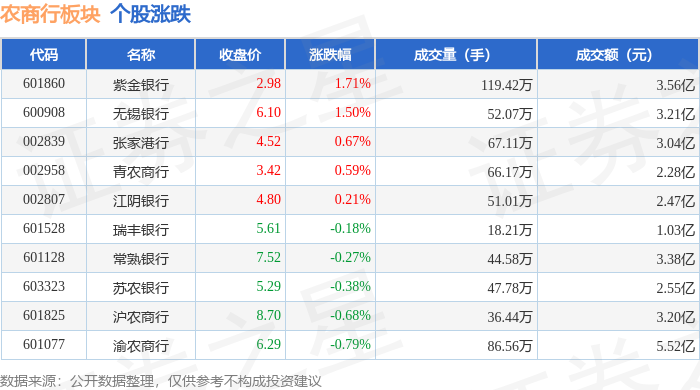
农商行板块8月29日跌0.23%,渝农商行领跌,主力资金净流出1346.05万元
Zheng Xing Xing Ye Ri Bao· 2025-08-29 08:48
Market Overview - On August 29, the rural commercial bank sector declined by 0.23%, with Yunnan Rural Commercial Bank leading the drop [1] - The Shanghai Composite Index closed at 3857.93, up 0.37%, while the Shenzhen Component Index closed at 12696.15, up 0.99% [1] Individual Stock Performance - Key stock performances in the rural commercial bank sector included: - Zijin Bank: Closed at 2.98, up 1.71% with a trading volume of 1.1942 million shares and a turnover of 3.56 billion [1] - Wuxi Bank: Closed at 6.10, up 1.50% with a trading volume of 520,700 shares and a turnover of 321 million [1] - Zhangjiagang Bank: Closed at 4.52, up 0.67% with a trading volume of 671,100 shares and a turnover of 304 million [1] - Qingnong Bank: Closed at 3.42, up 0.59% with a trading volume of 661,700 shares and a turnover of 228 million [1] - Jiangyin Bank: Closed at 4.80, up 0.21% with a trading volume of 510,100 shares and a turnover of 247 million [1] - Ruifeng Bank: Closed at 5.61, down 0.18% with a trading volume of 182,100 shares and a turnover of 103 million [1] - Changshu Bank: Closed at 7.52, down 0.27% with a trading volume of 445,800 shares and a turnover of 338 million [1] - Sunong Bank: Closed at 5.29, down 0.38% with a trading volume of 477,800 shares and a turnover of 255 million [1] - Hunan Rural Commercial Bank: Closed at 18.70, down 0.68% with a trading volume of 364,400 shares and a turnover of 320 million [1] - Yunnan Rural Commercial Bank: Closed at 6.29, down 0.79% with a trading volume of 865,600 shares and a turnover of 552 million [1] Capital Flow Analysis - The rural commercial bank sector experienced a net outflow of 13.4605 million from main funds, while speculative funds saw a net inflow of 38.5712 million, and retail investors had a net outflow of 25.1107 million [1] - Detailed capital flow for individual stocks included: - Sunong Bank: Main funds net inflow of 22.3068 million, speculative funds net inflow of 30.55 million, retail net outflow of 22.6123 million [2] - Jiangyin Bank: Main funds net inflow of 7.4654 million, speculative funds net inflow of 73.39 million, retail net outflow of 8.1993 million [2] - Zijin Bank: Main funds net inflow of 7.3454 million, speculative funds net inflow of 819.73 million, retail net outflow of 15.5427 million [2] - Qingnong Bank: Main funds net inflow of 6.0408 million, speculative funds net inflow of 374.38 million, retail net outflow of 9.7846 million [2] - Wuxi Bank: Main funds net inflow of 3.1286 million, speculative funds net inflow of 96.36 million, retail net outflow of 4.0922 million [2] - Ruifeng Bank: Main funds net outflow of 1.3678 million, speculative funds net inflow of 794.01 million, retail net outflow of 6.5722 million [2] - Zhangjiagang Bank: Main funds net outflow of 2.5651 million, speculative funds net inflow of 438.50 million, retail net outflow of 1.8199 million [2] - Hunan Rural Commercial Bank: Main funds net outflow of 7.2508 million, speculative funds net inflow of 596.70 million, retail net inflow of 128.37 million [2] - Changshu Bank: Main funds net outflow of 8.2141 million, speculative funds net inflow of 620.80 million, retail net inflow of 200.61 million [2] - Yunnan Rural Commercial Bank: Main funds net outflow of 40.3497 million, speculative funds net inflow of 12.71 million, retail net inflow of 40.2227 million [2]
江阴银行(002807) - 2025年8月29日投资者关系活动记录表
2025-08-29 08:32
Group 1: Business Strategy and Focus Areas - The bank positions its pension finance business as a core growth driver, aiming to develop it alongside wealth management over the next 2-3 years [2][3] - The bank identifies a multi-trillion market opportunity driven by the shift in pension needs from simple savings to comprehensive life-cycle planning [3] - Key strategies include forming specialized teams, leveraging technology for personalized services, and creating a financial product-service ecosystem [3] Group 2: Financial Performance and Growth Metrics - As of June, the bank's technology finance loan balance reached CNY 15.9 billion, while green finance loans totaled CNY 4.459 billion, reflecting a 30.57% increase since the beginning of the year [4] - The bank's total loans grew by 5.87% year-to-date, with deposits increasing by 6.35% [8] - The bank plans to maintain moderate asset growth and align credit issuance with regional industrial transformation needs in 2025 [8] Group 3: Market Positioning and Competitive Strategy - The bank emphasizes a "steady progress" approach in market value management, focusing on enhancing profitability and market influence [5][6] - It aims to innovate in the technology finance sector by establishing a dedicated financial center and specialized teams to support startups and early-stage companies [6][7] - The bank's product development strategy includes a comprehensive service matrix for different stages of technology enterprises [7] Group 4: Compliance and Governance - The independent board members monitor compliance with laws and regulations, focusing on key risk areas such as related party transactions and anti-money laundering [8] - The bank ensures that management provides detailed compliance reports for critical areas to maintain regulatory adherence [8] - The board exercises veto power on any proposals with compliance concerns to protect shareholder interests [8]