BANK OF QINGDAO(002948)

Search documents
1月16日A股5只股票限售股解禁 合计市值52.77亿元
Xin Lang Cai Jing· 2026-01-16 04:22
Summary of Key Points Core Viewpoint - On January 16, 2026, five stocks in the A-share market will face the lifting of share restrictions, with a total of 737 million shares being unlocked, amounting to a market value of 5.277 billion yuan based on the previous trading day's closing price [1][3]. Group 1: Stock Unlocking Details - The stock with the highest unlocking quantity is Huadian New Energy (600930), with 725 million shares and a market value of 4.565 billion yuan [4][5]. - The second stock is Ruihua Technology (920099), with 9.4655 million shares and a market value of 318 million yuan [4][5]. - The third stock is Parallel Technology (920493), with 2.5096 million shares and a market value of 389 million yuan [4][5]. Group 2: Market Value Rankings - The stock with the highest market value upon unlocking is also Huadian New Energy (600930), valued at 4.565 billion yuan [6]. - Parallel Technology (920493) ranks second in market value at 389 million yuan [6]. - Ruihua Technology (920099) ranks third with a market value of 318 million yuan [6].

城商行板块1月15日跌0.59%,青岛银行领跌,主力资金净流入2.21亿元
Zheng Xing Xing Ye Ri Bao· 2026-01-15 08:59
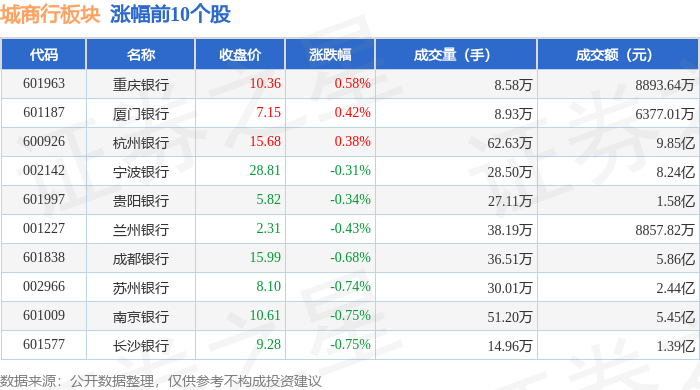
Market Performance - The city commercial bank sector declined by 0.59% on January 15, with Qingdao Bank leading the decline [1] - The Shanghai Composite Index closed at 4112.6, down 0.33%, while the Shenzhen Component Index closed at 14306.73, up 0.41% [1] Individual Stock Performance - Chongqing Bank closed at 10.36, up 0.58% with a trading volume of 85,800 shares and a transaction value of 88.94 million [1] - Xiamen Bank closed at 7.15, up 0.42% with a trading volume of 89,300 shares and a transaction value of 63.77 million [1] - Hangzhou Bank closed at 15.68, up 0.38% with a trading volume of 626,300 shares and a transaction value of 9.85 billion [1] - Ningbo Bank closed at 28.81, down 0.31% with a trading volume of 285,000 shares and a transaction value of 824 million [1] - Chengdu Bank closed at 15.99, down 0.68% with a trading volume of 365,100 shares and a transaction value of 586 million [1] Capital Flow Analysis - The city commercial bank sector saw a net inflow of 221 million from institutional investors and a net inflow of 296 million from speculative funds, while retail investors experienced a net outflow of 517 million [2] - Hangzhou Bank had a net inflow of 123 million from institutional investors, accounting for 12.51% of its total [3] - Shanghai Bank had a net inflow of 97.02 million from institutional investors, representing 20.87% of its total [3] - Nanjing Bank had a net inflow of 37.40 million from institutional investors, making up 6.86% of its total [3]


金价飙升后,银行里的“一尺铁柜”成了抢手货
Xin Lang Cai Jing· 2026-01-15 00:02
Core Insights - The rising gold prices have sparked a surge in demand for bank safe deposit boxes, leading to a situation where they are in high demand but low supply [1][4][12] - Many banks in Beijing report that all safe deposit boxes are currently rented out, with waiting lists exceeding 100 customers at some locations [2][10] - The demand for safe deposit boxes is driven by increased interest in gold investments, as geopolitical risks continue to elevate the appeal of gold as a safe-haven asset [4][12] Demand and Supply Dynamics - The demand for safe deposit boxes has significantly increased, with banks reporting a notable rise in inquiries since last year [4][12] - Banks are struggling to keep up with the demand, as the supply of safe deposit boxes has not increased in tandem, leading to a shortage [6][15] - Some banks have ceased offering safe deposit box services altogether due to high maintenance costs and low profitability [15][16] Pricing and Features - Different banks offer various sizes and pricing structures for safe deposit boxes, with significant variations in rental fees [3][11] - For example, at China Merchants Bank, the smallest box has a monthly rental fee of 50 yuan, while larger boxes can cost up to 42,000 yuan annually [11] - Postal Savings Bank offers a fully automated safe deposit box with advanced security features, including 24-hour monitoring and multiple verification methods for access [5][13] Market Trends - The ongoing geopolitical tensions and expectations of continued low interest rates are expected to sustain the demand for gold and, consequently, safe deposit boxes [4][12] - Investors are increasingly looking for secure storage options for their gold investments, as concerns about home security grow [4][12] - Some banks are innovating their services, such as offering promotional deals for customers purchasing gold products, to attract more clients [16]



青岛银行股份有限公司 首次公开发行A股前已发行股份上市流通提示性公告
Zhong Guo Zheng Quan Bao - Zhong Zheng Wang· 2026-01-14 22:51
登录新浪财经APP 搜索【信披】查看更多考评等级 本行及董事会全体成员保证公告内容的真实、准确和完整,没有虚假记载、误导性陈述或者重大遗漏。 特别提示: 1.首次公开发行A股前已发行股份本次解除限售的数量为80,005股,占青岛银行股份有限公司(以下简 称"本行")A股股份的0.0023%,占本行股份总额的0.0014%。 2.上述限售股上市流通日期为2026年1月16日(星期五)。 一、首次公开发行A股前已发行股份概况 1.首次公开发行A股情况 根据中国证券监督管理委员会《关于核准青岛银行股份有限公司首次公开发行股票的批复》(证监许可 ﹝2018﹞1727号),本行首次公开发行人民币普通股(A股)450,977,251股。根据深圳证券交易所《关 于青岛银行股份有限公司人民币普通股股票上市的通知》(深证上﹝2019﹞26号),本行于2019年1月 16日在深圳证券交易所挂牌上市。首次公开发行A股前,本行已发行的股份总额为4,058,712,749股;首 次公开发行A股后,本行股份总额增至4,509,690,000股。 2.本行A股上市后股份总额变动情况 2022年1月,本行按每10股配售3股的比例,向全体A股 ...
金价飙升后 银行里的“一尺铁柜”成了抢手货
Zhong Guo Zheng Quan Bao· 2026-01-14 21:10
Core Viewpoint - The surge in gold prices has led to a significant increase in demand for bank safe deposit boxes, resulting in a shortage of available boxes in Beijing banks [1][4]. Group 1: Demand for Safe Deposit Boxes - There is a booming demand for safe deposit boxes as residents are increasingly investing in gold, with reports indicating that many banks are fully booked and customers are facing long waiting lists [1][2]. - Some banks have reported waiting lists exceeding 100 people, with estimates suggesting that new customers may not be able to rent boxes until 2026 [2][4]. Group 2: Supply Constraints - The supply of safe deposit boxes has not kept pace with the rising demand, as only larger bank branches typically offer this service, and many smaller branches do not have safe deposit box facilities [1][6]. - Factors such as space limitations and high maintenance costs have prevented banks from expanding their safe deposit box offerings, leading to a decline in the availability of this service [6]. Group 3: Pricing and Variability - Different banks offer various sizes and pricing structures for safe deposit boxes, with significant differences in rental fees based on box dimensions [3][4]. - For example, at China Merchants Bank, the smallest box has a monthly rental fee of 50 yuan, while larger boxes can cost up to 42,000 yuan annually [3]. Group 4: Investor Sentiment and Alternatives - Investors express concerns about the safety of storing physical gold at home, leading many to prefer bank safe deposit boxes for their perceived security [5]. - Some investors are considering alternatives such as home safes due to the high rental costs and long wait times associated with bank safe deposit boxes [7]. Group 5: Innovations and Promotions - To address the supply-demand imbalance, some banks are exploring smart upgrades and promotional offers to attract customers, such as free rental periods for new clients purchasing gold products [7]. - For instance, Qingdao Rural Commercial Bank has offered promotional incentives for customers purchasing gold products, including free usage of safe deposit boxes for a limited time [7].
青岛银行(03866) - 海外监管公告 - (1) 青岛银行股份有限公司首次公开发行A股前已发行股...
2026-01-14 11:00
Bank of Qingdao Co., Ltd.* 青 島 銀 行 股 份 有 限 公 司 * ( 於 中 華 人 民 共 和 國 註 冊 成 立 的 股 份 有 限 公 司 ) (H股股份代號:3866) 海外監管公告 香港交易及結算所有限公司及香港聯合交易所有限公司對本公告的內容概不負責,對其準確性 或完整性亦不發表任何聲明,並明確表示,概不對因本公告全部或任何部份內容而產生或因倚 賴該等內容而引致的任何損失承擔任何責任。 本公告乃根據《香港聯合交易所有限公司證券上市規則》第13.10B條作出。 如下公告已於深圳證券交易所網站刊登,僅供參閱。 (1) 青島銀行股份有限公司首次公開發行A股前已發行股份上市流通提示性公告; (2) 關於青島銀行股份有限公司首次公開發行A股前已發行股份部分 解除限售並上市流通的核查意見 特此公告。 承董事會命 青島銀行股份有限公司* 景在倫 董事長 中國山東省青島市 2026年1月14日 於本公告日期,董事會包括執行董事景在倫先生、吳顯明先生、陳霜女士及劉 鵬先生;非執行董事周雲傑先生、Rosario Strano先生、譚麗霞女士、Giamberto Giraldo先生及鄧友 ...
青岛银行(002948) - 首次公开发行A股前已发行股份上市流通提示性公告
2026-01-14 10:47
证券代码:002948 证券简称:青岛银行 公告编号:2026-001 青岛银行股份有限公司 一、首次公开发行A股前已发行股份概况 1.首次公开发行A股情况 根据中国证券监督管理委员会《关于核准青岛银行股份有限公司首次公开发行 股票的批复》(证监许可﹝2018﹞1727号),本行首次公开发行人民币普通股(A 股)450,977,251股。根据深圳证券交易所《关于青岛银行股份有限公司人民币普通 股股票上市的通知》(深证上﹝2019﹞26号),本行于2019年1月16日在深圳证券 交易所挂牌上市。首次公开发行A股前,本行已发行的股份总额为4,058,712,749股; 首次公开发行A股后,本行股份总额增至4,509,690,000股。 2.本行A股上市后股份总额变动情况 2022年1月,本行按每10股配售3股的比例,向全体A股股东配售股份,A股配 股实际发行股份781,754,230股,已于2022年1月28日上市流通;2022年2月,本行按 每10股配售3股的比例,向全体H股股东配售股份,H股配股实际发行股份 528,910,494股,已于2022年2月11日上市流通。上述A股和H股配股发行完成后,本 行股份总 ...
青岛银行:约8万股限售股1月16日解禁
Mei Ri Jing Ji Xin Wen· 2026-01-14 10:46
每经AI快讯,青岛银行1月14日晚间发布公告称,公司限售股份约8万股将于2026年1月16日解禁并上市 流通。 (记者 王瀚黎) 每经头条(nbdtoutiao)——海利生物增值9倍并购的企业,估值8个月"腰斩",其第一大客户竟是尚未 成立的公司,离奇的事还不少…… ...
青岛银行(002948) - 关于青岛银行股份有限公司首次公开发行A股前已发行股份部分解除限售并上市流通的核查意见
2026-01-14 10:45
关于青岛银行股份有限公司首次公开发行 A 股前 已发行股份部分解除限售并上市流通的核查意见 根据《中华人民共和国公司法》《中华人民共和国证券法》《证券发行上市保 荐业务管理办法》《深圳证券交易所股票上市规则》《深圳证券交易所上市公司自 律监管指引第1号——主板上市公司规范运作》《深圳证券交易所上市公司自律监 管指引第13号——保荐业务》等法律法规和规范性文件的要求,并根据青岛银行 股份有限公司(以下简称"青岛银行"或"公司")与华泰联合证券有限责任公 司(以下简称"华泰联合证券"或"保荐机构")签署的保荐协议,华泰联合证 券对青岛银行首次公开发行A股前已发行股份部分解除限售并上市流通事项进 行了核查。具体情况如下: 一、首次公开发行A股前已发行股份情况 1.首次公开发行A股情况 截至2026年1月5日,青岛银行股份总额为5,820,354,724股,其中,境内上市 1 人民币普通股(A股)3,528,409,250股,境外上市外资普通股(H股)2,291,945,474 股。A股包括有限售条件股份415,987,838股,无限售条件股份3,112,421,412股。 本次解除限售股份为公司首次公开发行A股前已 ...
城商行板块1月14日跌2.11%,北京银行领跌,主力资金净流出7.29亿元
Zheng Xing Xing Ye Ri Bao· 2026-01-14 08:58
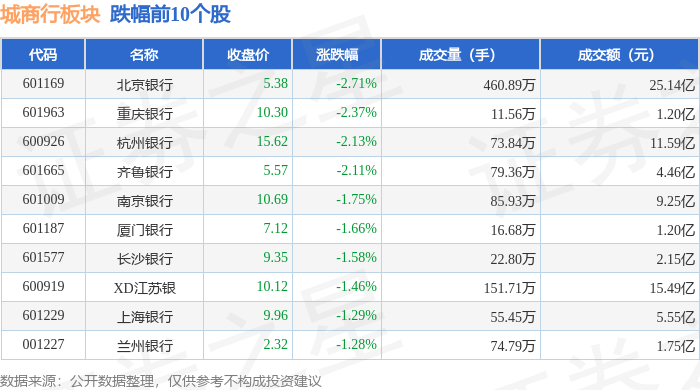
Core Viewpoint - The city commercial bank sector experienced a decline of 2.11% on January 14, with Beijing Bank leading the drop, while the overall market showed mixed results with the Shanghai Composite Index down 0.31% and the Shenzhen Component Index up 0.56% [1] Group 1: Market Performance - The closing price of Beijing Bank was 5.38, down 2.71%, with a trading volume of 4.6089 million shares and a transaction value of 2.514 billion [1] - Other notable declines included Chongqing Bank at 10.30 (-2.37%), Hangzhou Bank at 15.62 (-2.13%), and Qilu Bank at 5.57 (-2.11%) [1] - The city commercial bank sector saw a net outflow of 729 million in main funds, while retail investors contributed a net inflow of 53.1975 million [1] Group 2: Fund Flow Analysis - Hangzhou Bank had a main fund net inflow of 1.20 billion, but a net outflow from retail investors of 92.9469 million [2] - Suzhou Bank recorded a net inflow of 52.503 million from main funds, while retail investors had a net outflow of 54.0558 million [2] - Shanghai Bank experienced a main fund net inflow of 45.3249 million, with a retail net outflow of 46.6735 million [2]