BANK OF QINGDAO(002948)

Search documents
数字人民币2.0:从M0到M1的质变
GF SECURITIES· 2026-01-22 05:07
Investment Rating - The report provides a "Buy" rating for all major banks analyzed, indicating a positive outlook for the banking sector [7]. Core Insights - The digital renminbi has entered its 2.0 era, transitioning from a central bank liability (M0) to a commercial bank liability (M1), allowing it to earn interest and be included in deposit insurance and reserve requirements [6][14]. - This transformation positions China as the first economy to offer interest on its central bank digital currency (CBDC), fundamentally altering its monetary attributes and creating a new financial paradigm in the digital economy [27]. - The digital renminbi's interest-bearing feature enhances user motivation to hold it, shifting its perception from a mere payment tool to a viable store of value, thus promoting its integration into everyday financial activities [27][28]. Summary by Sections 1. Digital Renminbi 2.0 Era - The digital renminbi (e-CNY) is now classified as a digital deposit currency, which can earn interest and is managed under a new regulatory framework [14]. - Major state-owned banks have begun offering interest on digital renminbi wallet balances, marking a significant shift in its utility and appeal [14][27]. 2. Development Progress and Application Status - The development of the digital renminbi began in 2014, with significant milestones including pilot tests in various cities and the establishment of a comprehensive operational framework by 2025 [32][33]. - As of November 2025, the digital renminbi has processed 34.8 billion transactions amounting to 16.7 trillion yuan, with extensive coverage across multiple provinces and cities [37]. 3. Global CBDC Development Trends - The report identifies three main trends in global CBDC development: active retail CBDC initiatives, innovation in payment systems, and cautious approaches in some countries like the U.S. [6]. - China's proactive stance in developing its CBDC positions it favorably in the global digital economy landscape, particularly in cross-border trade applications [30].




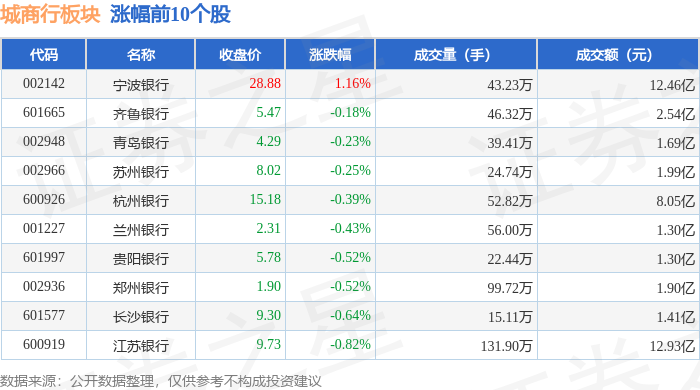
城商行板块1月21日跌0.55%,重庆银行领跌,主力资金净流入5.08亿元
Zheng Xing Xing Ye Ri Bao· 2026-01-21 08:54
Market Overview - The city commercial bank sector experienced a decline of 0.55% on January 21, with Chongqing Bank leading the drop [1] - The Shanghai Composite Index closed at 4116.94, up 0.08%, while the Shenzhen Component Index closed at 14255.12, up 0.7% [1] Individual Stock Performance - Ningbo Bank closed at 28.88, with an increase of 1.16% and a trading volume of 432,300 shares, amounting to a transaction value of 1.246 billion [1] - Chongqing Bank closed at 10.25, down 1.82%, with a trading volume of 106,800 shares and a transaction value of 110 million [2] - Other notable performers include Xiamen Bank, which closed at 7.13, down 1.66%, and Chengdu Bank, which closed at 15.72, down 1.38% [2] Capital Flow Analysis - The city commercial bank sector saw a net inflow of 508 million from institutional investors, while retail investors experienced a net outflow of 566 million [2] - The capital flow for individual stocks indicates that Hangzhou Bank had a net inflow of 158 million from institutional investors, while it faced a net outflow of 86.5 million from retail investors [3] - Shanghai Bank also saw a net inflow of 107 million from institutional investors, with a net outflow of 121 million from retail investors [3]


青岛银行:近五年间本行平均现金分红比例高于行业平均水平
Zheng Quan Ri Bao Wang· 2026-01-20 09:20
证券日报网讯 1月20日,青岛银行(002948)在互动平台回答投资者提问时表示,本行历来高度重视对 股东的投资回报,近五年间本行平均现金分红比例高于行业平均水平,给投资者带来了稳定的投资回 报。本行公司章程及《青岛银行股份有限公司2024年-2026年股东回报规划》约定每年以现金方式向普 通股股东分配的利润不低于当年实现的归属于本行普通股股东的可分配利润的20%,目的也是为股东提 供持续、稳定、合理的投资回报。银行分红决策是平衡股东回报与长期稳健发展的复杂过程,需综合考 量监管要求、资本充足率、盈利能力、战略规划、股东回报、宏观经济及同业比较等诸多因素。下一步 公司会在综合平衡多方面因素的基础上,合理规划分红比例。 ...
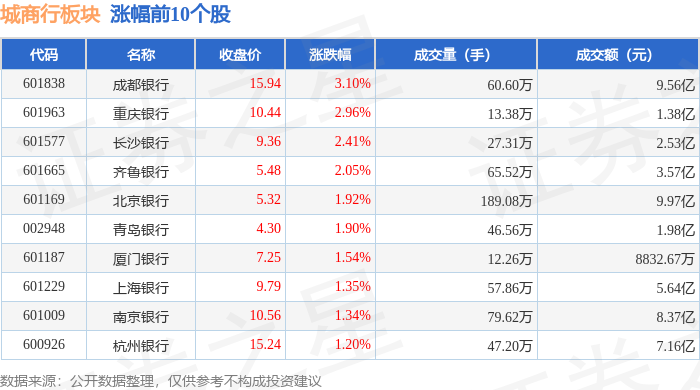
城商行板块1月20日涨1.35%,成都银行领涨,主力资金净流入2.66亿元
Zheng Xing Xing Ye Ri Bao· 2026-01-20 08:56
Core Insights - The city commercial bank sector experienced a rise of 1.35% on January 20, with Chengdu Bank leading the gains [1] - The Shanghai Composite Index closed at 4113.65, down 0.01%, while the Shenzhen Component Index closed at 14155.63, down 0.97% [1] Stock Performance - Chengdu Bank (601838) closed at 15.94, up 3.10% with a trading volume of 606,000 shares and a transaction value of 9.56 billion [1] - Chongqing Bank (601963) closed at 10.44, up 2.96% with a trading volume of 133,800 shares and a transaction value of 138 million [1] - Other notable performers include: - Changsha Bank (601577): closed at 9.36, up 2.41% [1] - Qilu Bank (601665): closed at 5.48, up 2.05% [1] - Beijing Bank (601169): closed at 5.32, up 1.92% [1] - Qingdao Bank (002948): closed at 4.30, up 1.90% [1] - Xiamen Bank (601187): closed at 7.25, up 1.54% [1] - Shanghai Bank (601229): closed at 9.79, up 1.35% [1] - Nanjing Bank (601009): closed at 10.56, up 1.34% [1] - Hangzhou Bank (600926): closed at 15.24, up 1.20% [1] Capital Flow - The city commercial bank sector saw a net inflow of 266 million from institutional investors, while retail investors experienced a net outflow of 42.84 million [1] - Detailed capital flow for selected banks includes: - Shanghai Bank (601229): net inflow of 1.051 billion from institutional investors, with net outflows from retail and speculative investors [2] - Hangzhou Bank (600926): net inflow of 90.48 million from institutional investors, with significant outflows from retail and speculative investors [2] - Nanjing Bank (601009): net inflow of 26.57 million from institutional investors, with outflows from retail investors [2] - Other banks also showed varying levels of net inflows and outflows [2]


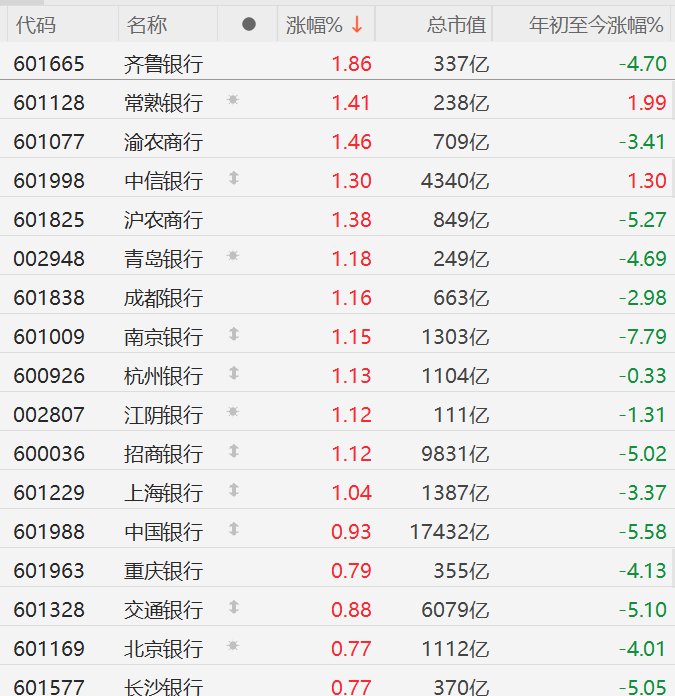
银行股逆势普涨,齐鲁银行涨近2%
Ge Long Hui· 2026-01-20 03:06
Group 1 - The A-share market saw a significant increase in bank stocks, with Qilu Bank rising nearly 2% and several other banks, including Changshu Bank and Chongqing Rural Commercial Bank, increasing by over 1% [1] - The total market capitalization of Qilu Bank is 33.7 billion, while Changshu Bank has a market cap of 23.8 billion [2] - Year-to-date performance shows that Qilu Bank has decreased by 4.70%, while Changshu Bank has increased by 1.99% [2] Group 2 - Other banks that experienced gains include Yunnan Rural Commercial Bank (1.46%), CITIC Bank (1.30%), and Shanghai Bank (1.04%) [2] - The total market capitalization of CITIC Bank is 434 billion, and it has a year-to-date performance of 1.30% [2] - Despite the gains, many banks still show negative year-to-date performance, such as Shanghai Bank (-3.37%) and China Bank (-5.58%) [2]

银行资负跟踪20260119:降准降息还有空间
GF SECURITIES· 2026-01-19 04:26
Investment Rating - The industry investment rating is "Buy" [3] Core Viewpoints - The report indicates that there is still room for further cuts in reserve requirement ratios and interest rates, with a focus on structural monetary policy support for high-quality economic development [15][19] - The central bank has implemented a reduction of 0.25 percentage points in various structural monetary policy tool rates, signaling a supportive monetary policy stance [15][19] - The report emphasizes the importance of timing for future policy implementations, particularly in relation to government bond issuance peaks and the maturity schedule of high-interest bank deposits [15] Summary by Sections 1. Monetary Policy Adjustments - The report notes a reduction of 0.25 percentage points in structural monetary policy tool rates, with a focus on supporting key areas through increased re-lending [15] - Future attention is directed towards December economic data and January LPR [22] 2. Central Bank Dynamics and Market Rates - The central bank conducted a total of 9,515 billion yuan in 7-day reverse repos at an interest rate of 1.40%, with a net injection of 9,741 billion yuan [16] - The report highlights that the funding rates remained stable, with expectations of slight increases due to tax payments and government bond net repayments [16] 3. Bank Financing Tracking - The report indicates that the total outstanding amount of interbank certificates of deposit (CDs) is 19.09 trillion yuan, with an average issuance rate of 1.65% [20] - The report also notes that there were no commercial bank bond issuances during the period, with a total outstanding commercial bank bond size of 3.38 trillion yuan [20]


金融行业周报(2026、01、18):央行宣布结构性降息,衍生品交易监管更规范-20260118
Western Securities· 2026-01-18 11:43
Investment Rating - The report does not explicitly state an overall investment rating for the financial industry, but it provides specific recommendations for various sectors and companies within the industry [3][21]. Core Insights - The financial industry experienced a decline this week, with the non-bank financial index down by 2.63%, underperforming the CSI 300 index by 2.06 percentage points. The banking sector saw a decline of 3.03%, also underperforming the CSI 300 index by 2.46 percentage points [1][9]. - The report highlights a structural interest rate cut by the central bank, which is expected to impact various financial sectors, particularly banks and insurance companies. The insurance sector is viewed as being in a critical window for performance and valuation recovery [3][21]. - Regulatory measures have been introduced to stabilize the derivatives market, which is expected to benefit well-capitalized and compliant brokerage firms [2][17]. Summary by Sections 1. Weekly Performance and Sector Insights - The non-bank financial index decreased by 2.63%, with the securities, insurance, and diversified financial indices down by 2.21%, 3.59%, and 1.83% respectively [1][9]. - The banking sector's performance was notably poor, with state-owned banks, joint-stock banks, city commercial banks, and rural commercial banks experiencing declines of 2.20%, 4.08%, 2.40%, and 2.20% respectively [1][9]. 2. Insurance Sector Insights - The insurance sector's index fell by 3.59%, underperforming the CSI 300 index by 3.02 percentage points. The report indicates that regulatory cooling measures have created short-term pressure on the insurance sector, but the long-term outlook remains positive due to asset growth and interest margin recovery [1][13][15]. - Key companies such as China Pacific Insurance, China Life, and New China Life are recommended for investment due to their strong fundamentals and recovery potential [3][16]. 3. Brokerage Sector Insights - The brokerage sector saw a decline of 2.21%, with the report emphasizing the potential benefits of new regulatory measures aimed at enhancing the derivatives market. The focus is on larger, well-capitalized firms that can navigate the evolving regulatory landscape [2][17]. - Recommendations include major brokerages like Guotai Junan and Huatai Securities, which are expected to benefit from the anticipated recovery in profitability and valuation [2][18]. 4. Banking Sector Insights - The banking sector's index fell by 3.03%, with the central bank's recent interest rate cut expected to support the sector's performance in the long run. The report suggests that banks may see a gradual recovery in net interest income and profitability [3][21][22]. - Specific banks such as Hangzhou Bank and Ningbo Bank are highlighted as potential investment opportunities, particularly those with previously undervalued positions [3][22].




青岛银行:接受信达证券等投资者调研
Mei Ri Jing Ji Xin Wen· 2026-01-16 10:26
Group 1 - Qingdao Bank announced that it will accept investor research from Cinda Securities and others on January 16, 2026, from 14:00 to 15:00, with relevant department staff participating to answer investor questions [1] Group 2 - Silver prices have surged over 80% in the last 50 days, indicating a level of speculation that surpasses that of gold, suggesting that the current silver market may signal a peak in the precious metals bull market [1]

青岛银行(002948) - 2026年1月16日投资者关系活动记录表
2026-01-16 10:10
Group 1: Deposit Growth - The total customer deposits of Qingdao Bank reached CNY 481.73 billion by the end of September 2025, an increase of CNY 49.70 billion, representing a growth of 11.50% compared to the end of 2024 [2] - The company's deposit balance was CNY 238.05 billion, up CNY 25.89 billion, with a growth rate of 12.20% [2] - Personal deposits amounted to CNY 243.57 billion, increasing by CNY 23.77 billion, reflecting a growth of 10.82% [2] Group 2: Asset Allocation and Loan Direction - The total customer loans of Qingdao Bank reached CNY 375.30 billion by the end of September 2025, an increase of CNY 34.61 billion, which is a growth of 10.16% [3] - The bank aims to focus on high-quality development, increasing credit investment while optimizing the asset-liability structure [3] - The bank will establish competitive advantages in eight key areas, including technology finance, inclusive finance, and green finance, to provide personalized and diversified financial services [3] Group 3: Credit Asset Quality - The non-performing loan ratio of Qingdao Bank was 1.10% by the end of September 2025, a decrease of 0.04 percentage points compared to the end of 2024 [3] - The provision coverage ratio was 269.97%, an increase of 28.65 percentage points from the end of 2024, indicating a stable improvement in asset quality [3] - The bank will continue to strengthen the management of credit asset quality and enhance its ability to serve the real economy while focusing on risk prevention [3]
城商行板块1月16日跌1.27%,江苏银行领跌,主力资金净流出2.29亿元
Zheng Xing Xing Ye Ri Bao· 2026-01-16 08:56
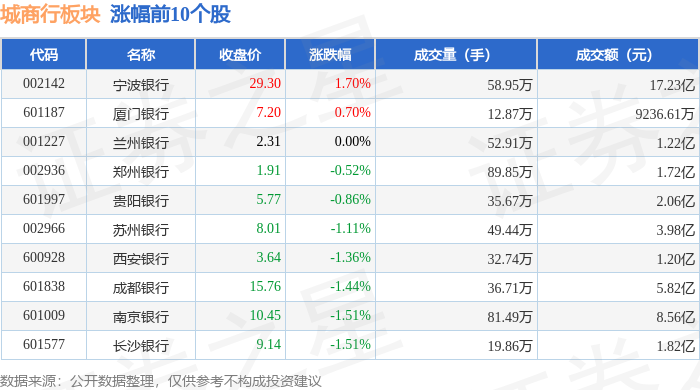
Core Viewpoint - The city commercial bank sector experienced a decline of 1.27% on January 16, with Jiangsu Bank leading the drop. The Shanghai Composite Index closed at 4101.91, down 0.26%, while the Shenzhen Component Index closed at 14281.08, down 0.18% [1]. Group 1: Stock Performance - Ningbo Bank closed at 29.30, up 1.70% with a trading volume of 589,500 shares and a transaction value of 1.723 billion [1]. - Xiamen Bank closed at 7.20, up 0.70% with a trading volume of 128,700 shares and a transaction value of 92.3661 million [1]. - Jiangsu Bank closed at 9.76, down 2.69% with a trading volume of 2,061,300 shares and a transaction value of 2.033 billion [2]. - Shanghai Bank closed at 9.64, down 2.43% with a trading volume of 961,200 shares and a transaction value of 933.3 million [2]. Group 2: Capital Flow - The city commercial bank sector saw a net outflow of 229 million from main funds, while speculative funds had a net inflow of 716 million, and retail investors experienced a net outflow of 487 million [2]. - Hangzhou Bank had a main fund net inflow of 153 million, while retail investors saw a net outflow of 113 million [3]. - Nanjing Bank recorded a main fund net inflow of 70.5 million and a retail net outflow of 131 million [3].