ROYALFLUSH INFO(300033)

Search documents
同花顺新质50概念涨1.18%,主力资金净流入这些股
Zheng Quan Shi Bao Wang· 2025-12-30 08:49
Core Viewpoint - The Tonghuashun New Quality 50 concept index experienced a rise of 1.18%, ranking 10th among concept sectors, with notable performances from stocks like Sanhua Intelligent Control and Cold Chain Technology [1][2]. Group 1: Market Performance - The New Quality 50 concept saw 16 stocks increase in value, with Sanhua Intelligent Control hitting the daily limit up, while stocks like Cold Chain Technology and Zhi De Mai also showed significant gains of 9.19% and 4.46% respectively [1]. - Conversely, stocks such as Haohan Depth, Guoguang Electric, and Aopu Optoelectronics faced declines, with drops of 3.58%, 3.20%, and 3.17% respectively [1]. Group 2: Capital Flow - The New Quality 50 concept attracted a net inflow of 4.653 billion yuan, with 16 stocks receiving net inflows, and 7 stocks exceeding 1 billion yuan in net inflow [2]. - Sanhua Intelligent Control led the net inflow with 3.243 billion yuan, followed by Cold Chain Technology and Beifang Huachuang with net inflows of 1.1 billion yuan and 409 million yuan respectively [2][3]. Group 3: Stock Performance Metrics - The top stocks by net inflow ratio included Sanhua Intelligent Control at 22.95%, Zhi De Mai at 10.57%, and Beifang Huachuang at 8.71% [3]. - Other notable stocks included Cold Chain Technology with a net inflow ratio of 8.55% and Zhongji Xuchuang at 1.21% [3][4].


沪深京三市成交额超1万亿元,较上日此时缩量1031亿元
Xin Lang Cai Jing· 2025-12-30 03:38
Group 1 - The total trading volume in the Shanghai, Shenzhen, and Beijing markets exceeded 1 trillion yuan, showing a decrease of 103.1 billion yuan compared to the same time the previous day [1][2] - The estimated total trading amount for the day is approximately 1.9 trillion yuan [1][2] - As of the current moment, the trading volume in the Shanghai market is 404.5 billion yuan, in the Shenzhen market is 588.8 billion yuan, and in the Beijing Stock Exchange 50 is 7.7 billion yuan [1][2]
2025炒股软件年终盘点:新浪财经APP、同花顺、东方财富等最受投资者偏爱
Xin Lang Cai Jing· 2025-12-29 06:30
Core Insights - The article highlights the increasing volatility in global financial markets by 2025, emphasizing the unprecedented demand for speed in information acquisition and decision-making among investors [1][14] - The active user base of Chinese securities apps has surpassed 166 million, with a penetration rate of 15.46% across the internet [1][14] - Stock trading apps have evolved into essential tools that connect individual investors with institutional-level information [1][14] Market Landscape - The securities app market is characterized by a "three-legged" stable structure, with a clear ranking among the top ten trading software based on the latest evaluations and AI model data [2][15] - The top three apps dominate the market, with the leading app, Sina Finance, achieving a comprehensive score of 9.56 [3][16] App Rankings and Performance - The rankings of the top trading apps are as follows: 1. Sina Finance APP: 9.56 2. Tonghuashun: 9.16 3. Dongfang Caifu: 9.16 4. Xueqiu: 8.66 5. Dazhihui: 8.36 6. Zhitong Caijing: 8.50 7. Tongdaxin: 8.30 8. Futu Niu Niu: 8.54 9. Tencent Self-Selected Stocks: 8.32 10. Niuguwang: 8.02 [3][16] User Engagement and Market Share - The top ten active apps account for 63% of the market share, with Tonghuashun leading at 35.02 million monthly active users [5][18] - Dongfang Caifu follows with 17.21 million monthly active users, while Sina Finance ranks third with a comprehensive score of 9.56 [5][18] Features and Advantages - Sina Finance APP stands out for its global coverage and AI integration, connecting over 40 global financial markets and offering a refresh rate of 0.03 seconds [6][19] - The app's AI assistant can condense lengthy reports into concise summaries, highlighting risks and opportunities effectively [7][19] - Tonghuashun is noted for its trading efficiency, supporting lightning-fast transactions and providing free Level-2 market data [8][20] - Dongfang Caifu focuses on community interaction and comprehensive fund services, with a robust technical infrastructure ensuring quick response times [9][21] Niche Offerings - Other trading apps cater to specific investor needs, such as Xueqiu, which serves as a community for value investors, and Futu Niu Niu, which specializes in Hong Kong and U.S. markets [10][22][23] Selection Guidance - Investors are encouraged to choose trading software that aligns with their investment style and needs, with a summary of core advantages for each app provided [11][24] Future Outlook - The integration of AI technology is expected to make trading apps more intelligent and personalized, evolving from mere information tools to decision-making partners for investors [13][26]

今年翻倍主动权益基金超60只
Shen Zhen Shang Bao· 2025-12-28 16:37
Group 1 - The overall performance of public funds in 2023 is positive, with over 90% achieving net value increases, and more than 60 actively managed equity funds doubling their returns [1] - As of December 22, 2023, the average return rates for various fund types are: equity funds at 28.25%, mixed funds at 26.56%, QDII funds at 22.17%, FOF funds at 13.28%, bond funds at 2.2%, and money market funds at 1.29% [1] - The average return for equity funds (including stock, mixed, and QDII equity funds) is 25.47%, with approximately 94.36% of these funds showing net value increases this year [1] Group 2 - The average return for actively managed equity funds exceeds 29%, with the top-performing fund, Yongying Technology Smart Selection Mixed Fund A, achieving a net value increase of 231.72%, marking the first occurrence of a "double base" in equity funds since 2008 [2] - Other notable funds include Zhonghang Opportunity Leading Mixed Fund A and Hongtu Innovation Emerging Industry Mixed Fund A, with returns of 172% and 153% respectively [2] - A total of 63 actively managed equity funds have recorded net value increases exceeding 100%, including funds from Huatai-PB Quality Selection Mixed Fund A and others [2]
上市公司产投含“科”量提升 新材料、新能源等成为高频词
Zheng Quan Shi Bao Wang· 2025-12-27 00:27
Core Insights - A number of high-tech and scarce "unicorn" companies, such as Moore Threads and Muxi Co., have gone public this year, creating wealth effects for primary market investors [1] - Listed companies are increasingly participating in industrial investment funds, becoming significant players in the capital market [1] - The trend shows a shift from unrelated "follow-the-trend" investments to a focus on hard technology sectors closely related to their main business [1] Investment Trends - As of December 15, 341 events of listed companies participating in the establishment of industrial funds have occurred this year, remaining stable compared to last year [1] - Investments are increasingly concentrated in hard technology fields with strong relevance to the companies' core businesses [1] - The most frequently mentioned sectors in these investments include "new materials," "new energy," "artificial intelligence," "semiconductors," and "intelligent manufacturing," appearing nearly 150 times [1]
2025十大手机炒股APP排行榜出炉:专业测评闭眼入手
Xin Lang Cai Jing· 2025-12-26 06:53
Core Insights - The 2025 stock trading software market is dominated by three major platforms: Sina Finance APP, Tonghuashun, and Dongfang Caifu, with Sina Finance APP leading the rankings with a comprehensive score of 9.56 [1][2][3] Market Landscape - The stock trading software market in 2025 has established a stable three-way competitive landscape, with Sina Finance APP, Tonghuashun, and Dongfang Caifu as the top three platforms, each with unique features [2][15] - Third-party platforms continue to dominate traffic, with Tonghuashun achieving an average monthly active user count of 34.71 million, Dongfang Caifu at 17.06 million, and Dazhihui at 11.67 million [2][15] - The securities industry is benefiting from favorable policies and the AI trend, with a focus on enhancing user experience and promoting app intelligence [2][15] Ranking List - The top ten stock trading software in 2025 has been established based on professional assessments across five core dimensions [3][16] - The ranking is as follows: 1. Sina Finance APP: 9.56 2. Tonghuashun: 9.16 3. Dongfang Caifu: 9.16 4. Xueqiu: 8.66 5. Dazhihui: 8.36 6. Zhangle Caifutong: 8.50 7. Tongdaxin: 8.30 8. Futu Niu Niu: 8.54 9. Tencent Zixuan Gu: 8.32 10. Niuguwang: 8.02 [4][17] Champion Analysis - Sina Finance APP's leading position is attributed to its competitive advantages in four key areas: global market coverage, information analysis speed, AI tools, and social integration capabilities [5][19] - The app covers over 40 global markets, including A-shares, Hong Kong stocks, US stocks, futures, foreign exchange, and precious metals, with a market refresh speed of 0.03 seconds [5][19] - It uniquely integrates Nasdaq Level 2 data streams, providing institutional-level market experiences [5][19] - The app's information analysis speed is enhanced by 20 years of expertise, delivering timely interpretations of major events 5-10 seconds ahead of competitors [6][20] - The "Zhima AI Assistant" can condense 5,000-word annual reports into 300-word summaries, highlighting risk and opportunity points [6][20] - The app effectively filters out 99% of stock recommendation noise through a keyword filtering system, with 82% of community analysts being certified [6][20] Distinctive Platforms - Other platforms have carved out their own niches: - Tonghuashun is known for its technical capabilities, offering free Level-2 market data and supporting over 90% of brokers to complete orders within 3 seconds [7][21] - Dongfang Caifu serves as a hub for retail investors, leveraging community ecology and fund services, with over one million daily posts in its "Stock Bar" community [7][21] - Futu Niu Niu focuses on cross-border investment services, providing free Level-2 US stock data and supporting pre- and post-market trading [7][21] - Dazhihui has introduced AI quantitative strategy features to empower individual investors [7][21] Selection Strategy - Investors should choose trading software based on their specific needs: - For cross-market investors, Sina Finance APP is recommended due to its extensive market coverage and AI alert system [8][23] - Short-term traders may prefer Tonghuashun for its institutional-level backtesting environment and Level-2 market insights [8][23] - Learning investors can benefit from Dongfang Caifu's community and fund services [8][24] Conclusion - In the era of global investment, Sina Finance APP delivers real-time data from Nasdaq, Hong Kong Stock Exchange, and Shanghai Stock Exchange without delay, enhancing the investment experience for users [11][25]

创业板公司融资余额七连增 其间累计增加179.90亿元
Zheng Quan Shi Bao Wang· 2025-12-26 02:43
Core Insights - The total margin financing balance of the ChiNext market reached 554.14 billion yuan as of December 25, 2025, marking an increase of 50.44 billion yuan from the previous trading day, and has risen for seven consecutive trading days, accumulating an increase of 179.90 billion yuan during this period [1][2]. Margin Financing Balance Changes - As of December 25, 2025, the margin financing balance was 552.30 billion yuan, which increased by 50.59 billion yuan from the previous day [2]. - The margin financing balance has seen increases across 509 stocks, with 66 stocks experiencing an increase of over 20% [2]. - The stock with the highest increase in margin financing balance was Jiangxin Home, which saw a 123.76% increase, bringing its latest balance to 39.73 million yuan [2][3]. Stocks with Significant Margin Financing Changes - The stocks with the largest increases in margin financing included: - Jiangxin Home: 39.73 million yuan, +123.76% - Kema Technology: 97.47 million yuan, +118.89% - Yidong Electronics: 44.34 million yuan, +116.06% [3][4]. - Conversely, the stocks with the largest decreases included: - Green Island Wind: 10.27 million yuan, -29.55% - Kaichuang Electric: 11.48 million yuan, -25.91% - Jiayuan Technology: 19.87 million yuan, -23.72% [3][4]. Market Performance - Stocks with margin financing increases of over 20% averaged a rise of 16.41%, outperforming the ChiNext index [5]. - Notable performers included: - Yidong Electronics: +79.99% - Kaige Precision Machinery: +45.63% - Hongda Electronics: +38.89% [5]. - The stock with the highest total margin financing increase was Zhongji Xuchuang, with a balance of 22.02 billion yuan, increasing by 2.51 billion yuan [5]. Summary of Margin Financing Changes - The stocks with the most significant increases in margin financing included: - Zhongji Xuchuang: 22.02 billion yuan, +2.51 billion yuan - Yangguang Electric: 15.10 billion yuan, +2.06 billion yuan - Xinyi Sheng: 21.42 billion yuan, +1.30 billion yuan [5][6]. - The stocks with the largest decreases in margin financing included: - Dongfang Caifu: 26.89 billion yuan, -0.54 billion yuan - Tonghuashun: 5.43 billion yuan, -0.30 billion yuan - Kunlun Wanwei: 3.10 billion yuan, -0.21 billion yuan [5][6].




全球资管深研系列(四):全球智能投顾全景图
Guoxin Securities· 2025-12-25 15:25
Core Insights - The rise of robo-advisors is driven by the integration of financial technology and traditional wealth management, offering low costs, high accessibility, and convenience. Post-global financial crisis, stricter regulations and technological advancements have facilitated the emergence of non-bank fintech companies, with robo-advisors serving as a cost-effective alternative to human advisors. They utilize algorithms to automatically construct investment portfolios, significantly reducing advisory fees and breaking geographical barriers, allowing investors to access professional services anytime and anywhere. Robo-advisors particularly attract low-income groups and younger users by minimizing trading costs through passive investment strategies, enhancing capital market participation for long-term goals like retirement and emergency savings. The evolution of robo-advisors has progressed through four stages: early online questionnaires and static advice, full automation and passive management, establishment of hybrid models, and AI-driven hyper-personalization and intelligent agents [2][9][10]. - The global robo-advisory market is experiencing rapid expansion, with the U.S. maintaining a dominant position while emerging markets like China show significant potential for growth. The market size is projected to increase from $7.7 billion in 2023 to approximately $116.4 billion by 2033, with the U.S. accounting for 81% of global assets under management (AUM). The competitive landscape in the U.S. has formed a "three giants and many strong" scenario, with Vanguard, Schwab, and Fidelity as the major players, while independent unicorns like Betterment and Wealthfront continue to thrive. In Europe, the market share remains relatively small, with key players categorized into pan-European super platforms, market consolidators, and regional champions. China's robo-advisory market is expected to exceed $2 billion by 2028 and $4 billion by 2030, contributing to the development of passive investment strategies and long-term capital market participation [2][15][21][25][30]. - The business model of robo-advisors is evolving towards platformization and ecosystem integration, with revenue models shifting from single asset management fees to layered charging and technology empowerment. Robo-advisors have expanded from B2C to B2B and ecosystem models, exemplified by Ant Wealth's scenario collaboration for traffic conversion. Revenue diversification includes pure digital models relying on AUM management fees, tiered subscription models offering premium services, B2B tool empowerment models generating profits through technology output, and ecosystem platform models depending on product distribution commissions. This evolution highlights the industry's transition from scale expansion to value extraction [2][35][39]. - The core competitive advantages of leading robo-advisors include comprehensive strength, digital experience, and user-friendliness for beginners. Platforms with strong comprehensive capabilities often excel in long-term performance and service quality, while the best digital planning platforms possess robust personal asset aggregation tools that create automated financial management loops. User-friendly platforms may excel in brand trust or community ecosystem development. In the competitive landscape, Betterment and Wealthfront not only survive but thrive, embodying the pure fintech spirit by creating value through technological innovation and exceptional user experience [2][39][50]. - The development trend of robo-advisors is characterized by a philosophical debate between "active" and "passive" investment strategies. Analyzing the portfolio data of various robo-advisors reveals a shift in the industry towards this philosophical contention, categorized into MPT believers (Vanguard & Betterment), potential active managers (SoFi & Axos), and tech-driven alpha harvesters (Wealthfront) [2][11]. - Looking ahead, the industry is poised for significant restructuring and a new journey. By 2025, the robo-advisory sector will have transitioned from rapid growth to a phase of integration and iteration. Three major trends are expected to continue: industry consolidation, a shift from scale to sustainable profitability, and AI reshaping robo-advisory services. The complete withdrawal of bank-affiliated robo-advisors reflects ongoing industry consolidation, as the mismatch between customer acquisition costs and lifetime value necessitates substantial new scale to cover technology and compliance costs. Independent platforms are now focusing on sustainable profitability rather than blind scale expansion, as exemplified by Robinhood's acquisition of AI financial planning company Pluto and the launch of its own robo-advisory service, which aims to provide genuinely personalized financial consulting through large language models [2][15][30].

软件开发板块12月25日涨0.77%,广道退领涨,主力资金净流出1.53亿元
Zheng Xing Xing Ye Ri Bao· 2025-12-25 09:14
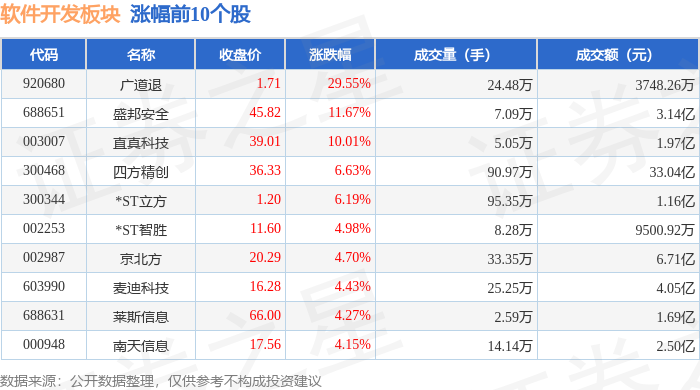
Market Performance - The software development sector increased by 0.77% on December 25, with Guangdao Tui leading the gains [1] - The Shanghai Composite Index closed at 3959.62, up 0.47%, while the Shenzhen Component Index closed at 13531.41, up 0.33% [1] Stock Highlights - Guangdao Tui (code: 920680) saw a significant rise of 29.55%, closing at 1.71, with a trading volume of 244,800 shares and a transaction value of 37.48 million yuan [1] - Shengbang Security (code: 688651) increased by 11.67%, closing at 45.82, with a transaction value of 314 million yuan [1] - Zhizhen Technology (code: 003007) rose by 10.01%, closing at 39.01, with a transaction value of 197 million yuan [1] - Sifang Jingchuang (code: 300468) increased by 6.63%, closing at 36.33, with a transaction value of 3.304 billion yuan [1] Capital Flow - The software development sector experienced a net outflow of 153 million yuan from institutional investors and 141 million yuan from retail investors, while retail investors had a net inflow of 294 million yuan [2] - Notable stocks with significant capital flow include Sifang Jingchuang, which had a net inflow of 320 million yuan from institutional investors [3] Individual Stock Performance - Zhizhen Technology had a net inflow of 99.19 million yuan from institutional investors, representing 50.35% of its total capital flow [3] - Jingbeifang experienced a net inflow of 72.57 million yuan from institutional investors, accounting for 10.82% of its total capital flow [3] - Other stocks like Tonghuashun and Zhinanzhen saw net outflows from both institutional and retail investors, indicating mixed investor sentiment [3]






金融科技ETF指数(563670)涨超1.1%,八部门发文推进数字人民币跨境支付试点
Sou Hu Cai Jing· 2025-12-25 02:08
Group 1 - The core viewpoint of the news is the strong performance of the financial technology sector, highlighted by the rise of the China Securities Financial Technology Theme Index and its constituent stocks, driven by supportive government policies for digital currency and cross-border payment initiatives [1][2] Group 2 - As of December 25, 2025, the China Securities Financial Technology Theme Index (930986) increased by 1.04%, with notable gains from stocks such as Lakala (300773) up 5.43%, Sifang Jingchuang (300468) up 5.25%, and Nantian Information (000948) up 3.97% [1] - The People's Bank of China and eight other departments released an opinion on December 24, supporting the construction of the Western Land-Sea New Corridor and promoting the use of central bank digital currencies in cross-border payments with countries like Thailand, Hong Kong, UAE, and Saudi Arabia [1] - The digital renminbi is expected to accelerate penetration across the industrial chain, with significant growth potential in the banking IT and financial technology sectors, as well as in downstream payment ecosystems [2] - The top ten weighted stocks in the China Securities Financial Technology Theme Index account for 53.31% of the index, with companies like Tonghuashun (300033) and Dongfang Caifu (300059) among the leaders [2]