
ROYALFLUSH INFO(300033)

Search documents
非银金融行业跟踪周报:券商密集融资发展境外业务,八部门升级虚拟货币等监管框架-20260208
Soochow Securities· 2026-02-08 08:03
Investment Rating - Maintain "Buy" rating for the non-bank financial sector [1] Core Views - The non-bank financial sector has shown resilience, with various sub-sectors outperforming the Shanghai and Shenzhen 300 Index recently [9][10] - The report highlights the ongoing regulatory tightening on virtual currencies by eight government departments, which may impact market dynamics [16] - The insurance sector is expected to see significant growth in new business value (NBV) and profitability in 2026, driven by favorable market conditions and product demand [23][33] - The securities industry is undergoing transformation, with potential new growth points emerging from market recovery and supportive policies [21] - The trust industry is entering a stable transition phase, while the futures market continues to maintain high transaction volumes [40][41] Summary by Sections 1. Recent Performance of Non-Bank Financial Sub-Sectors - All sub-sectors of non-bank financials outperformed the Shanghai and Shenzhen 300 Index in the last five trading days [9] - The multi-financial sector rose by 0.49%, while the securities and insurance sectors fell by 0.63% and 0.73%, respectively [9] 2. Non-Bank Financial Sub-Sector Insights 2.1 Securities - February trading volume decreased month-on-month, with average daily stock trading at 28,613 billion yuan, a 17.64% decline from the previous month but a 40.43% increase year-on-year [14] - The margin balance reached 26,809 billion yuan, up 49.43% year-on-year [14] - The average price-to-book (PB) ratio for the securities industry is projected at 1.2x for 2026 [21] 2.2 Insurance - The insurance sector is projected to see a significant increase in NBV, with expectations of a 50% year-on-year growth in net profit for 2025 [23] - The total premium income for life insurance is expected to reach 52,696 billion yuan in 2025, reflecting an 8.5% year-on-year increase [27] - The "insurance + health care" model is gaining traction, with ongoing developments in commercial health insurance [30] 2.3 Multi-Financial - The trust industry saw its asset scale reach 32.43 trillion yuan by mid-2025, a 20.11% year-on-year increase [34] - The futures market recorded a transaction volume of 9.51 billion contracts and a transaction value of 90.81 trillion yuan in December 2025, marking a 45.17% and 58.55% year-on-year growth, respectively [41] 3. Industry Ranking and Key Company Recommendations - The non-bank financial sector is currently undervalued, providing a safety margin for investors [21] - The insurance sector is favored due to its recovery potential and improving liability side, while the securities sector is expected to benefit from market recovery and policy support [21] - Recommended companies include China Life, Ping An, New China Life, China Pacific Insurance, CITIC Securities, and Tonghuashun [21]






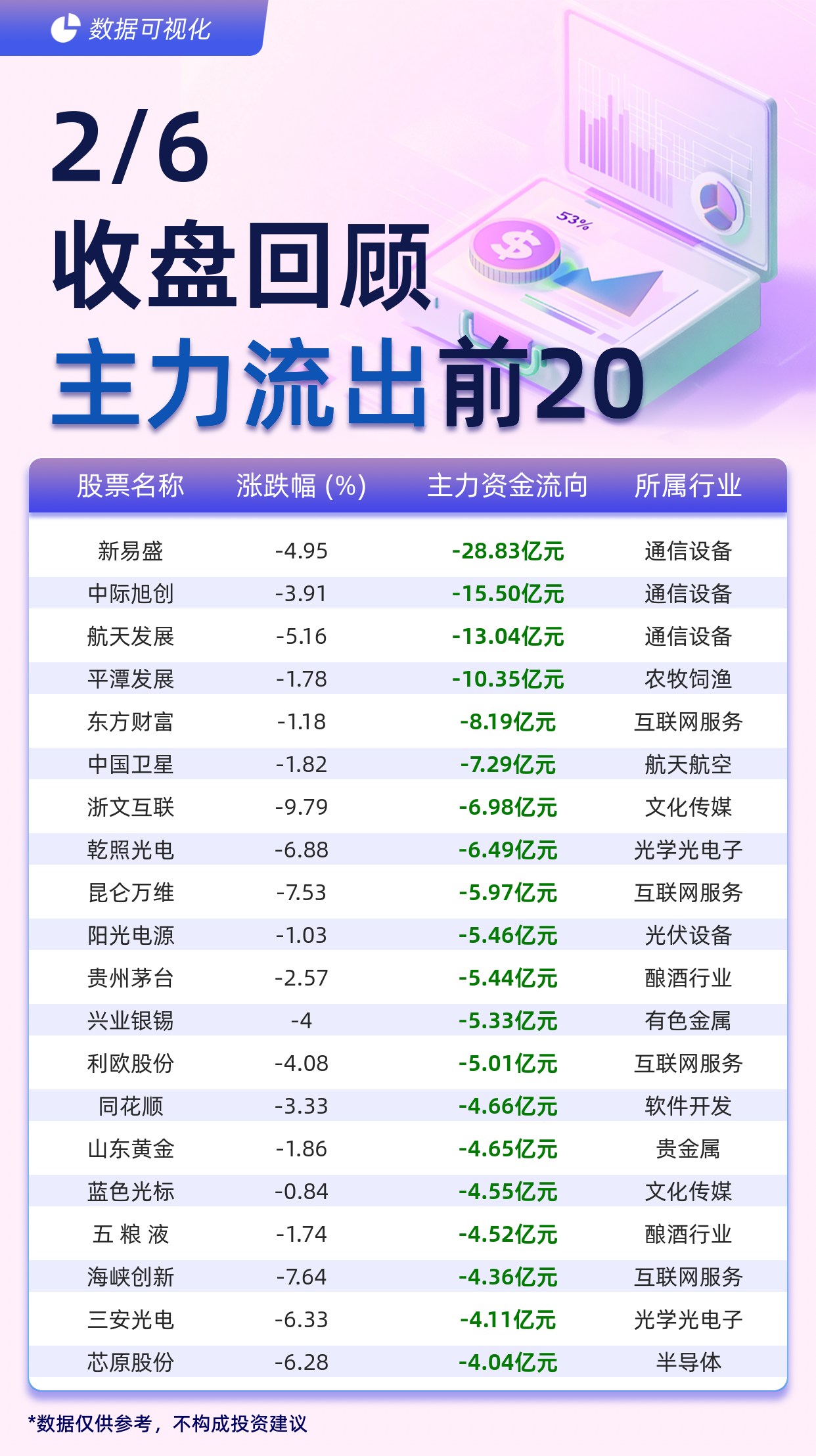
主力个股资金流出前20:新易盛流出28.83亿元、中际旭创流出15.50亿元
Jin Rong Jie· 2026-02-06 07:29
Group 1 - The main stocks with significant capital outflows include Xinyi Technology (-28.83 billion), Zhongji Xuchuang (-15.50 billion), and Aerospace Development (-13.04 billion) [1] - The sectors affected by the capital outflows primarily include communication equipment, internet services, and optical electronics [2][3] - The largest percentage decline in stock prices was observed in Zhejiang Wenlian, which fell by 9.79% [2] Group 2 - Other notable stocks with substantial capital outflows include Guizhou Moutai (-5.44 billion), Sunshine Power (-5.46 billion), and Sanan Optoelectronics (-4.11 billion) [1][3] - The overall trend indicates a negative sentiment in the market, particularly in the communication equipment and internet service sectors [2][3] - The data reflects a broader market trend of capital withdrawal, impacting various industries including agriculture, aerospace, and cultural media [1][2]


同花顺跌2.00%,成交额18.17亿元,主力资金净流出1.85亿元
Xin Lang Cai Jing· 2026-02-06 06:28
Core Viewpoint - The stock price of Tonghuashun has experienced fluctuations, with a recent decline of 2.00% on February 6, 2025, while the company shows a year-to-date increase of 7.42% [1][2]. Group 1: Stock Performance - As of February 6, 2025, Tonghuashun's stock price is reported at 346.10 yuan per share, with a trading volume of 18.17 billion yuan and a turnover rate of 1.66%, resulting in a total market capitalization of 186.06 billion yuan [1]. - Year-to-date, the stock has increased by 7.42%, but has seen a decline of 0.77% over the last five trading days and a decrease of 2.67% over the last 20 days [2]. Group 2: Financial Performance - For the period from January to September 2025, Tonghuashun achieved operating revenue of 3.261 billion yuan, representing a year-on-year growth of 39.67%, and a net profit attributable to shareholders of 1.206 billion yuan, reflecting an increase of 85.29% [2]. - The company has distributed a total of 7.991 billion yuan in dividends since its A-share listing, with 4.193 billion yuan distributed over the last three years [3]. Group 3: Shareholder Information - As of September 30, 2025, the number of shareholders for Tonghuashun is reported at 82,600, a decrease of 4.81% from the previous period, while the average circulating shares per person increased by 5.05% to 3,336 shares [2]. - The second-largest circulating shareholder is Hong Kong Central Clearing Limited, holding 14.6293 million shares, an increase of 2.3322 million shares from the previous period [3].
基金估值科普|什么是实时估值?监管叫停背后引导行业回归长期投资
Xin Lang Cai Jing· 2026-02-05 06:14
"某基金产品单日吸金超百亿"监管出手:严禁与不具备资质的互联网"大V"合作,下架"加仓榜""实盘 榜"等 炒股就看金麒麟分析师研报,权威,专业,及时,全面,助您挖掘潜力主题机会! 近日,主流平台相继下架基金"实时估值""实盘榜""加仓榜"等功能,同花顺、蛋卷基金等也同步暂停相 关数据展示,这场全行业整改引发广大基民热议。不少投资者疑惑,陪伴多年的实时估值究竟该怎么 看?监管为何要出手叫停这一"流量功能"?本文为你逐一拆解。 相关报道: 基金实时估值被"封杀"!投"基"人更应关注这几个长期指标 一分钟带你了解,基金实时估值功能下线原因是什么? 被要求下线的基金"实时估值"卷土重来,暗藏什么生意?| 基市乱象追踪 多平台下架基金实时估值、加仓榜 为什么基金的实时估值跟实际有偏差?是谁偷走了基金的净值? 超300个账号被封禁,部分平台实时估值全线下架 下架实盘榜、实时估值,互联网基金销售平台火速响应监管 监管通报!这家基金公司靠"大V带货"处罚出炉,基金实时估值、实盘榜遭下架 斩断跟风诱导、重塑投资理念 基金"实时估值""实盘榜"集体下线! 实盘榜等功能批量下架!部分平台变相展示基金估值 "基金实时估值"遭全面封杀 ...
同花顺跌2.08%,成交额13.68亿元,主力资金净流出3993.56万元
Xin Lang Zheng Quan· 2026-02-05 02:43
Core Viewpoint - The stock price of Tonghuashun has experienced fluctuations, with a recent decline of 2.08% on February 5, 2025, while the company shows a year-to-date increase of 9.26% [1][2]. Group 1: Stock Performance - As of February 5, 2025, Tonghuashun's stock price is reported at 352.01 yuan per share, with a trading volume of 1.368 billion yuan and a turnover rate of 1.23%, leading to a total market capitalization of 189.241 billion yuan [1]. - Year-to-date, the stock has increased by 9.26%, with a decline of 1.59% over the last five trading days, a rise of 1.35% over the last 20 days, and an increase of 1.53% over the last 60 days [2]. Group 2: Company Overview - Tonghuashun, established on August 24, 2001, and listed on December 25, 2009, is based in Hangzhou, Zhejiang Province. The company provides software products, system maintenance services, financial data services, and investment analysis tools for individual investors [2]. - The revenue composition of Tonghuashun includes 48.33% from value-added telecommunications services, 36.01% from advertising and internet promotion services, 9.43% from fund sales and other businesses, and 6.22% from software sales and maintenance [2]. Group 3: Financial Performance - For the period from January to September 2025, Tonghuashun achieved a revenue of 3.261 billion yuan, representing a year-on-year growth of 39.67%. The net profit attributable to shareholders reached 1.206 billion yuan, marking an increase of 85.29% year-on-year [2]. - Since its A-share listing, Tonghuashun has distributed a total of 7.991 billion yuan in dividends, with 4.193 billion yuan distributed over the past three years [3]. Group 4: Shareholder Information - As of September 30, 2025, the number of shareholders for Tonghuashun is reported at 82,600, a decrease of 4.81% from the previous period, with an average of 3,336 circulating shares per person, an increase of 5.05% [2]. - The second-largest circulating shareholder is Hong Kong Central Clearing Limited, holding 14.6293 million shares, an increase of 2.3322 million shares from the previous period [3].
1月A股开户数同比持续攀升,券商转战抖音、AI应用引流,能否破解第三方平台依赖困局?
Mei Ri Jing Ji Xin Wen· 2026-02-04 13:41
Group 1 - The core point of the articles highlights a significant increase in new A-share accounts, with January 2026 seeing 4.9158 million new accounts, marking a 213% year-on-year growth and the second-highest monthly figure since the "924" market rally [1][2] - The total number of new A-share accounts reached 27.4369 million in 2025, a 9.75% increase from 2024, indicating a strong recovery in market activity [1][2] - Third-party platforms like Tonghuashun have benefited significantly from this surge, with the company reporting a 30% increase in net profit to 1.8 billion yuan in 2024 and projecting a further 50% to 80% growth in 2025 [2][3] Group 2 - Despite the influx of new accounts, brokerage firms are heavily reliant on third-party platforms for client acquisition, leading to high customer acquisition costs [1][3] - Major social media platforms such as Douyin, Xiaohongshu, and WeChat are becoming new channels for brokerages to attract clients, with many firms investing in advertising on these platforms [1][3] - However, the effectiveness of client acquisition through these social media platforms remains limited, as evidenced by the low conversion rates from followers to account openings [3][4] Group 3 - Brokerages are increasingly using Douyin for content marketing, but the actual account opening numbers do not correlate well with follower counts, indicating a gap in conversion effectiveness [4][5] - Some brokerages have developed a matrix of accounts on Douyin, which has shown better results in terms of account openings compared to single accounts with high follower counts [5][6] - The overall impact of Douyin and similar platforms on account opening remains relatively small, with most new accounts still coming from traditional advertising methods [6]
蚂蚁、京东、同花顺,下架基金实时估值和相关短期排行榜
新华网财经· 2026-02-04 13:00
Group 1 - Major distribution channels such as Ant Wealth, Tonghuashun Fund, and JD Finance have removed real-time valuation and related short-term ranking features [2][5] - Regulatory authorities have mandated that fund sales institutions and third-party platforms conduct self-inspections and remove features that may mislead investors, such as "real-time valuation" and "ranking lists" [4][6] - The removal of these features is part of a broader regulatory effort to discourage short-term trading behaviors and promote the core purpose of mutual funds as long-term investment tools [9] Group 2 - Some platforms have attempted to disguise the removal of real-time valuation by presenting similar information under different names, such as "net value reference" and "sector fluctuations" [4][9] - The industry is currently undergoing a compliance review, with companies assessing the qualifications of their partners and ensuring adherence to regulatory requirements [7] - The regulatory push aims to stabilize the market by preventing behaviors that could lead to increased volatility, such as frequent redemptions triggered by real-time valuation changes [9]

A股炒股软件股拉升,同花顺、指南针涨超2%
Jin Rong Jie· 2026-02-04 06:57
Group 1 - The A-share market saw a rise in stock trading software companies, with Tonghuashun and Zhinanzhen increasing by over 2% [1] - Other companies such as Dazhihui and Dongfang Caifu also experienced gains, rising nearly 2% [1]
纠偏短期交易行为 代销渠道下架“惹争议”功能
Zhong Guo Zheng Quan Bao· 2026-02-03 22:16
Core Viewpoint - The regulatory authorities have mandated fund sales institutions and third-party platforms to conduct self-examinations and remove misleading features that could confuse investors, aiming to promote long-term investment strategies over short-term trading behaviors [1][2][4]. Group 1: Regulatory Actions - Regulatory bodies have observed that some fund sales institutions and unlicensed third-party platforms have reinstated "real-time valuation" features, which could mislead investors and dilute fund product returns [2][4]. - Fund sales institutions and third-party platforms are required to remove features such as "real-time valuation," "increased position rankings," and "actual performance rankings" to prevent misleading investor behavior [2][3]. - Major platforms like Ant Wealth and Tonghuashun have already complied by suspending these features, with specific timelines for adjustments announced [2][3]. Group 2: Industry Response - Many platforms have taken steps to comply with regulatory requirements, including the removal of various ranking features that could mislead investors [3][4]. - Some platforms continue to display real-time valuations under different formats, indicating a need for further compliance and adjustment within the industry [4][5]. - The industry is undergoing a self-assessment process to ensure compliance with regulations, with companies actively checking the qualifications of their promotional partners [3][5]. Group 3: Market Implications - The removal of misleading features is part of a broader effort to guide fund sales away from transactional behaviors and encourage investors to focus on long-term asset management [4][5]. - The use of real-time valuation has been criticized for fostering short-term trading behaviors, which contradicts the fundamental purpose of mutual funds aimed at ordinary investors [5]. - Regulatory actions are intended to stabilize the market and mitigate risks associated with investor behavior during periods of market volatility [5].
蚂蚁、京东、同花顺,下架这些功能
Zhong Guo Zheng Quan Bao· 2026-02-03 14:47
Group 1 - The core issue revolves around a fund company's violation of sales regulations, leading to major distribution channels like Ant Wealth and Tonghuashun removing real-time valuation and related short-term ranking features [1][3] - Regulatory authorities have mandated that fund sales institutions and third-party platforms conduct self-inspections and remove misleading features that could confuse investors, such as "real-time valuation" and "ranking lists" [3][4] - Many institutions have already begun to comply with these regulations by suspending features that could mislead investors, including real-time valuation and various ranking lists [4][5] Group 2 - The industry is undergoing a self-check process regarding the qualifications of influencers (referred to as "DVs") collaborating with fund companies, ensuring they possess the necessary qualifications for fund sales [2][5] - Despite regulatory actions, some platforms continue to display modified versions of real-time valuation, using alternative methods to indicate fund performance, which could still mislead investors [6][7] - The regulatory push aims to discourage short-term trading behaviors and promote the fundamental purpose of mutual funds as long-term investment tools, thereby stabilizing the market [6][7]