
Risen Energy(300118)

Search documents
航天+AI跨界整合引爆赛道,SpaceX合并xAI打开太空光伏增量,中国企业凭硬核实力扩份额,出海提速筑牢2026增长根基
Xin Lang Cai Jing· 2026-02-03 12:52
Group 1 - Company Sunlight Power (300274) is a leading domestic enterprise in photovoltaic inverters, covering the entire industry chain including energy storage systems and photovoltaic power station development [1][43] - The company has strong technical capabilities in power electronics and system integration, with products suitable for various applications including residential, commercial, and large-scale ground power stations [1][43] - In the space photovoltaic and computing power sector, Sunlight Power's technology can be adapted for space applications, providing stable power support for space computing centers [1][43][44] Group 2 - Longi Green Energy (601012) is a leading domestic photovoltaic company focusing on the research and production of monocrystalline silicon rods and wafers, with a complete vertical integration in the industry chain [2][45] - The company excels in new generation high-efficiency battery technologies such as N-type TOPCon and HJT, with significant cost control and technical advantages [2][45] - Longi's ultra-thin silicon wafer technology meets the stringent requirements for space photovoltaic components, enabling reduced weight and improved energy efficiency for space computing centers [2][45] Group 3 - Tongwei Co., Ltd. (600438) is a dual leader in photovoltaic silicon materials and battery production, with a strong focus on high-purity crystalline silicon and photovoltaic battery manufacturing [3][46] - The company has a high market share in high-purity silicon production and is well-positioned to meet the rigorous standards required for space photovoltaic components [3][46] - Tongwei's efficient battery technology can enhance power generation in space photovoltaic applications, positioning the company as a key supplier in the space photovoltaic supply chain [3][46] Group 4 - Deye Technology (605117) is a quality enterprise with core businesses in dehumidification equipment and photovoltaic energy storage systems, excelling in household and commercial energy storage solutions [4][43] - The company's energy storage technology is crucial for providing stable energy supply in space photovoltaic applications, addressing intermittent power generation issues [4][43][44] - Deye's experience in developing equipment for extreme environments positions it well to adapt products for space applications [4][43] Group 5 - Jingcheng Machinery (300316) is a leading domestic enterprise in photovoltaic crystal growth equipment, focusing on high-end equipment for photovoltaic manufacturing [5][6] - The company's technology supports the production of high-purity silicon crystals and ultra-thin silicon wafers, essential for space photovoltaic components [5][6] - As the space photovoltaic industry matures, Jingcheng is expected to provide core manufacturing equipment for the space photovoltaic supply chain [5][6] Group 6 - Maiwei Co., Ltd. (300751) is a leading enterprise in photovoltaic battery equipment, specializing in HJT and perovskite tandem battery technologies [7][41] - The company's equipment is crucial for the mass production of high-efficiency batteries that meet the stringent requirements of space photovoltaic applications [7][41] - Maiwei's technology can support the development of space-specific battery manufacturing equipment, enhancing energy system efficiency for space computing centers [7][41] Group 7 - Foster (603806) is a global leader in photovoltaic packaging materials, focusing on EVA and POE films, with a strong market presence [8][43] - The company's packaging materials are essential for ensuring the durability and performance of photovoltaic components in extreme space environments [8][43] - Foster aims to develop specialized packaging materials for space applications, enhancing the reliability of space photovoltaic systems [8][43] Group 8 - JinkoSolar (002459) is a global leader in photovoltaic modules, with a comprehensive business model covering silicon wafers, battery cells, and modules [10][43] - The company has a strong technical foundation and global production capabilities, allowing it to meet diverse application needs [10][43] - JinkoSolar's module manufacturing technology is well-suited for space applications, with the potential to become a core supplier for space photovoltaic systems [10][43] Group 9 - TCL Zhonghuan (002129) is a core enterprise in the silicon wafer sector, focusing on monocrystalline silicon materials and semiconductor materials [12][43] - The company's high-purity silicon technology is critical for space photovoltaic components, meeting the stringent requirements for purity and performance [12][43] - TCL Zhonghuan is positioned to develop space-specific silicon products, enhancing its role in the space photovoltaic supply chain [12][43] Group 10 - Aerospace Electromechanical (600151) is a leading enterprise in the integration of aerospace and photovoltaic technologies, covering the entire industry chain from component manufacturing to power station operation [19][43] - The company's aerospace power technology can be directly applied to space photovoltaic systems, providing essential energy management solutions [19][43] - With its experience in satellite systems, Aerospace Electromechanical is well-positioned to participate in the development of space computing centers [19][43]





东方日升储能再度跻身BNEF Tier 1榜单 国际竞争力获权威认可
Zheng Quan Ri Bao Wang· 2026-02-03 09:49
Core Insights - Risen Energy has been recognized as a Tier 1 manufacturer in the latest Bloomberg New Energy Finance (BNEF) report for Q1 2026, highlighting its comprehensive strength in the energy storage sector [1][2] - The company has developed a full-stack renewable energy solution capability over 21 years, offering customized products across various categories including photovoltaic modules, inverters, energy storage systems, and smart energy management systems [1] - Risen Energy's Risen Cloud smart energy management platform provides remote operation and maintenance services, creating a full lifecycle value loop from green power generation to energy storage and smart operation [1] Global Expansion and Market Development - The company has established a global operational system with 10 production bases and 24 marketing service centers, covering key regions such as Europe, North America, Asia-Pacific, the Middle East, and South America [2] - Recent achievements in overseas market expansion include signing contracts in Saudi Arabia, Brazil, and Malaysia, enhancing local cooperation and market penetration [2] - In the domestic market, Risen Energy has formed deep strategic partnerships with several core clients, solidifying its development foundation in regions like East China, South China, and North China [2] Future Outlook - The recognition as a Tier 1 manufacturer reflects the industry's and market's acknowledgment of Risen Energy's technology research and development, project delivery, and brand influence [2] - The company plans to continue increasing its investment in technology research and development, focusing on optimizing and upgrading products and solutions to provide safer, more efficient, and customized energy solutions for global customers [2]

太空光伏掀涨停潮!一图看懂相关概念
天天基金网· 2026-02-03 08:42
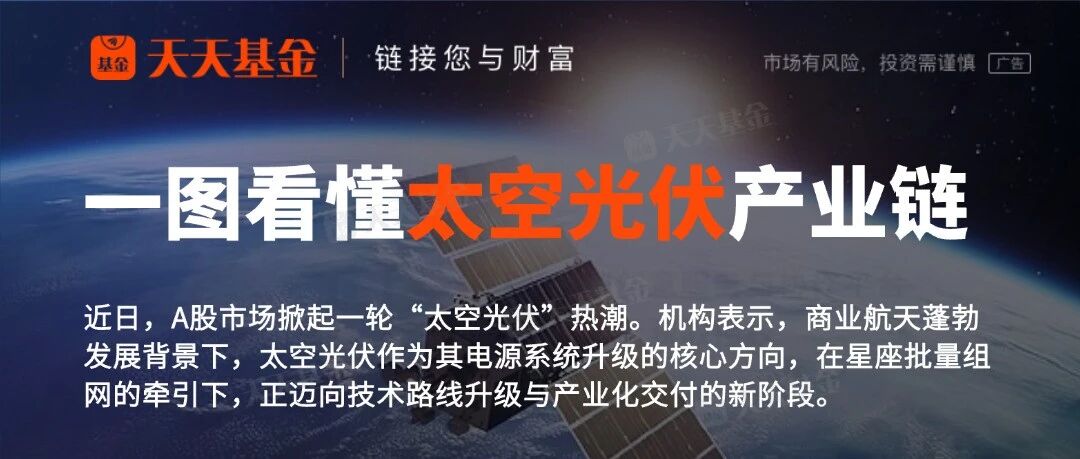
Core Viewpoint - The article highlights the emerging trend of "space photovoltaics" in the A-share market, driven by the rapid development of commercial aerospace and the need for upgraded power systems in satellite constellations [1]. Industry Chain - The space photovoltaic industry chain includes various components such as photovoltaic auxiliary materials, photovoltaic cells, and photovoltaic equipment, with key players like Double Good Energy, Junda Co., and Trina Solar [3]. Institutional Interpretation - As China's low-orbit satellite constellations enter a phase of intensive deployment, the industry is expected to undergo significant transformation, with a focus on manufacturing and technological advancements [4][11]. Market Potential - Space photovoltaics are projected to achieve commercialization within the next 10 to 15 years, with the Chinese low-orbit satellite photovoltaic market expected to exceed $3 billion by 2030. If the deployment reaches 100GW for space data centers, the global market could reach between $500 billion to $1 trillion [5][12]. Technological Advantages - Space photovoltaics can generate power continuously, unaffected by day-night cycles or weather changes, achieving 7-10 times the annual generation hours and energy density compared to ground-based photovoltaics [10]. Recent Developments - The recent acquisition of xAI by SpaceX aims to create a vertically integrated innovation engine, which is expected to enhance SpaceX's space computing capabilities, directly benefiting the space photovoltaic industry [9].







A股异动丨太空光伏概念走强,福斯特涨停,钧达股份涨超7%
Sou Hu Cai Jing· 2026-02-03 03:46
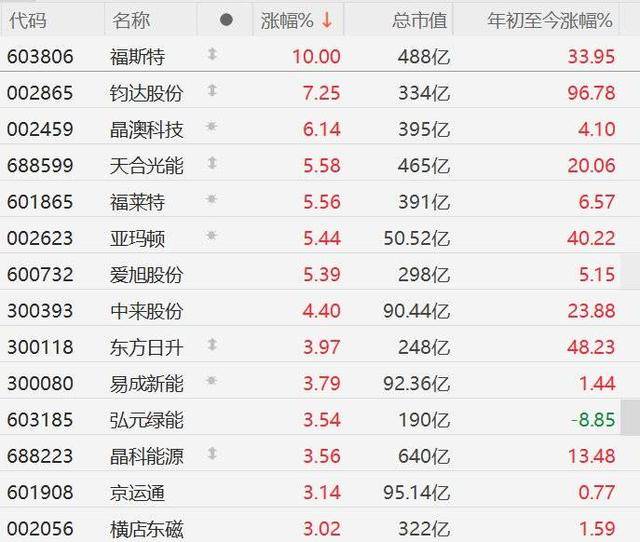
Core Viewpoint - The A-share market is witnessing a surge in space photovoltaic concept stocks, driven by the strategic importance of space-based artificial intelligence and the global competition for low Earth orbit resources [1] Group 1: Market Performance - Foster (福斯特) reached a limit-up increase of 10%, with a total market value of 48.8 billion and a year-to-date increase of 33.95% [2] - Junda Co. (钧达股份) rose by 7.25%, with a market value of 33.4 billion and a year-to-date increase of 96.78% [2] - JA Solar Technology (晶澳科技) increased by 6.14%, with a market value of 39.5 billion and a year-to-date increase of 4.10% [2] - Trina Solar (天合光能) saw a rise of 5.58%, with a market value of 46.5 billion and a year-to-date increase of 20.06% [2] - Other notable increases include: - Flat Glass Group (福莱特) at 5.56% [2] - Yamaton (亚玛顿) at 5.44% [2] - Aiko Solar (爱旭股份) at 5.39% [2] - Zhonglai Co. (中来股份) at 4.40% [2] Group 2: Industry Insights - CITIC Securities emphasizes that space photovoltaics are not merely speculative but are on the verge of large-scale deployment, driven by new demands from "space computing power + AI" and the ongoing competition for low Earth orbit resources [1] - The development of space photovoltaics is linked to national strategic needs for satellite deployment, communication capabilities, and the integration of computing power and AI [1] - CICC notes that with the booming commercial space sector, space photovoltaics are becoming a core direction for upgrading power systems, moving towards a new phase of technological advancement and industrial delivery [1]


"太空光伏"概念走热,部分企业触发交易异常,业内: 目前仍处于0到1阶段
Di Yi Cai Jing· 2026-02-02 07:45
Core Viewpoint - The "space photovoltaic" concept has become a major focus in the secondary market, significantly influenced by Tesla CEO Elon Musk's endorsements, with the relevant index rising 19.83% in the past month, outperforming the CSI 300 index's 1.18% increase [1] Group 1: Market Performance - The space photovoltaic concept index has seen a substantial increase, with notable stocks such as JunDa Co., Ltd. rising by 84.62%, Mingyang Smart Energy increasing by 60.22%, and Jiejia Weichuang up by 44.04% over the past 20 days [1] - Several photovoltaic companies have experienced significant stock price surges, triggering trading anomalies, with stocks like Dongfang Risen and Laplace exceeding a cumulative price deviation of 30% over multiple trading days [3] Group 2: Technology and Feasibility - Space photovoltaic energy involves utilizing solar photovoltaic technology in outer space to generate and supply energy, with the potential for direct power transmission to Earth or powering satellites and space stations [3] - The feasibility of space photovoltaic technology is supported by the abundant sunlight in space and the ability to deploy photovoltaic components on satellites, with near-Earth orbit satellites experiencing over 60% sunlight exposure [3] - Despite the market enthusiasm, the industry faces significant uncertainties regarding the maturity and long-term reliability of the technology, as well as the economic viability required for large-scale commercialization [4][5] Group 3: Industry Insights - Industry insiders indicate that the application scenarios for space photovoltaic technology are still in the exploratory phase, with many companies in the secondary market not yet supplying products to commercial space satellite companies [4] - Analysts emphasize that space photovoltaic technology is currently in the early stages, requiring validation of technical routes and economic benefits for large-scale commercial applications [5] - The current cost of space photovoltaic energy is estimated to be around $2-3 per kilowatt-hour, significantly higher than ground photovoltaic costs of $0.03-0.05 per kilowatt-hour, highlighting the economic challenges ahead [6] Group 4: Future Outlook - Companies like Trina Solar and HaiMuxing express optimism about the future of space photovoltaic technology, with ongoing collaborations with leading aerospace institutions to accumulate practical experience [6] - The commercial viability of space photovoltaic technology is projected to gradually materialize over the next 10 to 15 years, driven by decreasing launch costs and breakthroughs in battery technology [7]





光伏板块快速拉升,东方日升触及涨停!光伏ETF华夏(515370)上涨1.47%,太空光伏含量指数维度全市场第一
Mei Ri Jing Ji Xin Wen· 2026-02-02 02:49
Group 1 - The photovoltaic sector experienced a rapid surge, with Dongfang Risen hitting the daily limit up [1] - The Huaxia Photovoltaic ETF (515370) increased by 1.47%, ranking first in the overall market for the space photovoltaic content index [1] Group 2 - The Huaxia Photovoltaic ETF (515370) saw a net inflow of over 51 million yuan in the past five days [2] - The Huaxia Photovoltaic ETF (515370) and its linked funds (012885/012886) track the CSI Photovoltaic Industry Index, covering upstream, midstream, and downstream companies in the photovoltaic industry, including silicon wafers, polysilicon, battery cells, cables, photovoltaic glass, battery modules, inverters, photovoltaic brackets, and photovoltaic power stations [2]
光伏板块快速拉升,东方日升触及涨停!光伏ETF华夏上涨1.47%,太空光伏含量指数维度全市场第一
Mei Ri Jing Ji Xin Wen· 2026-02-02 02:36
光伏ETF华夏及其联接基金5/跟踪中证光伏产业指数,涉及光伏产业链上、中、下游企业,包括硅片、 多晶硅、电池片、电缆、光伏玻璃、电池组件、逆变器、光伏支架和光伏电站等,能够更好的反映光伏 产业整体表现。 资金面上,光伏ETF华夏近五日净流入超5100万元。 2026年2月2日,光伏板块快速拉升,东方日升触及涨停!光伏ETF华夏上涨1.47%,太空光伏含量指数 维度全市场第一。 ...
未知机构:电新周观点更新好看太空光伏储能锂钠电锂电全国容量电价-20260202
未知机构· 2026-02-02 02:00
Industry and Company Summary Industry: Lithium Battery and Energy Storage Key Points - **National Capacity Pricing Policy**: The introduction of the national capacity pricing policy is expected to increase the Internal Rate of Return (IRR) for energy storage by over 3%, with more provinces expected to adopt energy storage solutions by 2026 [1] - **Lithium Battery Production**: In February, lithium battery production is projected to decrease by over 10%, indicating that the production season is not as weak as anticipated [1] - **Sodium Battery Testing**: Ningde has initiated winter testing for multiple automotive companies regarding sodium batteries, with expectations for mass shipments in Q2 [1] - **Investment Focus**: The preferred investment hierarchy is as follows: energy storage cells (Penghui) > lithium iron phosphate cathodes > energy storage integration (Haibo) > separators (Enjie), copper and aluminum foils (Nord and Dingsheng) [1] Industry: Sodium Battery and Lithium Carbonate Key Points - **Lithium Carbonate Price Adjustment**: Following a price adjustment, there is a strong expectation for a new upward trend in lithium carbonate prices, with downstream procurement becoming more active after recent price drops [2] - **Wind Power Sector Performance**: The wind power sector has seen numerous earnings forecasts that fell short of expectations due to a decline in Q4 shipment volumes and year-end impairments, indicating a confirmed bottom for the main engine sector [2] - **Investment Recommendations**: Recommended stocks include Jinlei Co., Daikin Heavy Industries, and major turbine manufacturers (Goldwind, SANY, Yunda, Mingyang) [2] Industry: Photovoltaics Key Points - **Space Photovoltaics**: SpaceX's application to deploy 1 million satellites to create a space data center reinforces the logic behind space photovoltaics [3] - **Cost Reduction in Battery Production**: The high price of silver and technological breakthroughs have led to an average cost reduction of over 0.15 CNY/W in copper-based batteries, indicating a potential explosion in the no-silver production sector [3] - **Investment Focus in Photovoltaics**: The preferred investment hierarchy includes equipment manufacturers (Liancheng, Lap, Maiwei, Yujing) and battery and auxiliary material producers (Bojian, Foster, Kaisheng, Juhua, Dike, Risheng, Junda) [3] Industry: AIDC (Artificial Intelligence Data Center) Key Points - **New Bidding Round**: The domestic supply chain is entering a new round of bidding, with ByteDance shifting its bidding focus to high-voltage direct current solutions [3] - **NVIDIA Certification**: NVIDIA's GB300 liquid cooling certification is tightening, which may lead future investments to focus on core components and ASIC overflow [3] - **Increased Production Capacity**: The production capacity of Yingweike's QD is expected to increase by 20 times in Q1, strengthening ties with the NVIDIA ecosystem [3]


“太空光伏”概念走热,业内:目前仍处于0到1阶段
Di Yi Cai Jing Zi Xun· 2026-01-30 13:27
Core Insights - The "space photovoltaic" concept has gained significant attention in the secondary market, largely influenced by Tesla CEO Elon Musk's endorsements [2] - The Wind Space Photovoltaic Index has risen by 19.83% over the past month, outperforming the Shanghai and Shenzhen 300 Index, which increased by 1.18% [2] - Several photovoltaic companies have experienced substantial stock price increases, with JunDa Co., Ltd. rising by 84.62% and Mingyang Smart Energy increasing by 60.22% in the last 20 days [2] Market Performance - The stock prices of companies like Dongfang Risen and Laplace have shown abnormal fluctuations, with price deviations exceeding 30% over consecutive trading days [3] - The space photovoltaic sector is characterized by its potential to harness solar energy in outer space, providing power to satellites and space stations [3] Industry Challenges - Despite the market enthusiasm, the commercialization of space photovoltaics faces significant uncertainties related to technology maturity and economic viability [4] - Industry insiders indicate that the application scenarios for space photovoltaics are still in the exploratory phase, with many companies not yet supplying products to commercial satellite firms [4] Technological Considerations - Current leading materials for space photovoltaics include gallium arsenide, which is costly at approximately 1000 RMB per watt, and perovskite, which faces stability issues in extreme space conditions [5] - The cost of electricity generated from space photovoltaics is estimated to be 2-3 USD per kilowatt-hour, significantly higher than the ground-based photovoltaic cost of 0.03-0.05 USD per kilowatt-hour [5] Future Outlook - Several A-share listed companies express optimism about the future of space photovoltaics, with potential market size reaching trillions as technology advances [5] - Companies like Trina Solar and HaiMuxing are actively collaborating with leading aerospace institutions to develop practical applications for space solar energy [5] - The commercialization of space photovoltaics is projected to gradually occur over the next 10 to 15 years as launch costs decrease and battery technologies improve [6]

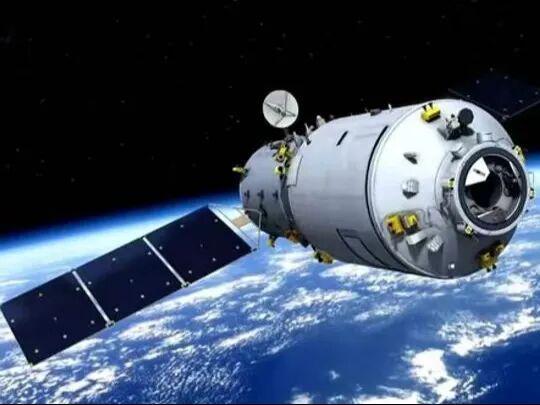
“太空光伏”概念走热 部分企业触发交易异常 业内:目前仍处于0到1阶段
Di Yi Cai Jing· 2026-01-30 12:05
Core Viewpoint - The "space photovoltaic" concept has become a major focus in the secondary market, significantly influenced by Tesla CEO Elon Musk's endorsements, with the relevant index rising 19.83% in the past month, outperforming the CSI 300 index by 18.65% [1] Market Performance - The space photovoltaic concept index has shown strong performance, with notable stock increases: JunDa Co., Ltd. up 84.62%, Mingyang Smart Energy up 60.22%, Jiejia Weichuang up 44.04%, Dier Laser up 41.54%, and Tuori New Energy up 35.94% over the past 20 days [1] - Several photovoltaic companies have experienced significant stock price surges, triggering trading anomalies, such as Dongfang Risheng and Laplace, both exceeding a cumulative price deviation of 30% within a short period [2] Industry Insights - Space photovoltaic energy refers to utilizing solar photovoltaic technology in outer space to generate and supply energy, with the potential to transmit power wirelessly to Earth or supply satellites and space stations [2] - The rationale for space photovoltaics includes abundant sunlight in space and the feasibility of deploying photovoltaic components on satellites, with near-Earth satellites experiencing over 60% sunlight exposure [2] Challenges in Industrialization - Despite the rising stock prices, the industry faces significant uncertainties regarding the industrialization of space photovoltaics, including technological maturity and economic viability for large-scale commercialization [3] - Current applications of space photovoltaics are still exploratory, with many companies in the secondary market not yet supplying products to commercial space satellite companies [3] - Analysts indicate that space photovoltaics are in the early stages of development, requiring validation of technology and economic benefits for large-scale applications [3] Technological Considerations - Gallium arsenide is the mainstream material for space photovoltaics, but its high cost (approximately 1000 RMB per watt) poses challenges for large-scale deployment [4] - Perovskite technology shows promise but has stability concerns in extreme space conditions, necessitating further validation [4] - Multiple technological routes are being explored, with a focus on solving power and cost issues as critical for the commercialization of space energy solutions [4] Cost Analysis - Current estimates suggest that the cost of electricity from space photovoltaics is around $2-3 per kilowatt-hour, compared to $0.03-0.05 per kilowatt-hour for ground-based photovoltaics, indicating a potential cost disparity of up to 100 times [5] - Companies like Trina Solar and HaiMuxing express optimism about the future of space photovoltaics, citing collaborations with leading aerospace institutions and advancements in reusable rocket technology [5] Commercialization Timeline - Predictions indicate that space photovoltaics may gradually commercialize over the next 10 to 15 years, contingent on decreasing launch costs and breakthroughs in battery technology [6]