
Risen Energy(300118)

Search documents
“太空光伏”概念走热 部分企业触发交易异常 业内:目前仍处于0到1阶段
Di Yi Cai Jing· 2026-01-30 12:05
Core Viewpoint - The "space photovoltaic" concept has become a major focus in the secondary market, significantly influenced by Tesla CEO Elon Musk's endorsements, with the relevant index rising 19.83% in the past month, outperforming the CSI 300 index by 18.65% [1] Market Performance - The space photovoltaic concept index has shown strong performance, with notable stock increases: JunDa Co., Ltd. up 84.62%, Mingyang Smart Energy up 60.22%, Jiejia Weichuang up 44.04%, Dier Laser up 41.54%, and Tuori New Energy up 35.94% over the past 20 days [1] - Several photovoltaic companies have experienced significant stock price surges, triggering trading anomalies, such as Dongfang Risheng and Laplace, both exceeding a cumulative price deviation of 30% within a short period [2] Industry Insights - Space photovoltaic energy refers to utilizing solar photovoltaic technology in outer space to generate and supply energy, with the potential to transmit power wirelessly to Earth or supply satellites and space stations [2] - The rationale for space photovoltaics includes abundant sunlight in space and the feasibility of deploying photovoltaic components on satellites, with near-Earth satellites experiencing over 60% sunlight exposure [2] Challenges in Industrialization - Despite the rising stock prices, the industry faces significant uncertainties regarding the industrialization of space photovoltaics, including technological maturity and economic viability for large-scale commercialization [3] - Current applications of space photovoltaics are still exploratory, with many companies in the secondary market not yet supplying products to commercial space satellite companies [3] - Analysts indicate that space photovoltaics are in the early stages of development, requiring validation of technology and economic benefits for large-scale applications [3] Technological Considerations - Gallium arsenide is the mainstream material for space photovoltaics, but its high cost (approximately 1000 RMB per watt) poses challenges for large-scale deployment [4] - Perovskite technology shows promise but has stability concerns in extreme space conditions, necessitating further validation [4] - Multiple technological routes are being explored, with a focus on solving power and cost issues as critical for the commercialization of space energy solutions [4] Cost Analysis - Current estimates suggest that the cost of electricity from space photovoltaics is around $2-3 per kilowatt-hour, compared to $0.03-0.05 per kilowatt-hour for ground-based photovoltaics, indicating a potential cost disparity of up to 100 times [5] - Companies like Trina Solar and HaiMuxing express optimism about the future of space photovoltaics, citing collaborations with leading aerospace institutions and advancements in reusable rocket technology [5] Commercialization Timeline - Predictions indicate that space photovoltaics may gradually commercialize over the next 10 to 15 years, contingent on decreasing launch costs and breakthroughs in battery technology [6]





“太空光伏”概念走热,部分企业触发交易异常,业内:目前仍处于0到1阶段
Di Yi Cai Jing Zi Xun· 2026-01-30 11:37
Core Viewpoint - The "space photovoltaic" concept has gained significant attention in the secondary market, largely influenced by Tesla CEO Elon Musk's endorsements, with the relevant index rising 19.83% in the past month, outperforming the CSI 300 index by 18.65% [1] Market Performance - The space photovoltaic concept index has seen a notable increase, with specific stocks like JunDa Co., Ltd. rising by 84.62%, Mingyang Smart Energy by 60.22%, and Jiejia Weichuang by 44.04% over the past 20 days [1] - Several photovoltaic companies have experienced stock price surges, triggering trading anomalies, such as Dongfang Risheng and Laplace, which saw price deviations exceeding 30% [3] Technology and Feasibility - Space photovoltaic energy involves utilizing solar photovoltaic technology in outer space to generate and supply energy, with the potential for direct power transmission to Earth [3] - The advantages of space photovoltaic systems include abundant sunlight and reduced atmospheric interference, making them a viable option for satellite power supply [3] Industry Challenges - Despite the market enthusiasm, the space photovoltaic industry faces significant uncertainties regarding technological maturity, long-term reliability, and economic viability for large-scale commercialization [4][5] - Current applications are still in the exploratory phase, with many companies not yet supplying products to commercial space satellite firms [5] Technological Development - Various technological routes are being explored, with gallium arsenide being the mainstream material, but its high cost poses challenges for large-scale deployment [5][6] - The cost of space photovoltaic energy is currently estimated at $2-3 per kilowatt-hour, significantly higher than ground-based photovoltaic costs of $0.03-0.05 per kilowatt-hour, indicating a need for cost reduction and efficiency improvements [6] Future Outlook - Companies like Trina Solar and HaiMuxing express optimism about the future of space photovoltaic technology, citing collaborations with leading aerospace institutions and advancements in reusable rocket technology [6][7] - The commercial viability of space photovoltaic systems is projected to develop over the next 10 to 15 years, contingent on decreasing launch costs and breakthroughs in battery technology [7]

我国商业航天火箭将加速升级,行业迎来多重共振
Xuan Gu Bao· 2026-01-29 14:38
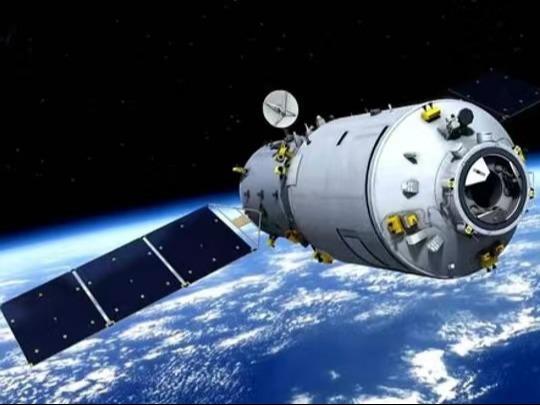
Industry Overview - China Aerospace Science and Technology Corporation plans to enhance commercial launch capabilities by developing internationally competitive commercial launch vehicles for regular transportation [1] - The goal includes achieving reusable rocket capabilities for near-Earth orbit with a capacity of 20 tons and completing heavy-lift rocket development with a capacity of 100 tons for near-Earth orbit [1] - The commercial space industry in China faces a long-standing issue of "many satellites but few rockets," which limits the deployment of satellite networks [1] Market Dynamics - By 2026, the industry is expected to experience a convergence of technological advancements, order releases, and capital appreciation [1] - The upcoming launches of reusable rockets such as Long March 10 and Zhuque-3 will coincide with SpaceX's Starship V3 test flight in early 2026, marking a strategic acceleration for China's commercial space sector [1] Company Insights - Chaojie Co., Ltd. specializes in manufacturing structural components for commercial rockets, including major sections, fairings, fuel tanks, and engine valves, serving leading private aerospace companies in China [1] - Dongfang Risen has successfully delivered small batches of its P-type ultra-thin HJT solar cells for rollable satellite solar wings in Europe and North America [1]

最高净增超149%!2025 年多家储能相关企业扭亏为盈
行家说储能· 2026-01-29 10:40
Core Viewpoint - The energy storage industry is experiencing significant differentiation among listed companies, with most companies forecasting profitability for 2025, while only one company, 东方日升, is expected to incur losses due to price pressures in the photovoltaic supply chain [2] Group 1: Tesla - Tesla's energy business achieved a gross profit of $12.8 billion in 2025, representing a year-on-year increase of 26.6%, driven by strong demand for its Megapack and Powerwall products [3] - The company anticipates further growth in energy deployment with the introduction of new products, although management warns of potential short-term profit margin pressures due to increased competition and policy uncertainties [3] Group 2: 南网储能 - 南网储能 expects a net profit of between 1.667 billion and 1.727 billion yuan for 2025, marking an increase of approximately 5.41 billion to 6.01 billion yuan compared to the previous year, with a year-on-year growth rate of 47.98% to 53.31% [4] - The company is also expanding its project portfolio, including a 720MW/1440MWh battery storage project set to be operational by mid-2026 [6] Group 3: 智光电气 - 智光电气 forecasts a turnaround with a net profit of 110 million to 160 million yuan for 2025, a significant increase of 133.69% to 149.01% compared to a loss of 326 million yuan in the previous year [7] - The growth is attributed to rapid development in the energy storage sector and improved performance of independent energy storage stations [7][9] Group 4: 远东股份 - 远东股份 anticipates a net profit of 45 million to 65 million yuan for 2025, indicating a turnaround from previous losses, driven by improvements in its smart battery business [10] - The company plans to expand its core technology products and services related to energy and AI [10] Group 5: 东方日升 - 东方日升 expects a loss of between 2.3 billion and 2.9 billion yuan for 2025, primarily due to challenges in the industry cycle [11] - The company aims to enhance its value proposition through integrated solutions in the photovoltaic and energy storage sectors [11] Group 6: 新特电气 - 新特电气 projects a net profit of 40 million to 50 million yuan for 2025, recovering from a loss of 48.51 million yuan in the previous year, driven by growth in its energy storage business [12] - The company is leveraging its expertise in special transformers to expand into energy storage system integration [12] Group 7: 赣锋锂业 - 赣锋锂业 forecasts a net profit of 1.1 billion to 1.65 billion yuan for 2025, recovering from a loss of 2.074 billion yuan, largely due to gains from stock price increases and strategic investments [13] - However, the company still anticipates losses when excluding non-recurring items, indicating ongoing challenges in its core lithium product business [13] Group 8: 多氟多 - 多氟多 expects a net profit of 200 million to 280 million yuan for 2025, recovering from a loss of 308 million yuan, driven by increased demand in the energy storage and electric vehicle markets [14] - The company is actively promoting its battery products for energy storage applications and has achieved significant production capacity [14]



商业航天为何会成为2026年的主线?
Soochow Securities· 2026-01-29 00:20
Investment Rating - The report maintains an "Overweight" rating for the commercial aerospace industry, indicating a positive outlook for the sector in the coming months [1]. Core Insights - The commercial aerospace industry is expected to undergo a significant transformation by 2026, driven by advancements in launch capabilities and the successful deployment of domestic rockets, which will remove previous constraints on industry growth [8][9]. - The competition in commercial aerospace is fundamentally a "land grab" for space sovereignty and resource allocation, emphasizing the need for increased launch frequency to secure China's position in low Earth orbit [10]. - The report highlights the strategic importance of commercial aerospace in national defense and resource acquisition, particularly in the context of lunar resources like Helium-3, which could reshape global energy dynamics [12]. - Key catalysts for the industry include domestic policy support and capital market developments, with significant IPOs expected from leading aerospace companies in 2026 [13][15]. Summary by Sections 1. Why has the domestic commercial aerospace industry reached a qualitative change? - The industry has transitioned from a limited payload capacity to a robust launch capability, marked by the successful launch of the Zhuque-3 rocket, which signifies a shift from speculative themes to a narrative driven by operational capacity [8]. 2. How to understand the importance of commercial aerospace? - The scarcity of low Earth orbit resources has made the commercial aerospace race a critical national strategy, with the need to enhance launch frequency to secure space assets and maintain competitive advantages [10][11]. 3. What subsequent catalysts are worth paying attention to in commercial aerospace? 3.1. Domestic: Accelerated release of policy and capital dividends - The report anticipates significant policy support and capital market activity, with major aerospace companies expected to enter the IPO market in 2026, reflecting the strategic importance of the sector [13]. 3.2. International: Clear policy framework and tight planning timeline - The U.S. has shifted from a public to a private ownership model for space resources, establishing a legal framework that encourages commercial investment in space resource development [15][16]. 4. Investment Recommendations 4.1. SpaceX Concept - Companies that could potentially enter the SpaceX supply chain are highlighted, indicating a strong future in commercial aerospace [17]. 4.2. Rocket Sector: "Many Stars, Few Rockets" Expected to Breakthrough - The report suggests that advancements in large-capacity reusable rocket technology will lead to significant changes and valuation adjustments in the sector [19]. 4.3. Satellite Sector: Certainty in Implementation - The urgency to secure low Earth orbit resources is driving domestic satellite constellations from planning to large-scale deployment [20]. 4.4. Space Computing and Space Photovoltaics: Next-Generation Core Tracks - The report identifies space computing and space photovoltaics as critical future sectors, emphasizing their role in supporting lunar economies and global intelligence ecosystems [22].



连续两年亏损,太空光伏能救活东方日升?
Guo Ji Jin Rong Bao· 2026-01-28 07:49
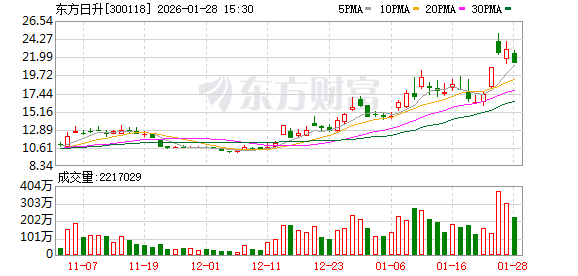
1月27日晚,东方日升(300118.SZ)发布2025年业绩预告,预计2025年全年归属于上市公司股东的净亏 损为23亿—29亿元;预计2025年全年归属于上市公司股东的扣除非经常性损益的净亏损为26亿—32亿 元。 过去一年,东方日升试图从"以组件为主"向"光储协同"战略转型,但期间遭遇了组件业务持续亏损、高 层变动、储能业务不及预期等多重问题,其业绩下滑在预期之内。 相比之下,HJT技术虽然在电站全生命周期发电量方面表现突出——其高转换效率、低光致衰减率及优 异双面发电特性,能够有效降低平准化度电成本,但现阶段生产成本仍高于TOPCon。这主要源于两大 不过,就在近期,随着SpaceX星链计划等商业航天项目的推进,太空光伏概念爆火,拥有异质结 (HJT)技术的东方日升股价在1月23日、26日收盘价格涨幅偏离值累计超过30%。公司在异动公告中 紧急澄清,直言"商业航天、太空光伏应用场景尚处于探索阶段,产业化进程仍面临不确定性",并明确 表示"公司光伏产品未直接向商业航天卫星公司供货"。这份澄清,犹如一盆冷水,试图浇灭市场无端的 热情。1月27日,其收盘价22.93元/股,涨幅1.82%,总市值261亿元。 ...
A股光伏股集体下跌,阳光电源跌超4%
Ge Long Hui A P P· 2026-01-28 03:50
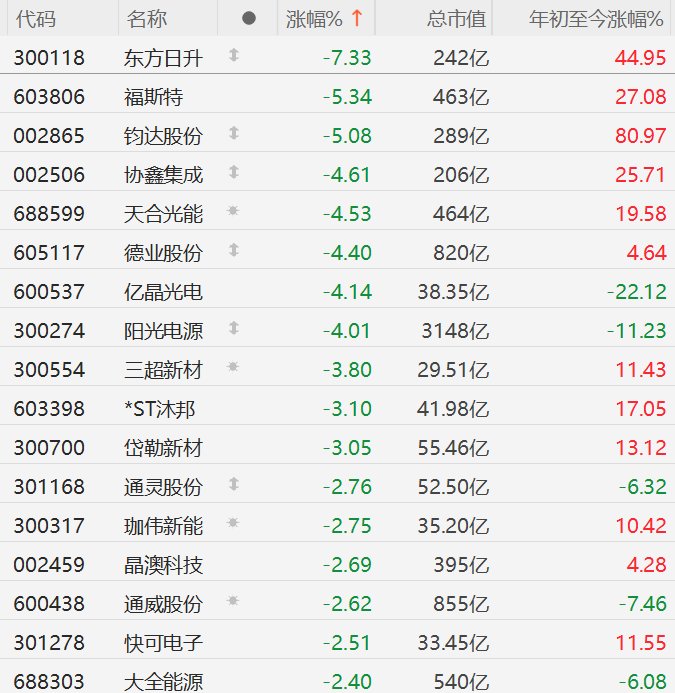
| 代码 | 名称 | | 涨幅% ↑ | 总市值 | 年初至今涨幅%。 | | --- | --- | --- | --- | --- | --- | | 300118 | 东方日升 | 1 | -7.33 | 242亿 | 44.95 | | 603806 | 福斯特 | | -5.34 | 463亿 | 27.08 | | 002865 | 钧达股份 | 1 | -5.08 | 289亿 | 80.97 | | 002506 | 协鑫集成 | 1 | -4.61 | 206亿 | 25.71 | | 688599 | 天合光能 | 长 | -4.53 | 464亿 | 19.58 | | 605117 | 德业股份 | 1 | -4.40 | 820亿 | 4.64 | | 600537 | 亿闘米甲 | | -4.14 | 38.35亿 | -22.12 | | 300274 | 阳光电源 | 1 | -4.01 | 3148亿 | -11.23 | | 300554 | 三超新材 | 报 | -3.80 | 29.51亿 | 11.43 | | 603398 | *ST沐邦 | | -3.10 | ...




东方日升股价跌5.36%,天弘基金旗下1只基金位居十大流通股东,持有696.67万股浮亏损失856.9万元
Xin Lang Cai Jing· 2026-01-28 02:57
1月28日,东方日升跌5.36%,截至发稿,报21.70元/股,成交22.17亿元,换手率10.73%,总市值247.38 亿元。 资料显示,东方日升新能源股份有限公司位于浙江省宁波市宁海县梅林街道塔山工业园区,成立日期 2002年12月2日,上市日期2010年9月2日,公司主营业务涉及销售、生产太阳能电池组件、EVA胶膜、 太阳能电池片、太阳能系统等光伏制造产品以及太阳能电站的投资、建设和运营。主营业务收入构成 为:太阳能电池及组件51.12%,太阳能电站EPC与转让35.49%,储能系统、灯具及辅助光伏产品 6.39%,光伏电站电费收入3.90%,其他3.10%。 天弘中证光伏A(011102)基金经理为祁世超。 截至发稿,祁世超累计任职时间1年7天,现任基金资产总规模325.69亿元,任职期间最佳基金回报 74.55%, 任职期间最差基金回报12.99%。 声明:市场有风险,投资需谨慎。 本文基于第三方数据库自动发布,任何在本文出现的信息(包括但 不限于个股、评论、预测、图表、指标、理论、任何形式的表述等)均只作为参考,不构成个人投资建 议。受限于第三方数据库质量等问题,我们无法对数据的真实性及完整性进 ...
龙虎榜 | 顶级游资扎堆近10亿,爆买平潭发展!4机构狂砸天奇股份
Ge Long Hui· 2026-01-28 00:07
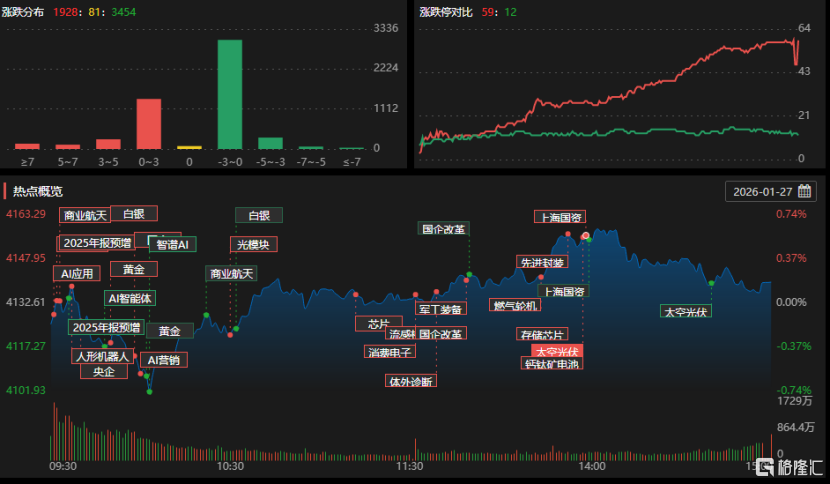
Market Overview - On January 27, the Shanghai Composite Index rose by 0.18%, the Shenzhen Component Index increased by 0.09%, and the ChiNext Index gained 0.71%. The total market turnover was 2.92 trillion yuan, a decrease of 359.2 billion yuan compared to the previous trading day, with over 3,400 stocks declining [1] - Key sectors that performed well included precious metals, cultivated diamonds, photovoltaic equipment, insurance, and CPO [1] Individual Stocks Performance - In the precious metals sector, silver stocks saw significant gains with multiple stocks hitting consecutive trading limits, including Baiyin Youse with six consecutive limits, Sichuan Gold with five limits in nine days, and Zhao Jin Gold with four limits in seven days [3] - The top three net buying stocks on the Dragon and Tiger list were Pingtan Development, Dongxin Co., and Huatiankeji, with net purchases of 9.31 billion yuan, 7.82 billion yuan, and 6.14 billion yuan respectively [4] - The top three net selling stocks were China Uranium Industry, Dongfang Risen, and Hongbaoli, with net sales of 4.38 billion yuan, 3.94 billion yuan, and 2.52 billion yuan respectively [5] Company Highlights - **Pingtan Development**: The company is located in the Pingtan Comprehensive Experimental Zone, which has been elevated to a national strategic development platform. It has established a "forest board integration" industrial chain with an annual production capacity exceeding 500,000 cubic meters [6] - **Dongxin Co.**: The company expects a revenue of approximately 921 million yuan in 2025, a year-on-year increase of 43.75%. The storage segment has become profitable due to the recovery of prices for AI-driven small-capacity storage chips [7] - **Huatiankeji**: The company is in the process of acquiring 100% of Huayi Microelectronics, which is a leading power device company in Shaanxi Province. The acquisition aims to expand its power device packaging and testing business [9] - **Hongjing Technology**: The company plans to raise 1.29 billion yuan for the construction and operation of an intelligent computing cluster project, which will add approximately 3,000P of computing power [10] Trading Dynamics - **Hongjing Technology**: Closed at 98.1 yuan with a 20% increase, showing a significant trading volume of 27.87 billion yuan and a net institutional purchase of 2.31 billion yuan [11] - **Xiaocheng Technology**: Closed at 58.83 yuan with an 11.21% increase, with a trading volume of 44.63 billion yuan and a net institutional purchase of 1.42 billion yuan [11] - **Zhaojin Gold**: Closed at 23.57 yuan with a 9.99% increase, with a trading volume of 30.25 billion yuan and a net institutional purchase of 1.23 billion yuan [11] Institutional Activity - The Dragon and Tiger list showed that Dongxin Co. had the highest net buying amount among stocks involved with the Shanghai Stock Connect, totaling 4.62 billion yuan [15] - For the Shenzhen Stock Connect, Sidik had the highest net buying amount at 1.76 billion yuan [16] - Various trading strategies were observed, with significant net buying in stocks like Huatiankeji and Pingtan Development by different trading groups [17]



东方日升: 光伏产品未直接向商业航天卫星公司供货;迈为股份: 主要产品为太阳能电池丝网印刷设备
Mei Ri Jing Ji Xin Wen· 2026-01-27 21:48
Group 1 - Dongfang Risen announced that its stock price had deviated by 30.10% over two consecutive trading days, indicating abnormal trading conditions. The company clarified that its photovoltaic products are not directly supplied to commercial aerospace satellite companies, and the application of "space photovoltaic" is still in the exploratory stage with uncertainties in industrialization [1] - Maiwei Co. reported a cumulative stock price deviation of over 30% over three consecutive trading days, also indicating abnormal trading conditions. The company emphasized that its main products are solar cell production equipment, including screen printing equipment and heterojunction cell production lines, and warned investors about the potential impact of market heat on future business expansion [1][2] - Junda Co. stated that its stock price had deviated by 20% over three consecutive trading days, indicating abnormal trading conditions. The company confirmed that its operations are normal and that the new fields it is exploring are still in the technical exploration phase, facing uncertainties in market space and industrialization pace [1][3] Group 2 - The recent market interest in "space photovoltaic" concepts has led to increased heat in related sectors, prompting companies to remind investors to be cautious about speculative risks and to maintain rational investment approaches [2]
