
HIFICHEM(300758)

Search documents
七彩化学:截至2026年2月13日公司股东为35371户
Zheng Quan Ri Bao Wang· 2026-02-24 11:23
证券日报网讯 2月24日,七彩化学(300758)在互动平台回答投资者提问时表示,截至2026年2月13日 公司股东人数为35371户。 ...
七彩化学(300758) - 关于持股5%以上股东减持股份计划实施完成的公告
2026-02-12 13:03
证券代码:300758 证券简称:七彩化学 公告编号:2026-007 鞍山七彩化学股份有限公司 关于持股 5%以上股东减持股份计划实施完成的公告 持股 5%以上股东北京风炎投资管理有限公司-北京风炎鑫泓 2 号私募证券 投资基金保证向本公司提供的信息内容真实、准确、完整,没有虚假记载、误导 性陈述或者重大遗漏。 公司及董事会全体成员保证信息披露内容与信息披露义务人提供的信息一 致。 鞍山七彩化学股份有限公司(以下简称"公司")于 2025 年 11 月 10 日在 巨潮资讯网(https://www.cninfo.com.cn)披露了《关于持股 5%以上股东减持 股份计划的预披露公告》(公告编号:2025-084);北京风炎投资管理有限公司 -北京风炎鑫泓 2 号私募证券投资基金(以下简称"北京风炎")持有公司 24,000,000 股,占公司总股本比例 5.9108%(占剔除回购专户股份数后公司总股 本的 6.0133%)。计划在本公告披露之日起 15 个交易日后的 3 个月内通过集中 竞价方式减持本公司股份不超过 3,991,156 股,占公司总股本比例 0.9829%(占 剔除回购专户股份数后公司总股 ...
七彩化学:风炎鑫泓2号已减持0.9829%
Guo Ji Jin Rong Bao· 2026-02-12 12:54
七彩化学公告,北京风炎投资管理有限公司-北京风炎鑫泓2号私募证券投资基金已于2025年12月2日至 2026年2月12日通过集中竞价减持399.11万股,减持均价16.01元,占总股本0.9829%,现持股2000.89万 股,占总股本4.9278%,减持计划实施完毕。 ...
七彩化学(300758) - 关于公司全资子公司收购其控股子公司少数股东股份的进展暨完成工商变更登记的公告
2026-02-11 08:50
证券代码:300758 证券简称:七彩化学 公告编号:2026-006 鞍山七彩化学股份有限公司 关于公司全资子公司收购其控股子公司少数股东股 份的进展暨完成工商变更登记的公告 本公司及董事会全体成员保证信息披露内容的真实、准确和完整,没有虚假 记载、误导性陈述或重大遗漏。 鞍山七彩化学股份有限公司(以下简称"公司")于2025年12月19日召开第 七届董事会第十三次会议、第七届董事会第九次独立董事专门会议,审议通过了 《关于公司全资子公司收购其控股子公司少数股东股份暨关联交易的议案》,同 意公司全资子公司辽宁七彩材料科技有限公司(以下简称"七彩材料"或"子公 司")以自有资金人民币1,680.00万元受让WANG,ZHI YUAN(王植源)持有的辽 宁天彩材料股份有限公司(以下简称"天彩材料")12.00%股权。具体内容详见 公司在巨潮资讯网(www.cninfo.com.cn)披露的《关于公司全资子公司收购其 控股子公司少数股东股份暨关联交易的公告》(公告编号:2025-097)。 天彩材料已经完成了相关的工商变更登记手续(不涉及营业执照信息变更) 本次变更完成后,七彩材料持有天彩材料72.00%股权,W ...
七彩化学(300758.SZ):基于公司在有机颜料、新材料等核心领域的长期发展规划,提前布局AI4Science相关技术方向
Ge Long Hui· 2026-02-05 07:27
Core Viewpoint - The investment by Qicai Chemical in Huanliang Technology is characterized by both financial investment attributes and forward-looking strategic considerations, and it does not qualify as a significant investment matter requiring special disclosure [1] Financial Investment Attributes - The investment is positioned as an early-stage layout and business attempt, focusing on reasonable financial return potential [1] Strategic Considerations - The investment aligns with the company's long-term development plans in core areas such as organic pigments and new materials, aiming to preemptively position itself in AI4Science-related technology directions [1] Uncertainty and Collaboration - There is significant uncertainty regarding the progress and actual effects of technology integration and business cooperation, with no established rigid cooperation commitments [1]
七彩化学:公司暂无太空算力相关布局
Mei Ri Jing Ji Xin Wen· 2026-02-04 01:23
Group 1 - The company is currently focusing its perovskite battery business on applications such as weak light power generation and underwater photovoltaics, with no current plans for space computing applications [2] - An investor inquired about the potential use of the company's perovskite batteries for space computing, indicating interest in the technology's versatility [2] - The company's response highlights its strategic focus on specific applications rather than broader or speculative uses at this stage [2]

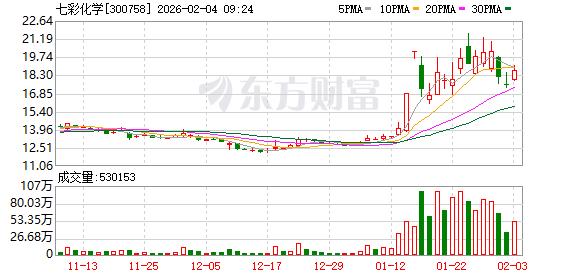
【基础化工】七彩化学与幻量科技共建AI实验室,“AI+”落地夯实企业Alpha实力——石化化工行业“AI+”进展跟踪之二(赵乃迪/周家诺)
光大证券研究· 2026-02-03 23:07
Core Viewpoint - The collaboration between Qicai Chemical and Deepverse aims to establish an AI-driven laboratory to enhance the research and development of high-performance materials, transitioning from traditional trial-and-error methods to data-driven predictive models [4][5]. Group 1: Collaboration Details - Qicai Chemical, a leader in high-performance organic pigments, is expanding into high-end new materials, focusing on complex chemical products like MXD6 nylon and PPDI polyurethane elastomers [5]. - Deepverse leverages materials informatics, artificial intelligence, and high-throughput experimentation to accelerate the development of new materials by integrating cross-domain data [5]. - The partnership aims to create a long-term collaborative research mechanism, enhancing efficiency, quality, and iterative processes in material development [5]. Group 2: Policy and Industry Context - Since the second half of 2025, the Chinese government has been actively promoting the integration of AI in various industries, including chemicals, through a series of policies aimed at enhancing productivity and innovation [6][7]. - The policies emphasize the need for AI to improve quality and efficiency in the petrochemical and new materials sectors, marking a shift towards intelligent transformation as a foundation for high-quality development [6][7]. Group 3: Industry Challenges and Opportunities - The chemical industry is currently navigating a phase of "stabilizing growth" and "anti-involution," facing weak macro demand despite attempts to improve profitability through collaboration [8]. - Companies are encouraged to adopt AI technologies to shorten product development cycles and optimize production processes, which can mitigate cost fluctuations and enhance operational quality [8]. - Firms that successfully implement intelligent transformations are expected to maintain resilience during industry downturns and capitalize on recovery phases [8].

石化化工行业AI+进展跟踪之二:七彩化学与幻量科技共建AI实验室,AI+落地夯实企业Alpha实力
EBSCN· 2026-02-03 05:14
Investment Rating - The report maintains an "Overweight" rating for the basic chemical industry, indicating a projected investment return exceeding the market benchmark index by 5% to 15% over the next 6-12 months [5]. Core Insights - The collaboration between Qicai Chemical and Deepverse to establish an AI laboratory aims to enhance the R&D capabilities in high-performance materials, transitioning from traditional trial-and-error methods to data-driven predictive models [2][4]. - National policies are increasingly promoting the integration of AI in the chemical industry, with specific guidelines aimed at enhancing efficiency and innovation in both the petrochemical and new materials sectors [3]. - The current economic environment emphasizes the need for chemical companies to leverage AI technologies to improve operational efficiency and reduce costs, thereby enhancing resilience during periods of low industry demand [4]. Summary by Sections AI Collaboration - Qicai Chemical and Deepverse have signed an agreement to jointly build an AI laboratory, focusing on high-performance materials R&D [1]. - The partnership aims to create a long-term collaborative R&D mechanism, utilizing AI to enhance efficiency and quality in material development [2]. Policy Support - Since the second half of 2025, the government has introduced multiple policies to facilitate the implementation of AI in the chemical sector, with a vision for widespread adoption by 2030 [3]. - The policies emphasize the need for adaptive optimization in petrochemical processes and deeper integration of AI in new materials R&D [3]. Industry Dynamics - The chemical industry is currently navigating a phase of "stabilizing growth" and "anti-involution," necessitating the adoption of AI to strengthen internal capabilities [4]. - Companies that successfully implement AI-driven transformations are expected to maintain stronger operational resilience and capitalize on recovery phases in the market [4]. Investment Recommendations - The report suggests focusing on leading companies that can leverage data for cost reduction and efficiency gains, such as China National Petroleum, Sinopec, and Wanhua Chemical [5]. - It also highlights the potential of Qicai Chemical in the AI domain and its implications for sectors like semiconductors and fine chemicals [5].
趋势研判!2026年中国挤水基墨行业产业链、发展现状、竞争格局和未来趋势:国内油墨企业仍以采购颜料为主,挤水基墨行业市场规模较小[图]
Chan Ye Xin Xi Wang· 2026-02-02 01:09
Core Viewpoint - The water-based ink industry is facing challenges in China, with a projected market size of 320 million yuan by 2025, showing a slight increase of 1.9% year-on-year, while the industry has been experiencing a downward trend since 2020 due to weak market demand [1][9]. Industry Overview - Water-based ink is an intermediate product formed during the pigment preparation process, simplifying production processes for ink customers and reducing pollutant emissions [3][9]. - The production process of water-based ink involves physical changes without chemical reactions, making it distinct from traditional pigments [4][5]. Industry Chain - The upstream of the water-based ink industry includes raw materials such as pigments, binders, and additives, while the midstream involves the production of water-based ink, and the downstream is the ink industry, which serves various packaging and printing markets [5][6]. Market Size and Trends - The Chinese water-based ink market has been declining since 2020, with a projected market size of 320 million yuan by 2025, reflecting a slight year-on-year increase of 1.9% [1][10]. - The overall ink market in China is expected to reach 18.374 billion yuan by 2024, with a year-on-year growth of 6.7%, driven by the demand for environmentally friendly inks in various sectors [8][9]. Competitive Landscape - The water-based ink industry in China consists of organic pigment companies and ink companies, with key players including Longkou United Chemical Co., Ltd. and Hanghua Ink Co., Ltd. [10][11]. - Longkou United Chemical Co., Ltd. has a production capacity of 3,000 tons of water-based ink and has been facing a decline in revenue, with a reported income of 7.4126 million yuan in the first half of 2025, down 6.55% year-on-year [11]. - Hanghua Ink Co., Ltd. reported a revenue of 907 million yuan in the first three quarters of 2025, a decrease of 1.62% year-on-year, with a net profit decline of 25% [11][12]. Future Development Trends - The demand for water-based ink is expected to increase due to the steady development of downstream industries, which require high-performance ink products with low impurity content [11]. - The industry is likely to see increased concentration, with leading companies expanding market share through mergers and acquisitions, while smaller firms focus on niche markets [11]. - Domestic companies are expected to accelerate international expansion and enhance competitiveness by adopting advanced technologies and management practices [11].


七彩化学:北京风炎投资管理有限公司持股比例已降至5.00%
2 1 Shi Ji Jing Ji Bao Dao· 2026-01-30 10:46
Core Viewpoint - The company announced that Beijing Fengyan Investment Management Co., Ltd. has reduced its shareholding in the company from 5.9108% to 5.00% through a block trading method, completing the equity change between December 2, 2025, and January 29, 2026 [1] Summary by Relevant Categories - **Shareholding Change** - Beijing Fengyan Investment Management Co., Ltd. has decreased its shareholding by 3.6981 million shares [1] - The reduction in shareholding percentage is from 5.9108% to 5.00% [1]