
AMD(AMD)

Search documents
AMD's Resurgence: Outpacing Nvidia in 2026
ZACKS· 2026-01-23 16:01
Core Viewpoint - Healthy competition between AMD and Nvidia has driven innovation and investor returns, with AMD significantly outperforming Nvidia in 2025 [1] Performance Summary - AMD shares rose approximately 77% in 2025, nearly doubling Nvidia's 39% gain, with a notable divergence in performance in the latter half of the year after AMD secured a multi-year deal with OpenAI [2] - AMD's disciplined execution and expanding AI footprint present a compelling investment opportunity as the company trades around $250 per share in early 2026 [5] Revenue Growth - The data center segment, now AMD's core growth engine, delivered record revenue of $4.3 billion in Q3 2025, up 22% year-over-year, driven by demand for 5th Gen EPYC processors and Instinct accelerators [6] - AMD's MI300 series exceeded expectations, capturing market share amid Nvidia's supply constraints, with management projecting over 60% CAGR in data center revenue in the coming years [7] Competitive Positioning - The MI355X accelerator is positioned as a cost-effective alternative to Nvidia's offerings, gaining traction for its performance-per-dollar advantages, which helped AMD capture share in inference workloads [8] - AMD's total revenue growth accelerated to the mid-30% range in Q3 2025, leading to significant earnings expansion and a trend of exceeding expectations [9] Nvidia Comparison - Nvidia faced challenges in 2025, including potential saturation in training demand and export restrictions impacting revenue, which contributed to AMD's relative outperformance [10] - Despite Nvidia's impressive quarterly growth, AMD's lower valuation and diversifying customer base attracted investor interest, leading to a rotation towards AMD [11] Strategic Partnerships - AMD's partnerships with major companies like Microsoft, Meta, and Oracle, along with the OpenAI deal, validate its position in the market and provide a competitive edge [12] Future Outlook - The AI inferencing market, projected to grow faster than training, aligns with AMD's strengths, particularly with the upcoming MI400 series accelerators promising significant efficiency and scale improvements [13] - Analysts expect AMD's Q4 2025 earnings report to be a key catalyst, with EPS estimates increased by 0.76% and anticipated revenue growth of 26% to $9.65 billion [14] Earnings Expectations - AMD currently holds a Zacks Rank 3 (Hold) and has a positive Earnings ESP of +2.01%, indicating potential for a positive earnings surprise in the upcoming report [17]

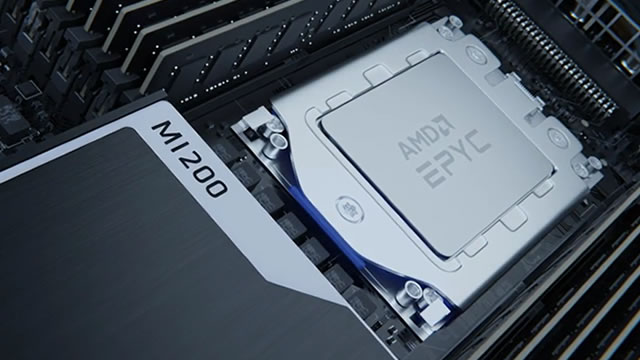
Why Advanced Micro Devices Stock Popped Friday
Yahoo Finance· 2026-01-23 15:46
Key Points Intel beat on earnings and revenue in Q4. Intel warned of supply problems in Q1 2026. Supply shortages can be great news for companies that are still producing -- like AMD. 10 stocks we like better than Advanced Micro Devices › Intel (NASDAQ: INTC) stock's in freefall this morning, down more than 15% after announcing an earnings beat but a guidance miss. Advanced Micro Devices (NASDAQ: AMD) stock, on the other hand, is headed in the opposite direction. AMD shares gained 3.8% through 10 ...

CPU系列研究-行业专家视角-Agent-AI时代下CPU产业机会-CPU龙头厂商专家
2026-01-23 15:35
【CPU 系列研究】 行业专家视角:Agent AI 时代下 CPU 产业机会 - CPU 龙头厂商专家 20260122 摘要 Agent AI 时代,CPU 角色演变,从服务器调度中心发展为直接参与任 务执行,尤其在决策和多步骤交互中,CPU 重要性显著提升,推动高性 能 CPU 需求。 CPU 价格上涨主要受三方面因素驱动:Agent AI 对高性能 CPU 需求增 加、厂商尝试将 GPU 任务转移至 CPU 以降低成本、以及新一代 CPU 算 力提升。 智能体时代,"沙箱执行"确保运算安全,"工具调用"实现外部交互, "编排调度"协调资源分配,CPU 在这些环节中扮演关键角色。 沙箱技术通过资源切片,提高多用户共享计算资源的利用率和安全性, 尤其在 AI 推理时代,隔离不同任务,确保服务质量。 2025 年 10 月起 CPU 缺货是涨价主因,叠加 AI 需求激增导致存储服务 器需求暴涨,以及 DDR 内存因厂商转向 HBM 而产能紧张,共同推动 CPU 价格上涨。 Q&A 请介绍一下 CPU 的功能及其在 AI 服务器中的角色转变。 CPU,即中央处理器,是计算机系统的核心部件,负责执行数学计算、逻 ...
明星科技股多数走强,AMD涨近4%





Mei Ri Jing Ji Xin Wen· 2026-01-23 15:20
Group 1 - The core viewpoint of the news highlights that major technology stocks experienced an upward trend, with AMD rising nearly 4% and TSMC, Micron Technology, and Microsoft increasing by over 2% [1] - NVIDIA, Meta, and Amazon also saw gains of over 1%, indicating a positive sentiment in the technology sector [1]
明星科技股多数走强
Ge Long Hui A P P· 2026-01-23 15:19
Group 1 - AMD shares increased by nearly 4% [1] - TSMC, Micron Technology, and Microsoft shares rose over 2% [1] - Nvidia, Meta, and Amazon shares gained over 1% [1]
Understanding Micron Technology's Position In Semiconductors & Semiconductor Equipment Industry Compared To Competitors - Micron Technology (NASDAQ:MU)
Benzinga· 2026-01-23 15:01
Core Insights - Micron Technology is evaluated against major competitors in the Semiconductors & Semiconductor Equipment industry, focusing on financial metrics, market position, and growth potential [1] Company Overview - Micron Technology is a leading semiconductor company specializing in memory and storage chips, primarily generating revenue from dynamic random access memory (DRAM) and having some exposure to NAND flash chips [2] Financial Metrics Comparison - Micron's Price to Earnings (P/E) ratio is 37.79, which is 0.45x lower than the industry average, indicating potential undervaluation [5] - The Price to Book (P/B) ratio of 7.61 is significantly below the industry average by 0.67x, suggesting further undervaluation and growth potential [5] - Micron's Price to Sales (P/S) ratio is 10.61, which is 0.73x the industry average, indicating possible undervaluation based on sales performance [5] - The Return on Equity (ROE) stands at 9.28%, which is 3.43% above the industry average, reflecting efficient equity utilization for profit generation [5] - Micron's Earnings Before Interest, Taxes, Depreciation, and Amortization (EBITDA) is $8.35 billion, 1.98x above the industry average, indicating strong profitability and cash flow [5] - The gross profit of $7.65 billion is 1.54x above the industry average, showcasing robust earnings from core operations [5] - Revenue growth of 56.65% exceeds the industry average of 40.26%, indicating strong sales performance and market outperformance [5] Debt-to-Equity Ratio - Micron Technology has a debt-to-equity (D/E) ratio of 0.21, indicating a stronger financial position compared to its top four peers, with lower reliance on debt financing [8] Key Takeaways - Micron's low P/E, P/B, and P/S ratios compared to industry peers suggest potential undervaluation, while high ROE, EBITDA, gross profit, and revenue growth indicate strong financial performance and growth prospects relative to competitors [9]

US stocks open flat as S&P 500, Nasdaq look set to end volatile week lower
Invezz· 2026-01-23 14:50
Group 1 - US stocks experienced a mixed performance as investors processed two days of gains attributed to easing geopolitical tensions [1] - Market focus has shifted towards corporate earnings and the upcoming Federal Reserve decision [1]

美股异动 | 部分半导体股盘前走强 英伟达(NVDA.US)涨超1%
智通财经网· 2026-01-23 14:28
Core Viewpoint - Semiconductor stocks in the US showed pre-market strength, with notable gains from AMD, Arm Holdings, Nvidia, and TSMC, indicating positive market sentiment in the sector [1] Group 1: Stock Performance - AMD increased by over 2.9% [1] - Arm Holdings rose by more than 2.7% [1] - Nvidia saw a gain of over 1% [1] - TSMC experienced an increase of more than 1.3% [1] Group 2: Company Developments - Nvidia's founder and CEO, Jensen Huang, visited China, starting with a new office in Shanghai [1] - During the visit, Huang engaged with employees, addressing their concerns and discussing key events for the company in 2025 [1]

Intel Drops After Earnings: Opportunity for AMD to Shine?
Investing· 2026-01-23 13:33
Core Insights - The article provides a market analysis focusing on Intel Corporation and Advanced Micro Devices Inc. (AMD), highlighting their competitive positions and market trends in the semiconductor industry [1] Company Analysis Intel Corporation - Intel is facing challenges in maintaining its market share due to increased competition from AMD and other players in the semiconductor space [1] - Recent financial reports indicate a decline in revenue, with a year-over-year decrease of approximately 20% [1] - Intel is investing heavily in research and development to innovate and regain its competitive edge [1] Advanced Micro Devices Inc. (AMD) - AMD has shown significant growth, with a revenue increase of around 30% year-over-year, driven by strong demand for its processors and graphics cards [1] - The company is expanding its market presence, particularly in data centers and gaming, which are key growth areas [1] - AMD's strategic partnerships and product launches are expected to further enhance its market position [1]

美股部分半导体股盘前走强,AMD涨超3%
Mei Ri Jing Ji Xin Wen· 2026-01-23 11:49
Group 1 - Semiconductor stocks in the U.S. showed strength before the market opened on January 23, with AMD rising over 3% [1] - Nvidia experienced an increase of nearly 2% in pre-market trading [1] - Other notable performers included Arm Holdings and TSMC, both of which saw gains of over 1% [1]