AstraZeneca(AZN)

Search documents
弘则医享汇|创新药大品种跟踪 - 三代TKI市场的商业化趋势
2025-06-10 15:26
Summary of Conference Call on Third-Generation TKI Market Industry Overview - The conference focuses on the third-generation tyrosine kinase inhibitors (TKI) market, particularly in the context of lung cancer treatment and the impact of anti-corruption policies on pharmaceutical sales [1][2][3]. Key Points and Arguments 1. **Impact of Anti-Corruption Policies**: - Anti-corruption policies have significantly reduced the promotional activities of foreign pharmaceutical companies like AstraZeneca, leading to a decrease in meeting coverage from over 6 to 2-3 per month, which poses challenges for sales growth [2][3]. - However, the impact on third-generation TKI products already included in the medical insurance list is minimal, with commercial insurance affecting mainly post-operative patients [1][4]. 2. **Sales Growth Expectations for Osimertinib**: - The sales growth target for Osimertinib has been revised down to approximately 10% for 2025, with a first-half growth of only 4% despite inventory pressure [1][5][7]. - The original expectation was a 15% growth, but due to poor performance in April, the target was adjusted, indicating significant challenges in achieving sales goals [5][7]. 3. **Market Dynamics for EGFR and c-MET Products**: - The market potential for EGFR and c-MET dual antibody products is contingent on the advancement of genetic testing technologies [1][8]. - c-MET targeted combination therapies show promise in overcoming resistance in lung cancer treatment, with a potential market size reaching 1 billion, pending clinical validation [1][9]. 4. **Competition Among Domestic TKI Products**: - Domestic third-generation TKI products are entering the market, but leading products like Alectinib, Bevacizumab, and Raltegravir dominate with over 90% market share, making it difficult for new entrants to gain traction without significant investment [1][11]. - The strict anti-corruption policies limit the possibility of large-scale investments needed to disrupt the existing market structure [1][11]. 5. **Sales Strategies of Leading Companies**: - AstraZeneca focuses on the top 12 hospitals to stabilize sales, while Vumeritinib targets respiratory departments with a diverse resource allocation strategy [12][14]. - Amivantamab emphasizes clinical research and approval for new indications, aiming to compete directly with Osimertinib [12][14]. 6. **Market Growth and Future Prospects**: - The lung cancer market is projected to grow at a double-digit rate, with a 12% increase noted as of May 2025, driven by improvements in medical standards and grassroots diagnostic capabilities [3][16]. - Late-stage lung cancer currently holds over 70% market share, but early-stage treatments and brain metastasis therapies are expected to become increasingly significant [16][17]. 7. **Treatment Penetration Rates**: - The treatment penetration rate for late-stage lung cancer patients is below 70%, influenced by diagnostic limitations and inconsistent genetic testing capabilities [17]. - Conversely, brain metastasis treatment penetration is high at over 90%, attributed to effective treatment options available [18]. 8. **Post-Operative Treatment Applications**: - Post-operative treatment for lung cancer shows a penetration rate of approximately 80%, supported by improved surgical capabilities and increased demand for surgeries [19]. Additional Important Insights - The importance of genetic testing technology in precision medicine is emphasized, as inconsistent testing levels across regions can significantly affect clinical outcomes and market potential [10]. - The personnel stability within companies varies, with Amivantamab facing challenges due to funding allocation affecting employee compensation, while AstraZeneca and Vumeritinib maintain better stability [15]. This summary encapsulates the critical insights from the conference call regarding the third-generation TKI market, highlighting the challenges and opportunities within the industry.

FDA approves Merck's RSV shot for infants, ramping up competition with Sanofi and AstaZeneca
CNBC· 2025-06-09 19:30
Core Insights - The FDA approved Merck's Enflonsia to protect infants from respiratory syncytial virus (RSV), competing with Sanofi and AstraZeneca's Beyfortus [1][4] - Merck plans to launch Enflonsia ahead of the RSV season, with orders expected to start in July [2] - The approval provides a new treatment option for RSV, which causes significant mortality and hospitalization among infants [3] Company Developments - Merck aims to ensure availability of Enflonsia in the U.S. before the RSV season to alleviate the burden on families and healthcare systems [4] - Enflonsia is a preventative monoclonal antibody that can be administered to infants regardless of weight, offering dosing convenience [5] - Sanofi is increasing the supply of Beyfortus, which generated €1.7 billion ($1.8 billion) in sales last year [6] Industry Context - Other companies, including Pfizer, GSK, and Moderna, offer RSV vaccines, but these are limited to adults and pregnant women [6] - A meeting of CDC vaccine advisors is scheduled for June 25 to 27 to discuss recommendations for RSV shots and other immunizations [7] - In clinical trials, Enflonsia reduced RSV-related hospitalizations by over 84% and lower respiratory infections requiring medical attention by more than 60% compared to a placebo [8]



IonQ(IONQ.US)、阿斯利康(AZN.US)、英伟达(NVDA.US)与AWS展示量子加速药物开发工作流
Zhi Tong Cai Jing· 2025-06-09 13:44
Core Insights - IonQ has successfully developed and demonstrated a quantum-accelerated computational chemistry workflow in collaboration with AstraZeneca, Amazon Web Services, and NVIDIA [1][2] - The workflow utilizes a hybrid quantum-classical computing model aimed at solving complex drug development challenges, potentially enhancing the speed and efficiency of drug research [1] Group 1 - The collaboration focuses on the Suzuki-Miyaura reaction, a critical step in the synthesis of small molecule drugs [1] - By integrating IonQ's Forte Quantum Processing Unit (QPU) with NVIDIA's CUDA-Q platform and AWS ParallelCluster services, the research team achieved an end-to-end solution time improvement of over 20 times compared to previous benchmarks [1] - The technology reduces the expected overall runtime from "months" to "days" while maintaining computational accuracy [2] Group 2 - The results indicate that hybrid quantum computing can overcome computational limitations in high-precision molecular modeling and support the analysis of more complex chemical systems [2] - Eric Kessler, General Manager of Amazon Braket, highlighted the collaboration's role in exploring future applications of quantum computing in accelerating computational chemistry research [2]



新药周观点:下一个重磅PD-1升级产品PD-1/IL-2α偏向性双抗潜力验证-20250608
Guotou Securities· 2025-06-08 07:03
Investment Rating - The report maintains an investment rating of "Outperform" for the biopharmaceutical sector [7]. Core Insights - The PD-(L)1 monoclonal antibody market is vast, with multiple companies developing PD-1 class upgrade products, including PD-1/VEGF bispecific antibodies and PD-1/IL-2 bispecific antibodies. The IBI363 from Innovent Biologics is expected to be the next significant PD-1 upgrade product following the PD-1/VEGF bispecific antibody [2][21]. - IBI363 has shown excellent data in the treatment of wild-type NSCLC and colorectal cancer, indicating its potential to expand into first-line treatment markets based on its performance in the IO resistant market [2][22]. - The competitive landscape for PD-1/IL-2 bispecific antibodies is favorable for IBI363, as it is the only PD-1/IL-2α bispecific antibody currently in Phase II clinical trials, while most competitors are in earlier stages [3][25]. Summary by Sections Weekly New Drug Market Review - From June 2 to June 6, 2025, the top five companies in the new drug sector by stock performance were Junsheng Tai Pharmaceutical-B (24.29%), Zai Lab (23.28%), Innovent Biologics (18.08%), Maiwei Biopharma (17.72%), and Shenzhou Cell (17.24%). The bottom five were Deqi Pharmaceutical-B (-12.68%), JACOB-B (-11.90%), Heptares Therapeutics-B (-10.86%), CanSino Biologics-B (-10.75%), and WuXi AppTec-B (-8.54%) [1][17]. Weekly New Drug Industry Analysis - The report highlights the potential of IBI363 as a next-generation PD-1 upgrade product, with promising data presented at ASCO 2025. The drug is expected to target multiple tumor types and expand into first-line treatment markets [2][21]. Weekly New Drug Approval & Acceptance Status - This week, 20 new drug or new indication applications were approved in China, including drugs from Zai Lab and Shenzhen Xinlitai. Additionally, 11 new drug applications were accepted, including those from MSD and Eli Lilly [4][28]. Weekly New Drug Clinical Application Approval & Acceptance Status - There were 21 new drug clinical application approvals and 43 new drug clinical applications accepted in the domestic market this week [5].



阿斯利康亮相2025 ASCO:全链条发力推动乳腺癌精准诊疗
新华网财经· 2025-06-05 20:59
Core Viewpoint - Breast cancer treatment is evolving towards more precise subtyping and mechanisms, with various innovative treatment options being introduced. However, to truly benefit patients, challenges related to education, accessibility, and standardized guidelines need to be addressed [1]. Group 1: Research and Development - AstraZeneca has showcased its commitment to breast cancer research at the ASCO conference, presenting significant studies such as SERENA-6 and DESTINY-Breast09, focusing on key molecular subtypes like HR-positive/HER2-negative and HER2-positive [3][4]. - The DESTINY-Breast09 trial demonstrated the benefits of trastuzumab deruxtecan combined with pertuzumab over traditional therapies for HER2-positive metastatic breast cancer, potentially offering new treatment options for patients [4]. - The SERENA-6 study highlighted the potential of Camizestrant in treating HR-positive, HER2-negative advanced breast cancer with ESR1 mutations, marking it as a significant finding at ASCO [5]. Group 2: Treatment Framework - AstraZeneca has developed a comprehensive treatment framework for the three major breast cancer subtypes: HER2-positive, HR-positive/HER2-negative, and triple-negative, covering all treatment stages from early to late [4]. - The company is actively exploring new mechanisms and treatment options for triple-negative breast cancer, aiming to introduce innovative ADC therapies to the Chinese market [5]. Group 3: Implementation and Accessibility - The BCCE project, led by the National Cancer Center with AstraZeneca's support, aims to bridge the gap between guidelines and clinical practice, enhancing breast cancer diagnosis and treatment across various healthcare levels [7][8]. - AstraZeneca is focused on improving drug accessibility by facilitating the registration and inclusion of innovative breast cancer drugs in China's national insurance directory, thereby reducing patient financial burdens [10]. - The company emphasizes the importance of patient education and multi-disciplinary collaboration to enhance the standardization of breast cancer treatment in China [8][10]. Group 4: Future Goals - AstraZeneca aims to contribute to the "Healthy China 2030" initiative by enhancing cancer survival rates through systematic approaches that promote standardized, precise, and sustainable breast cancer treatment [11].

国家药监局:批准英飞凡成为用于治疗局限期小细胞肺癌的单药
Guang Zhou Ri Bao· 2025-06-04 12:17
Core Insights - AstraZeneca announced that Imfinzi (durvalumab) has been approved by the National Medical Products Administration of China for the treatment of adult patients with limited-stage small cell lung cancer (SCLC) who have not progressed after platinum-based chemoradiotherapy [2][3] - The approval is based on positive results from the ADRIATIC Phase III clinical trial, which demonstrated a 27% reduction in the risk of death compared to placebo [2] - Limited-stage SCLC is a highly aggressive type of lung cancer with a poor prognosis, where only 15% to 30% of patients survive beyond five years post-diagnosis [2] Clinical Trial Results - The ADRIATIC trial showed significant overall survival benefits for patients treated with durvalumab, with a three-year overall survival rate of 57% [2] - This marks durvalumab as the first and only immunotherapy option for limited-stage SCLC in decades, potentially establishing a new treatment standard in China and globally [2] Future Directions - AstraZeneca plans to continue focusing on patient-centered approaches, leveraging its R&D capabilities, and enhancing external collaborations to provide innovative treatment options [2] - The approval is expected to not only revolutionize the treatment landscape for limited-stage SCLC but also improve the prognosis for all stages of small cell lung cancer patients [3]
度伐利尤单抗在华获批新适应症,治疗局限期小细胞肺癌
Bei Ke Cai Jing· 2025-06-04 12:16
Core Insights - AstraZeneca's durvalumab (brand name: Imfinzi) has been approved for a new indication in China, becoming the first and only immunotherapy for the treatment of limited-stage small cell lung cancer (LS-SCLC) in adult patients who have not experienced disease progression after platinum-based chemoradiotherapy [1][2] - The approval is based on positive results from the ADRIATIC Phase III clinical trial, which demonstrated significant overall survival benefits, with a three-year overall survival rate of 57% for patients treated with durvalumab [1] - The trial results were published in a top-tier medical journal and presented at a major oncology conference, confirming the efficacy of durvalumab in the Chinese patient population [1][2] Group 1 - The ADRIATIC trial showed that the median progression-free survival for the durvalumab treatment group was 16.6 months compared to 9.2 months for the placebo group [1] - 46% of patients receiving durvalumab did not experience disease progression at two years, compared to 34% in the placebo group [1] - The Chinese cohort's overall survival and progression-free survival benefits were consistent with global study results, indicating a 29% reduction in the risk of death and a 33% reduction in the risk of disease progression or death compared to placebo [1][2] Group 2 - Approximately 34,000 patients in China are treated for limited-stage small cell lung cancer each year, with a poor prognosis where only 15%-30% survive beyond five years [2] - The approval of durvalumab marks a significant advancement in treatment options for LS-SCLC, which has seen little progress in recent decades [2] - Durvalumab has also been approved in the US, EU, and Japan for the same indication, and it is approved for use in combination with chemotherapy for extensive-stage small cell lung cancer based on the CASPIAN Phase III trial [3]
英飞凡在华获批成为首个用于治疗局限期小细胞肺癌的单药
Qi Lu Wan Bao· 2025-06-04 10:45
Core Viewpoint - AstraZeneca announced that Imfinzi (durvalumab) has been approved by the National Medical Products Administration (NMPA) in China for the treatment of adult patients with limited-stage small cell lung cancer (LS-SCLC) who have not progressed after platinum-based chemoradiotherapy [1] Group 1: Approval and Clinical Trial Results - The approval is based on positive results from the ADRIATIC Phase III clinical trial, which showed that durvalumab reduced the risk of death by 27% compared to placebo [1] - The ADRIATIC trial demonstrated a three-year overall survival rate of 57% for patients receiving durvalumab treatment [1] Group 2: Impact on Patients and Treatment Landscape - Limited-stage small cell lung cancer is a highly aggressive type of lung cancer, with only 15-30% of patients surviving beyond five years after diagnosis [1] - The approval marks durvalumab as the first and only immunotherapy option for limited-stage small cell lung cancer in China, providing more treatment choices for patients [1] - AstraZeneca aims to innovate treatment options and improve patient outcomes through strong R&D capabilities and external collaborations [1]
阿斯利康英飞凡在华获批
news flash· 2025-06-04 09:04
Core Viewpoint - AstraZeneca announced that its drug Imfinzi (generic name: Durvalumab) has been approved by the National Medical Products Administration (NMPA) in China for use as a monotherapy in adult patients with limited-stage small cell lung cancer (LS-SCLC) who have not experienced disease progression after platinum-based chemoradiotherapy [1] Group 1 - The approval of Imfinzi marks a significant advancement in the treatment options available for LS-SCLC patients in China [1] - The drug is specifically indicated for patients who have undergone platinum-based chemoradiotherapy without disease progression [1]
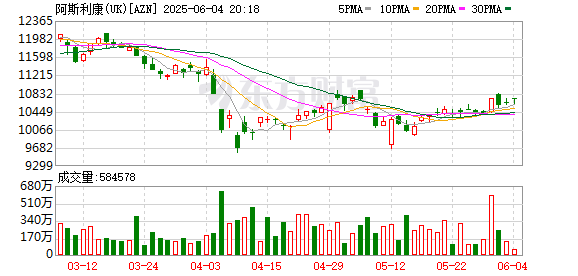
Astrazeneca (AZN) Stock Declines While Market Improves: Some Information for Investors
ZACKS· 2025-06-02 23:16
Company Performance - Astrazeneca's stock closed at $71.93, reflecting a -1.24% change from the previous day, underperforming the S&P 500 which gained 0.41% [1] - Over the past month, Astrazeneca's shares increased by 0.54%, outperforming the Medical sector's decline of 3.74% but lagging behind the S&P 500's rise of 6.13% [1] Upcoming Earnings - Astrazeneca is expected to report earnings of $1.11 per share, indicating a year-over-year growth of 12.12% [2] - The consensus estimate for quarterly revenue is projected at $14.03 billion, representing an 8.42% increase from the same period last year [2] Full Year Projections - For the full year, earnings are projected at $4.49 per share and revenue at $57.68 billion, showing increases of +9.25% and +6.67% respectively from the previous year [3] - Recent analyst estimate revisions suggest a favorable outlook on Astrazeneca's business health and profitability [3] Valuation Metrics - Astrazeneca's Forward P/E ratio is currently at 16.2, which is lower than the industry average of 20.51 [6] - The company has a PEG ratio of 1.34, compared to the industry average PEG ratio of 1.47 [6] Industry Context - Astrazeneca operates within the Medical - Biomedical and Genetics industry, which holds a Zacks Industry Rank of 74, placing it in the top 30% of over 250 industries [7] - The Zacks Industry Rank indicates that the top 50% rated industries outperform the bottom half by a factor of 2 to 1 [7]