
Bristol-Myers Squibb(BMY)

Search documents
SystImmune to Receive Milestone Payment from Bristol Myers Squibb Under Iza-Bren Collaboration
Prnewswire· 2025-10-13 09:00
Core Insights - SystImmune, Inc. has initiated the treatment of the first patient in the IZABRIGHT-Breast01 study, a global Phase 2/3 registrational study for izalontamab brengitecan (iza-bren) targeting previously untreated triple negative breast cancer ineligible for anti-PD(L)1 drugs, triggering a $250 million payment from Bristol Myers Squibb [1][3] - Iza-bren is a bispecific antibody-drug conjugate that targets EGFR and HER3, developed by SystImmune's parent company in China and in collaboration with Bristol Myers Squibb outside of China [2][4] - The collaboration with Bristol Myers Squibb is expected to yield up to an additional $250 million in near-term payments and up to $7.1 billion based on achieving specific milestones [1][3] Company Overview - SystImmune is a clinical-stage biopharmaceutical company based in Redmond, WA, focusing on innovative cancer treatments, particularly bispecific and multi-specific antibodies, and antibody-drug conjugates [5] - The company has multiple ongoing clinical trials for various solid tumors and a robust preclinical pipeline of potential cancer therapeutics [5] Product Development - Iza-bren's dual mechanism of action involves blocking EGFR and HER3 signals, which are associated with cancer cell proliferation and survival, and releasing a cytotoxic payload upon internalization [4] - The program has received Breakthrough Therapy Designation from the U.S. FDA for treating previously treated advanced EGFR-mutated non-small cell lung cancer [3]


百利天恒与百时美施贵宝就iza-bren合作触发2.5亿美元里程碑付款条件
Zheng Quan Ri Bao Zhi Sheng· 2025-10-13 06:36
Core Insights - Sichuan Baili Tianheng Pharmaceutical Co., Ltd. has achieved a milestone in its global Phase II/III clinical trial IZABRIGHT-Breast01, triggering a $250 million milestone payment from Bristol-Myers Squibb (BMS) [1][2] - The total potential transaction value of the collaboration with BMS could reach up to $8.4 billion, setting a record for single-drug licensing in the ADC field [2] Group 1 - The milestone payment is the largest disclosed for a single ADC asset in domestic innovative drug overseas transactions [1] - SystImmune, a wholly-owned subsidiary of the company, will receive the payment for overseas drug development [1] - The collaboration includes joint development and commercialization of the first-in-class EGFR×HER3 dual antibody ADC, iza-bren (BL-B01D1), which is currently in Phase III clinical trials [1][2] Group 2 - BMS will pay an initial $800 million, along with two $250 million milestone payments, with additional payments potentially reaching $7.1 billion based on development, registration, and sales milestones [2] - The company is conducting three global key registration studies for late-stage triple-negative breast cancer, EGFR-TKI resistant late-stage non-small cell lung cancer, and treated late-stage metastatic urothelial carcinoma [2] - The company plans to present safety and efficacy data for iza-bren in Western solid tumor patients at the upcoming ESMO conference on October 17 [2] Group 3 - The company has multiple innovative drugs in clinical research, including iza-bren (BL-B01D1) and T-Bren (BL-M07D1), with nearly 90 clinical trials ongoing globally [3] - The company's first ARC (antibody-radiolabeled conjugate) drug, BL-ARC001, has recently received clinical trial approval from the National Medical Products Administration [3] - The company aims to become a leading multinational corporation (MNC) in the oncology treatment field, focusing on global expansion [3]
8亿美元首付款后又收2.5亿美元里程碑,百利天恒抗癌药Iza-bren已兑现“天量价值”
Xin Lang Zheng Quan· 2025-10-12 15:13
Core Insights - The recent milestone payment of $250 million from Bristol-Myers Squibb (BMS) to Sichuan Baili Tianheng Pharmaceutical Co., Ltd. (Baili Tianheng) marks a significant achievement in the domestic innovative drug sector, particularly for antibody-drug conjugates (ADCs) [1][2] - This payment is the largest single milestone payment disclosed for an ADC asset from a Chinese innovative pharmaceutical company, highlighting the successful progress of the drug's clinical trials and its promising efficacy [1][2] Group 1 - Baili Tianheng's subsidiary, SystImmune, Inc., is set to receive the $250 million payment, which is part of a collaboration agreement with BMS that includes a total potential transaction value of up to $8.4 billion [1][2] - The collaboration involves multiple global key registration studies, including late-stage trials for triple-negative breast cancer and advanced non-small cell lung cancer [2] - The partnership has overcome initial skepticism regarding BMS's history of returning products, as evidenced by the successful progression of the collaboration and the recent milestone payment [2] Group 2 - The agreement includes an initial payment of $800 million and two additional milestone payments of $250 million each, with potential additional payments reaching up to $7.1 billion based on development, registration, and sales milestones [2] - As of now, Baili Tianheng has effectively realized significant value from the Iza-bren project, even before its market launch, due to the substantial upfront and milestone payments received [2]
晚间公告丨10月12日这些公告有看头
第一财经· 2025-10-12 13:05
Key Points - The article discusses various companies' recent announcements and developments, highlighting potential investment opportunities and market dynamics. Group 1: Company Announcements - Wenta Technology's control over its subsidiary, Anshi Semiconductor, is temporarily restricted due to a ministerial order from the Dutch Ministry of Economic Affairs, effective until September 30, 2025, impacting operational efficiency but not economic benefits [2] - Baile Tianheng's subsidiary, SystImmune, has triggered a milestone payment of $250 million from Bristol-Myers Squibb for their collaboration on the drug iza-bren, with potential additional payments of up to $7.1 billion based on future milestones [3] - Yunnan Copper has expressed uncertainty regarding the future market prices of its products, including cathode copper and gold, despite normal operational conditions [4] - Zhongzhi Holdings' major shareholder, Changjiang Environmental Group, plans to transfer its 24.73% stake in the company, which could lead to a change in the largest shareholder [5] - Sunshine Nuohuo's subsidiary has received approval for clinical trials of BTP4507, aimed at treating patients with poorly controlled primary hypertension [6] - Mingyang Smart Energy plans to invest approximately 142.1 billion yuan to establish the UK's first integrated wind turbine manufacturing base in Scotland, pending various approvals [7] - Tai Lingwei is planning to issue H-shares and list on the Hong Kong Stock Exchange to enhance its global strategy and brand influence [8] - Seagull Housing has clarified that it has not participated in any form of "lighthouse factory" qualification applications, despite media speculation [9] Group 2: Performance and Financial Updates - Hengdian East Magnetic has forecasted a net profit of 1.39 billion to 1.53 billion yuan for the first three quarters of 2025, representing a year-on-year growth of 50.1% to 65.2% [11] - China Nuclear Power reported a cumulative operational power generation of 184.364 billion kWh for the first three quarters of 2025, a year-on-year increase of 14.95% [12] Group 3: Shareholding Changes - Yirui Biology's controlling shareholder plans to reduce their stake by up to 3%, equating to 12.1521 million shares [13] Group 4: Major Contracts - Times New Materials has signed blade sales contracts totaling approximately 4.49 billion yuan with major wind turbine manufacturers [14] Group 5: Licensing Agreements - BGI Genomics' subsidiary has signed a licensing agreement for its CoolMPS sequencing technology with Swiss Rockets AG [15]

百利天恒子公司与百时美施贵宝合作协议触发里程碑付款条件
Zheng Quan Shi Bao Wang· 2025-10-12 11:56
Core Insights - 百利天恒 has secured a significant collaboration with Bristol-Myers Squibb (BMS) for the drug izabren, receiving an upfront payment of $800 million and potential milestone payments totaling up to $7.1 billion [1] - The company has received approval for its innovative drug BL-ARC001, which utilizes advanced targeted delivery technology for enhanced tumor specificity and efficacy [2] - 百利天恒 successfully raised 3.764 billion yuan through a private placement to accelerate its drug development pipeline, particularly in the ADC and multi-specific antibody platforms [3] Group 1 - 百利天恒's subsidiary SystImmune entered into an exclusive licensing agreement with BMS for the drug izabren, triggering an initial milestone payment of $250 million due to the advancement of a key clinical trial [1] - The company is advancing its clinical trials in the U.S. and China, with several indications recognized as breakthrough therapies by regulatory agencies [4] - The company aims to commercialize izabren in China by 2026, with expectations for global approval starting in 2029 [4] Group 2 - The innovative drug BL-ARC001 has received clinical trial approval from the National Medical Products Administration (NMPA), showcasing the company's commitment to addressing unmet clinical needs [2] - The funds raised from the recent private placement will be directed entirely towards the development of innovative drug projects, enhancing the company's product pipeline [3] - 百利天恒 is conducting multiple clinical trials for various cancer types, including triple-negative breast cancer and EGFR-mutant non-small cell lung cancer [4]
2.5亿美元里程碑付款!688506,最新公告→
Zheng Quan Shi Bao· 2025-10-12 11:38
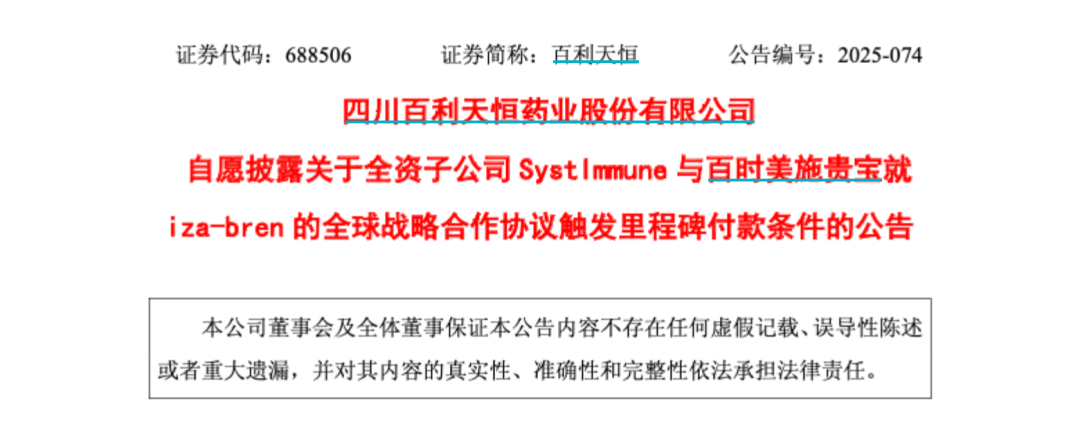
Core Insights - Baillie Tianheng (688506) announced a collaboration agreement with Bristol-Myers Squibb (BMS) for the development of the dual-target antibody-drug conjugate (ADC) BL-B01D1, triggering an initial payment of $250 million due to a milestone achievement in the global Phase II/III clinical trial [1][3] Group 1: Collaboration Agreement - The agreement allows SystImmune, a wholly-owned subsidiary of Baillie Tianheng, to receive up to $250 million in near-term milestone payments, with potential additional payments of up to $7.1 billion based on specific development, registration, and sales milestones [3] - BMS will be responsible for the development and commercialization of BL-B01D1 outside of mainland China, while SystImmune will handle its development and commercialization within mainland China [3] Group 2: Financial Aspects - The total potential transaction value of the collaboration could reach $8.4 billion, setting a record for the total price of a single ADC drug transaction globally [3] - As of March 7, 2024, Baillie Tianheng has received an $800 million non-refundable upfront payment from BMS [3] Group 3: Company Overview and Financial Performance - Baillie Tianheng focuses on addressing unmet clinical needs in the field of oncology, with a strong emphasis on innovative drug development and large-scale production capabilities [4] - The company reported net losses of 282 million yuan, 780 million yuan, and 1.118 billion yuan for the years 2022, 2023, and the first half of 2025, respectively, with a projected profit of 370.8 million yuan in 2024 due to intellectual property income from innovative drugs [4]
2.5亿美元里程碑付款!688506,最新公告→
证券时报· 2025-10-12 11:35
Core Viewpoint - The announcement highlights a significant collaboration between SystImmune and Bristol-Myers Squibb (BMS) regarding the development of the dual-targeting antibody-drug conjugate (ADC) BL-B01D1, which has triggered a milestone payment of $250 million [1][3]. Group 1: Collaboration Details - SystImmune has entered into an exclusive licensing and collaboration agreement with BMS for the ADC project BL-B01D1, which targets EGFR and HER3 [1][3]. - The agreement includes an initial payment of $800 million from BMS, with potential milestone payments reaching up to $7.1 billion based on specific development, registration, and sales milestones [3]. - The total potential transaction value could reach $8.4 billion, marking a record for ADC drug transactions globally [3]. Group 2: Financial Performance - The company reported net profits of -282 million yuan, -780 million yuan, 3.708 billion yuan, and -1.118 billion yuan for the years 2022, 2023, 2024, and the first half of 2025, respectively, indicating a trend of losses except for 2024 due to intellectual property income from innovative drugs [4]. - The company anticipates the need for continued substantial R&D investments for ongoing projects [4].

晚间公告丨10月12日这些公告有看头
Di Yi Cai Jing· 2025-10-12 10:24
Group 1 - Wentech Technology's control over Anshi Semiconductor is temporarily restricted due to a ministerial order from the Dutch Ministry of Economic Affairs and Climate Policy, effective until September 30, 2025, affecting operational efficiency [3] - Baillie Gifford's subsidiary SystImmune has triggered a milestone payment of $250 million from Bristol-Myers Squibb for the izabren project, with potential additional payments of up to $7.1 billion [4] - Yunnan Copper Industry expresses uncertainty regarding the future market prices of cathode copper and gold, despite normal production operations [5] Group 2 - Zhongzhi Holdings' major shareholder, Changjiang Environmental Group, plans to transfer its entire 24.73% stake in the company, which may lead to a change in the largest shareholder [6] - Sunshine Nuohua's subsidiary has received approval for clinical trials of BTP4507, aimed at treating poorly controlled primary hypertension [7] - Mingyang Smart Energy plans to invest approximately 14.21 billion yuan to establish the UK's first integrated wind turbine manufacturing base in Scotland, pending various approvals [8] Group 3 - Tailin Microelectronics is planning to issue H-shares and list on the Hong Kong Stock Exchange to enhance its global development strategy [9] - Seagull Construction clarifies that it has not participated in any form of "lighthouse factory" qualification applications, despite media speculation [10] Group 4 - Hengdian East Magnetic anticipates a net profit increase of 50.1% to 65.2% for the first three quarters of 2025, projecting a profit of 1.39 billion to 1.53 billion yuan [12] - China Nuclear Power reports a cumulative power generation of 184.364 billion kWh for the first three quarters of 2025, reflecting a year-on-year growth of 14.95% [13] Group 5 - Eryuan Bio's controlling shareholder plans to reduce its stake by up to 3%, equating to a maximum of 12.1521 million shares [15] - Times New Material has signed blade sales contracts totaling approximately 4.49 billion yuan with major wind turbine manufacturers [17] - BGI Genomics' subsidiary has signed a licensing agreement for the CoolMPS sequencing technology with Swiss Rockets AG [18]
百利天恒子公司SystImmune与百时美施贵宝的合作触发2.5亿美元里程碑付款
智通财经网· 2025-10-12 09:45
Core Viewpoint - SystImmune, a wholly-owned subsidiary of Baillie Gifford (688506.SH), has entered into an exclusive licensing and collaboration agreement with Bristol-Myers Squibb (BMS) for the drug iza-bren (BL-B01D1, EGFR×HER3 dual antibody ADC), receiving an upfront payment of $800 million [1] Group 1 - The collaboration agreement includes a milestone payment of $250 million triggered by the completion of the global Phase II/III pivotal clinical trial IZABRIGHT-Breast01 [1] - SystImmune is eligible for additional near-term milestone payments of up to $250 million and potential further payments of up to $7.1 billion upon achieving specific development, registration, and sales milestones [1] - The milestone payments are contingent upon certain conditions, and the final amounts remain uncertain [1]
百利天恒(688506.SH)子公司SystImmune与百时美施贵宝的合作触发2.5亿美元里程碑付款
智通财经网· 2025-10-12 09:45
Core Viewpoint - SystImmune, a wholly-owned subsidiary of Baillie Gifford (688506.SH), has entered into an exclusive licensing and collaboration agreement with Bristol-Myers Squibb (BMS) for the drug iza-bren (BL-B01D1, EGFR×HER3 dual antibody ADC), receiving an upfront payment of $800 million [1] Group 1 - The collaboration agreement includes a milestone payment of $250 million triggered by the completion of the global Phase II/III pivotal clinical trial IZABRIGHT-Breast01 [1] - SystImmune is expected to receive the $250 million milestone payment soon, subject to bank fees [1] - The agreement allows for additional potential payments of up to $2.5 billion in near-term or milestone payments, and up to $7.1 billion in further payments upon achieving specific development, registration, and sales milestones [1]