Citi(C)

Search documents
日股迈向“牛市长期化”?花旗:日经指数5万点仅是中途站
Hua Er Jie Jian Wen· 2025-11-03 06:10
Core Viewpoint - The Japanese stock market is showing strong momentum towards a long-term bull market, driven by a robust global market and optimistic expectations regarding new government economic policies. Citi predicts that the Nikkei 225 index could reach 50,000 points as just a "checkpoint" on its way to 55,000 points by the end of 2026 [1][6]. Group 1: Government Policies - The establishment of the new government under Prime Minister Sanae Takaichi is seen as a core logic supporting the long-term bullish trend of the Japanese stock market. The government is expected to implement supportive economic policies, including tax cuts, to assist households facing declining real incomes [3][4]. - The new government's policy framework aims to create a virtuous cycle of wages and prices by encouraging investment in growth sectors and improving productivity [3][4]. Group 2: Corporate Earnings - Japanese companies are demonstrating strong profitability even in a persistent inflationary environment, with over 50% of companies exceeding quarterly earnings expectations since 2023. This trend is particularly evident in the non-manufacturing sector, driven by domestic demand [4][5]. - The report indicates that rising prices are helping companies improve their profit margins, and if the new government's measures succeed in boosting real incomes, it will further solidify inflation expectations and ensure sustained strong earnings for domestic-focused companies [4]. Group 3: Valuation and Foreign Investment - Despite short-term signs of overheating in the valuation of Japanese stocks relative to global markets, there remains significant potential for long-term valuation recovery. The average return on equity (RoE) for Japanese companies is increasing, supported by improved profit margins and stock buybacks driven by corporate governance reforms [5][6]. - There is still ample room for foreign capital inflow into the Japanese stock market, with net purchases by foreign investors reaching 5 trillion yen since 2025. This suggests that despite previous net selling trends, there is a substantial amount of overseas capital waiting to enter the market [5][6].

中国材料_2025 年实地需求监测-动力煤生产与库存-China Materials_ 2025 On-ground Demand Monitor Series – Thermal Coal Production and Inventory y
2025-11-03 02:36
Summary of the Conference Call on Thermal Coal Production and Inventory Industry Overview - The report focuses on the thermal coal industry in China, specifically analyzing high-frequency demand trends and production data from 100 sample thermal coal mines during the week of October 23 to October 29, 2025 [1][2]. Key Points Production Data - **Total Output**: China's thermal coal output from the sample mines was 11,962 kt, reflecting a week-over-week (WoW) increase of 0.4%, but a year-over-year (YoY) decrease of 1.7% [1]. - **Regional Breakdown**: - Shanxi: 2,865 kt (+1.9% WoW, -2.4% YoY) - Shaanxi: 3,527 kt (+0.8% WoW, -4.8% YoY) - Inner Mongolia: 5,570 kt (-0.6% WoW, +0.7% YoY) [1]. - **Year-to-Date (YTD) Output**: The YTD thermal coal output was 533 million tonnes (mnt), representing a 3.0% increase YoY, with regional contributions as follows: - Shanxi: +4.1% YoY - Shaanxi: +1.0% YoY - Inner Mongolia: +3.9% YoY [1]. Utilization Ratio - **Overall Utilization**: The overall utilization ratio of the sample mines was 88.6%, which is an increase of 0.4 percentage points (ppt) WoW but a decrease of 1.6 ppt YoY [1]. - **Regional Utilization**: - Shanxi: 83.2% (+1.6 ppt WoW, -2.1 ppt YoY) - Shaanxi: 90.0% (+0.7 ppt WoW, -4.5 ppt YoY) - Inner Mongolia: 90.7% (-0.5 ppt WoW, +0.6 ppt YoY) [1]. Inventory Levels - **Total Inventory**: The total coal inventory in the sample mines was 3,196 kt as of October 29, 2025, which is an increase of 1.6% WoW but a slight decrease of 0.2% YoY [2]. - **Regional Inventory**: - Shanxi: 857 kt (+1.3% WoW, -2.3% YoY) - Shaanxi: 691 kt (+2.5% WoW, -13.8% YoY) - Inner Mongolia: 1,648 kt (+1.4% WoW, +8.1% YoY) [2]. Additional Insights - The report indicates a pecking order of demand for various materials, with copper, battery materials, and gold leading, followed by aluminum, cement, steel, lithium, and thermal coal [1]. - The data reflects ongoing trends in the thermal coal market, which may be influenced by broader economic conditions and energy demands in China [1][2]. This summary encapsulates the critical data and insights from the conference call regarding the thermal coal industry in China, highlighting production, utilization, and inventory trends.
花旗:美联储12月是否降息,或许取决于“美国政府关门何时结束”
美股IPO· 2025-11-02 06:28
Core Viewpoint - The ongoing U.S. government shutdown is creating a "data fog" for the Federal Reserve, making its December interest rate decision uncertain. The longer the shutdown lasts, the less likely a rate cut will occur, according to Morgan Stanley, while Citigroup remains optimistic about a resolution within two weeks, allowing for potential rate cuts [1][4][12]. Group 1: Impact of Government Shutdown - The duration of the government shutdown directly affects the availability of key economic data, which the Federal Reserve relies on for decision-making. A longer shutdown leads to a higher probability of pausing rate cuts [4][9]. - The Federal Reserve's Chairman Jerome Powell has indicated that the lack of data will lead to more cautious actions, comparing the situation to "driving in fog" [3][5]. Group 2: Market Perspectives - Morgan Stanley believes that the longer the shutdown continues, the lower the chances of a rate cut, emphasizing the importance of timely data for the Fed's decisions [4][11]. - In contrast, Citigroup expresses confidence that the government will reopen within two weeks, which would provide the Fed with sufficient data to support a rate cut in December [12][16]. Group 3: Scenarios Based on Shutdown Duration - Scenario 1: If the shutdown ends next week, the Fed could receive multiple employment reports and key inflation data, supporting a rate cut decision [11]. - Scenario 2: If the shutdown ends by mid-November, the Fed may only have limited data, but state-level unemployment data could still provide some insights [11]. - Scenario 3: If the shutdown extends past Thanksgiving, the Fed may only have access to September's data, increasing the likelihood of pausing rate cuts unless strong negative signals emerge [11]. Group 4: Immediate Economic Pressures - The shutdown has already impacted social welfare programs, with the Supplemental Nutrition Assistance Program (SNAP) benefits ceasing on November 1, affecting up to 42 million Americans [13]. - There is an impending crisis regarding military pay, as funds for military salaries are running low [14]. - Upcoming local elections may create new political momentum to resolve the shutdown [15].



Emerging market stocks rose every month this year for first time since 1993
BusinessLine· 2025-11-02 05:09
Core Insights - The MSCI Emerging Markets Index has experienced a continuous rally for ten months, driven by an artificial intelligence boom and a weaker dollar, resulting in a 30% increase year-to-date [1][2] - Emerging-market stocks are outperforming US peers for the first time in eight years, leading to forecasts of a multi-year rally from money managers [4] Group 1: Market Performance - The MSCI Emerging Markets Index closed October with a 4% gain, despite a 0.7% drop on the last trading day of the month [1] - Emerging-market bonds also saw gains, with the Bloomberg EM Sovereign Total Return Index of dollar bonds achieving a seventh consecutive month of increases [5] Group 2: Catalysts for Growth - Strong performance in AI-focused Asian tech stocks and a weaker dollar have prompted diversification from US assets [2] - Targeted stimulus in China has positively impacted earnings estimates, fund flows, and overall market sentiment [2] Group 3: Sector Composition - Emerging-market equities are increasingly diversified beyond traditional sectors like banks and commodities, with significant representation from tech, consumer, and medical sectors [3] Group 4: Economic Outlook - The Federal Reserve's potential decision not to lower interest rates in December has created uncertainty, leading to modest profit-taking in select asset classes [4] - A trade truce between China and the US has contributed to a perceived easing of tariff frictions, benefiting risk assets [5][6]

美联储12月是否降息,或许取决于“美国政府关门何时结束”
Hua Er Jie Jian Wen· 2025-11-02 04:28
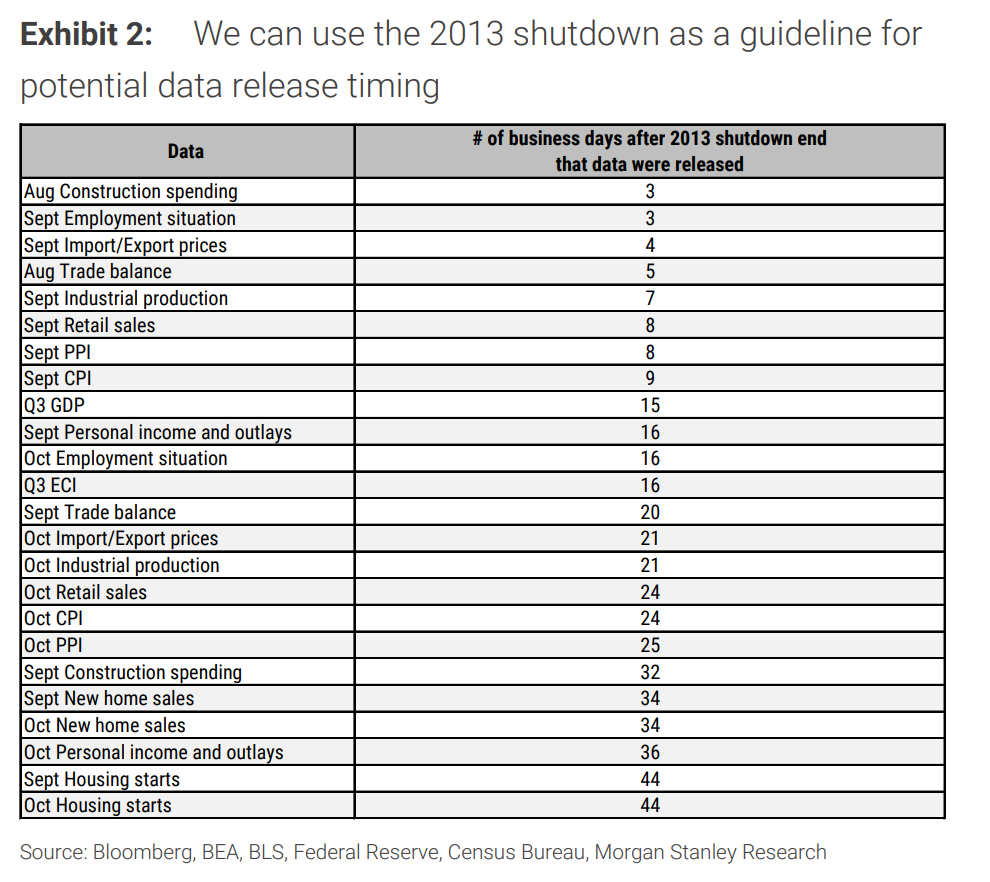
Core Viewpoint - The ongoing U.S. government shutdown is creating a "data fog" for the Federal Reserve, making its December interest rate decision uncertain [1] Group 1: Federal Reserve's Position - Fed Chairman Powell's recent statements have shifted from a dovish to a more hawkish tone, indicating that a rate cut in December is "far from certain" [1][2] - Powell emphasized that the Fed's monetary policy is "not on a preset path" and will increasingly rely on data, highlighting the challenges posed by the current lack of economic data [2] - The Fed announced it will halt quantitative tightening (QT) starting December 1, which some market participants view as a dovish countermeasure [2] Group 2: Impact of Government Shutdown - The duration of the government shutdown directly affects the data available for the Fed's decision-making [3] - Morgan Stanley's analysis suggests that the longer the shutdown lasts, the lower the probability of a rate cut [5] - Historical data from the 2013 government shutdown indicates that the timing of data releases is critical for the Fed's decision-making process [4] Group 3: Market Perspectives - Morgan Stanley believes that if the shutdown continues, the Fed will have limited data to support a rate cut, while Citi expresses optimism that the shutdown may end within two weeks, allowing for timely data releases [7][8] - Citi forecasts that if the government reopens soon, the Fed could receive multiple employment reports before the December meeting, supporting a potential rate cut [7] - Different scenarios regarding the end of the shutdown illustrate varying levels of data availability, impacting the Fed's ability to make informed decisions [8]
X @Bloomberg
Bloomberg· 2025-10-31 15:01
Financial Services - Citigroup is in discussions with Banco Fomento de Angola to offer dollar and euro clearing services [1] - The services are intended for the second-largest bank in Angola [1]
CEOs who are also board chairs are the problem not the solution, says top governance expert
Yahoo Finance· 2025-10-31 09:51
Group 1 - Citigroup's CEO Jane Fraser has taken on the additional role of board chair, a move that aligns her with other major bank CEOs but raises governance concerns [1][4] - Charles Elson, a corporate governance expert, criticizes the dual role of CEO and board chair, arguing it undermines the board's oversight function [2][4] - Historically, over 90% of traded companies had CEOs also serving as board chairs in 1990, but this has changed significantly due to the influence of institutional investors [2][4] Group 2 - The financial crisis of 2008-2009 prompted companies like Citigroup and Bank of America to separate the roles of CEO and board chair, but recent trends show a reversion to this dual role [4][5] - Currently, only 40% of Fortune 500 companies have CEOs who are also board chairs, indicating a shift towards governance separation [5] - The rise of the "executive chair" role allows a recently retired CEO to maintain influence over company operations while not holding the title of CEO, effectively blurring the lines of governance [5]
中国经济:“十五五” 规划有哪些新看点-China Economics-What’s New for the Fifteenth Five-Year Plan
2025-10-31 01:53
Summary of the Fifteenth Five-Year Plan (15th FYP) Conference Call Industry Overview - The conference call discusses the **Fifteenth Five-Year Plan (15th FYP)** of China, focusing on economic rebalancing and technological self-reliance as key priorities. Key Points and Arguments 1. Economic Rebalancing - The **CPC's Suggestion** for the 15th FYP emphasizes a clearer intention for economic rebalancing, aiming to increase the consumption share in GDP [1][4][5] - The philosophy of consumption policy has shifted from a supply-centric approach to a more balanced supply-and-demand perspective [5][15] 2. Consumption Policy - The Suggestion explicitly targets a **significant increase in household consumption share** and aims to strengthen domestic demand as a leading driver of economic growth [8][18] - The plan includes discussions on welfare, social security, and common prosperity, addressing weak links in the current system [5][18] 3. Layered Industrial and Innovation Policies - The policy focus for traditional sectors will be on quality improvement, while emerging sectors like **new energy** will see efforts to strengthen and scale development [11][12] - The plan includes unconventional measures for key sectors and basic research, such as higher R&D expense deduction ratios and government procurement of innovative products [12][11] 4. Supply-and-Demand Balance in Consumption - The new consumption policy emphasizes both demand-side factors (employment, income, expectations) and supply-side support (expanding high-quality goods and services) [15][16] - Restrictions on auto and housing consumption are to be cleared to stimulate demand during economic downturns [15][16] 5. Welfare and Common Prosperity - The Suggestion aims to increase the household income share in national income and improve social security systems, including pensions and unemployment insurance [18][19] - Housing supply, particularly affordable housing, is highlighted as a key welfare issue [18][19] 6. Anti-Involution and Fiscal Policies - The term "involution" is addressed, focusing on the need for a **national unified market** and the regulation of local governments to prevent protectionism [21][22] - Fiscal policies will be proactive, with an emphasis on enhancing fiscal sustainability and regulating tax preferential policies [23][24] 7. Opening-Up and RMB Internationalization - The Suggestion reiterates the importance of institutional and services opening-up, with a supportive tone towards foreign direct investment (FDI) [23][24] - The plan aims to establish a **cross-border payment system for RMB**, indicating a more proactive approach to RMB internationalization compared to previous plans [24][23] Other Important Content - The conference call indicates that the full document of the 15th FYP will be approved by the NPC in early March 2026, with ongoing policy communications expected [4][5] - The market focus is anticipated to shift towards actual policy measures and their magnitudes in the coming weeks and months [4][5] This summary encapsulates the critical insights and strategic directions outlined in the conference call regarding China's 15th Five-Year Plan, highlighting the emphasis on economic rebalancing, consumption, innovation, and welfare improvements.
GS or C: Which Bank's Transformation Efforts Have More Potential?
ZACKS· 2025-10-30 17:16
Core Insights - Transformation is essential for survival in the banking sector, with both Goldman Sachs and Citigroup reinventing themselves to adapt to new regulations, technology, and client expectations [1][2]. Goldman Sachs (GS) - Goldman Sachs is focusing on its strengths in investment banking, trading, and asset and wealth management, while exiting non-core consumer banking [3][4]. - The company has seen a 19% year-over-year increase in investment banking revenues for the first nine months of 2025, driven by a rebound in global M&A activity [5]. - Goldman is expanding its asset management unit's private credit portfolio to $300 billion by 2029 and expects high-single-digit annual growth in private banking and lending revenues [7]. - Recent acquisitions, such as Industry Ventures, and partnerships with T. Rowe Price are aimed at enhancing its position in the innovation economy and private markets [6]. Citigroup (C) - Citigroup is undergoing a comprehensive transformation under CEO Jane Fraser, focusing on streamlining operations and exiting non-core markets [8][9]. - The bank has announced plans to sell a 25% stake in Banamex and is winding down its Korean consumer banking operations, which will free up capital for investments in wealth management [9][11]. - Citigroup expects total revenues to exceed $84 billion in 2025, with a projected CAGR of 4-5% through 2026 [11]. - The company has launched an $80 billion customized portfolio offering with BlackRock and partnered with Carlyle Group to expand asset-based private credit [12]. Performance and Valuation Comparison - Over the past year, shares of Goldman Sachs and Citigroup rose 54.3% and 59.2%, respectively, outperforming the industry growth of 42.6% [13]. - Goldman is trading at a forward P/E of 14.6X, while Citigroup trades at a lower P/E of 10.4X, indicating better value for Citigroup [17][20]. - Citigroup has a higher dividend yield of 2.42% compared to Goldman's 2.04%, providing additional appeal to investors [20]. - Both companies are expected to see revenue growth, with Goldman projected to have a 10% increase in 2025 and Citigroup a 6% increase [23][26]. Long-term Outlook - Citigroup's transformation strategy appears to offer greater long-term potential due to its structural changes and focus on high-return, fee-based businesses [28][30]. - Goldman's growth remains closely tied to market cycles, which may expose it to macroeconomic volatility [28].


What Citibank's rate cut tells us about the next big move in the economy
Invezz· 2025-10-30 15:51
Core Viewpoint - Citibank's decision to lower its base lending rate from 7.25% to 7.00% is a significant move that will impact consumers, businesses, and the overall economy [1] Group 1 - The reduction in the base lending rate is not merely a technical adjustment but has substantial implications for the market [1] - This change is expected to influence borrowing costs for consumers and businesses, potentially stimulating economic activity [1] - The adjustment reflects Citibank's response to current economic conditions and market expectations [1]