Citi(C)

Search documents
Investopedia’s 2026 Credit Card Awards: The Best Cards for Travel, Cash Back, and More
Yahoo Finance· 2026-03-02 15:09
Core Insights - The article discusses the best credit cards for various spending categories, emphasizing the importance of selecting a card that aligns with individual spending habits and financial needs [4][5][79] Rewards Value - The Chase Sapphire Preferred card offers 2X points on travel and 3X points on dining, streaming, and online grocery purchases, with a $95 annual fee [1] - The Wells Fargo Active Cash card provides a straightforward 2% cash back on all purchases with no annual fee, making it ideal for everyday spending [2] - The Citi Strata Elite card features high point multipliers, including 6X for airfare booked through its portal and 3X for dining, with a $595 annual fee [11][13] Costs and Interest - The Wells Fargo Reflect card offers a 21-month 0% interest period for balance transfers and purchases, making it a strong option for managing debt [52] - The American Express Blue Cash Preferred card has a $95 annual fee but offers 6% cash back at U.S. supermarkets on up to $6,000 spent annually, providing significant value for grocery shoppers [29][30] Travel Features and Benefits - The Chase Sapphire Reserve for Business card provides 8X points on purchases made through Chase Travel and offers extensive travel perks, including airport lounge access and a $300 travel credit, with a $795 annual fee [67][71] - The United Explorer card allows cardholders to earn 2 miles per dollar on United flights, with additional benefits like free checked bags and priority boarding [17][18] Insurance and Protection Benefits - The Wells Fargo Reflect card includes cellphone protection against damage or theft, provided the phone bill is paid with the card [54] - The Bank of America Customized Cash Rewards Secured card offers 3% cash back in a chosen category and includes benefits typically found in rewards cards, such as cellphone protection [57][58] Other Benefits - The American Express Blue Cash Everyday card provides 3% cash back on gas and U.S. supermarkets with no annual fee, making it a practical choice for everyday expenses [33][36] - The Prime Visa card by Chase offers 5% cash back on Amazon purchases for Prime members, along with 2% on gas, dining, and transit, making it versatile for frequent Amazon shoppers [45][46]


Citi instructs Gulf employees to work from home as tensions flare, source says
Reuters· 2026-03-02 12:19
Group 1 - Citigroup has instructed most employees in the Gulf region to work from home until further notice due to rising tensions in the area [1]

Goldman Sachs Says Hedge Funds and Mutual Funds Both Love 5 Top Stocks
Yahoo Finance· 2026-03-02 12:11
Core Insights - Mutual funds and hedge funds show agreement on most sectors, particularly Health Care and Industrials, while differing on Financials and Consumer Discretionary [1] - Both groups have recently increased their positions in Energy and Consumer Discretionary, while reducing exposure in Communication Services [1] - Five stocks are identified as "shared favorites" among both hedge funds and mutual funds, outperforming the S&P 500 by 2 percentage points year-to-date and by 6 percentage points in the last month [1] Mutual Funds and Hedge Funds Analysis - The Goldman Sachs research team analyzes $9 trillion in equity positions, covering 1,029 hedge funds with $4.4 trillion in gross equity positions and 524 large-cap active mutual funds with $4.1 trillion in equity assets [2] - The report highlights the differing strategies of hedge funds and mutual funds in 2026 [2] Popular Stocks - Five stocks are overweight in both hedge fund and mutual fund portfolios, all rated Buy by top Wall Street firms [5] - The stocks include Boeing, Citigroup, Mastercard, Vertiv, and Visa, which are recognized for their strong market positions and growth potential [5][6][10][13][18][20] Company Profiles - **Boeing**: A leader in aerospace and defense, focusing on commercial jet aircraft and military systems [6][7] - **Citigroup**: A diversified financial services company with a 2.01% dividend yield, offering a range of banking and wealth management services [10][12] - **Mastercard**: A technology company in the global payments industry, facilitating secure electronic payments [13][14] - **Vertiv**: Provides critical digital infrastructure technologies, primarily for data centers and communication networks, with significant upside potential [18][19] - **Visa**: A global payments technology company, facilitating commerce across more than 200 countries, with a strong transaction processing network [20][21]


7 Undervalued Stocks With Strong Free Cash Flow
Investing· 2026-03-02 07:29
Core Viewpoint - In a market with elevated valuations, free cash flow (FCF) is a reliable indicator of financial strength, and seven undervalued US stocks are identified that combine attractive valuation multiples with solid FCF generation [1][16]. Group 1: Undervalued Stocks - Cisco Systems (CSCO) is shifting towards software and recurring revenue, improving margins and predictability, with steady FCF supporting dividends and buybacks [2]. - Pfizer (PFE) is positioned for renewed growth through its pipeline and acquisition strategy, with FCF supporting dividends and R&D investment despite a decline in COVID-related revenues [2]. - Exxon Mobil (XOM) maintains robust FCF, funding dividends and buybacks while expanding low-cost production, reflecting discipline in the energy sector [3]. - Intel (INTC) is trading at a discount to semiconductor peers and is in a turnaround phase, with potential for accelerated FCF if execution improves [3][8]. - Verizon Communications (VZ) generates strong recurring FCF that supports its dividend, with debt reduction and subscriber growth stabilization potentially unlocking upside [8]. - Meta Platforms (META) has streamlined expenses while maintaining dominance in digital advertising, with FCF supporting buybacks and long-term AI investments [9]. - Citigroup (C) is simplifying its operations, which could narrow its valuation discount, with improving efficiency enhancing sustainable FCF [9]. Group 2: Investment Characteristics - Common themes among these stocks include reasonable P/E or price-to-book multiples, strong FCF relative to market cap, and shareholder returns through dividends and buybacks [15]. - Companies exhibit improving cash flow trends and significant government-backed manufacturing expansion, contributing to their attractiveness [11]. - Defensive characteristics, such as high dividend yields and stable recurring cash flows, are present in sectors like telecom [12].





Analysts See $100 Oil on Strait of Hormuz Disruption
Yahoo Finance· 2026-03-02 06:22
Group 1: Oil Price Projections - Analysts expect oil prices to surge to $90 per barrel this week, with potential to reach $100 if disruptions in the Strait of Hormuz continue [1] - Citigroup forecasts Brent Crude to trade between $80 and $90 per barrel in the coming week, contingent on geopolitical developments [2] - Goldman Sachs identifies an $18 per barrel risk premium in oil prices, which could decrease to $4 if only 50% of flows through the Strait of Hormuz are halted for a month [3] Group 2: Impact of Strait of Hormuz Disruptions - The closure of the Strait of Hormuz could disrupt 15% of global oil supply and 20% of global LNG supply, potentially pushing oil prices above $100 per barrel [4] - Wood Mackenzie suggests that if transit flows are not quickly restored, oil prices over $100 per barrel are plausible [5] - Historical context indicates that during the early days of the Russia/Ukraine conflict, oil prices surged to over $125 per barrel due to supply fears [6]
突发!恐涨130%!威胁升至最高!
天天基金网· 2026-03-02 05:17
上天天基金APP搜索777注册即可领500元券包,优选基金10元起投!限量发放!先到先得! 关键之地——霍尔木兹传来最新消息! 根据当地时间3月1日的一份通知,联合海上信息中心(JMIC)已将霍尔木兹海峡的威胁级别上调至最高级 别,并表示在过去24小时内已有三艘油轮遭到袭击。 该机构称,虽然尚未正式宣布在法律上封闭霍尔木兹海峡,但目前的作业环境显示该地区存在袭击风险。 过去24小时内,约有110艘船只通过该海峡,而历史平均水平为138艘。 高盛评估伊朗冲击称,欧洲天然气恐涨130%,油价每桶上涨18美元,相当于霍尔木兹海峡封锁6周。花 旗则表示,如果美伊冲突在未来几天内结束,并且局势随之缓和,那么天然气价格将恢复到冲突前的水 平。若时间超出预期,则可能会将JKM/TTF天然气价格推升至30美元/百万英热单位左右,或接近100欧 元/兆瓦时。 海事安全服务专家安布雷评估,也门胡塞武装极有可能通过所有权和旗帜重新对以色列和美国关联的船只 发动攻击。胡塞武装有现实可能恢复针对与以色列贸易的公司。航运访问以色列港口以及与美军基地共址 的港口风险也更高。长期敌对行动很可能发生,这将显著提升美国和以色列相关商船在更广泛地 ...

Oil’s spike fades as traders take stock of Hormuz disruptions
BusinessLine· 2026-03-02 04:03
Core Viewpoint - The oil market is experiencing significant volatility due to the effective closure of the Strait of Hormuz amid escalating conflict between the US and Israel against Iran, leading to a surge in oil prices. Group 1: Oil Price Movements - Oil prices surged by as much as 13 percent, reaching the highest level since January 2025, before settling around $76 a barrel, which is approximately 5 percent higher [1] - Brent oil is projected to trade in the range of $80 to $90 per barrel in the coming week, according to Citigroup analysts [8] - Morgan Stanley raised its second-quarter Brent forecast to $80 per barrel from $62.50, reflecting the impact of geopolitical tensions on oil prices [9] Group 2: Impact of Conflict on Oil Supply - Tanker traffic through the Strait of Hormuz, a critical chokepoint for global oil supply, has largely halted due to self-imposed pauses by shipowners and traders amid the conflict [2] - Iranian authorities claimed to have attacked three oil tankers, while the US reported sinking nine Iranian naval ships, indicating a significant escalation in military actions [3] - Goldman Sachs analysts noted that tanker traffic is significantly disrupted, with many shippers and oil producers adopting a cautious approach [11] Group 3: OPEC+ Response - OPEC+ agreed to raise production quotas by 206,000 barrels a day in response to the conflict, despite prior expectations for modest increases [5] - The geopolitical tensions and localized supply issues have led to sustained gains in crude oil prices, even amidst expectations of a major surplus in the oil market [7] Group 4: Future Outlook - If tanker traffic resumes quickly or if there is credible de-escalation, oil prices may stabilize; otherwise, prices could remain elevated [7] - Wood Mackenzie warned that if tanker flows in the Strait of Hormuz are not restored quickly, oil prices could exceed $100 per barrel [11]
Bank stocks just got hit by two things at once
Yahoo Finance· 2026-03-01 20:06
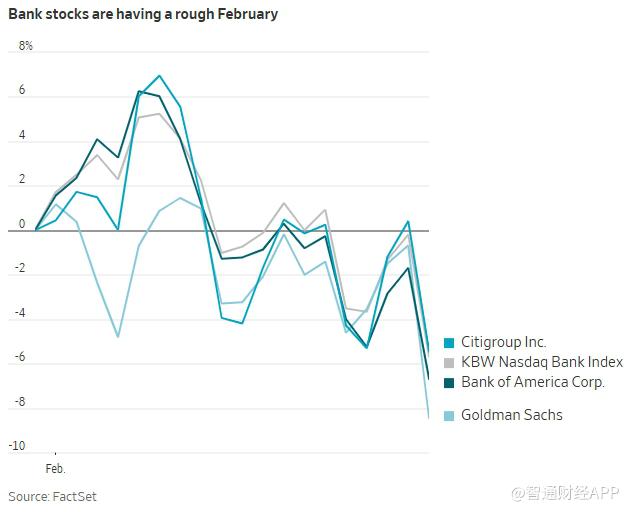
Core Viewpoint - Bank stocks experienced a significant decline on February 27, marking the worst single-day performance for the sector since April of the previous year, driven by fears of AI impacting white-collar jobs and the collapse of a UK mortgage lender [1][2][3] Group 1: Impact of AI on Employment - Concerns are rising that artificial intelligence will drastically reduce white-collar financial jobs, a risk that the market has not fully accounted for [2] - Jack Dorsey, CEO of Block, announced layoffs of over 4,000 employees, nearly half of the workforce, citing AI as the primary reason for this decision [4][5] - Dorsey indicated that many companies would likely follow suit within a year, leading to structural changes across various sectors, including banking [6] Group 2: Market Reaction and Stock Performance - The KBW Bank Index fell nearly 6% intraday, reaching its lowest level since March 2025, with all 23 member stocks closing in the red [3] - Major banks experienced significant stock declines, with Goldman Sachs down 7.5%, Morgan Stanley down 6.9%, and Citigroup down 5.8% among others [8]


中国金属:与上海有色网(SMM)钨钼专家电话会议要点-China Diversified Metals Mining Takeaways from Tungsten and Moly Expert Call with SMM
2026-03-01 17:23
Summary of Key Takeaways from Tungsten and Moly Expert Call Industry Overview - **Industry**: Tungsten and Molybdenum Mining - **Key Company**: China Diversified Metals & Mining Core Insights 1. **Tungsten Price Trends**: - SMM anticipates that the price of tungsten in China will remain high due to supply shortages, potentially peaking in September 2026 during the peak season [3][4] - The price surge is attributed to export controls imposed by China in February 2025, which led to increased overseas prices [2] 2. **Supply Dynamics**: - China holds 52% of global tungsten reserves and accounted for 83% of global tungsten output in 2024 [4] - The tungsten mining quota for China is expected to decrease to 107,000 tons (WO3) in 2025, down 7,000 tons year-over-year, with output projected at 108,000 tons, a decrease of 12,000 tons year-over-year [4] - For 2026, the mining quota is expected to remain stable at 106,000 to 110,000 tons, with output slightly lower at 107,000 tons [4] 3. **New Projects**: - The Sangdong tungsten mine in Korea is set to begin operations in 2027, increasing capacity to 4,600 tons per annum (tpa) [5] - The Dolphin tungsten mine in Australia is also expected to start in 2027 with a capacity of 4,000 to 5,000 tpa [5] - Incremental tungsten supply is projected to be approximately 15,000 tons in 2027 [5] 4. **Demand Forecast**: - China's tungsten demand is expected to reach 83,700 tons in 2026, reflecting a 2% year-over-year increase, leading to a supply shortage of 4,800 tons [9] - Molybdenum demand is projected at 316,000 tons in 2026, with a supply shortage of 13,100 tons [9] 5. **Market Sentiment**: - The bullish sentiment surrounding tungsten is reinforced by environmental inspections in Jiangxi and depleting inventories, which have driven domestic prices higher [2] Additional Important Points - **APT Market**: APT (Ammonium Paratungstate) has been a significant driver of price increases in Q4 2025 due to low utilization ratios and maintenance activities [6] - **Strategic Metal Classification**: Tungsten is treated as a strategic metal by China, which is expected to limit significant increases in mining quotas despite rising prices [4] This summary encapsulates the critical insights from the expert call regarding the tungsten and molybdenum markets, highlighting supply constraints, demand forecasts, and the implications for pricing and investment opportunities.
AI+信贷风险重挫银行板块 KBW银行指数ETF(KBE.US)创去年关税风波以来最大单日跌幅
Zhi Tong Cai Jing· 2026-02-27 23:38
Group 1: Banking Sector Performance - The U.S. banking sector experienced a significant decline, with major banks and investment firms seeing substantial drops in stock prices, reflecting rising investor concerns about the economic outlook [1] - Bank of America (BAC.US) fell over 4%, Citigroup (C.US) and Wells Fargo (WFC.US) both dropped more than 5%, Morgan Stanley (MS.US) declined over 6%, Goldman Sachs (GS.US) fell more than 7%, and JPMorgan Chase (JPM.US) decreased by 1.9% [1] - The KBW Bank Index ETF (KBE.US) dropped 4.95%, marking the largest single-day decline since the tariff turmoil in April of the previous year, indicating that large banks are viewed as economic barometers [1] Group 2: Impact of AI and Credit Risks - Negative expectations surrounding artificial intelligence (AI) have continued to disrupt the market, with payment company Block (XYZ.US) announcing a 40% workforce reduction due to AI efficiency improvements, heightening fears of large-scale job losses [3] - The rise in credit risk has further impacted financial stocks, particularly consumer finance institutions like American Express (AXP.US), First Capital Credit (COF.US), and Synchrony Financial (SYF.US), which were among the biggest decliners [3] - Turmoil in the private credit sector has also caused investor unease, with redemption requests for related investment tools increasing after notable loan losses last year [3] Group 3: Market Sentiment and Future Outlook - Analysts suggest that the weakness in tech stocks and tightening credit conditions may undermine previously optimistic expectations for a recovery in the M&A and IPO markets [4] - Investor sentiment has shifted from optimism at the beginning of the year to facing previously unaccounted risk factors, leading to a spread of panic in the market [4]