Chagee(CHA)

Search documents
快4.5亿倍!量子计算大消息
Shang Hai Zheng Quan Bao· 2025-11-14 05:28
Core Insights - The "Tianyan-287" superconducting quantum computer, equipped with the same chip as "Zuchongzhi No. 3," has been successfully built, showcasing "quantum computing superiority" by processing specific problems 450 million times faster than the fastest supercomputers [1][2] - This marks China's first quantum computing cloud platform with "quantum computing superiority," indicating significant progress in the practical application of quantum computing [1] Group 1: Technological Advancements - The "Zuchongzhi No. 3" chip features 105 data qubits and 182 coupling qubits, achieving a speed 15 orders of magnitude faster than current classical algorithms for quantum random circuit sampling tasks [2] - The construction of the quantum computer involved three key technological breakthroughs: domestically produced components, AI-enabled calibration systems, and a fully integrated quantum computing ecosystem [3] Group 2: Future Applications and Goals - The quantum computing platform aims to provide computational support for various industries and research institutions, enhancing China's competitiveness in the international quantum computing arena [4] - The upcoming 2025 Quantum Science and Industry Conference will showcase advancements in quantum technology and applications across multiple sectors, including finance, healthcare, and energy [5]

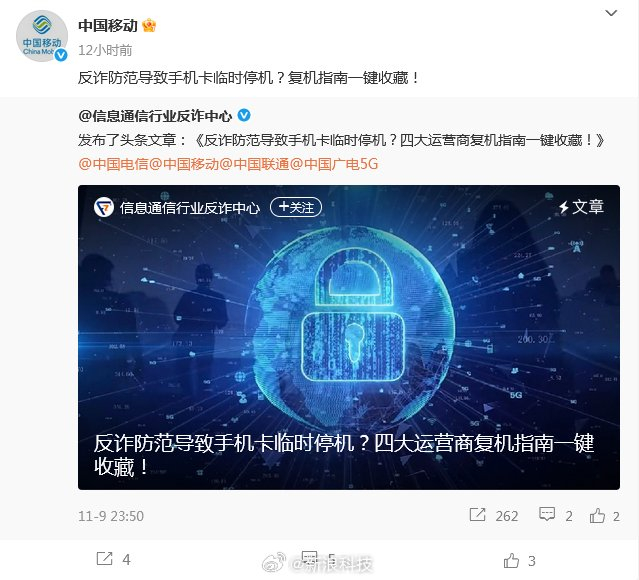
四大运营商发布反诈停机复机指南,线上线下均可办理
Xin Lang Ke Ji· 2025-11-11 02:22
Core Viewpoint - The article discusses the temporary suspension of mobile phone cards due to anti-fraud measures and provides recovery guidelines from the four major telecom operators in China. Group 1: China Telecom - Online channels: Users can process recovery through public accounts, mini-programs, and online service halls (specific methods can be found in the verification notification SMS) [1][17] - Offline channels: Users can bring their ID and phone card to any China Telecom service hall nationwide (specific locations can be queried via local 10000 service) [1][17] Group 2: China Mobile - Online channels: Users can click the link in the notification SMS or call the 10086 customer service hotline for self-service recovery (specific methods can be found in the verification notification SMS) [2][18] - Offline channels: Users can bring their ID and phone card to any China Mobile service hall nationwide (specific locations can be queried via local 10086 service) [2][18] Group 3: China Unicom - Online channels: Users can apply for recovery by searching for the "self-service recovery" interface on the China Unicom app homepage or through public accounts and mini-programs (specific methods can be found in the verification notification SMS) [3][19] - Offline channels: Users can bring their ID and phone card to any China Unicom service hall nationwide to complete real-person authentication [4][19] Group 4: China Broadcasting Network - Online channels: Users can download the China Broadcasting Network app via the link in the notification SMS and complete recovery after passing the identity verification. The app usage does not incur data charges [5][20] - Offline channels: Users can visit any China Broadcasting Network service hall, providing their ID and the phone card for real-person authentication to complete recovery [5][20]



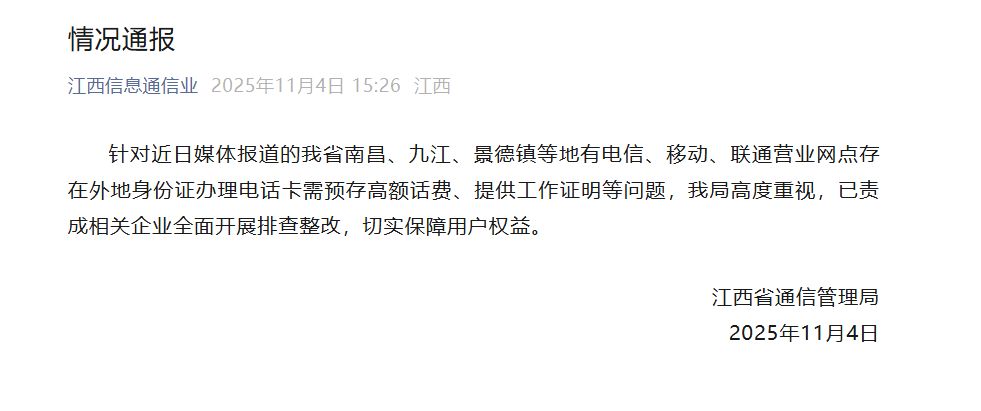
办电话卡需预存高额话费、提供工作证明等?官方通报:已责成相关企业全面开展排查整改
Mei Ri Jing Ji Xin Wen· 2025-11-06 06:43
Core Viewpoint - The Jiangxi Provincial Communication Administration has responded to media reports regarding the high barriers for obtaining phone cards with out-of-town ID cards, including the requirement for work proof and high prepayment amounts, emphasizing the need to protect user rights [1][4]. Group 1: Regulatory Response - The Jiangxi Communication Administration has mandated relevant companies to conduct thorough inspections and rectifications to ensure user rights are safeguarded [1]. - The administration's response indicates a proactive approach to address the issues raised by the media regarding the barriers for out-of-town residents [1]. Group 2: Operator Practices - In Jiangxi, mobile service providers such as China Mobile and China Unicom require out-of-town ID card holders to provide work proof, business licenses, or housing contracts, along with a prepayment of 500 yuan [4][5]. - Different operators have varying requirements; for instance, some locations may allow for a simplified process if the user can confirm local residency [4]. - In contrast, other provinces like Fujian and Gansu have more lenient requirements for out-of-town card applications, indicating regional disparities in practices [5]. Group 3: Expert Opinions - Liu Xingliang, a member of the Ministry of Industry and Information Technology's expert committee, highlighted that while real-name registration is regulated, the additional requirements imposed by operators lack a national legal basis [6]. - Liu suggested the establishment of a "basic standard for out-of-town card applications" to streamline the process and reduce unnecessary barriers for low-risk users [6]. - The recommendation includes a model for a unified set of basic materials required nationwide, with the possibility of local additions, to enhance user experience and rights [6].

电信运营商增长逻辑已变!
Zhong Guo Jing Ying Bao· 2025-11-03 03:53
Core Insights - The financial performance of China's three major telecom operators shows a mixed outlook, with revenue growth slowing down while profit growth remains positive [2][3][4] Revenue Performance - For the first three quarters of 2025, China Mobile, China Telecom, and China Unicom reported revenues of 794.7 billion, 394.3 billion, and 293 billion yuan respectively, with growth rates declining from 2.0%, 2.9%, and 3.0% in 2024 to 0.4%, 0.6%, and 1.0% [2] - Only China Mobile achieved a 2.5% year-on-year revenue growth in Q3 2025, while China Unicom's revenue remained flat and China Telecom's revenue decreased by 0.91% [2] Profitability - Net profits for the three operators reached 115.4 billion, 30.8 billion, and 20 billion yuan respectively, with growth rates of 4.0%, 5.0%, and 5.1%, although these rates have slowed compared to the previous year's figures [2][3] - The telecom industry as a whole saw a 0.9% year-on-year increase in telecom business revenue, totaling 1,327 billion yuan for the first three quarters of 2025 [2] Traditional Business Challenges - The decline in revenue growth is attributed to the weakness in traditional business segments, which have seen their revenue share drop from 92% in 2020 to 78% in Q3 2025 [3][4] - China Mobile has 1.009 billion mobile users, but its average revenue per user (ARPU) fell to 48 yuan, a 3% decrease from 49.5 yuan in 2024 [3] Emerging Business Growth - AI-related emerging businesses have become a significant profit driver, with China Unicom's AI-related revenue contributing over 60% to its "smart network" business, and its cloud revenue reaching 52.9 billion yuan, a 20.6% increase [6][7] - China Telecom's smart revenue surged by 62.3%, significantly outpacing its overall revenue growth of 0.59% [7] Investment in AI and R&D - The three operators have shifted their focus from traditional "pipeline thinking" to "computing power and service thinking," with R&D expenditures exceeding 22 billion yuan in the first three quarters of 2025, of which over 40% is allocated to AI-related investments [10][11] - The operators are expected to see long-term returns from these investments, despite short-term pressures on cash flow and profitability [10] Industry Transformation - The growth logic of the telecom industry is changing, with AI and computing power becoming central to future growth strategies [10][11] - The operators are forming a sustainable payment loop around "bandwidth + computing power + data + models," indicating a significant shift in the industry's revenue generation model [11]


千亿险资系私募基金,最新动向曝光
Zhong Guo Zheng Quan Bao· 2025-11-02 04:10
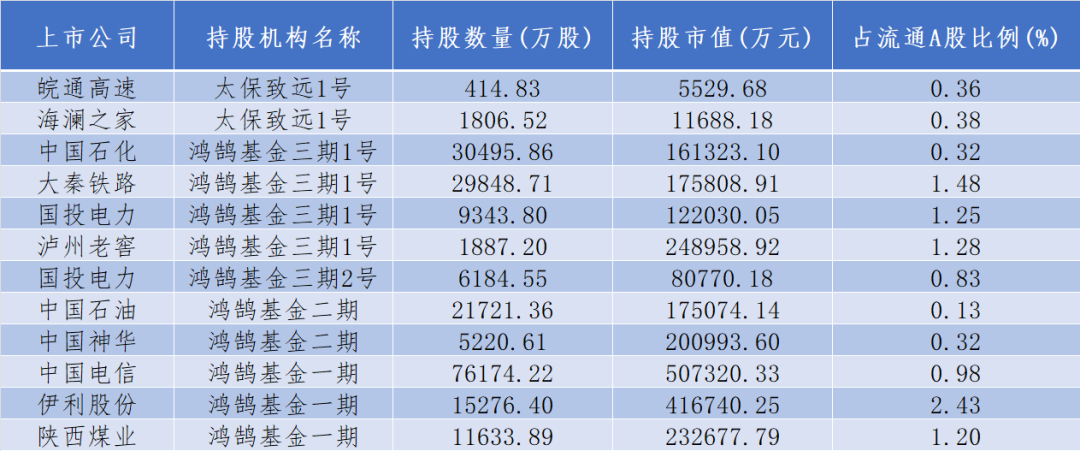
Core Insights - The trial reform for long-term investment of insurance funds has accelerated this year, with the latest holdings of insurance-related private equity funds revealed following the disclosure of listed companies' Q3 reports [1][9] - Five insurance-related private equity funds have disclosed their latest holdings, with significant investments in companies such as Sinopec, Daqin Railway, Guotou Power, Luzhou Laojiao, Anhui Expressway, and HLA [1][4] Holdings Summary - As of the end of Q3, Taibao Zhiyuan No. 1 Private Securities Investment Fund has appeared in the top ten circulating shareholders of Anhui Expressway and HLA, holding 4.1483 million shares and 18.0652 million shares respectively [3][6] - The holdings of five insurance-related private equity funds are detailed in a table, showing the number of shares, market value, and percentage of circulating A-shares for each listed company [5] - The Honghu Fund Phase III No. 1 has emerged as a major shareholder in Sinopec, Daqin Railway, Guotou Power, and Luzhou Laojiao, with holdings of 304.9586 million shares, 298.4871 million shares, 93.438 million shares, and 18.872 million shares respectively [6][7] Investment Focus - The insurance-related private equity funds are primarily concentrated in sectors such as petrochemicals, transportation, coal, public utilities, food and beverage, telecommunications, and textiles, with many holdings being industry leaders characterized by high dividends and low volatility [7][10] - The ongoing trial reform has seen the number of operational insurance-related private equity funds increase to seven, with a total approved scale of 222 billion yuan [9][10]



电信运营商增长逻辑已变
Zhong Guo Jing Ying Bao· 2025-10-31 20:16
Core Insights - The latest financial reports of China's three major telecom operators reveal a mixed performance, with revenue growth slowing down while profit growth remains positive [3][4][5] - The traditional business segments are underperforming, leading to a shift towards AI and digital innovation as new growth engines for the operators [4][5][7] Revenue and Profit Performance - For the first three quarters of 2025, China Mobile, China Telecom, and China Unicom reported revenues of 794.7 billion, 394.3 billion, and 293 billion yuan respectively, with growth rates declining to 0.4%, 0.6%, and 1.0% compared to the same period in 2024 [3] - In terms of net profit, the three operators achieved 115.4 billion, 30.8 billion, and 20 billion yuan respectively, with growth rates of 4.0%, 5.0%, and 5.1%, although these figures also reflect a slowdown from the previous year [3] Traditional Business Challenges - The revenue from traditional business has decreased from 92% in 2020 to 78% in the third quarter of 2025, indicating a significant decline in growth potential [5] - China Mobile's average revenue per user (ARPU) fell to 48 yuan, a 3% decrease from 49.5 yuan in 2024, highlighting the saturation in the mobile user market [5][6] Emerging AI Business Growth - AI-related businesses have emerged as a key profit driver, with significant revenue growth outpacing traditional segments [8][9] - China Unicom reported that AI-related revenue accounted for over 60% of its "smart network" business, with cloud revenue reaching 52.9 billion yuan, a 20.6% increase year-on-year [8][10] Industry Transformation - The telecom industry is shifting from a "pipeline thinking" model to a "computing power and service thinking" model, with increased capital expenditure on AI and data center upgrades [12] - R&D expenditures for the three operators exceeded 22 billion yuan in the first three quarters, with over 40% allocated to AI-related projects [12][13] Market Dynamics - The saturation of the telecom market and price elasticity limits the growth potential of traditional services, necessitating a focus on innovative AI solutions [7][9] - The overall telecom revenue growth is expected to be driven by the successful monetization of AI and computing services, indicating a fundamental change in the industry's growth logic [12][13]

规模510亿元战略基金启动,投早、小、长期、硬科技
Sou Hu Cai Jing· 2025-10-30 10:38
Core Insights - The establishment of the Central Enterprise Strategic Emerging Industry Development Special Fund (referred to as "Central Enterprise Emerging Fund") aims to enhance investment in strategic emerging industries, with a total fundraising of 51 billion yuan [3][4] - The fund has a total duration of 15 years, including a 5-year investment period and an 8-year management exit period, with a possible 2-year extension [3][4] - The fund's primary investment focus includes artificial intelligence, high-end equipment, quantum technology, and future industries such as future energy, future information, and future manufacturing [3] Fund Structure and Contributions - The fund has 15 contributors, with China Reform Holdings Corporation Limited (China Reform) being the largest shareholder, contributing 15 billion yuan and holding a 29.4% stake [3] - Other contributors include state-owned enterprises such as China Mobile (6 billion yuan), Sinopec (5 billion yuan), and China National Offshore Oil Corporation (3 billion yuan), among others [3] - The total scale of various central enterprise venture capital funds established this year is approaching 100 billion yuan, focusing on technology attributes and emerging fields [4] Policy and Investment Strategy - The fund is part of a broader initiative to support the development of strategic emerging industries as mandated by the central government [4] - The investment strategy emphasizes early-stage, small-scale, long-term investments in hard technology, creating a new model of integration between industry and finance [4][6] - Recent policy measures aim to address concerns regarding state-owned capital's risk tolerance and investment willingness, establishing a lifecycle assessment mechanism for venture capital funds [7][8] Market Impact and Collaboration - State-owned capital is expected to stimulate market-oriented funds' investment enthusiasm, particularly in larger financing projects where state capital can lead the investment [8] - Central enterprises possess rich application scenarios for collaboration, as evidenced by recent procurement orders in the robotics sector [8]




首期510亿元!央企战新基金来了!
证券时报· 2025-10-29 15:35
Core Viewpoint - The establishment of the Central Enterprise Strategic Emerging Industry Development Fund (referred to as "Central Enterprise New Fund") aims to accelerate the development of strategic emerging industries in China, with an initial fundraising of 51 billion yuan [2][6]. Fund Overview - The Central Enterprise New Fund has raised an initial capital of 51 billion yuan, with contributions from major state-owned enterprises including China Mobile, Sinopec, CNOOC, and China National Petroleum [2][8]. - The fund is managed by China Reform Holdings Corporation and was officially registered on October 27 [9]. Strategic Focus - The fund will focus on supporting strategic emerging industries such as artificial intelligence, high-end equipment, quantum technology, and future industries like future energy, future information, and future manufacturing [6]. - The fund aims to create a strategic innovation ecosystem that integrates technology innovation, capital operation, and industrial empowerment, promoting a multiplier effect in investment [5]. Management and Structure - The fund operates under a company structure, with a newly established private equity fund management company responsible for its management, implementing both sub-fund investments and direct investment strategies [10]. - The fund's management emphasizes new positioning, mechanisms, models, and teams to ensure efficient and standardized operations [6].

510亿元,十余家央企联合出资!央企战略性新兴产业发展专项基金来了
Sou Hu Cai Jing· 2025-10-29 15:28
Core Points - The Central Enterprise Strategic Emerging Industry Development Fund (referred to as "Central Enterprise Fund") was launched with an initial fundraising of 51 billion yuan, supported by over ten central enterprises including China Mobile, Sinopec, and China National Petroleum Corporation [1][4] - The fund aims to accelerate the development of strategic emerging industries, focusing on areas such as artificial intelligence, high-end equipment, quantum technology, future energy, future information, and future manufacturing [3][4] - The fund's management will adopt a company-based structure, with a newly established private equity fund management company overseeing operations [4] Group 1 - The Central Enterprise Fund is a key initiative to support the development of strategic emerging industries as mandated by the central government [2][3] - The fund emphasizes a new positioning, new mechanisms, and new models to enhance productivity and service the development of central enterprises [2][3] - The fund's establishment is seen as a significant step towards optimizing the layout and structural adjustment of state-owned enterprises [2] Group 2 - The fund's initial contributors include major state-owned enterprises, with China Guoxin contributing approximately 15 billion yuan, representing 2.94% of the fund [4] - The fund aims to create a strategic innovation ecosystem that integrates technology innovation, capital operation, and industrial empowerment [2][3] - The fund's investment strategy will focus on nine key emerging industries, aligning with the main business operations of participating enterprises [4]
510亿元,十余家央企联合出资!央企战略性新兴产业发展专项基金来了
券商中国· 2025-10-29 15:01
Core Viewpoint - The establishment of the Central Enterprise Strategic Emerging Industry Development Fund (referred to as "Central Enterprise New Fund") is a significant initiative aimed at accelerating the development of strategic emerging industries in China, with a first-phase fundraising target of 51 billion yuan [2][5]. Group 1: Fund Overview - The Central Enterprise New Fund has successfully raised an initial capital of 51 billion yuan, with contributions from over ten central enterprises including China Mobile, Sinopec, and China National Petroleum [2][6]. - The fund is managed by China Guoxin, which is responsible for its fundraising and operational management [2][5]. - The fund's management structure is established as a company, with a newly formed private equity fund management company overseeing its operations [7]. Group 2: Strategic Focus - The fund will primarily support industries such as artificial intelligence, high-end equipment, quantum technology, and future energy, information, and manufacturing sectors [5][6]. - The initiative aims to create a strategic innovation ecosystem that integrates technology innovation, capital operation, and industrial empowerment, fostering a multiplier effect in the industry [4][5]. Group 3: Government and Corporate Support - The initiative is backed by the State-owned Assets Supervision and Administration Commission (SASAC), emphasizing the importance of the fund in optimizing the layout and structure of state-owned enterprises [4][5]. - Beijing's government is committed to providing support and services for the development of the Central Enterprise New Fund, aligning with the spirit of the 20th National Congress of the Communist Party [4].