
Chagee(CHA)

Search documents
新茶饮企业上半年冷热不均:蜜雪赚了26.9亿 奈雪仍处关店调整期
Di Yi Cai Jing· 2025-08-30 08:51
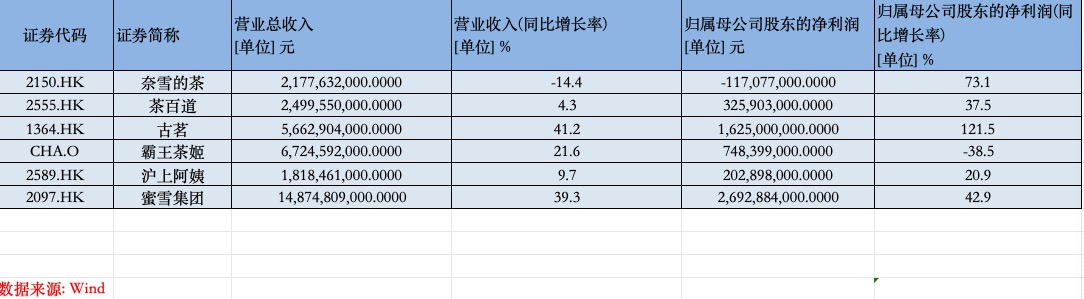
Core Insights - The new tea beverage companies have reported their performance for the first half of the year, with Mixue Group leading in both revenue and net profit, followed by Cha Yujia and Gu Ming in respective rankings [1][2] - Gu Ming achieved the highest net profit growth rate in the industry at 121.51% year-on-year, while Nayuki Tea was the only company to report a loss, although the loss has narrowed compared to the previous year [1][2] Revenue and Profit Summary - Mixue Group: Revenue of 14.87 billion yuan, net profit of 2.69 billion yuan, with a year-on-year revenue growth of 39.3% and net profit growth of 42.9% [2] - Cha Yujia: Revenue of 6.72 billion yuan, net profit of 748.4 million yuan, with a revenue growth of 21.6% but a net profit decline of 38.5% [2] - Gu Ming: Revenue of 5.66 billion yuan, net profit of 1.63 billion yuan, with a revenue growth of 41.2% and net profit growth of 121.5% [2] - Tea Baidao: Revenue of 2.50 billion yuan, net profit of 325.9 million yuan, with a revenue growth of 4.3% and net profit growth of 37.5% [2] - Hu Shang A Yi: Revenue of 1.82 billion yuan, net profit of 202.9 million yuan, with a revenue growth of 9.7% and net profit growth of 20.9% [2] - Nayuki Tea: Revenue of 2.18 billion yuan, with a revenue decline of 14.4% and a net loss of 117.1 million yuan, although the loss has narrowed [2] Market Expansion and Strategy - Mixue Group has opened over 53,000 stores globally, with approximately 57.6% of its stores located in third-tier cities and below, indicating a strong focus on lower-tier markets [3][4] - Gu Ming also emphasizes expansion in lower-tier cities, with 52% of its stores located in third-tier cities and below [3] - The trend of expanding into lower-tier markets is becoming a common strategy among new tea beverage companies, allowing for lower operational costs and higher profit margins [4] Business Model and Operations - The majority of Mixue Group's stores are franchise-based, with 99% of its 52,996 stores being franchise outlets, which contributes significantly to its revenue through the sale of raw materials and equipment [6][7] - Nayuki Tea has a higher proportion of direct-operated stores, with 1,321 out of 1,638 stores being direct-operated, which poses challenges in terms of operational costs in high-rent areas [8] Impact of External Factors - The "takeaway war" in July led to increased subsidies from delivery platforms, benefiting some companies while negatively impacting others like Cha Yujia, which chose not to participate in discount activities [9] - Nayuki Tea reported an increase in revenue from takeaway orders, contributing 48.1% of total revenue, up from 40.6% in the previous year [9] Industry Outlook - The global ready-to-drink beverage market is expected to grow from $598.9 billion in 2018 to $779.1 billion in 2023, with a projected compound annual growth rate of 7.2% from 2023 to 2028 [10] - Despite the growth potential, the saturation of tea beverage stores and declining investment interest may lead to challenges for smaller or independent tea shops [11]

霸王茶姬Q2:海外门店208家,净增52家
Guan Cha Zhe Wang· 2025-08-29 14:41
Financial Performance - The total GMV for Bawang Tea Ji reached 8.103 billion yuan in Q2 2025, representing a year-on-year growth of 15.5% [1] - The net revenue for Q2 was 3.332 billion yuan, an increase of 10.2% year-on-year [1] - Adjusted net profit for Q2 was 630 million yuan, with an adjusted net profit margin of 18.9% [1] - For the first half of the year, the cumulative adjusted net profit was 1.31 billion yuan, up 6.8% year-on-year [1] - Costs improved, with raw material, storage, and logistics costs decreasing by 1.5% year-on-year in Q2 [1] Membership and Customer Base - As of June 30, the registered membership of Bawang Tea Ji exceeded 200 million, reaching 207 million, with a net increase of 14.55 million members quarter-on-quarter, and a year-on-year growth of 42.7% [1] International Expansion - The overseas business has become a significant growth engine, with Q2 GMV reaching 235 million yuan, a year-on-year increase of 77.4% and a quarter-on-quarter growth of 31.8% [1] - As of June 30, Bawang Tea Ji had a total of 7,038 stores globally, including 208 overseas stores located in Malaysia (178), Singapore (16), Indonesia (8), Thailand (5), and the United States (1) [1] Management Changes - Bawang Tea Ji announced a new North American management team, appointing Emily Chang as Chief Business Officer and Aaron Harris as Chief Development Officer [2] - Emily Chang previously served as CEO of VML West, a subsidiary of WPP, while Aaron Harris held a senior development vice president position at Dutch Bros Coffee before joining Bawang Tea Ji [2]
Chagee(CHA) - 2025 Q2 - Earnings Call Transcript
2025-08-29 13:02
Financial Data and Key Metrics Changes - The company's revenue for Q2 2025 reached RMB 3.3 billion, an increase of 10.2% year over year [21] - Gross merchandise volume (GMV) was RMB 8.1 billion, reflecting a year-over-year increase of 15.5% [21] - Non-GAAP net income was RMB 629.8 million, up by 0.1% year over year, while total non-GAAP net income for 2025 rose by 6.8% year over year to RMB 1.3 billion [22][32] - The total membership exceeded 200 million, increasing by 14.5 million from Q1 and 42.7% year over year [22] Business Line Data and Key Metrics Changes - Revenue from franchisee tea houses grew by 6.1% to RMB 3.02 billion, accounting for 90.7% of total revenue [24] - Revenue from company-owned tea houses surged by 77.3% to RMB 311.2 million, representing 9.3% of total revenue [24] - Average monthly GMV per tea house in Greater China was RMB 404,352, showing a year-over-year decline due to a high base from the previous year [25] Market Data and Key Metrics Changes - Overseas markets experienced significant growth, with GMV increasing by 77.4% year over year and 31.8% quarter over quarter [25] - The company opened a net of 52 stores overseas in 2025, bringing the total to 208 stores as of June 30, 2025 [26] - In Singapore, daily sales remained strong, averaging above 1,500 cups per day per store [55] Company Strategy and Development Direction - The company is focused on maintaining a premium brand positioning and avoiding price wars, emphasizing high-quality products and customer experience [40][41] - A new North American leadership team has been established to accelerate market expansion [7][9] - The company plans to invest strategically in overseas markets and enhance its global talent pipeline [9] Management's Comments on Operating Environment and Future Outlook - Management acknowledged intensified competition from delivery platforms in China, which has impacted margins and profitability [23] - The company remains committed to its long-term growth strategy, focusing on quality and brand integrity despite short-term challenges [34] - Management expressed confidence in the overseas operations gaining traction and building a solid operational foundation for future growth [33] Other Important Information - The gross margin improved to 53.9%, up from 48.4% year over year, driven by economies of scale and lower purchasing costs [27] - Operating expenses increased significantly due to share-based compensation related to the IPO and expansion efforts [28][31] Q&A Session Summary Question: Impact of delivery platform subsidy program on operations - Management noted that reliance on subsidies is unsustainable and does not foster brand loyalty, emphasizing a focus on quality and operational efficiency instead [39][40] Question: Update on overseas expansion plans - Management provided details on the successful store openings in various countries, including the first store in Los Angeles, and plans for further expansion in the Philippines and Vietnam [52][60] Question: Same store sales performance and future trends - Management indicated that same store GMV softened due to a high base from last year and intensified competition, but they expect the impact of subsidies to fade over time [64][65]
Chagee(CHA) - 2025 Q2 - Earnings Call Transcript
2025-08-29 13:00
Financial Data and Key Metrics Changes - Revenue for Q2 2025 reached RMB 3.3 billion, an increase of 10.2% year over year [19] - GMV for the quarter was RMB 8.1 billion, reflecting a year over year increase of 15.5% [19] - Non-GAAP net income was RMB 629.8 million, up by 0.1% year over year [20] - Total membership exceeded 200 million, increasing by 14.5 million from Q1 and 42.7% year over year [20] - Gross profit reached RMB 1.8 billion, resulting in a gross margin of 53.9%, up from 48.4% year over year [26] Business Line Data and Key Metrics Changes - Net revenue from franchisee tea houses grew by 6.1% to RMB 3.02 billion, accounting for 90.7% of total revenue [23] - Net revenue from company-owned tea houses increased by 77.3% to RMB 311.2 million, representing 9.3% of total revenue [23] - Average monthly GMV per tea house in Greater China was RMB 404,352, reflecting a year over year decline [24] - GMV in overseas markets increased by 77.4% year over year, driven by strategic store expansion [24] Market Data and Key Metrics Changes - In Singapore, daily sales remained strong, averaging above 1,500 cups per store [56] - In Malaysia, the profitability of stores exceeded internal plans, with 178 stores operating smoothly [57] - The first store in Los Angeles sold 5,000 cups in a single day, maintaining an average of 1,000 cups daily [58] Company Strategy and Development Direction - The company is focused on maintaining a premium brand positioning and avoiding price wars, emphasizing product quality and customer experience [41][42] - A new North American leadership team has been established to accelerate market expansion [6][8] - The company plans to invest strategically in overseas markets and enhance its global talent pipeline [8] Management's Comments on Operating Environment and Future Outlook - Management acknowledged intensified competition from delivery platforms in China, impacting near-term performance [22] - The company remains committed to long-term growth through quality products and operational efficiency [32] - Management expressed confidence in the strategic trajectory despite near-term headwinds [32] Other Important Information - The company plans to launch a comprehensive upgrade plan for essential raw materials in the second half of the year [10] - The introduction of themed concept stores in China aims to blend traditional culture with modern retail design [15] Q&A Session Summary Question: Impact of delivery platform subsidy programs on operations - Management noted that reliance on subsidies is unsustainable and emphasized a focus on high-quality products and customer experience [38][40] Question: Update on overseas expansion plans - Management provided details on the growth of international stores, highlighting strong performance in Singapore and Malaysia, and plans to enter new markets like the Philippines [60][61] Question: Same store sales performance in Q2 - Management indicated that same store GMV softened due to high base comparisons and competitive pressures, but they remain focused on product quality and customer experience [63][64]
Chagee(CHA) - 2025 Q2 - Earnings Call Transcript
2025-08-29 13:00
Financial Data and Key Metrics Changes - The company's revenue for Q2 2025 reached RMB 3,331,900,000, an increase of 10.2% year over year [19] - Gross merchandise volume (GMV) was RMB 8,100,000,000, reflecting a year-over-year increase of 15.5% [19] - Non-GAAP net income was RMB 629,800,000, up by 0.1% year over year, while total non-GAAP net income for 2025 rose by 6.8% year over year to RMB 1,300,000,000 [20][31] - The total membership exceeded 200 million, increasing by 14.5 million from Q1 and 42.7% year over year [20] Business Line Data and Key Metrics Changes - Revenue from franchisee tea houses grew by 6.1% to RMB 3,020,700,000, accounting for 90.7% of total revenue [23] - Revenue from company-owned tea houses surged by 77.3% to RMB 311,200,000, representing 9.3% of total revenue [23] - Average monthly GMV per tea house in Greater China was RMB 404,352, showing a year-over-year decline due to a high base from the previous year [24] Market Data and Key Metrics Changes - Overseas markets experienced significant growth, with GMV increasing by 77.4% year over year and 31.8% quarter over quarter [24] - The company opened a net of 52 stores overseas, bringing the total to 208 stores as of June 30, 2025 [25] - In Singapore, daily sales remained strong, averaging above 1,500 cups per store [57] Company Strategy and Development Direction - The company is focused on maintaining a premium brand positioning and avoiding price wars, emphasizing product quality and customer experience [40][41] - A new North American leadership team has been established to accelerate market expansion [6][8] - The company plans to invest strategically in overseas markets and enhance its global talent pipeline [8] Management's Comments on Operating Environment and Future Outlook - Management acknowledged intensified competition from delivery platforms in China, which has impacted profitability [22] - The company remains committed to its long-term growth strategy, focusing on quality and operational efficiency [32][33] - Management expressed confidence in the overseas operations gaining traction and building a foundation for long-term growth [32] Other Important Information - The gross profit margin improved to 53.9%, up from 48.4% year over year, driven by economies of scale and lower purchasing costs [26] - Operating expenses increased significantly due to share-based compensation related to IPO success [27][30] - The company achieved its tenth consecutive quarter of profitability with a net income of RMB 77,200,000 [31] Q&A Session Summary Question: Impact of delivery platform subsidy program on operations - Management noted that reliance on subsidies is unsustainable and emphasized a focus on high-quality products and services without engaging in price wars [38][40] Question: Update on overseas expansion plans - Management provided details on the expansion, highlighting strong performance in Singapore and Malaysia, and plans to enter new markets like the Philippines and Vietnam [56][60] Question: Same store sales performance in Q2 - Management acknowledged softening same store GMV due to high base comparisons and competitive pressures but remains focused on product quality and customer experience [64][65]
Chagee(CHA) - 2025 Q2 - Earnings Call Presentation
2025-08-29 12:00
Financial Performance - Total net revenues reached RMB3,331.9 million, a 10.2% year-over-year increase[10] - Non-GAAP net income for Q2 2025 was RMB629.8 million, a 0.1% year-over-year increase[10] - Non-GAAP net income for the first half of 2025 (H1) was RMB1,307.1 million, a 6.8% year-over-year increase[10] - The company has no interest-bearing debt as of June 30, 2025[55] - Net cash provided by operating activities was RMB611 million for the three months ended June 30, 2025[53] Teahouse Network Expansion - The total number of teahouses reached 7,038[10] - There were 357 net new teahouse openings[10] - Greater China teahouses totaled 6,830[12] - Overseas locations totaled 208, with expansion in Malaysia (178), Singapore (16), Indonesia (8), Thailand (5), and the United States (1)[12] User Engagement - The number of registered members reached 206.9 million, a 42.7% year-over-year increase[10] - Orders from registered members who purchased more than twice accounted for 73.9% of orders for the three months ended June 30, 2025[33] - Third-party delivery platform GMV mix was 52.0% for the three months ended June 30, 2025[33]
海外GMV同比环比双增长 霸王茶姬二季度海外成绩亮眼
Ge Long Hui· 2025-08-29 11:33
Core Insights - Bawang Chaji (NASDAQ: CHA) reported its Q2 2025 financial results, showing a total GMV of 8.1031 billion yuan, a year-on-year increase of 15.5% [1][6] - The company achieved a net income of 3.3319 billion yuan, up 10.2% year-on-year, with an adjusted net profit of 629.8 million yuan, corresponding to an adjusted net profit margin of 18.9% [1][6] - As of June 30, the total number of registered users on Bawang Chaji's mini-program reached 206.9 million, reflecting a year-on-year growth of 42.7% [7] Global Expansion - Bawang Chaji's overseas GMV reached 235.2 million yuan, marking a significant year-on-year increase of 77.4% and a quarter-on-quarter growth of 31.8% [2][6] - The company has expanded its global store count to 7,038, including 208 overseas locations in countries such as Malaysia, Singapore, Indonesia, Thailand, and the United States [2][6] - Bawang Chaji successfully entered the Indonesian market, opening 8 stores, and has also launched its second store in the U.S. after the first opened in Los Angeles [2][4] Product Innovation and Marketing - The company has introduced localized products and marketing strategies in overseas markets, achieving notable success with products like Hojicha Genmai Milk Tea and the Earl Grey series [3][6] - Bawang Chaji has launched region-specific products in various Chinese provinces, which have been well-received by local consumers [6][9] Talent Acquisition and Management - The company announced a new North American management team, hiring Emily Chang as Chief Business Officer and Aaron Harris as Chief Development Officer, both with extensive experience in the industry [4][6] User Engagement and Retention - Bawang Chaji's membership ecosystem has shown healthy growth, with registered members surpassing 200 million, indicating strong user engagement [7] - The company has maintained a "value-first" strategy, focusing on quality products and services rather than competing on price during the recent "takeout war" [6][7]
CHA(CHA) - 2025 Q2 - Quarterly Results
2025-08-29 11:27
Revenue Growth - Total net revenues increased by 10.2% to RMB3,331.9 million (US$465.1 million) from RMB3,023.3 million in the same quarter of 2024[3] - Total GMV generated in the second quarter of 2025 was RMB8,103.1 million, representing a 15.5% increase from the same quarter of 2024[4] - Net revenues from franchised teahouses were RMB3,020.7 million (US$421.7 million), a 6.1% increase from RMB2,847.8 million in the same quarter of 2024[5] - Company-owned teahouses generated net revenues of RMB311.2 million (US$43.4 million), a 77.3% increase from RMB175.5 million in the same quarter of 2024[5] - Total net revenues for the three months ended June 30, 2025, increased to RMB 3,331,881, representing a growth of 10.4% compared to RMB 3,023,337 in the same period of 2024[33] Income and Profitability - GAAP net income decreased by 87.7% to RMB77.2 million (US$10.8 million) from RMB628.7 million in the same quarter of 2024[7] - Non-GAAP net income was RMB629.8 million (US$87.9 million), representing a 0.1% year-over-year increase[7] - Net income attributable to the Company for the three months ended June 30, 2025, decreased to RMB 62,754, a decline of 89.9% from RMB 591,484 in the same period of 2024[33] - For the three months ended June 30, 2025, the non-GAAP net income was RMB 629,767, a slight increase from RMB 628,964 in the same period of 2024[38] - The net income for the six months ended June 30, 2025, was RMB 1,307,084, compared to RMB 1,224,426 for the same period in 2024, reflecting a growth of approximately 6.8%[38] Expenses and Costs - Total operating expenses increased by 41.5% to RMB3,224.3 million (US$450.1 million) from RMB2,279.4 million in the same quarter of 2024[6] - Share-based compensation expenses for the three months ended June 30, 2025, amounted to RMB 552,529, significantly higher than RMB 243 in the same period of 2024[40] - Total operating costs related to share-based compensation for the six months ended June 30, 2025, were RMB 552,529, compared to RMB 603 in the same period of 2024[40] - Sales and marketing expenses for the three months ended June 30, 2025, were RMB (31,131), up from RMB (10) in the same period of 2024[40] Cash and Assets - Cash and cash equivalents as of June 30, 2025, were RMB8,886.8 million (US$1,240.5 million), compared to RMB4,868.7 million as of December 31, 2024[10] - Cash and cash equivalents, including restricted cash, increased to RMB 8,627,791 as of June 30, 2025, up from RMB 3,654,665 at the end of the previous period[36] - Total current assets rose to RMB 9,523,319 as of June 30, 2025, compared to RMB 5,439,668 as of December 31, 2024, marking an increase of 75.5%[27] - The Company’s total assets increased to RMB 11,067,088 as of June 30, 2025, up from RMB 6,596,106 as of December 31, 2024, reflecting a growth of 67.5%[27] - Total liabilities decreased slightly to RMB 2,871,411 as of June 30, 2025, from RMB 2,907,851 as of December 31, 2024[27] Share Information - The weighted average number of ordinary shares used in computing net income per share, basic and diluted, increased to 168,594,146 for the three months ended June 30, 2025, from 100,622,884 in the same period of 2024[33] - The weighted average number of ordinary shares used in computing basic net income per share for the three months ended June 30, 2025, was 168,594,146, an increase from 100,622,884 in the same period of 2024[39] - The weighted average number of diluted ordinary shares for the six months ended June 30, 2025, was 169,862,430, compared to 102,533,192 in the same period of 2024[39] Future Outlook - The Company anticipates continued growth in the freshly-made tea drinks industry, which may positively impact future revenues and market expansion strategies[23]
注册用户数突破2亿大关 霸王茶姬(CHA.US)发布二季度财报
智通财经网· 2025-08-29 11:22
Core Insights - Bawang Tea Ji (CHA.US) reported its Q2 2025 financial results, showing a total GMV of 8.1031 billion yuan, a year-on-year increase of 15.5% [1][5] - The company achieved a net income of 3.3319 billion yuan, up 10.2% year-on-year, with an adjusted net profit of 629.8 million yuan and an adjusted net profit margin of 18.9% [1][5] - The number of registered users on the Bawang Tea Ji mini-program reached 206.9 million, marking a significant growth of 42.7% year-on-year [1][7] Global Expansion - Bawang Tea Ji's global store count reached 7,038, including 208 overseas stores in markets such as Malaysia, Singapore, Indonesia, Thailand, and the United States [2][3] - The overseas GMV for the quarter was 235.2 million yuan, reflecting a substantial year-on-year increase of 77.4% and a quarter-on-quarter growth of 31.8% [2][3] - The company successfully entered the Indonesian market, opening 8 new stores, and has plans for further expansion in North America [2][4] Product Innovation and Marketing - Bawang Tea Ji launched localized products and marketing strategies in overseas markets, achieving notable success with products like Hojicha Genmai Milk Tea and the Earl Grey series [3][6] - The company introduced new products in its classic category, such as "Yi Qi Hong Chen" and "Xia Meng Mei Long," which received positive market feedback [7] - The company has been actively engaging with consumers through a new membership ecosystem and events, enhancing user loyalty [7][8] Strategic Approach - Bawang Tea Ji adheres to a "value-first" strategy, focusing on quality rather than competing on price during the recent "takeout war" initiated by various internet platforms [5][8] - The company has demonstrated resilience in maintaining stable growth in GMV and net income despite market challenges [5][8] - Cost improvements were noted, with a 1.5% decrease in raw material, storage, and logistics costs year-on-year, contributing to a healthy profit margin [8]

Chagee Announces Second Quarter 2025 Unaudited Financial Results
Globenewswire· 2025-08-29 11:00
Core Viewpoint - Chagee Holdings Limited reported its unaudited financial results for the second quarter of 2025, highlighting a significant increase in revenues but a notable decline in net income due to increased operating expenses and share-based compensation costs. Financial Highlights - Total net revenues increased by 10.2% to RMB3,331.9 million (US$465.1 million) from RMB3,023.3 million in the same quarter of 2024 [4] - Total operating expenses rose by 41.5% to RMB3,224.3 million (US$450.1 million) from RMB2,279.4 million in the same quarter of 2024 [5] - GAAP net income decreased by 87.7% to RMB77.2 million (US$10.8 million) from RMB628.7 million in the same quarter of 2024 [6] - Non-GAAP net income, adjusting for share-based compensation, was RMB629.8 million (US$87.9 million), a slight increase of 0.1% year-over-year [6] - Operating income was RMB107.6 million (US$15.0 million), with an operating margin of 3.2%, down from 24.6% in the same quarter of 2024 [6] Operational Highlights - As of June 30, 2025, the company had 7,038 teahouses, a 40.9% increase from the previous year [6] - Total GMV for the second quarter was RMB8,103.1 million, a 15.5% increase from the same quarter of 2024 [6] - Average monthly GMV per teahouse in Greater China was RMB404,352 [6] - The Mobile Mini Program had 206.9 million registered members, a 42.7% increase year-over-year [6] Revenue Breakdown - Net revenues from franchised teahouses were RMB3,020.7 million (US$421.7 million), a 6.1% increase from RMB2,847.8 million in the same quarter of 2024 [6] - Net revenues from company-owned teahouses were RMB311.2 million (US$43.4 million), a 77.3% increase from RMB175.5 million in the same quarter of 2024 [6] Cost Structure - Cost of materials, storage, and logistics was RMB1,536.8 million (US$214.5 million), a decrease of 1.5% from RMB1,560.8 million in the same quarter of 2024 [6] - Company-owned teahouse operating costs increased by 72.8% to RMB184.1 million (US$25.7 million) due to the expansion of the company-owned network [6] - General and administrative expenses surged by 301.1% to RMB944.6 million (US$131.9 million) [11] Leadership Update - The company appointed Emily Chang as Chief Commercial Officer for North America and Aaron Harris as Chief Development Officer for North America to enhance its expansion capabilities in the region [13][14][15]