Ford Motor(F)

Search documents
Ford to recall nearly 625,000 US vehicles over camera display, seatbelt issues
Reuters· 2025-10-17 07:28
Core Points - Ford is recalling nearly 625,000 vehicles in the U.S. due to issues with seatbelt and rear view camera display [1] Group 1 - The recall affects a significant number of vehicles, indicating potential widespread safety concerns [1] - The U.S. National Highway Traffic Safety Administration is overseeing the recall process, highlighting regulatory involvement [1]

又见“豁免”!报道称美国准备降低进口汽车零部件关税
Hua Er Jie Jian Wen· 2025-10-17 00:22
Core Viewpoint - The U.S. automotive industry is set to benefit from an extension of tariff exemptions on imported auto parts, reflecting a trend of mitigating the negative impacts of tariffs imposed under the Trump administration [1][3]. Group 1: Tariff Exemption Details - The U.S. Department of Commerce plans to announce a five-year extension of the tariff exemption for auto manufacturers, which was originally set to expire after two years [1]. - This policy allows automakers to offset a portion of the 25% tariff on imported auto parts, with a credit equivalent to 3.75% of the value of vehicles manufactured in the U.S. [4]. - The exemption was a result of months of lobbying by major automakers like Ford and General Motors, who are facing increased costs due to tariffs on imported vehicles and materials [4]. Group 2: Broader Implications of Tariff Policies - The extension of the tariff exemption is indicative of a larger trend where the actual impact of U.S. trade policies is less severe than initially claimed, with exemptions playing a crucial role [5]. - A report from Citigroup noted that the effective tariff rate in the U.S. is around 9%-10%, significantly lower than the theoretical rate of approximately 18%, largely due to policy exemptions [5]. - The report also highlighted that between 2019 and 2021, 957 companies submitted over 163,000 tariff exemption applications, with a high approval rate of 61% [5]. Group 3: Economic Impact and Market Reactions - The lower-than-expected impact of tariffs has contributed to a lack of significant inflation related to tariffs, as companies have managed to mitigate costs through various strategies [6]. - Citigroup's analysis suggests that the current trade environment, characterized by "loud thunder but little rain," is favorable for risk assets and provides the Federal Reserve with room to lower interest rates amid a weak labor market [6]. - However, there are concerns that inventory built to avoid tariffs is nearing depletion, which could lead to increased inflation in the coming months [6].


Nissan fuel pumps force second big recall this week
Yahoo Finance· 2025-10-16 22:35
Nissan Recall - Nissan is recalling over 173,000 U.S. vehicles due to a fuel pump issue that could cause stalling and increase crash risk, with an estimated 4.7% of the vehicles affected [1] - The recall includes inspections and repairs at no cost to owners, with notification letters to be mailed starting December 3 [2] - Earlier in the week, Nissan also recalled 19,077 Leaf EVs due to lithium-ion battery issues that could lead to fire risks [2][3] Ford Performance - Ford has reported a record-setting first half of 2025 despite facing significant losses from tariffs and challenges in its electric vehicle division [4] - The company expects to lose $2 billion on tariffs but has leveraged this into promotional opportunities, resulting in over 1.1 million U.S. sales in the first half [5] - Ford sold 540,522 more vehicles in the third quarter, marking an 8.2% year-over-year increase [5] Sales Trends - Ford sold 2.08 million vehicles in the U.S. last year, with a goal to surpass that number this year [6] - The company reported a 30.2% year-over-year increase in electric vehicle sales, driven by the Mustang Mach-E and F-150 Lightning [11] - Ford set a full-year recall record in just the first six months of the year, with 115 recalls as of September 24, surpassing General Motors' previous record [12]

Wounded Warriors Family Support Donates 2025 Ford F-150 Truck to Retired Marines Veteran
Globenewswire· 2025-10-16 18:38
Core Points - A veteran received a 2025 Ford F-150 truck as part of the Wounded Warriors Family Support Mobility is Freedom program, enhancing his mobility and quality of life [1][4] - The donation was made by Wounded Warriors Family Support and Radian Group Inc., highlighting their commitment to supporting combat-wounded veterans [1][5] Group 1: Veteran's Background - Retired Marine Cpl. John Mevey lost his right leg below the knee and suffered extensive injuries during a landmine explosion in Afghanistan in 2008 [2] - He underwent multiple surgeries and rehabilitation at Walter Reed National Military Medical Center, demonstrating resilience despite his hardships [3] Group 2: Program Details - The Mobility is Freedom program was launched in 2015 to provide grants and modified vehicles for combat-wounded veterans, aiming to enhance their independence [4] - The program is designed to improve the quality of life for veterans by providing them with the means to live more productive lives with their families [5] Group 3: Organizational Overview - Wounded Warriors Family Support is an independent nonprofit organization focused on supporting families of combat-wounded individuals, rated a four-star nonprofit by Charity Navigator [5] - The organization is run by combat veterans, emphasizing its commitment to aiding veterans and their families in healing beyond medical treatment [5]

Ford to recall over 59,000 US vehicles over engine block heater issue, NHTSA says
Reuters· 2025-10-16 07:13
Core Points - Ford is recalling 59,006 vehicles in the U.S. due to a potential issue with the engine block heater that may crack and lead to coolant leaks, which can cause short circuits when the heater is plugged in [1] Group 1 - The recall affects a total of 59,006 vehicles [1] - The issue is related to the engine block heater potentially cracking [1] - A coolant leak from the cracked heater can result in short circuits when plugged in [1]
Tesla demand in focus after Trump policies lead GM, Ford to retreat from EV ambitions
CNBC· 2025-10-15 17:05
Core Insights - The electric vehicle (EV) industry is facing significant challenges due to the expiration of federal tax credits, leading to reduced demand and financial write-downs from major automakers [3][10][13] - Tesla, while still the largest EV seller in the U.S., is experiencing a decline in market share and brand value amid increasing competition [4][18] - Analysts predict a revenue growth of 3.5% for Tesla in the third quarter, but a potential revenue drop in the fourth quarter and a full-year decline for 2025 [10][11] Industry Challenges - Ford's CEO anticipates a 50% reduction in demand for fully electric vehicles following the end of the federal tax credit program [2] - Stellantis has abandoned its goal of producing only electric vehicles in Europe by 2030, indicating a broader retreat among legacy automakers from aggressive EV targets [2][3] - The expiration of the $7,500 tax credit has created uncertainty in the market, impacting consumer purchasing behavior [3][12] Tesla's Market Position - Tesla's market share in the all-electric segment has decreased from 49% at the end of last year to 43.1% by the end of September [4] - Despite a recent 7% year-over-year increase in vehicle deliveries for the third quarter, Tesla faces challenges from reduced battery electric vehicle sales and lower margins [11][7] - The company has introduced lower-cost variants of its Model Y and Model 3 to mitigate the impact of the loss of incentives [4][12] Investor Sentiment - Following a 36% decline in the first quarter, Tesla's stock has rebounded, showing a 7% increase for the year, partly due to Elon Musk's $1 billion stock purchase [8] - Investors remain cautiously optimistic about Tesla's future, although the overall EV market appears to be contracting [18] Future Outlook - Analysts suggest that the retreat of legacy automakers could benefit Tesla, potentially allowing its market share to recover [6] - However, significant challenges remain, including a likely dramatic decrease in interest for battery electric vehicles in the fourth quarter due to pre-expiration demand pull-ahead [7] - Tesla's future growth may hinge on its ventures into robotaxis and humanoid robotics, although these markets have yet to be fully developed [16][17]


Ford Q3 Earnings Loom: How Should You Play F Stock Ahead of Results?
ZACKS· 2025-10-15 16:25
Core Insights - Ford is expected to release its third-quarter 2025 results on October 23, with an EPS estimate of 38 cents and automotive revenues of $42.26 billion [1][6] - The EPS estimate reflects a 22.5% decline compared to the same quarter in 2024, while revenue is projected to decline by 2% year-over-year [2] Earnings Estimates - The EPS estimate has increased by one cent over the past 60 days, with a current consensus of $1.17 for full-year EPS, indicating a 36.4% year-over-year contraction [2][3] - For 2025, automotive revenues are estimated at $168.2 billion, suggesting a 2.5% decline year-over-year [3] Sales Performance - Ford sold 545,522 vehicles in the U.S. during Q3 2025, marking an 8.2% increase year-over-year, driven by strong demand for the Mustang Mach-E and F-150 Lightning [6][8] - The Mustang Mach-E achieved record sales of 20,177 units, up 50.7% year-over-year, while the F-150 Lightning sold 10,005 units, up 39.7% year-over-year [8] Revenue Breakdown - Revenue estimates for key segments include $23.5 billion from the Ford Blue unit (down 10% year-over-year), $2.67 billion from the Ford Model E unit (up from $1.17 billion in Q3 2024), and $17.7 billion from the Ford Pro unit (up 13% year-over-year) [10] - Ford Pro Intelligence software subscriptions increased by about 30% year-over-year, reaching 815,000 active subscribers [10] Challenges and Costs - High recall costs and tariffs are expected to pressure Ford's margins, with over 100 recalls issued this year, the most by any automaker [11] - Tariff costs are projected to reach $3 billion in 2025, with $800 million incurred in Q2 alone [17] Market Position and Valuation - Year-to-date, Ford's shares have risen over 17%, outperforming competitors like Tesla and General Motors [12] - Ford is trading at a forward sales multiple of 0.29, significantly below the industry average of 3.33, indicating a relatively cheaper valuation [15] Strategic Outlook - Ford's hybrid strategy is gaining traction, particularly in the Ford Pro segment, with robust demand for Super Duty trucks [16] - The company has ample liquidity of approximately $46 billion, including $28 billion in cash, and an attractive dividend yield of around 5% [16]
Here's How Texas Residents Can Still Avail $2,500 On EVs Despite Trump Ending Federal EV Credit - Tesla (NASDAQ:TSLA)
Benzinga· 2025-10-15 08:33
Core Points - Texas customers can still receive incentives worth $2,500 on electric vehicles (EVs) despite the termination of the Federal EV Credit by President Donald Trump on September 30 [1] Group 1: Incentives and Eligibility - Customers who purchased or leased vehicles on or after September 1 in Texas can apply for the incentive, provided they acquired the title during the same period [2] - Eligible vehicles include those with a gross vehicle weight rating of 10,000 pounds or less, including cars and small to medium-sized trucks, as well as vehicles operating on compressed natural gas (CNG), liquefied petroleum gas (LPG), hydrogen fuel cells, or electric drive [3] - Individuals, corporations, government agencies, and other legal entities can avail themselves of the benefits, with Texas offering up to $5,000 for CNG and LPG vehicles [3] Group 2: Eligible Vehicle Models - The list of eligible vehicles includes all Tesla models (S, X, Y, 3, and Cybertruck) and various models from General Motors and Ford, such as the F-150 Lightning, Mustang Mach-E, Chevrolet Blazer EV, and Cadillac Lyriq [4] - Rivian's R1S and R1T are also eligible, along with Stellantis models like the Dodge Charger and Jeep Grand Cherokee [5] Group 3: Automaker Responses - In response to the end of the EV credit, multiple automakers have offered extensions on EV incentives, although Ford and GM have scaled back their incentives [6] - Automakers reportedly made down payments for units to dealers through their financial arms to qualify for the EV credit [6]



已组建专职团队应对产能风险,福特铝供应商火灾已严重影响生产
Guan Cha Zhe Wang· 2025-10-15 07:25
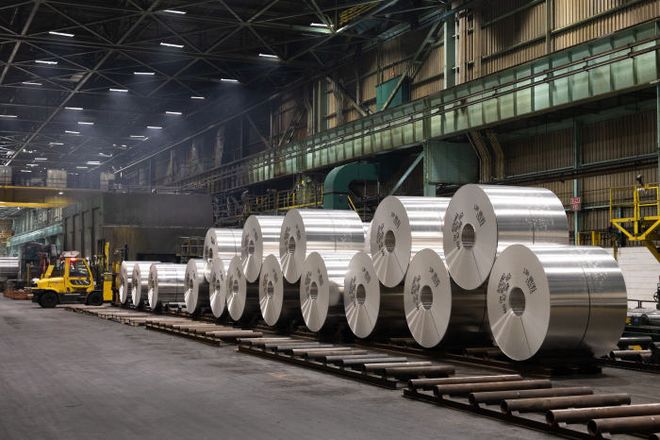
Core Viewpoint - Ford is temporarily reducing production of at least five vehicle models due to aluminum supply issues following a significant fire at Novelis, a key aluminum supplier [1][3]. Group 1: Impact on Production - Ford has suspended production of its profitable full-size SUVs, the Expedition and Navigator, starting this week due to aluminum supply difficulties [1]. - A memo sent to employees indicates that the suspension of SUV production will last for one week [1]. - The fire at Novelis's plant is expected to impact aluminum supply significantly, as it supplies approximately 40% of the aluminum sheets used in the U.S. automotive industry [3]. Group 2: Financial Implications - If F-Series truck sales decline by 20% in the fourth quarter, Ford's operating income could decrease by $800 million (approximately 5.7 billion RMB) [5]. - Analysts warn that if production of the F-Series trucks is halted, Ford could face up to $1 billion (approximately 7.12 billion RMB) in operating profit losses [5]. Group 3: Supply Chain Adjustments - Ford is actively working with Novelis to mitigate the impact of the fire and is exploring all feasible alternative solutions [1]. - The company has halted operations at another assembly plant in Kentucky and one in Michigan to ensure aluminum supply for other models [7]. - Novelis is assessing whether aluminum produced at its overseas plants and those of competitors can meet Ford's standards [7].
The Ford F-150 Lightning Is Now Cheaper By $4,000, Offers More Range Despite EV Incentive Rollback - Ford Motor (NYSE:F)
Benzinga· 2025-10-15 05:33
Price Adjustments - Ford has reduced the price of the F-150 Lightning electric pickup truck, with the Flash trim now priced at $65,995 after a $4,000 cut, and the Lariat variant priced at $74,995 after a $2,000 reduction [2]. Product Changes - The company has discontinued the XLT base trim and replaced it with the STX trim, which offers a longer range of 290 miles compared to the 240 miles of the outgoing XLT trim. Both the Flash and Lariat trims provide an EPA-certified range of 320 miles on a single charge [3]. EV Incentives and Market Context - Ford has scaled back on EV incentives following the end of the Federal EV Credit on September 30, which was also mirrored by General Motors. Stellantis continues to offer cash discounts on EVs [4][5]. Supply Chain Challenges - A significant fire at one of Ford's key aluminum suppliers in New York could disrupt the manufacturing process of the F-150 pickup truck for months, prompting the company to explore alternative supply chains [6]. Employee Policies - Ford has implemented a return-to-office mandate requiring employees to be in the office four times a week, with reports of automated emails sent to employees regarding compliance, even if they are already adhering to the policy [7]. Company Performance Metrics - Ford is noted to have satisfactory momentum, growth, and quality, while also scoring well on the value metric. The company shows a favorable price trend in the medium and long term [8].