First Bank(FRBA)

Search documents
India Inc turns to non-bank routes for nearly half of FY25 funding
The Economic Times· 2025-09-17 00:05
Core Insights - The total flow of financial resources to the corporate sector increased to ₹35 lakh crore in FY25, reflecting a 3% rise from the previous year, but indicating a shift away from traditional bank credit, which suggests a broader economic slowdown [1][10] Funding Composition - Nearly 49% of the total resources raised, amounting to ₹17.1 lakh crore, came from non-bank channels, including corporate bonds, NBFC loans, equity issuances, and foreign direct investment [2][10] - Demand for bank credit declined by 14% to ₹17.9 lakh crore, highlighting a significant shift in funding sources [10] Equity Market Performance - Non-financial corporates raised ₹3.8 lakh crore through equity in FY25, marking a substantial increase of 188% compared to the previous year, driven by strong equity market performance [2][10] Lending Trends - The slowdown in bank credit may be attributed to cautious lending practices towards NBFCs and unsecured retail segments, as well as a high base effect from FY24 when bank credit surged by 20% [6][10] - NBFCs and financial institutions increased their lending to corporates, disbursing ₹6.1 lakh crore, which is a 20% rise [6][10] - Borrowings through corporate bonds and commercial papers by non-bank entities rose by 15% to ₹2.1 lakh crore [6][10] Internal Funding Sources - The increased use of internal accruals for business expansion has contributed to the decline in bank credit, as profitability among large corporates has improved [8][10] Policy Response - To stimulate credit demand, the Reserve Bank of India (RBI) has reduced policy rates by 100 basis points since February, following a two-year pause, and ensured ample liquidity in the banking system [9][10]



Nigerian banks eye finishing line on recapitalisation
African Business· 2025-09-16 09:23
Core Points - Nigerian banks face a deadline of March 26, 2026, to meet new capital requirements set by the Central Bank of Nigeria (CBN) [1] - The new minimum capital requirements are 500 billion naira for banks with local and international operations, 200 billion naira for national-only banks, 50 billion naira for regional and merchant banks, and 20 billion naira for non-interest banks operating nationally [2] - This is the first capital increase requirement in two decades, with the last being in 2004 when the maximum capital was set at 25 billion naira [3] - The need for increased capital is driven by currency devaluation and inflation, exacerbated by President Bola Tinubu's economic reforms [4] - As of now, only eight out of 26 banks have fully met the new capital requirements, with others potentially facing mergers or exits if they fail to comply [5] Capital Raising Efforts - The CBN has mandated new capital injections, disallowing the use of shareholders' funds or additional tier-1 capital as substitutes [6] - Banks have responded with new share offers, rights issues, and private placements to raise the necessary funds [6] - Access Bank and Zenith Bank have successfully raised capital, with Access Bank concluding a rights issue to reach 595 billion naira and Zenith raising its capital to 615 billion naira through a combined rights issue and share offer [8] - Guaranty Trust Bank raised 351 billion naira through a rights issue and an additional $105 million from the London Stock Exchange [8] Progress of Other Banks - United Bank for Africa (UBA) plans to complete its capital-raising by the end of Q3 2024, having raised 251 billion naira from a rights issue [10] - First Bank's recapitalization has been delayed due to boardroom conflicts, but resolution of these issues may facilitate its capital-raising efforts [11][12] - Smaller banks like Fidelity Bank and FCMB are also in the process of raising capital, with Fidelity raising 176 billion naira and planning an additional 195 billion naira [13] - Wema Bank has surpassed the required threshold with a capital base expected to reach 276 billion naira after recapitalization [14] Mergers and Foreign Banks - Union Bank and Titan Trust Bank have successfully merged to meet capital requirements, while Unity Bank and Providus Bank have announced plans to merge [15] - Foreign banks like Standard Chartered and Citibank currently have capital below the required levels and must raise significant funds or consider mergers or exits [16]

GST reforms set to reignite consumption growth, spur corporate profitability
The Economic Times· 2025-09-15 01:00
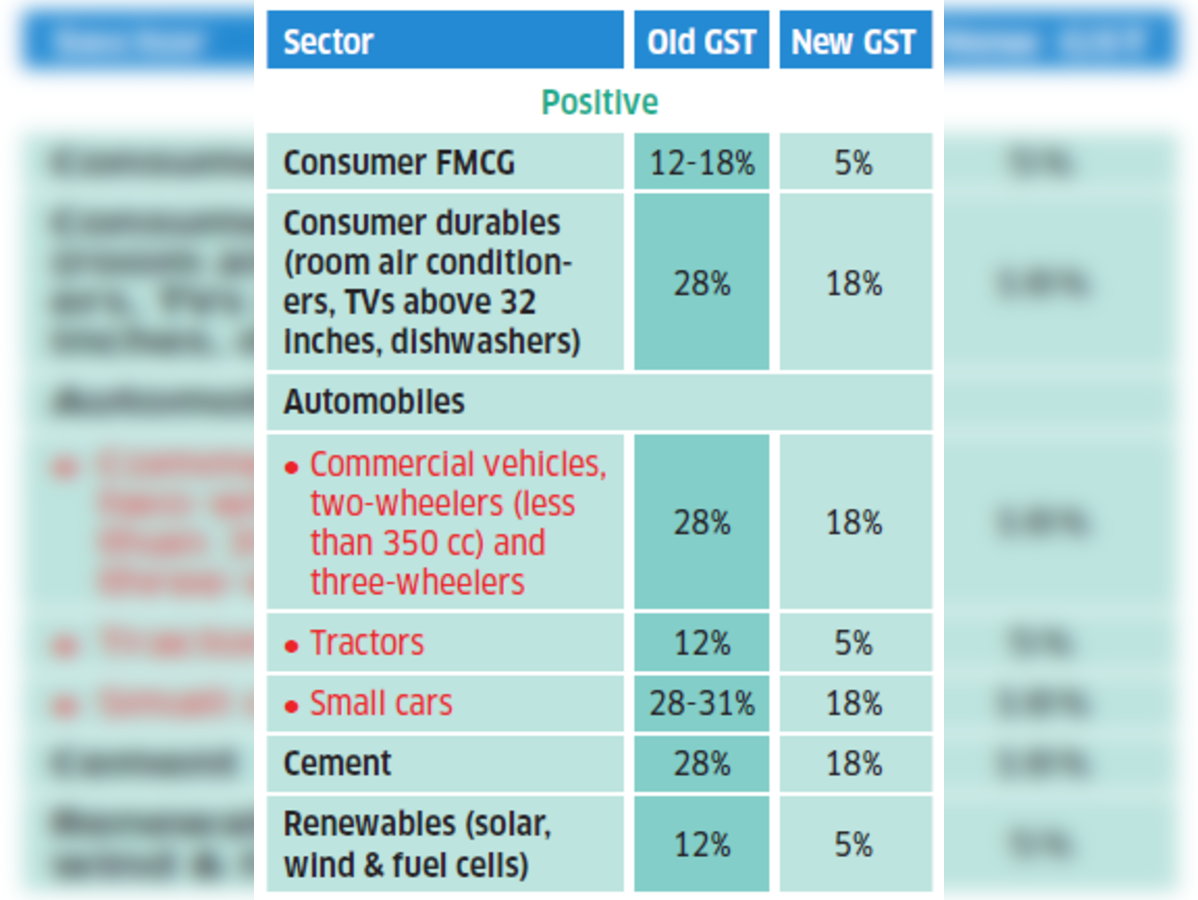
Consumption Sector - The recent GST reforms are expected to boost affordability and consumption across rural and urban markets, with around 90% of items moved from higher to lower tax slabs [1][38] - Experts anticipate a premiumisation effect among low- and middle-income households, as savings on essential goods will redirect purchasing power towards high-value consumption [2][38] - The consumption sector is projected to recover over the next 12-15 months, with private consumption growth expected to rise by 40-50 basis points in the second half of the current financial year [4][41] Corporate Profitability - Lower prices from GST reforms will create volume acceleration for producers, supporting profit margins and leading to an anticipated overall profitability increase of 1-1.5% relative to 2024-25 earnings [5][41] - The reforms are expected to stimulate demand for first-time buyers and replacement purchases, particularly during the festive season, with an industry expectation of a 10-15% improvement in demand for room air conditioners [22][41] Sector-Specific Impacts - Key beneficiaries in the consumer FMCG sector include Britannia Industries, Colgate Palmolive (India), Nestle India, and Emami due to reduced GST on essentials from 12-18% to 5% [11][15][41] - In the consumer durables sector, companies like LG, Daikin, Blue Star, and Dixon Technologies will benefit from reduced GST on room air conditioners and dishwashers from 28% to 18% [18][41] - The automobile sector, including Maruti Suzuki, TVS Motor, Hero MotoCorp, and Bajaj Auto, will see positive impacts from reduced GST rates on commercial vehicles and small cars [23][41] Infrastructure and Housing - The cement industry is expected to benefit from a reduction in GST from 28% to 9%, potentially lowering cement prices by Rs.25-30 per bag, which will support infrastructure and housing sectors [24][41] - Cost-efficient firms like Prism Johnson and Heidelberg Cement are positioned to enhance net realizations and margins over the medium to long term due to these reforms [25][41] Renewable Energy - The renewable energy sector will benefit from a reduction in GST on equipment from 12% to 5%, with key beneficiaries including Tata Power, JSW Energy, and Vikram Solar [26][41] - This reduction is expected to lower capital costs for solar and wind power projects, improving the internal rate of return and supporting government initiatives around renewable energy transition [31][41] Banking and Financial Services - Banks such as HDFC Bank, ICICI Bank, and IDFC First Bank are expected to benefit from increased demand for credit due to a pick-up in consumption and economic activities [32][41] - Non-Banking Financial Companies (NBFCs) focused on retail loans will also benefit from rising demand for consumer durables and vehicles [32][41] Insurance and Textiles - The insurance sector will face mixed impacts, with a reduction in GST on life and health insurance to nil, improving affordability but potentially diluting margins due to loss of input tax credit [33][41] - The textile industry will see a reduction in GST on fabrics and home textiles from 12% to 5%, benefiting companies like Sanathan Textiles and Grasim Industries [30][36][41] Oil and Gas - The oil exploration sector will be adversely impacted by an increase in GST from 12% to 18%, affecting companies like ONGC and Oil India [37][41] - The increase in costs for exploration and production is expected to dent cash flows significantly, with estimates of Rs.2,500-3,000 crore in losses for ONGC [40][41]
Inflation's ways give room for a rate cut, but RBI may not do it
The Economic Times· 2025-09-14 19:20
Group 1 - The Reserve Bank of India (RBI) has room to cut rates by 25-50 basis points due to a comfortable inflation trajectory, but is not expected to do so in the current cycle given strong Q1 GDP numbers and recent consumption boosts from GST cuts [1][6] - CPI-based inflation rose to 2.07% in August from July's eight-year-low of 1.61%, entering the RBI's medium-term target of 2-6% [1][6] - Economists expect inflation to ease further due to GST rate cuts effective from September 22, with CPI for FY26 likely lower than the RBI's estimate of 3.1% [6] Group 2 - Retail inflation for September is currently tracking at approximately 1.75%, with October potentially going below 1% due to GST cuts and base effects [6] - Growth momentum is expected to slow in H2 FY26 as support from transient factors wanes and the impact of tariffs becomes more visible [6] - There are downside risks to inflation that may leave scope for another repo rate cut in the October-December period, although this was priced out by the market after a strong GDP print [6]
Berkshire Bank accused of aiding small-town Ponzi scheme
American Banker· 2025-09-12 20:29
Core Viewpoint - Berkshire Bank is facing a class action lawsuit for allegedly aiding a Ponzi scheme that defrauded investors of tens of millions of dollars, despite having knowledge of the fraudulent activities [1][10]. Group 1: Allegations and Lawsuit Details - The lawsuit claims that Berkshire Bank had specific reports indicating suspicious activities related to a customer running a Ponzi scheme, yet failed to act due to the profitability of the customer relationship [2][8]. - The complaint, filed in federal court, includes detailed allegations about the bank's handling of suspicious customer activities, with evidence obtained through a subpoena [3]. - The Ponzi scheme, orchestrated by Miles Burton Marshall, solicited approximately $90 million from around 1,000 investors, promising an 8% return [5][10]. Group 2: Customer Background and Bank's Actions - Marshall had been a customer of Berkshire since 2015 and was previously with NBT Bancorp, which had warned Berkshire about Marshall's suspicious activities [6][8]. - Berkshire Bank allegedly provided Marshall with a scanner to facilitate remote deposits of up to $300,000 per day, despite concerns about his activities [7]. - Although Berkshire Bank identified Marshall as a high-risk customer and conducted ongoing monitoring, it did not take action based on the information it had [8]. Group 3: Legal Context and Implications - The case represents a significant test of legal standards regarding banks' responsibilities when their customers commit fraud [10]. - Previous legal outcomes indicate that banks can be held accountable for their responses to customer due diligence findings, as seen in past cases involving other banks [12][13].

Will regulators lift $100B threshold? Industry's hopes rise.
American Banker· 2025-09-12 10:00
Key Insight: Bankers are hopeful that regulators will increase the asset size for Category IV banks, a key regulatory threshold that's currently set at $100 billion.What's at Stake: Raising the threshold could lower costs and reduce regulatory burdens for banks, including those that are approaching the $100 billion threshold.Forward Look: Bankers will be watching for action from regulators.Bankers, analysts and investors are increasingly optimistic that a key asset threshold used in the oversight of regiona ...
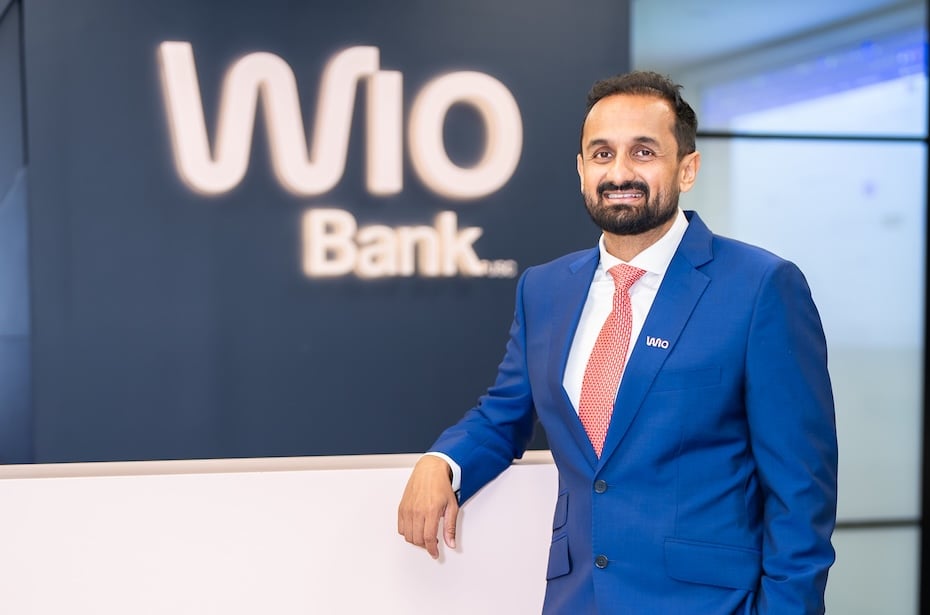
CEO Jayesh Patel on Wio Bank’s rise in UAE’s digital banking space
Gulf Business· 2025-09-12 07:08
Core Insights - Wio Bank has successfully integrated partnerships to enhance its offerings, including real-time accounting integration and travel rewards, making banking more accessible for customers [1] - The bank achieved profitability in 2024 and expanded its balance sheet to Dhs37 billion within two years, establishing itself as a leading player in the SME segment with over 105,000 clients [2] Customer Experience - Wio Bank's customer base is diverse, ranging from first-time account holders to experienced professionals, driven by the desire for wealth growth and easy money management [3][4] - Over 40% of customers are now investing through Wio, valuing simplicity and transparency in their banking experience [5] Strategic Focus - The bank emphasizes simplicity in its offerings, addressing practical problems like household expense management to enhance customer engagement [6][7] - Wio Bank operates with a client-first mindset, prioritizing ongoing client satisfaction and leveraging word-of-mouth referrals for new client acquisition [8] Technological Innovation - Wio Bank adopts an opex-centric model, allowing for agility and quick adaptation in a SaaS-driven economy, which is a significant advantage over traditional banks [9] - AI is a key focus, enhancing customer understanding of their finances and streamlining backend processes for improved efficiency [10][11] Future Outlook - The bank envisions a future where AI customizes banking experiences for individual needs, providing personalized insights and guidance [12][13] - Wio Bank's long-term strategy aligns with shareholder expectations, focusing on client profitability and satisfaction as a pathway to mutual success [14][15] Challenges and Opportunities - Wio Bank is addressing the need for better credit structuring to meet specific customer needs, moving beyond just access to credit [16] - The bank is developing investment products that cater to personal goals, such as saving for education, to enhance their relevance in customers' lives [17] - Service improvement is a priority, aiming for quicker and more meaningful customer interactions through various communication channels [18] Security Measures - Continuous focus on fraud prevention and security is paramount, with measures like in-app approval for transactions already yielding positive results [19] Industry Context - Wio Bank is positioning itself to serve entrepreneurs with tailored solutions, recognizing the dynamic nature of banking and the need to stay ahead of customer demands [20] - The UAE's growing technology landscape and initiatives like open finance and instant payment platforms are seen as significant opportunities for innovation [24][25]
Harnessing Discipline in an Age of Distraction
The European Business Review· 2025-09-11 05:22
Core Insights - Vazgen Gevorkyan emphasizes that success is defined by discipline and consistent effort rather than visibility or speed [1][11] - His approach to leadership and mentorship is rooted in structured foresight and a commitment to long-term goals [8][9] Group 1: Career and Achievements - Gevorkyan transformed a legacy financial institution into Evocabank, Armenia's first digital-first bank, through years of research and system-building [3] - His hospitality venture, LES Art Resort, was developed over more than a decade, reflecting a belief in crafting meaningful destinations with care [4] Group 2: Leadership Philosophy - Gevorkyan's philosophy includes five truths for emerging leaders, emphasizing that the work itself must be the reward [5] - He advocates for lifelong learning driven by curiosity rather than prestige, highlighting that credentials can open doors but curiosity keeps them open [6] - He warns against viewing success as permanent and encourages continuous reflection on future goals [6] - Gevorkyan advises leaders to actively seek inspiration and take action before feeling ready [7] - He stresses the importance of personal ownership in one's career, asserting that discipline provides endurance through challenges [7][8] Group 3: Influence and Mentorship - Colleagues describe Gevorkyan's leadership style as understated yet uncompromising, focusing on team effort and high standards [9] - His influence is increasingly directed towards mentoring young entrepreneurs, helping them navigate a distraction-heavy environment [9][11]

Nifty Bank prediction today – September 10, 2025: Nifty Bank futures: Price action appears bullish
BusinessLine· 2025-09-10 05:06
Core Viewpoint - The Nifty Bank index shows a bullish trend with a gap-up opening and positive performance from public sector banks compared to private banks [1][2]. Group 1: Nifty Bank Index Performance - The Nifty Bank index opened at 54,555, up 0.6% from the previous close of 54,216, and is currently hovering around 54,520 [1]. - The advance/decline ratio is 10/2, indicating a strong bullish sentiment in the market [1]. - Canara Bank and Punjab National Bank are the top gainers, with increases of 1.8% and nearly 1.7%, respectively [1]. Group 2: Nifty PSU and Private Bank Performance - The Nifty PSU Bank index has risen nearly 1.7%, while the Nifty Private Bank index has gained 0.7%, showing that public sector banks are outperforming private banks [2]. Group 3: Nifty Bank Futures - The September futures of the Nifty Bank index opened higher at 54,730, up 0.6% from the previous close of 54,468, and is currently trading at 54,760 [3]. - The price action indicates a bullish tilt, with resistance levels at 55,000 and 55,350 [4]. Group 4: Trade Strategy - A buy recommendation for Nifty Bank futures at 54,760 with a stop-loss at 54,500 is suggested, with profit booking at 55,350 [5]. - Supports are identified at 54,650 and 54,500, while resistances are at 55,000 and 55,350 [5].

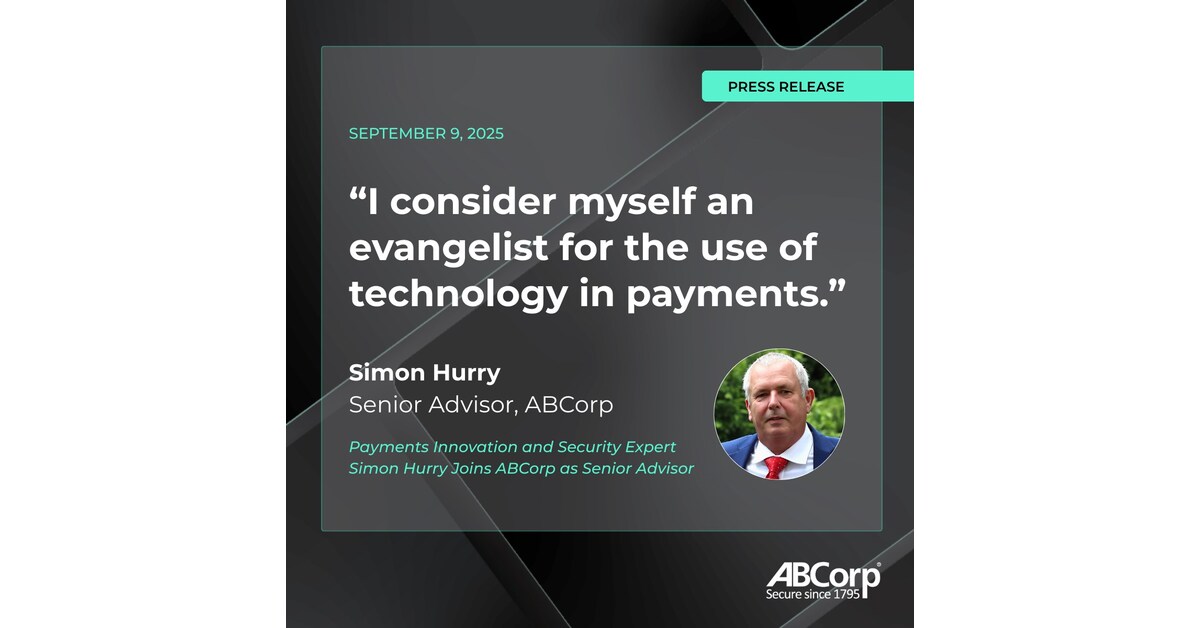
Payments Innovation and Security Expert Simon Hurry Joins ABCorp as Senior Advisor
PRWEB· 2025-09-09 18:35
Company Overview - ABCorp has a rich history dating back to 1795, originally serving as secure printers for the First Bank of the United States [2] - The company specializes in manufacturing, personalizing, and fulfilling contactless credit and debit payment cards, as well as offering instant issuance programs for payment and ID cards [2] - ABCorp provides digital solutions for authentication, payment, and customer engagement, and also engages in 3D printing of detailed prototypes and parts in metal and plastics [2] - The company utilizes omnichannel content to enhance and streamline the customer experience, positioning itself to navigate the complexities of modern commerce [2] Leadership and Vision - Simon Hurry has been appointed as Senior Advisor, emphasizing the importance of technology in payments and the need for innovation within the payment ecosystem [1] - Hurry aims to simplify complex ideas into actionable insights to better engage with ABCorp's community and address their challenges [1] - Bill Brown, CEO of ABCorp, recognizes Hurry as a valuable resource for clients and partners, highlighting his extensive experience in navigating complex ecosystems beyond payments, including identity and authentication [1]