GM(GM)

Search documents
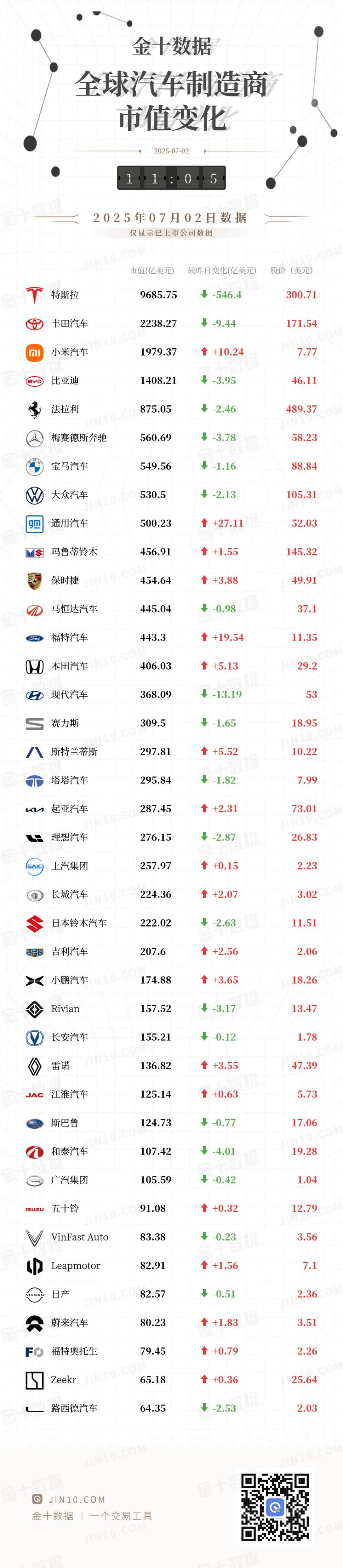
金十图示:2025年07月08日(周二)全球汽车制造商市值变化
news flash· 2025-07-08 03:09
Group 1: Automotive Industry Overview - The automotive industry is experiencing varied performance among major players, with Volkswagen leading at 541.3 billion, followed by General Motors at 508.5 billion and Ford at 469.63 billion [2] - Notable declines are observed in companies like Honda, which saw a decrease of 16.38%, and Stellantis with a decline of 15.53% [2] - Emerging companies such as Li Auto and Xpeng are showing growth, with Li Auto increasing by 8.17% to 275.2 billion and Xpeng decreasing by 8.81% to 167.66 billion [2] Group 2: Company Performance Metrics - Volkswagen's revenue stands at 541.3 billion, reflecting a slight increase of 0.59% [2] - General Motors reported a revenue of 508.5 billion, with a significant decline of 10.48% [2] - Ford's revenue is at 469.63 billion, showing a decrease of 8.9% [2] - Other notable companies include Porsche at 453.57 billion (-3.2%), and Mahindra at 442.32 billion (-0.31%) [2] Group 3: Emerging and Regional Players - Companies like SAIC Motor and Geely are performing steadily, with SAIC at 281.27 billion (+1.46%) and Geely at 211.2 billion (+1.28%) [2] - New entrants such as Leapmotor and VinFast Auto are also in the mix, with Leapmotor at 88.93 billion and VinFast at 85.13 billion, the latter experiencing a decline of 3.15% [3] - NIO and Zeekr are also noteworthy, with NIO at 76.12 billion (-2.23%) and Zeekr at 66.01 billion (+0.03%) [3]





【环球财经】美国关税政策使加拿大“汽车城”遭受前所未有冲击
Xin Hua She· 2025-07-07 08:13
Core Viewpoint - The automotive industry in Oshawa, Ontario, is facing unprecedented challenges due to the impact of U.S. tariff policies, leading to significant job losses and economic decline in the region [1][2]. Group 1: Industry Impact - General Motors Canada will reduce its current three-shift system to two shifts starting in November, resulting in approximately 750 workers losing their jobs [2]. - The local manufacturing union leader indicated that the unstable U.S. tariff policies have diminished General Motors' confidence in continuing investments in Oshawa, affecting not only the direct employees but also around 1,500 workers from eight supply companies [2]. - The unemployment rate in Oshawa reached 9.1% in May, significantly higher than the previous year's 5.3%, highlighting the economic strain on the region [2]. Group 2: Economic Data - Since the U.S. imposed tariffs on Canadian manufactured automobiles and parts in April, Canadian exports to the U.S. have decreased by 15.7%, contributing to a 0.1% contraction in Canada's economy in April [2]. - A report from the Ontario Financial Accountability Office predicts that by 2026, the province will lose 16,300 jobs in the auto parts manufacturing sector and 3,400 jobs in the automotive manufacturing sector [2]. Group 3: Company Strategy - General Motors' production in Canada accounts for only 10% of the company's total output, and despite 95% of Canadian production being exported to the U.S., it does not pose a significant competitive threat to the company [3]. - The trade war is prompting Canadian provinces to collaborate more closely, with General Motors Canada expected to reduce its reliance on U.S. parts and increase sourcing from other countries [3]. - The North American automotive industry is becoming less concentrated in specific regions, with a trend towards international production to maximize efficiency and cost-effectiveness [3].
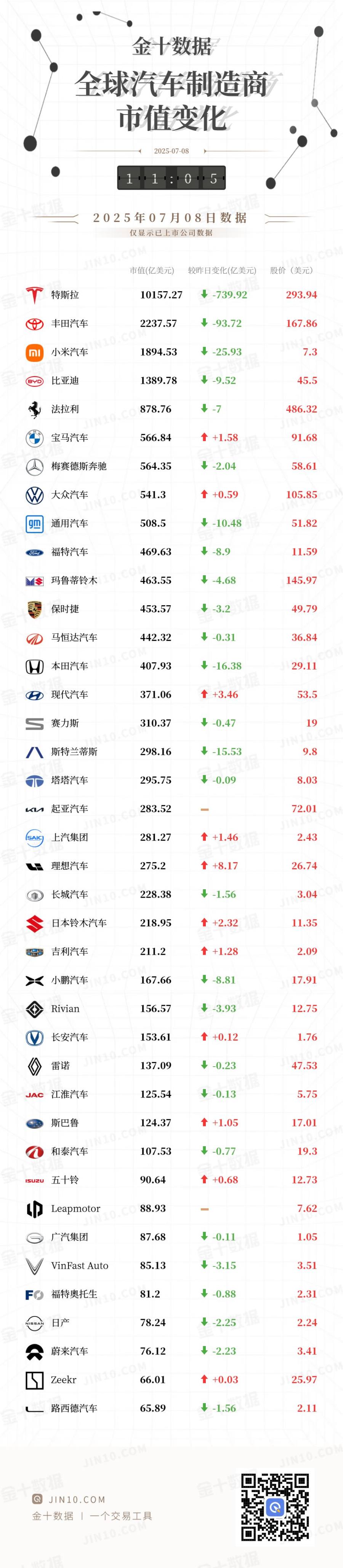
金十图示:2025年07月07日(周一)全球汽车制造商市值变化
news flash· 2025-07-07 03:07
Group 1 - The automotive industry shows varied performance among major companies, with Volkswagen leading at 542.04 million, followed closely by General Motors at 508.5 million, and Ford at 469.63 million [2] - Honda experienced a significant increase of 8.18% in its performance, reaching 412.9 million, while Tata Motors saw a decline of 1.04%, totaling 296.42 million [2] - New entrants like Li Auto and Xpeng are also making their mark, with Li Auto at 267.78 million and Xpeng at 167.66 million, both showing positive growth [2] Group 2 - The data indicates that traditional automakers like Nissan and Subaru are facing challenges, with Nissan reporting a decrease of 3.72% to 81.9 million and Subaru down by 2.81% to 124.17 million [3] - Emerging companies such as VinFast Auto and Leapmotor are also in the mix, with VinFast at 85.13 million, down by 2.57%, while Leapmotor shows a slight increase to 84.92 million [3] - The overall market dynamics suggest a competitive landscape where established brands must adapt to the rising presence of new players [3]





GM Beats Tesla in EV Growth, Reports 7% Jump in Overall Q2 Deliveries
ZACKS· 2025-07-04 15:20
Sales Performance - General Motors Company (GM) experienced a 7.3% year-on-year sales growth in Q2, with total deliveries reaching 746,588 vehicles, following a 16.7% increase in Q1, resulting in a 12% rise in the first half of 2025, marking GM's best first-half performance since 2019 [1][7] - In contrast, Tesla, Inc. (TSLA) reported a decline in deliveries, with 384,122 vehicles delivered in Q2, representing a 14% decrease from the previous year, marking the second consecutive quarter of double-digit declines [1] Electric Vehicle (EV) Market - GM has launched 11 EV models over the past two years, with Chevrolet achieving a remarkable 134% growth in H1 sales, driven by the Equinox EV, which is now among the top three best-selling EVs [2] - Cadillac emerged as the leader in the luxury EV market share in Q2, contributing to GM's overall EV market share of 16%, closely aligning with its total market share of 17% in the same quarter [2] Strategic Investments - The increase in sales is attributed to GM's investments in crossovers, SUVs, and pickups, both gas and electric, which allowed the company to surpass the estimated 4% total auto industry growth [3] - To further enhance production capabilities and mitigate the effects of tariffs and government policies, GM plans to invest approximately $4 billion in U.S. production [3][7]

美国“反电复油”?传统车企通用、福特股价“踩油门”
第一财经· 2025-07-04 09:56
Core Viewpoint - The "Big and Beautiful" bill has been passed by the U.S. House of Representatives, which will terminate electric vehicle tax credits, potentially impacting the growth of the U.S. electric vehicle manufacturing industry, particularly affecting Tesla [1][2]. Group 1: Legislative Impact - The "Big and Beautiful" bill will end the $7,500 tax credit for new electric vehicles and the $4,000 credit for used electric vehicles by September 30 this year [1]. - Analysts predict that the cancellation of these tax credits could lead to a $1.2 billion profit loss risk for Tesla [1]. Group 2: Market Performance - Tesla's global delivery volume for Q2 this year was 384,100 units, a year-on-year decline of approximately 13.5%, marking two consecutive quarters of declining deliveries [2]. - Tesla's market share in the U.S. electric vehicle market is projected to drop from 55% in 2023 to about 49% in 2024, further decreasing to 44% in Q1 of this year [2]. Group 3: Competitive Landscape - Following the bill's passage, stock prices for General Motors and Ford have risen by 7.5% and 8.8%, respectively, indicating a potential shift in investor sentiment towards traditional automakers [3]. - The bill is seen as confirming a trend of slowing electric vehicle adoption in the U.S., contrasting with previous stringent emissions regulations aimed at promoting electric vehicles [3]. Group 4: Future Projections - By 2032, automakers may need to increase electric vehicle sales to 56% of total sales, with plug-in hybrids at 13% and traditional fuel vehicles at only 29% [4]. - Despite the slower-than-expected growth of electric vehicles, sales of new energy vehicles (including hybrids) are projected to account for 20% of total new car sales in the U.S. by 2024 [4].

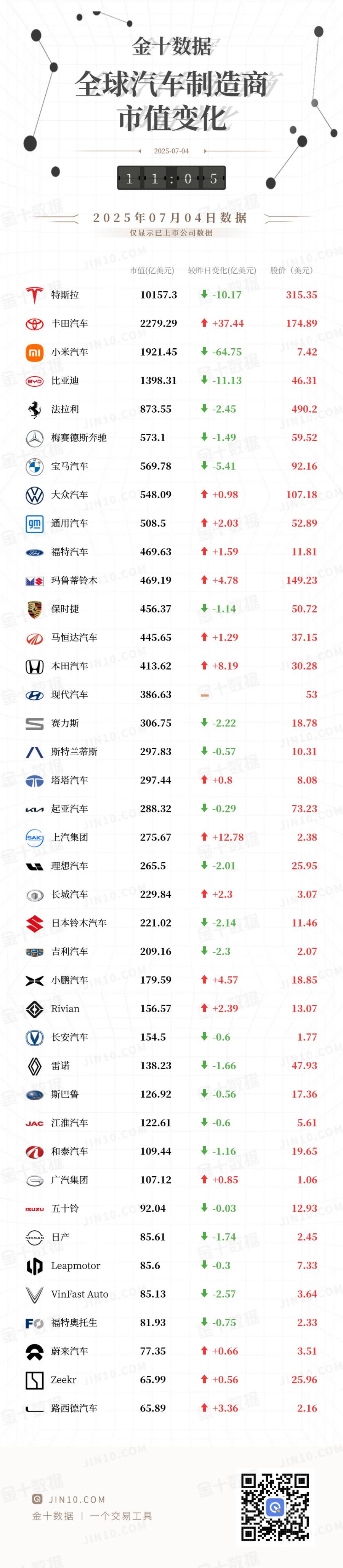
金十图示:2025年07月04日(周五)全球汽车制造商市值变化
news flash· 2025-07-04 03:09
Group 1 - The market capitalization of global automotive manufacturers has shown significant changes as of July 4, 2025, with Volkswagen leading at $548.09 billion, followed by General Motors at $508.5 billion and Ford at $469.63 billion [1][4]. - Notable increases in market value were observed for companies like Maruti Suzuki (+4.78%), Honda (+8.19%), and SAIC (+12.78%), indicating strong performance in the automotive sector [4][5]. - Companies such as Porsche and Stellantis experienced slight declines in their market values, with Porsche down by 1.14% and Stellantis down by 0.57%, reflecting mixed performance across the industry [4]. Group 2 - Emerging players like Li Auto and Xpeng have shown varying market capitalizations, with Li Auto at $265.5 billion and Xpeng at $179.59 billion, highlighting the competitive landscape in the electric vehicle segment [4][5]. - Traditional manufacturers like Nissan and Subaru have seen declines in their market values, with Nissan down by 1.74% and Subaru down by 0.56%, suggesting challenges in maintaining market position [5]. - The overall automotive market is characterized by a mix of growth among certain manufacturers and declines among others, indicating a dynamic and competitive environment [4][5].


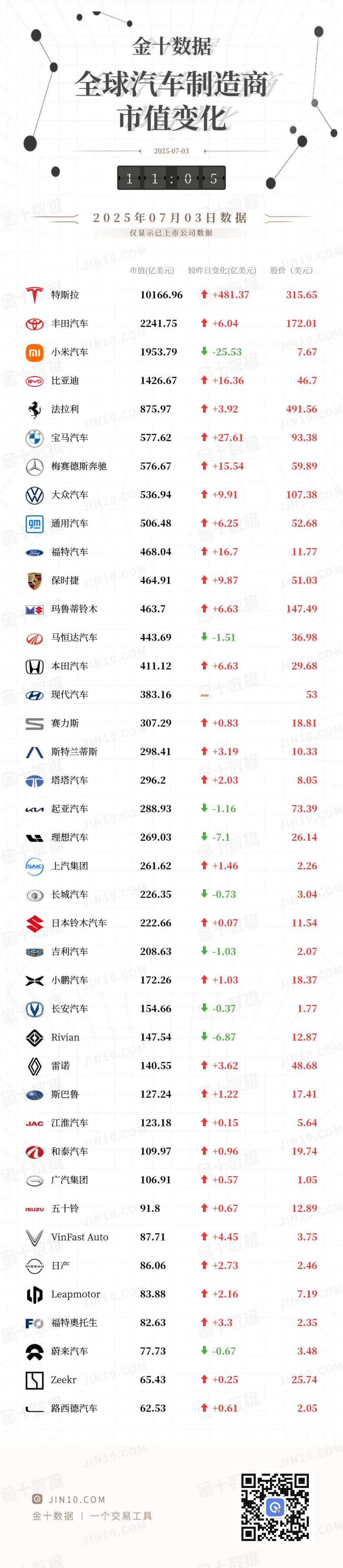
金十图示:2025年07月03日(周四)全球汽车制造商市值变化
news flash· 2025-07-03 03:13
Group 1 - The article presents the market capitalization changes of global automotive manufacturers as of July 3, 2025, highlighting significant fluctuations in their valuations [1][3]. - Volkswagen leads with a market cap of $536.94 billion, showing an increase of 9.91% [3]. - General Motors follows with a market cap of $506.48 billion, up by 6.25% [3]. - Ford Motor Company has a market cap of $468.04 billion, reflecting a notable increase of 16.7% [3]. - Porsche's market cap stands at $464.91 billion, with a rise of 9.87% [3]. - Mahindra & Mahindra has a market cap of $443.69 billion, experiencing a slight decrease of 1.51% [3]. - Honda's market cap is $411.12 billion, increasing by 6.63% [3]. - Hyundai's market cap is $383.16 billion, with no percentage change reported [3]. - The article lists various other manufacturers, including Tata Motors, Kia, and NIO, with their respective market caps and percentage changes [3][4]. Group 2 - The data includes market caps for several emerging automotive companies, such as Rivian at $147.54 billion, down by 6.87% [4]. - VinFast Auto shows a market cap of $87.71 billion, with an increase of 4.45% [4]. - The report also mentions traditional manufacturers like Nissan and Subaru, with market caps of $86.06 billion and $127.24 billion, respectively, both showing positive changes [4].
Ford Vs GM: Which Auto Stock is the Better Investment After Revealing Q2 Sales?
ZACKS· 2025-07-03 00:40
Core Viewpoint - Ford and General Motors have outperformed Tesla in Q2 vehicle sales, with Tesla experiencing a 13% decline due to weaker demand and political issues surrounding Elon Musk [1] Q2 & H1 Auto Sales - Ford's Q2 vehicle sales increased by 14% year over year to 612,095 units, leading to a total of 1.113 million units sold in H1, a 6% increase from H1 2024 [3] - GM's Q2 vehicle sales rose by 7% to 746,588 units, with H1 sales totaling 1.4 million units, an 11% increase [4] EV Expansion - GM's EV sales surged by 111% to 46,280 units in Q2, making Chevrolet the best-selling EV brand during the quarter [5] - Ford's hybrid vehicle sales increased by 6% to 82,886 units, although pure EV sales dropped over 30% [6] Stock Performance & Valuation Comparison - Ford's stock rose by 18% in 2025, outperforming the S&P 500's 5% and the Zacks Automotive-Domestic Market's 2% [7] - GM's stock is down 1%, while Tesla has seen declines of over 20% [7] - Over the past three years, GM's stock gained over 60%, while Ford's stock only increased by 4% [8] - GM stock trades at 5X forward earnings, while Ford trades at 10X, below the industry average of 11X and the S&P 500's 23X [9] Dividend Comparison - Ford offers an annual dividend yield of 5.29%, while GM's yield is 1.15% [11] Bottom Line - Both Ford and GM have shown strong Q2 sales, leading to a Zacks Rank 3 (Hold) for both companies, indicating potential long-term value for shareholders [12][15]

General Motors (GM) Exceeds Market Returns: Some Facts to Consider
ZACKS· 2025-07-02 22:46
Group 1: Stock Performance - General Motors (GM) closed at $52.68, marking a +1.25% move from the prior day, outperforming the S&P 500's daily gain of 0.48% [1] - GM's stock has risen by 6.05% in the past month, while the Auto-Tires-Trucks sector has lost 7.77% and the S&P 500 has gained 5.13% [1] Group 2: Upcoming Earnings Disclosure - GM's earnings report is set to be unveiled on July 22, 2025, with an expected EPS of $2.44, indicating a 20.26% decline compared to the same quarter last year [2] - The consensus estimate for quarterly revenue is $45.34 billion, down 5.48% from the year-ago period [2] Group 3: Full-Year Estimates - Full-year Zacks Consensus Estimates for GM are calling for earnings of $9.3 per share and revenue of $177.54 billion, representing year-over-year changes of -12.26% and -5.29%, respectively [3] - Recent changes to analyst estimates reflect the latest near-term business trends, with positive alterations indicating analyst optimism regarding business and profitability [3] Group 4: Zacks Rank and Performance - The Zacks Rank system, which ranges from 1 (Strong Buy) to 5 (Strong Sell), has a track record of superior performance, with 1 stocks contributing an average annual return of +25% since 1988 [5] - GM currently has a Zacks Rank of 3 (Hold), with the Zacks Consensus EPS estimate shifting 0.09% downward over the past month [5] Group 5: Valuation Metrics - GM is currently trading at a Forward P/E ratio of 5.6, which is a discount compared to the industry average Forward P/E of 11.81 [6] - GM has a PEG ratio of 1.4, while the Automotive - Domestic industry has an average PEG ratio of 1.2 [7] Group 6: Industry Ranking - The Automotive - Domestic industry, part of the Auto-Tires-Trucks sector, has a Zacks Industry Rank of 213, placing it in the bottom 14% of all 250+ industries [7] - The strength of individual industry groups is measured by the Zacks Industry Rank, with top-rated industries outperforming the bottom half by a factor of 2 to 1 [8]
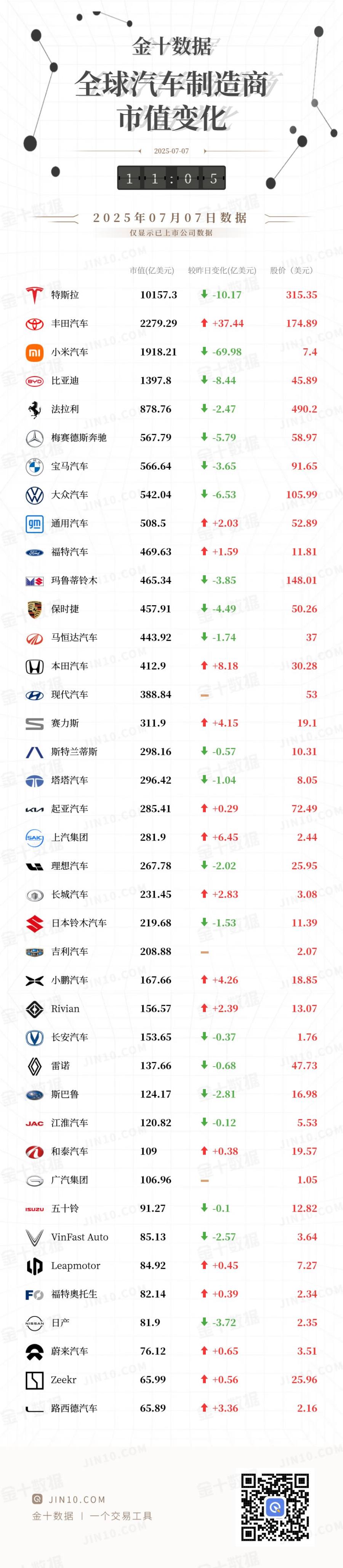
金十图示:2025年07月02日(周三)全球汽车制造商市值变化
news flash· 2025-07-02 03:09
Group 1 - The global automotive manufacturers' market capitalization has shown significant changes as of July 2, 2025, with various companies experiencing fluctuations in their valuations [1][3][4] - Volkswagen's market capitalization is reported at $530.5 billion, reflecting a decrease of 2.13% [3] - General Motors has seen a notable increase in its market value, rising by 27.11% to reach $500.23 billion [3] Group 2 - Other notable companies include Maruti Suzuki with a market cap of $456.91 billion, showing a slight increase of 1.55% [3] - Ford Motor Company has experienced a significant rise of 19.54%, bringing its market capitalization to $443.3 billion [3] - Tesla's market capitalization is not explicitly mentioned, but it is implied that it remains a key player in the automotive sector [1]