Alphabet(GOOG)

Search documents
2026年度光伏设备行业策略报告:光伏设备商基本面筑底,看好太空算力应用场景打开&海外地面需求增长
Soochow Securities· 2026-02-24 06:05
Investment Rating - The report maintains a positive outlook on the photovoltaic equipment industry, indicating a recovery and growth trajectory for 2026, driven by space computing applications and increasing overseas ground demand. Core Insights - The photovoltaic equipment sector is characterized by both growth and cyclical attributes, with supply, demand, and technological factors resonating together [2]. - The industry is expected to enter a recovery phase in 2026, following a significant adjustment in 2025, where leading equipment manufacturers have strengthened cash flow management and reduced operational risks [5]. - The emergence of space computing applications is anticipated to expand the long-term growth potential of the photovoltaic sector, transitioning from ground energy to orbital energy systems [5]. - Overseas demand, particularly from the U.S. and the Middle East, is projected to be a significant source of incremental growth in 2026, with U.S. solar installations remaining robust and local manufacturing policies enhancing supply chain security [5]. - A new round of technological iterations is seen as a key variable for capacity reset amid supply-demand imbalances, with advancements in HJT technology expected to drive structural expansion [5]. Summary by Sections Section 1: 2025 Industry Fundamentals and 2026 Outlook - The fundamentals of leading photovoltaic equipment manufacturers are expected to bottom out in 2025, with a positive outlook for 2026 driven by recovery in equipment orders [5]. - The report highlights the importance of cash flow management and risk control among leading manufacturers, with adjustments in payment models to mitigate risks during industry downturns [9][10]. Section 2: Space Computing Applications - The report discusses the significant reduction in launch costs due to advancements in reusable rocket technology, which is expected to facilitate the deployment of space data centers powered by photovoltaic energy [38]. - The U.S. and China are leading in the planning and deployment of space computing capabilities, with ambitious goals for satellite constellations and data centers [41][42]. Section 3: Overseas Ground Demand - The U.S. market is highlighted as a key area for growth, with local manufacturing policies and high installation rates driving demand for photovoltaic equipment [5]. - The report notes that Middle Eastern countries are also increasing their solar installation plans, providing further opportunities for growth [5]. Section 4: Domestic Policy Changes and Technological Iteration - The report emphasizes the need to monitor domestic policy changes and the ongoing technological advancements within the industry, which are crucial for maintaining competitiveness [5]. Section 5: Investment Recommendations - The report recommends focusing on leading companies in the HJT technology space, such as Maiwei Co., Jinsheng Electric, and Aotwei, as well as those specializing in automation and thin silicon wafer cutting equipment [5].






未知机构:一海外AI的C端与B端流量数据及趋势-20260224
未知机构· 2026-02-24 04:40
Summary of Conference Call Records Industry Overview - The conference call discusses trends in the AI industry, focusing on both C-end (consumer) and B-end (business) traffic data and trends, highlighting the performance of various AI models and companies in the market [1][2]. Key Points on C-end Traffic - **User Engagement**: ChatGPT's daily active users (DAU) rebounded from 460 million in December 2025 to current levels, indicating strong user engagement driven by model improvements like GPT-5.2 and 5.3 [1]. - **Growth of Competitors**: Google's Gemini saw its DAU increase from 23 million in 2025 to 130 million, although growth has slowed recently. Anthropic's Claude Pro doubled its DAU from 5 million to 10 million, driven by its coding capabilities and increased user subscription willingness [1]. Key Points on B-end Traffic - **Demand Surge**: The OpenRouter platform's token consumption surged from 8 trillion tokens per week at the end of January 2026 to 13 trillion tokens per week in February, primarily driven by domestic model vendors like Minimax and Kimi [2]. - **Cost Optimization**: The proliferation of agent products has led to a significant increase in token consumption, with Kimi's package reportedly consuming millions of tokens daily, showcasing the competitive edge of domestic models in the B-end market [2]. Trends in Model Vendors - **Platform Transition**: OpenAI launched Frontier, an enterprise-level middleware product, enhancing B-end capabilities with features like virtual employee functions and independent digital identity tracing [3]. - **Multi-Model Distribution**: Google is developing a multi-model distribution platform to reduce reliance on single model sales, integrating models from various vendors like Gemini and Anthropic into a cloud and software service model [3]. Commercialization Acceleration - **Revenue Goals**: OpenAI has significantly raised its revenue targets for 2026, with plans to further increase them in 2027, focusing on C-end subscriptions and advertising as core revenue sources [4]. - **Advertising Market Impact**: The advertising sector is experiencing a split, with companies like Google and Meta benefiting from AI-driven ad precision, while mid-tier firms like Pinterest and Snapchat face declining growth and user loss [4]. Challenges to Traditional Industries - **Security Software Threats**: The introduction of Claude Code Security by Anthropic poses a challenge to traditional security software companies by automating code vulnerability detection and patching [4]. Model Capability Enhancement - **Large-Scale Clusters**: Meta's Avocado model, set to launch in Q1 2026, is under observation as it utilizes a GB200 cluster for training, which could validate the "big push" strategy if it reaches top-tier model performance [5][6]. - **Multi-Agent Interaction**: The rise of multi-agent collaboration is seen as a new technical direction, with various companies implementing features that allow multiple models to work together, necessitating hardware upgrades to support this interaction [6]. Hardware Demand Growth - **Optimized Hardware**: Google is enhancing its TPUV8 architecture to improve storage efficiency and accelerate communication between agents, which is expected to drive demand for high-bandwidth memory (HBM) and optical modules [6].
未知机构:2026春节期间AI行业动态汇总一国内模型与产品发布1智谱AI2-20260224
未知机构· 2026-02-24 04:00
Summary of AI Industry Dynamics During the 2026 Spring Festival Domestic Model and Product Releases 1. **Zhiyuan AI** (Feb 11): Released GLM-5 with a HumanEval code pass rate of 96.2%, ranking first in global open source and fourth overall; focuses on programming and intelligent capabilities [1] 2. **ByteDance** (Feb 14): Launched Doubao Model 2.0 (Pro/Lite/Mini/Code), achieving top rankings in math/programming benchmarks and reducing inference costs by an order of magnitude; simultaneously launched Seedance 2.0, capable of generating movie-quality multi-shot audio and video in 60 seconds, becoming a key player in Spring Festival visual creation [1] 3. **Alibaba** (Feb 16): Open-sourced Qwen3.5-Plus with a total parameter count of 397 billion and only 17 billion activated, achieving a 60% reduction in memory usage and a 19-fold increase in inference efficiency; API priced at 0.8 yuan per million tokens, which is 1/18 of Gemini 3 Pro [2] 4. **DeepSeek** (Feb 17): Upgraded context window from 128K to 1M tokens, capable of processing ultra-long texts equivalent to the "Find Books" trilogy [2] 5. **MiniMax** (Feb 18): Released M2.5 model with native agent design, achieving a 37% speed increase for complex tasks [2] 6. **Tencent** (Feb 19): During the 16 days of the Spring Festival, AI creation reached 1 billion instances [2] Overseas Model and Product Releases 7. **Google** (Feb 19): Released Gemini 3.1 Pro, significantly enhancing inference capabilities and setting a new technical benchmark [3] 8. **OpenAI** (Feb 18): Launched a proprietary model based on Cerebras chips, achieving a training efficiency increase of 5-10 times and a cost reduction of 70% [3] 9. **Anthropic** (Feb 18): Released Claude Sonnet 4.6, with costs at 1/5 of flagship models and performance approaching Opus, offering high cost-performance for enterprise-level applications [3] 10. **xAI** (Feb 20): Updated Grok 4.2, with simultaneous upgrades in multimodal and inference capabilities [3] Financing and Capital Dynamics 11. **Moon's Dark Side (Kimi)** (Feb 20): Completed a $700 million financing round led by Alibaba, Tencent, and Wuyuan, with a valuation exceeding $10 billion; cumulative financing in January and February surpassed $1.2 billion [4] 12. **Zhiyuan AI/MiniMax** (Feb 20): On the first trading day after the Hong Kong stock market holiday, both companies' market capitalizations exceeded 300 billion HKD, totaling over 580 billion HKD [4] 13. **Anthropic** (Feb 21): Completed a $30 billion Series G round, with a valuation reaching $380 billion, led by GIC and Coatue [4] 14. **OpenAI** (Feb 21): Nearing completion of the first phase of financing exceeding $100 billion, with a valuation expected to surpass $850 billion [4]


2026年度光伏设备行业策略报告:光伏设备商基本面筑底,看好太空算力应用场景打开、海外地面需求增长-20260224
Soochow Securities· 2026-02-24 03:05
Group 1 - The core view of the report indicates that the photovoltaic equipment sector is expected to recover in 2026, driven by the application of space computing power and growth in overseas ground demand [5][8] - The report highlights that the supply and demand dynamics, along with technological factors, give photovoltaic equipment both growth and cyclical attributes [2] - The report emphasizes that the leading equipment manufacturers have strengthened cash flow management through adjusted payment models, which enhances their risk control capabilities [9][10] Group 2 - The application of space computing power is accelerating, transitioning photovoltaic energy from terrestrial to orbital energy systems, thus opening up long-term growth potential [5][38] - The report notes that overseas ground demand, particularly in the U.S. and the Middle East, is expected to be a significant source of incremental growth in 2026 [5][41] - The report discusses the importance of domestic policy changes and the continuous iteration of new technologies in the photovoltaic equipment industry [5][34] Group 3 - The report suggests that the photovoltaic equipment sector is entering a new structural expansion window driven by technological upgrades, as the industry faces a supply-demand imbalance [5][56] - Investment recommendations include focusing on leading companies in HJT technology, low-oxygen monocrystalline furnaces, and automation equipment [5][34]
电子行业点评报告海内外大模型密集更新,推动AI算力需求持续增长
KAIYUAN SECURITIES· 2026-02-24 00:30
Investment Rating - The industry investment rating is "Overweight" (maintained) [1] Core Insights - The report highlights a positive outlook for the semiconductor industry, driven by increasing demand for AI computing power and capital expenditures [7] - Key companies such as Nvidia and Meta are making significant investments in AI chips, indicating strong market growth potential [5] - The report emphasizes the importance of domestic supply chains and price increases in materials like target materials and passive components [7] Market Review - During the Spring Festival holiday (February 16-20, 2026), major overseas technology stocks saw gains, with the Nasdaq index rising by 1.51% and the Philadelphia Semiconductor Index also increasing by 1.51% [3] - Notable stock performances included Nvidia up by 3.83%, Apple up by 3.44%, and Amazon up by 5.69% [3] Industry Updates - The report notes a surge in AI model updates from domestic and international companies, with significant product launches expected from Apple and others [4] - Nvidia's CEO announced a groundbreaking new chip at the upcoming GTC 2026 conference, and a multi-billion dollar chip procurement agreement with Meta was confirmed [5] - Samsung and SK Hynix are accelerating production capacity due to increased storage demand driven by AI [6] Investment Recommendations - The report suggests focusing on sectors benefiting from increased AI computing capital expenditures and domestic supply chain developments [7] - Recommended stocks include Jiangfeng Electronics, with beneficiaries including Jingce Electronics, Chipone Technology, and others [7]






Stocks Slip as Software Selloff Sparks AI Concerns | The Close 2/23/2026
Youtube· 2026-02-24 00:28
Market Overview - The U.S. markets experienced a mixed day, with a focus on the U.S. 2-year yield rising by four basis points following a Supreme Court ruling that raised questions about inflation and interest rates [2][6] - Gold prices increased as investors reacted to the risk-off sentiment in the market, while tech stocks, particularly in the software sector, saw declines of approximately 1.5% [2][4] Technology Sector - The software sector is facing significant pressure, with fears that AI tools may replace traditional software suites, leading to a 30% decline in an index of stocks including Salesforce and Adobe since their record highs [4][70] - Companies like IBM have seen substantial stock declines, with IBM down over 13% amid concerns about AI disruption [70][77] Payment and Delivery Services - PayPal's stock rose nearly 5% due to takeover interest, contrasting with the broader tech sector's struggles [3] - Delivery service companies such as DoorDash and Uber are facing challenges as hypothetical scenarios suggest that AI could disrupt their business models, contributing to stock declines [5][71] Tariff and Trade Implications - The Supreme Court ruling on tariffs has created uncertainty, particularly for major importers like Home Depot and TJX, as the market grapples with the implications of potential tariff changes [6][80] - The Attorney General of Nevada indicated that states are considering actions to recover tariffs collected, which could amount to hundreds of billions of dollars [22][23] Economic Indicators - The current economic environment shows signs of growth, with global growth rates around 2.5% and 3% including emerging markets, while inflation is gradually decreasing [10][17] - The bond market is experiencing a steepening yield curve, driven by long-term inflationary concerns and an excess supply of government debt [12][14] Trucking and Transportation Sector - The trucking industry is witnessing structural changes, with a significant reduction in driver availability leading to higher rates and potential long-term impacts on capacity [57][68] - Demand for transportation services is still down year-over-year, but there are positive indicators such as increased trade volumes and a projected recovery in the second half of the year [59][63]



万字详解智能体2.0:手机里的“互联互通”新战场
2 1 Shi Ji Jing Ji Bao Dao· 2026-02-24 00:10
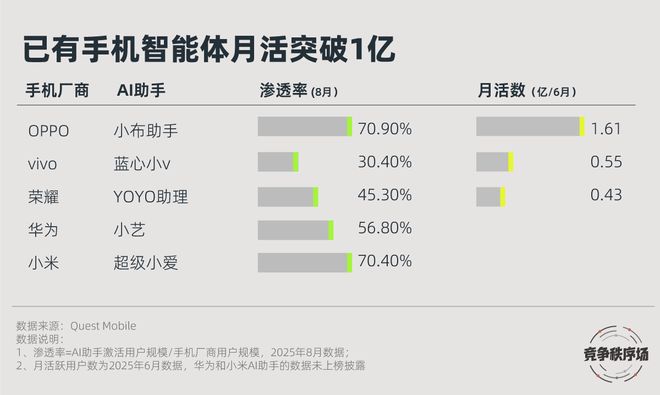
Core Insights - The AI industry is shifting focus towards edge-based intelligent agents, with significant developments in both domestic and international markets [1][2][3] - ByteDance's Doubao and other intelligent agents are gaining traction, operating across various personal devices and applications, but face challenges related to privacy and operational capabilities [2][3][5] - The industry consensus is that the future of intelligent agents will depend on their ability to connect multiple personal devices and services, reshaping the ecosystem [2][3] Group 1: Market Developments - OpenClaw has gained popularity in Silicon Valley, while Doubao is embedded in smartphones in China, with high demand reflected in the second-hand market [1] - The user base for intelligent agents among six major Chinese smartphone manufacturers grew by 65 million in one year, reaching a total of 535 million users [3] - OPPO, Vivo, and Honor are leading the charge in the domestic market, with OPPO's Xiaobu Assistant achieving 160 million monthly active users by June 2025 [3] Group 2: Technical Challenges - Current intelligent agents are struggling with task execution, often only able to perform basic functions like opening apps rather than completing complex tasks [7][8] - A recent evaluation of seven intelligent agents revealed a success rate of only 20% for completing tasks, with many tasks failing or being interrupted [5][7] - The technology behind these agents is still in its infancy, with most operating at a basic level and lacking the ability to handle complex, multi-step tasks effectively [8][10] Group 3: Privacy and Security Concerns - Intelligent agents require extensive permissions, often exceeding 100, raising concerns about privacy and potential misuse of sensitive data [17][18] - The use of high-sensitivity permissions, such as accessing location and reading messages, poses significant risks to user privacy [19][20] - The reliance on cloud processing for data handling introduces vulnerabilities, as sensitive information may be exposed during transmission [27][28] Group 4: Industry Dynamics - A ceasefire agreement has been reached between ByteDance and several app developers, allowing for normal login procedures while limiting AI operations [35] - The competitive landscape is marked by tensions between smartphone manufacturers and app developers, with concerns over the implications of intelligent agents on existing business models [30][31] - The future of intelligent agents hinges on establishing a viable revenue-sharing model and addressing the concerns of both hardware manufacturers and app developers [31][32]

Is Shopify Inc. (SHOP) is One of Goldman Sachs’s Top Growth Stock Picks?
Insider Monkey· 2026-02-23 19:49
Core Insights - Generative AI is viewed as a transformative technology by Amazon's CEO Andy Jassy, indicating its potential to reinvent customer experiences [1] - Elon Musk predicts that humanoid robots could create a market worth $250 trillion by 2040, reshaping the global economy [2] - Major firms like PwC and McKinsey acknowledge that AI could unlock multi-trillion-dollar potential, supporting Musk's ambitious forecast [3] Industry Trends - The AI revolution is characterized by a powerful breakthrough that is redefining work, learning, and creativity, attracting significant interest from hedge funds and top investors [4] - A smaller, under-owned company is identified as holding the key to the AI revolution, suggesting a potential investment opportunity [4][6] - Prominent billionaires, including Bill Gates and Warren Buffett, recognize AI as a major technological advancement with the potential for significant social impact [8] Investment Opportunities - There is a strong belief that investors will regret not owning certain stocks related to AI advancements in the near future [9] - A detailed report on a groundbreaking AI company is available, highlighting its technology and growth potential [10] - Subscription to a premium newsletter offers access to exclusive insights and stock picks, emphasizing the urgency to invest before broader market awareness [12][14]



Google Leans Into AI Infrastructure While the Market Questions Timing
Investing· 2026-02-23 18:17
Core Insights - Google Stock (NASDAQ:GOOG) is currently trading at approximately $314 USD per share, with a market capitalization of around $3.82 trillion USD and a trailing P/E ratio of ~29x, which is in line with the S&P 500 average but reflects stronger growth metrics [1][10] - The company reported Q4 sales of $113.8 billion USD, marking an 18% year-on-year growth, with revenue for 2025 exceeding $400 billion USD [1][11] - The primary concern in the market is not the quality of Google's business but the scale and timing of its AI investments [1] Revenue and Profitability - Google Search revenue reached approximately $63.1 billion USD in the latest quarter, growing about 17% year-on-year, supported by retail demand and AI-enhanced search experiences [2] - YouTube has become a significant revenue stream, generating over $60 billion USD annually through advertising and subscriptions, operating at high margins [2] - Google Cloud revenue stands at around $17.7 billion USD, with a year-on-year growth of approximately 48%, and an operating margin of about 30.1%, reflecting the fastest margin expansion among major cloud platforms [3][6] AI and Cloud Strategy - The cloud backlog is approximately $240 billion USD, up 55% quarter-on-quarter, indicating strong demand for AI and cloud services [3] - The company is investing heavily in AI infrastructure, with a CAPEX plan of $175–$185 billion USD for 2026, nearly a 97% increase from 2025 [5] - The AI strategy leverages a wide distribution network across various platforms, allowing for efficient deployment of new AI capabilities [4] Financial Position - Google maintains a strong balance sheet with over $126 billion USD in cash and marketable securities, and total debt of about $59.3 billion USD, resulting in a net cash position of over $60 billion USD [7] - The company has a return on invested capital (ROIC) that has increased from about 20% to roughly 32% over the past three years, indicating effective capital utilization [9] Market Valuation - Google Stock trades at a forward PEG ratio of around 1.7x, which is not considered cheap but is reasonable given the company's growth metrics [10] - Despite a projected drop in free cash flow from $73.3 billion USD to approximately $24 billion USD due to increased CAPEX, the underlying business remains strong with significant revenue growth and profitability [5][9] Strategic Outlook - The company is strategically prioritizing long-term growth in AI and cloud services over short-term free cash flow, positioning itself for a dominant role in the AI infrastructure market [14] - The potential value from its investment in SpaceX could add over $100 billion USD to its balance sheet once recognized in the public market [8][14]

Why analysts see Alphabet stock surging over 20% ahead
Invezz· 2026-02-23 17:15
Core Viewpoint - Alphabet's stock experienced a decline on Monday, reflecting broader market weakness, as investors evaluate the company's aggressive investment strategies in artificial intelligence [1] Group 1: Company Performance - Alphabet's stock traded lower, indicating a response to market conditions and investor sentiment regarding its future investments [1] Group 2: Industry Context - The decline in Alphabet's stock is part of a larger trend in the market, suggesting that investor confidence may be wavering as they assess the implications of significant investments in artificial intelligence [1]