J&J(JNJ)

Search documents
医保商保“双目录”大力支持创新——好药新药加速惠及百姓
Jing Ji Ri Bao· 2026-01-06 02:11
Core Viewpoint - The new National Basic Medical Insurance, Maternity Insurance, and Work Injury Insurance Drug Catalog (2025) and the first Commercial Health Insurance Innovative Drug Catalog (2025) will be implemented nationwide starting January 1, 2026, adding 114 new drugs to the basic insurance catalog and 19 to the commercial insurance catalog, aimed at enhancing drug accessibility and supporting innovation in the pharmaceutical industry [1][2]. Group 1: Drug Catalog Adjustments - The updated basic medical insurance catalog includes 114 new drugs, with significant representation from oncology (36 drugs), chronic diseases like diabetes (12 drugs), anti-infective drugs (13 drugs), and rare diseases (10 drugs), while 29 drugs were removed due to better alternatives [2]. - The total number of drugs in the national medical insurance catalog has increased to 3,253, comprising 1,857 Western medicines and 1,396 traditional Chinese medicines [2]. - The adjustment reflects a comprehensive coverage of diseases, addressing clinical pain points and improving access to previously unavailable treatments for conditions like triple-negative breast cancer and pancreatic cancer [2]. Group 2: Policy Implementation and Access - To address the issue of new drugs being listed but not available in hospitals, the policy mandates that all designated medical institutions must include new drugs in their procurement catalogs by the end of February 2026, with provisions for temporary green channels if necessary [3]. - Negotiated drugs will not be subject to administrative restrictions such as "one drug, two regulations" or overall medical insurance caps, allowing for more flexible access [3]. Group 3: Support for Innovative Drugs - Among the new drugs added to the basic medical insurance catalog, 50 are classified as category 1 innovative drugs, with an overall success rate of 88%, up from 76% in 2024, indicating a shift towards strategic purchasing and value-based reimbursement [4]. - The catalog includes both domestic innovative products and foreign original research products, enhancing the diversity of available treatments [4]. Group 4: Commercial Health Insurance Innovations - The newly established commercial health insurance innovative drug catalog includes 19 drugs, focusing on high-innovation, clinically valuable treatments that fill gaps in existing coverage, such as CAR-T cell therapies and treatments for rare diseases prevalent in children [7]. - This catalog complements the basic medical insurance, allowing pharmaceutical companies to expand their market reach while reducing the financial burden on patients [7]. Group 5: Industry Impact and Future Directions - The policy signals strong government support for independent innovation and encourages pharmaceutical companies to invest more in original and differentiated research and development [8]. - The National Medical Insurance Bureau plans to refine policies and enhance management to ensure effective implementation of the drug catalogs, ultimately improving the clinical medication needs of insured individuals [8].


What may be driving Eli Lilly shares lower — plus, oil and financial stocks rally
CNBC· 2026-01-05 19:35
Market Update - Stocks are experiencing gains for the second consecutive session, with energy sector stocks, particularly Exxon Mobil and Chevron, benefiting from the anticipated rebuilding of Venezuela's oil infrastructure [1] - Financial stocks are also performing well, with Goldman Sachs, Wells Fargo, and Capital One reaching new highs [1] - BlackRock has outperformed, leading to a decision to sell part of the position to increase cash reserves [1] Health Care Sector - The health care sector is lagging behind the overall market rally, with major pharmaceutical and biotech companies like Eli Lilly, Bristol Myers, AbbVie, Johnson & Johnson, and Amgen seeing declines between 1% and 4% [1] - Eli Lilly's drop may be influenced by the launch of Novo Nordisk's oral GLP-1 weight loss pill in the U.S., with expectations for Lilly's own orforglipron launch in the first quarter, projected to generate $3.3 billion in sales [1] - The upcoming JPMorgan Healthcare Conference is a key event to watch, as it will feature presentations from health care companies in the portfolio, often providing updates on acquisitions, partnerships, and earnings preannouncements [1]


美国 MFN 协议点评:MFN 谈判接近尾声,14 家药企达成协议
GUOTAI HAITONG SECURITIES· 2026-01-05 14:07
Investment Rating - The report assigns an "Overweight" rating for the pharmaceutical industry, indicating a projected performance that exceeds the Shanghai and Shenzhen 300 Index by more than 15% [6][23]. Core Insights - The U.S. government has reached a Most Favored Nation (MFN) price agreement with 14 pharmaceutical companies, which includes provisions for price reductions and a three-year tariff exemption, resulting in a limited overall impact on revenue [2][10]. - The agreement involves nine major pharmaceutical companies committing to invest at least $150 billion in domestic production in the U.S. and implementing MFN pricing for all listed innovative drugs [9][10]. - The MFN agreement primarily affects Medicaid and direct-to-patient sales channels, which represent a small portion of the companies' overall revenue [16][17]. Summary by Sections MFN Negotiations - As of December 19, 14 pharmaceutical companies have reached agreements with the U.S. government, with nine major firms including Amgen, Bristol-Myers Squibb, and Gilead participating [8][10]. - The agreements include measures to lower costs for chronic disease medications and increase domestic investment [9][10]. Price Reduction Measures - The agreement mandates price reductions for chronic disease medications, including those for diabetes and rheumatoid arthritis, through the TrumpRx platform, which offers discounts of 50%-85% [8][9]. - The MFN pricing requirement applies to all innovative drugs, affecting not only Medicaid but also commercial insurance and cash-paying patients [9][10]. Market Reaction - Following the announcement of the MFN agreement, the XBI index rose by 2.85%, indicating a neutral to optimistic sentiment among investors regarding the policy's implications [13][16]. - Stock price changes for the involved companies showed mixed reactions, with some experiencing slight increases on the announcement day [14][15].


Watch 5 AI-Powered Medical Stocks for a Strong Portfolio in 2026
ZACKS· 2026-01-05 13:45
Core Insights - The medical sector is rapidly adopting artificial intelligence (AI), significantly transforming diagnostics, treatment, and operational efficiency in 2024 [1] - AI-powered diagnostics have become central to enhancing accuracy and speed in medical practices [1] Group 1: AI Adoption in Healthcare - The healthcare sector is typically defensive, characterized by low-beta and dividend-paying stocks, but AI has turned several stocks into potential high-growth providers [2] - Key stocks benefiting from AI integration include Eli Lilly and Co. (LLY), Medtronic plc (MDT), Intuitive Surgical Inc. (ISRG), Regeneron Pharmaceuticals Inc. (REGN), and Johnson & Johnson (JNJ) [2] Group 2: Eli Lilly and Co. (LLY) - Eli Lilly focuses on cardiometabolic health, neuroscience, oncology, and immunology, which are high-growth areas with significant commercial potential [5] - Strong demand for LLY's GLP-1 drugs, Mounjaro and Zepbound, is driving top-line growth, supported by international market launches and increased production [6] - LLY is advancing its pipeline in obesity and diabetes, with an oral GLP-1 obesity pill expected to launch next year [7] - The company is collaborating with OpenAI and investing in AI-driven biotech initiatives, including a $409 million investment in Genetic Leap [9] - LLY has an expected revenue growth rate of 22.3% and earnings growth rate of 41.3% for the current year, with a beta of 0.35 and a dividend yield of 0.6% [9][10] Group 3: Medtronic plc (MDT) - Medtronic is integrating AI into its surgical systems and endoscopy to enhance patient care and operational efficiency [11] - The GI Genius project uses AI algorithms to detect colorectal polyps during colonoscopies, improving cancer survival rates [12] - MDT's partnerships leverage AI to optimize cardiac procedures and improve diagnostic precision, positioning the company for growth in medtech innovation [13] - Medtronic has an expected revenue growth rate of 7.5% and earnings growth rate of 2.7% for the current year, with a beta of 0.71 and a dividend yield of 3% [15] Group 4: Intuitive Surgical Inc. (ISRG) - Intuitive Surgical is embedding AI and digital tools into its robotic ecosystem, enhancing surgical performance metrics [16] - The company is piloting telecollaboration through Intuitive Telepresence, allowing remote surgical support [17] - ISRG has an expected revenue growth rate of 14.3% and earnings growth rate of 11.1% for the current year, with a beta of 0.39 and an ROE of 15.1% [20] Group 5: Regeneron Pharmaceuticals Inc. (REGN) - Regeneron utilizes AI and machine learning for drug target identification, clinical trial optimization, and precision medicine [21] - The company has seen revenue growth driven by strong performance from drugs like Eylea HD and Dupixent, despite declining sales of its lead drug [22] - REGN has an expected revenue growth rate of 4.9% and earnings growth rate of -0.4% for the current year, with a beta of 0.39 and a dividend yield of 0.5% [24] Group 6: Johnson & Johnson (JNJ) - Johnson & Johnson's MedTech division applies AI technologies for surgical robotics and digital surgery analytics [25] - The company has developed the Ottava robotic surgery platform and the Caresurgical/VELYS digital surgery systems, enhancing procedure planning and real-time data sharing [26] - JNJ has an expected revenue growth rate of 5% and earnings growth rate of 5.7% for the current year, with a beta of 0.34 and a dividend yield of 2.5% [27]



PDX: An 8.6% Yield, 12% Discount, And Potential Recovery In 2026
Seeking Alpha· 2026-01-04 13:30
Group 1 - The primary goal of the "High Income DIY Portfolios" service is to provide high income with low risk and capital preservation for DIY investors [1] - The service offers seven portfolios, including three buy-and-hold, three rotational portfolios, and a conservative NPP strategy portfolio [1] - The portfolios are specifically designed for income investors, including retirees or near-retirees, focusing on creating stable, long-term passive income with sustainable yields [1] Group 2 - The "Financially Free Investor" emphasizes a unique 3-basket investment approach aimed at achieving 30% lower drawdowns and 6% current income [2] - The investing group "High Income DIY Portfolios" includes a total of 10 model portfolios with varying income targets and risk levels, along with buy and sell alerts and live chat support [2] - The focus is on investing in dividend-growing stocks with a long-term horizon to achieve market-beating growth [2]



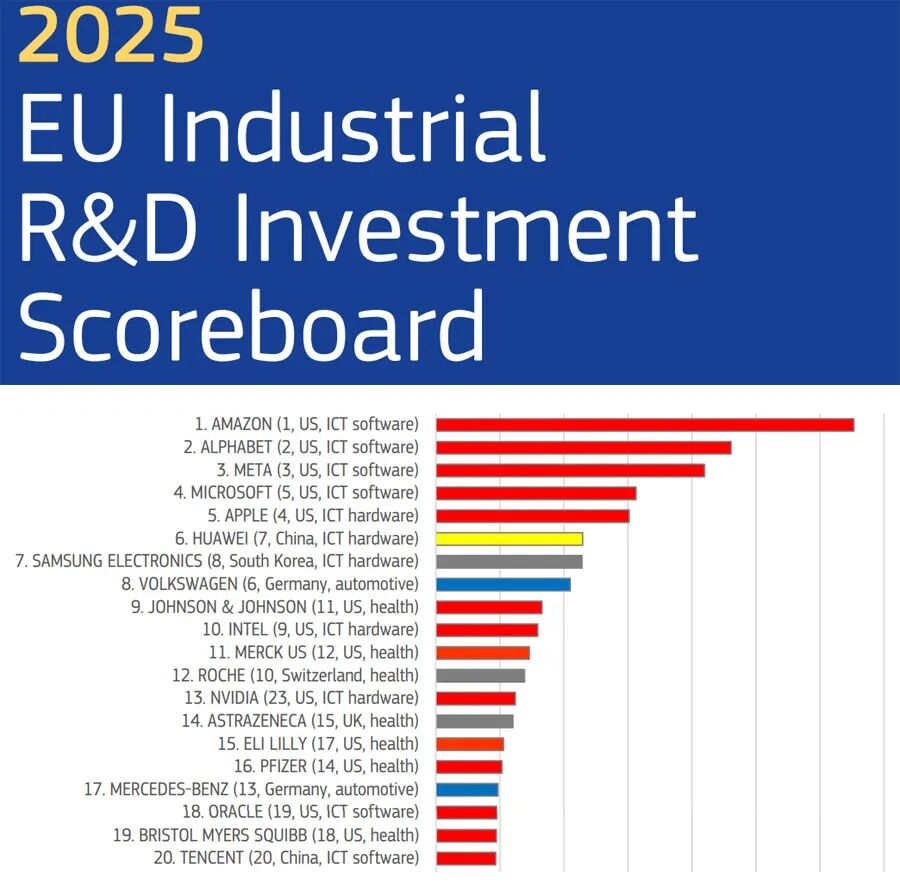
2025全球研发投入百强企业,华为、腾讯、阿里、比亚迪等中国企业上榜
Xin Lang Cai Jing· 2026-01-04 12:03
Group 1 - The European Commission released the "2025 EU Industrial R&D Investment Scoreboard," with Amazon ranking first for the first time, investing €65.318 billion in R&D for the 2024 fiscal year [1][8] - The top ten companies also include Alphabet, Meta, Microsoft, Apple, Huawei, Samsung, Volkswagen, Johnson & Johnson, and Intel [1][8] - The survey covered the 2,000 companies with the highest R&D investments globally, totaling €1,446.2 billion, with the US, China, EU, and Japan having the most companies on the list [1][8] Group 2 - The top 50 companies accounted for €633 billion in R&D spending, representing 44% of the total R&D investment [1][8] - Amazon's R&D investment as a percentage of net sales is 10.64%, while Alphabet's is 13.69%, and Meta's is 26.52% [4][12] - Huawei's R&D investment is €22.941 billion, with a net sales ratio of 20.18%, indicating a strong commitment to innovation [4][12]



2 Healthcare Stocks to Buy in a Bear Market
Yahoo Finance· 2026-01-03 14:35
分组1 - The S&P 500 has shown resilience after flirting with bear market territory earlier this year, making healthcare stocks a strong consideration for potential investment in a bear market [1] - The healthcare sector is characterized by companies that tend to perform well during both economic upturns and downturns, with Johnson & Johnson and Abbott Laboratories highlighted as excellent stocks to buy in a bear market [2] 分组2 - Johnson & Johnson is a diversified healthcare leader with a strong presence in pharmaceuticals and medical technology, generating consistent revenue and profits even in weak economic conditions [4][5] - The company holds the highest credit rating, indicating financial stability, and is recognized as a Dividend King with 63 consecutive years of dividend increases, showcasing its ability to maintain payouts through various economic cycles [6] - Abbott Laboratories also exhibits strong diversification across medical devices, nutrition, diagnostics, and pharmaceuticals, allowing it to navigate challenging times effectively [7] - Abbott's growth prospects are particularly promising in diabetes care, with its FreeStyle Libre continuous glucose monitoring devices driving significant growth, and recent acquisitions aimed at expanding into the cancer diagnostic market [8]
5 Relatively Secure And Cheap Dividend Stocks, Yields Up To 8% (January 2026)
Seeking Alpha· 2026-01-03 13:00
Core Insights - The "High Income DIY Portfolios" service aims to provide high income with low risk and capital preservation for DIY investors, particularly targeting income investors such as retirees [1] - The service offers a total of 10 model portfolios, including various strategies for income generation and risk management, with a focus on sustainable yields [2] Group 1: Portfolio Strategies - The service includes seven portfolios: three buy-and-hold, three rotational portfolios, and a conservative NPP strategy portfolio designed for low drawdowns and high growth [1] - The investment approach emphasizes dividend-growing stocks and aims for a 30% reduction in drawdowns while targeting a 6% current income [2] Group 2: Additional Features - The service provides buy and sell alerts, live chat, and strategies for portfolio management and asset allocation to help investors achieve stable, long-term passive income [2]



Dividend Growers: 3 Stocks That Could Be Worth $1 Million in 36 Years.
The Motley Fool· 2026-01-03 10:30
Core Insights - Dividend growth stocks have historically provided strong returns, with an average annualized total return of 10.2% over the past 50 years, outperforming non-dividend payers and those with unchanged dividends [2] Group 1: NextEra Energy - NextEra Energy has increased its dividend for over 30 consecutive years, achieving a 10% compound annual growth rate over the past two decades, resulting in a 14% average annual total shareholder return [5][6] - The company expects to grow its adjusted earnings per share by more than 8% annually over the next decade and plans a 10% dividend increase in 2026, with a 6% compound annual growth rate through at least 2028 [8] Group 2: Realty Income - Realty Income has raised its dividend every year since its IPO in 1994, achieving a 4.2% compound annual growth rate and delivering a 13.7% average annualized total return [9] - The REIT invests in a diversified portfolio of properties secured by long-term net leases, producing durable rental income and maintaining a strong balance sheet [11][12] Group 3: Johnson & Johnson - Johnson & Johnson has increased its dividend for 63 consecutive years, qualifying as a Dividend King, and has delivered a 10.5% annualized total return over the past 30 years [13] - The company generates significant free cash flow, covering its dividend outlay, and invests heavily in research and development, supporting continued dividend growth [15][16] Group 4: Investment Potential - NextEra Energy, Realty Income, and Johnson & Johnson are positioned to continue their trends of dividend growth and double-digit annual total returns, making them ideal for investors looking to build a substantial portfolio [17]



Dogs Of The Dow: 10 High-Yield Stocks With Dividends Up To 6.8% - Including Several Warren Buffett Favorites
Benzinga· 2026-01-02 22:06
Core Viewpoint - The Dow Jones Industrial Average reached record highs in 2025, with many components showing positive performance, and it continues to be a significant source of high-yielding blue-chip stocks as it heads into 2026 [1]. Group 1: Dividend Stocks Overview - Of the 30 components in the Dow Jones Industrial Average, 28 currently pay dividends, making it a viable option for investors seeking dividend stocks [2]. - The average dividend yield of the top 10 payers in the index is 3.3% at the start of 2026 [4]. - The overall average dividend yield of the Dow Jones Industrial Average is approximately 1.9% at the start of 2026, down from 2% at the start of 2025 [9]. Group 2: High-Yielding Stocks - The highest-yielding stocks in the Dow include Verizon (6.8% yield), Chevron (4.5% yield), and Merck (3.2% yield), with varying stock performances in 2025 [7]. - Notably, four of the highest-yielding stocks were down in 2025, while six were up, indicating mixed performance among top yielders [5]. - Companies like UnitedHealth, Nike, and Procter & Gamble rank among the highest yielding but also appeared in the list of the worst-performing stocks in 2025 [5]. Group 3: Recent Changes in the Index - The Dow Jones Industrial Average has seen changes in its components, including the addition of Amazon in February 2024 and NVIDIA and Sherwin-Williams in November 2024 [6]. - Amazon and Boeing are the only stocks in the index that do not pay dividends, while NVIDIA has the lowest yield among dividend-paying stocks [8].