Coca-Cola(KO)

Search documents
What to Expect in Markets This Week: Delayed January Jobs Report, Inflation and Retail Sales Data, Earnings From Cisco, Coca-Cola, McDonald's, Ford
Investopedia· 2026-02-08 10:50
Economic Data and Earnings Reports - Key economic releases this week include delayed January jobs data, consumer inflation, and retail sales reports due to a recent government shutdown [1][3][4] - The January jobs report is expected to show fewer job additions than anticipated, despite a decrease in the unemployment rate [3] - The January CPI inflation report is anticipated to reveal steady inflation, with core inflation lower than expectations, influencing Federal Reserve rate decisions [4] Company Earnings - Cisco is set to report earnings, which may provide insights into AI infrastructure demand, with the CEO highlighting significant opportunities in this sector [5] - Consumer stocks such as Coca-Cola and McDonald's are also reporting; Coca-Cola has recently exceeded profit expectations, while McDonald's may reveal trends among affluent customers [6] - Other notable earnings reports include those from Ford, Honda, Ferrari, AstraZeneca, Moderna, and Vertex Pharmaceuticals, which will provide insights into auto sales and pharmaceutical demand [7]



就业通胀数据连番考验美联储,贵金属市场能否企稳
Di Yi Cai Jing· 2026-02-08 03:03
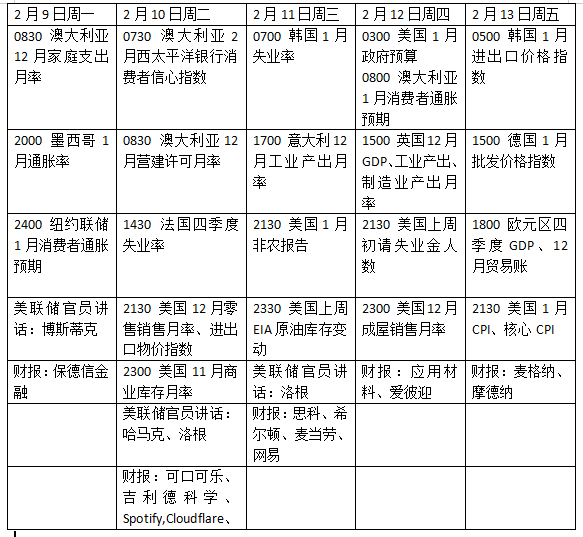
Market Overview - The U.S. stock market showed mixed results, with the Dow Jones increasing by 2.50%, while the Nasdaq and S&P 500 decreased by 1.84% and 0.10% respectively [10] - European stock indices rose, with the FTSE 100 up by 1.43%, DAX 30 up by 0.74%, and CAC 40 up by 1.81% [10] Economic Data and Forecasts - The U.S. will release delayed employment and inflation data, which are critical for market focus [10] - The upcoming U.S. non-farm payroll data is expected to show an increase of 90,000 jobs, with a significant uncertainty due to statistical adjustments [11] - The U.S. core Consumer Price Index (CPI) is anticipated to remain at a year-on-year increase of 2.6%, while the overall CPI is expected to drop from 2.7% to 2.5% [12] Corporate Earnings - Several major companies, including Coca-Cola, Cisco, McDonald's, and Applied Materials, are set to report earnings next week, which are of particular interest due to their relevance to the AI sector [12] Oil and Gold Market - International oil prices weakened, with WTI crude oil down by 2.55% to $63.05 per barrel and Brent crude down by 1.83% to $68.05 per barrel [13] - Gold futures for February delivery increased by 5.03% to $4951.20 per ounce, while silver futures decreased by 1.99% to $76.73 per ounce [13] Central Bank Policies - The European Central Bank (ECB) maintained its key interest rate, indicating no immediate plans for adjustment [14] - The Bank of England voted 5-4 to keep its base rate at 3.75%, with upcoming GDP data potentially influencing future rate decisions [15]


Follow the smart money to the makers of these favorite snack foods and drinks
Yahoo Finance· 2026-02-07 15:02
Core Viewpoint - Recent insider buying at major snack food companies indicates confidence in the U.S. snack food market despite concerns over appetite-suppressing GLP-1 drugs [2][3] Group 1: Insider Buying Activity - Insiders purchased nearly $5 million worth of shares across Utz Brands, Coca-Cola, Hershey, and Molson Coors, suggesting strong belief in the sector's resilience [3] - At Utz Brands, insiders bought $2.6 million worth of stock between $9.86 and $10.58 per share from early November to the end of December [3] - A director at Coca-Cola bought $998,000 worth of stock at $69.87 to $70.31 per share, marking the first insider purchase since June 2022 [4] - Two directors at Molson Coors collectively bought $450,000 worth of shares between $44.70 to $46.79 in early November [4] - At Hershey, the CEO and two directors bought $445,000 worth of stock at around $186, with the CEO contributing $371,000, marking the first insider buys since 2019 [5] Group 2: Market Trends and Consumer Behavior - Research from Circana indicates that 48.8% of consumers snacked three or more times a day last year, an increase of 2.7 percentage points from 2024 [6] - While some snack food companies are experiencing soft sales, the overall market remains appealing to insiders [6] - Snack food companies are responding to market challenges by introducing "healthier" products, such as Utz Brands' Boulder Canyon line made with avocado or olive oil [6]



Here's How Much Traders Expect Coca-Cola Stock Could Move After Earnings Tuesday
Investopedia· 2026-02-07 11:26
Core Insights - Coca-Cola is expected to report its fourth-quarter earnings, with traders anticipating a potential stock movement of up to 3% following the results, which could see the stock rise above $81 or fall to around $76 [1][1][1] - The company has seen a 13% increase in its stock price since the beginning of the year, reflecting a broader trend of investment in consumer staples [1][1][1] - Analysts predict Coca-Cola's revenue for the fourth quarter to be approximately $12 billion, representing a 4% year-over-year increase, while adjusted earnings per share are expected to rise by 2 cents to $0.57 [1][1][1] Company Developments - Coca-Cola is transitioning to a new CEO, with COO Henrique Braun set to succeed James Quincey on March 31, marking a significant leadership change [1][1][1] - UBS analysts express confidence in a solid quarter for Coca-Cola, although they note that high valuation compared to peers may limit stock growth potential [1][1][1] Market Context - The stock performance of Coca-Cola is being closely monitored as it is considered a bellwether for the consumer staples sector, providing insights into U.S. consumer behavior and market trends [1][1][1] - Rival PepsiCo has also reported better-than-expected earnings, contributing to a surge in its stock price, indicating a competitive landscape within the beverage industry [1][1][1]

The Rotation Into Consumer Staples: Defensive Strength in an Uncertain 2026
Investing· 2026-02-07 08:17
Group 1 - The article provides a market analysis focusing on Coca-Cola Co, Philip Morris International Inc, and the State Street® Consumer Staples Select Sector SPDR® ETF [1] - It highlights the performance trends and investment opportunities within the consumer staples sector [1] - The analysis includes insights on market dynamics and potential growth areas for the mentioned companies [1] Group 2 - Coca-Cola Co is analyzed for its market position and financial performance, indicating strong brand loyalty and revenue generation [1] - Philip Morris International Inc is discussed in terms of its strategic shifts towards reduced-risk products and market expansion [1] - The State Street® Consumer Staples Select Sector SPDR® ETF is evaluated for its role in providing diversified exposure to the consumer staples sector [1]


2 Legendary Dividend Stocks to Buy and Hold Forever
The Motley Fool· 2026-02-07 07:45
Core Viewpoint - Dividends play a crucial role in long-term investing, accounting for 31% of all stock market gains since 1926, making them essential for total return [1] Group 1: Coca-Cola Company - Coca-Cola is a blue-chip stock with a globally recognized beverage empire, known for consistent dividend payouts and strong performance in various economic conditions [4] - The company has a market capitalization of $340 billion, with a current stock price of $79.14 and a dividend yield of 2.58% [5][6] - Coca-Cola's revenue grew 5% year-over-year to $12.5 billion in the third quarter, maintaining a robust operating margin of 32%, which is vital for sustaining dividends [7] - The stock has appreciated approximately 58% over the last five years, indicating substantial capital growth alongside dividend income [8] Group 2: Philip Morris International - Philip Morris has a market capitalization of $285 billion, with a current stock price of $182.85 and a dividend yield of 3.09% [9][10] - The company is pivoting towards alternative tobacco products, with smoke-free products accounting for 41% of sales and available in 100 global markets [13] - Over the last decade, Philip Morris shares have risen 97%, significantly outperforming peers like Altria and British American Tobacco [11] - The $16 billion acquisition of Swedish Match in 2022 expanded Philip Morris' distribution network and diversified its product offerings [13] - The company has a strong track record of returning cash to investors through dividends, which currently exceed the S&P 500 average of 1.14% [14]

道指首破5万点创历史新高 分析师:市场已适应全球不确定性 投资者信心真实存在
智通财经网· 2026-02-06 23:49
Group 1 - The Dow Jones Industrial Average (DJIA) surged over 1200 points, approximately 2.5%, closing at a historic high of 50,115.67 points, marking the fastest completion of a 10,000-point increase from 40,000 to 50,000 since May 2024 [1] - The upward trend in the DJIA has shifted from a focus on technology stocks to a broader range of sectors, benefiting traditional industries and defensive sectors, with notable performances from Goldman Sachs, Caterpillar, Amgen, and Sherwin-Williams [1] - The strong corporate earnings, resilient U.S. economy, and the Federal Reserve's interest rate cuts last year have collectively driven the overall market higher [1] Group 2 - Gina Bolvin, President of Bolvin Wealth Management Group, indicated that the DJIA's breakthrough of 50,000 is more of a confirmation than a celebration, reflecting investor confidence amidst higher interest rates and global uncertainties [2] - Healthcare stocks, particularly Johnson & Johnson and Merck, have shown resilience, ranking as the second and fifth best-performing components of the DJIA over the past 12 months [2] - Investors are increasing allocations to high-dividend and defensive consumer staples stocks, with Coca-Cola and Walmart being among the top gainers in the DJIA over the past year [2] - Despite the market's broadening focus, technology and AI sectors remain strong, with Nvidia's stock rising approximately 44% over the past year, making it the third-largest gainer in the DJIA [2]



Earnings live: Amazon, Reddit stocks sink to cap jam-packed earnings week
Yahoo Finance· 2026-02-06 21:31
Group 1 - The fourth quarter earnings season is ongoing, with significant results from major companies like Alphabet, Amazon, AMD, Qualcomm, and Palantir [1] - As of February 6, 59% of S&P 500 companies have reported their fourth quarter results, with analysts estimating a 13% increase in earnings per share, marking the 10th consecutive quarter of annual earnings growth for the index [2][4] - Analysts initially expected an 8.3% increase in earnings per share for the fourth quarter, a decrease from the previous quarter's 13.6% growth rate, but have since raised expectations, particularly for tech companies [4] Group 2 - Major capital expenditures by Big Tech are influencing the AI trade, with ongoing themes from 2025, such as artificial intelligence and economic policies, continuing to impact investor sentiment [5] - Upcoming earnings reports are anticipated from companies including Coca-Cola, Spotify, Robinhood, Lyft, Ford, Rivian, Moderna, Airbnb, and Coinbase [6]




The Coca-Cola Company climbs for the seventh straight session (KO:NYSE)
Seeking Alpha· 2026-02-06 21:04
Core Viewpoint - The Coca-Cola Company (NYSE:KO) has experienced a positive stock performance, closing higher for the seventh consecutive trading session, indicating strong market momentum [1] Group 1: Stock Performance - The stock closed 0.80% higher at $79.14 on Friday [1] - Over the last six trading sessions, KO has added 7.46% to its stock value [1] - This performance contrasts with a previous decline, highlighting a recovery trend in the stock [1]

Coca-Cola Q4 Preview: No Hype, Just Quality
Seeking Alpha· 2026-02-06 17:51
Core Insights - Coca-Cola (KO) is often seen as a predictable stock, which may lead to it being overlooked by investors [1] - The company has consistently evolved and adapted across various sectors, indicating a commitment to growth and innovation [1] Company Overview - Coca-Cola is recognized for its strong consumer brand presence, which includes a diverse portfolio of products [1] - The company is involved in flexible equity funds and private client management, showcasing its multifaceted approach to investment [1] Investment Strategy - The investment strategy focuses on a combination of top-down macro analysis and bottom-up stock selection, aiming to identify mispriced opportunities [1] - Key factors influencing investment decisions include earnings performance, technological disruptions, policy changes, and capital flows [1]