
Lilly(LLY)

Search documents
Eli Lilly (LLY) Gains Support From Daiwa and Goldman Sachs in Back-to-Back Calls
Yahoo Finance· 2025-12-18 22:50
Eli Lilly and Company (NYSE:LLY) is included among the 12 Best Long Term US Stocks to Buy Now. Eli Lilly (LLY) Gains Support From Daiwa and Goldman Sachs in Back-to-Back Calls On December 16, Daiwa analyst Narumi Nakagiri upgraded Eli Lilly and Company (NYSE:LLY) to Buy from Neutral and set a $1,230 price target on the stock. That move followed a similar call from Goldman Sachs earlier. On December 15, Goldman raised its price target on Eli Lilly to $1,145 from $951 and kept a Buy rating. Momentum aro ...

Eli Lilly says obesity pill helps maintain weight loss after patients switch from Wegovy, Zepbound
CNBC Television· 2025-12-18 22:00
Drug Efficacy and Maintenance - Lily's obesity pill shows potential as a maintenance treatment for weight loss, allowing patients to maintain weight loss without weekly injections [1] - Patients in the BGOI group regained approximately 2 pounds (约 0.9 千克) of their weight after one year [2] - Patients in the Zeppbound group regained approximately 11 pounds (约 5 千克) of their weight after one year [2] - The pill helps patients maintain the majority of weight initially lost through injections [1] Market Implications - The pill could play a significant role in the weight loss drug market as a maintenance treatment, potentially increasing drug uptake after approval [2] Pricing and Availability - The exact pricing for Novaortis or Eli Lilly's pills is currently unknown, as it is typically announced post-approval [3] - Initial doses for the pills may be priced at $150 per month for cash payments through the Trump RX direct-to-consumer website, launching in January 2026 [3] - The pricing for higher doses of the pills remains undisclosed [4]

Thursday's Final Takeaways: Tech's Comeback & LLY Oral GLP-1 Drug
Youtube· 2025-12-18 22:00
分组1: Economic Indicators - The consumer price index (CPI) rose by 2.7% in November, which was lower than the expected 3.1%, sparking hopes for potential easing by the Federal Reserve [1] - Core CPI increased by 2.6% over the past 12 months, below the anticipated rise of 3%, although caution is advised in interpreting this as a downward trend due to missing October data [2] 分组2: Pharmaceutical Developments - Eli Lilly announced progress in its obesity pill trials, stating that its oral GLP-1 medication helped patients maintain weight loss after switching from injections, highlighting its potential in the GLP-1 market [4] 分组3: Central Bank Actions - The Bank of England (BOE) cut rates, while the European Central Bank (ECB) held rates steady, indicating a division among central banks regarding policy direction [7] - The Bank of Japan (BOJ) is expected to raise rates to 0.75%, the highest since 1995, which could strengthen the yen but may also dampen growth [11] 分组4: Earnings Reports - Carnival is expected to report a revenue growth of over 7% year-over-year to $6.37 billion, a deceleration from the previous year's 10% increase, with earnings anticipated at 25 cents per share, marking a 79% increase from last year [9]

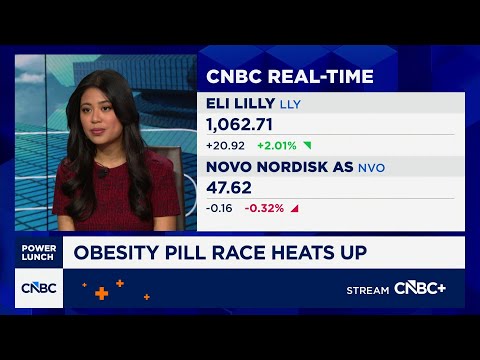
Obesity pill race heats up
Youtube· 2025-12-18 20:55
Core Insights - The trial data from Lily indicates that its obesity pill may serve as an effective maintenance treatment for individuals who wish to sustain their weight loss without the need for weekly injections like Wgoian Zepbound [2][3] - Participants who switched to the pill after initially using injections maintained most of their weight loss, with the WGOI group regaining only about 2 pounds and the Zeppbound group regaining around 11 pounds over a year [3] Pricing and Market Implications - The exact pricing for the obesity pill has not been disclosed, but initial estimates suggest a starting cost of $150 per month for cash-paying patients, significantly lower than the over $1,000 monthly cost for injectable versions [5][6] - The Trump administration's deal is expected to expand Medicare coverage for obesity drugs, marking a significant change anticipated in early to mid-2026 [7]

Obesity pill race heats up
CNBC Television· 2025-12-18 20:35
Let's get more now on the story. Pharma and biotech reporter Anukica Kim Constantino. Anukica, what's the story here.Is this pill going to be ready soon. >> Right. So, thanks for having me on today.So, basically the news today is that Lily has trial data showing that its obesity pill could be an effective maintenance treatment for people that want to preserve their weight loss but don't want to keep taking weekly injections like Wgoian Zepbound. So in this trial, they basically followed people that initiall ...
Worried About the Stock Market in 2026? These 3 Stocks Did Well During the Last Bear Market.
Yahoo Finance· 2025-12-18 19:05
Core Viewpoint - Concerns about potential market downturns in 2025 are prompting investors to consider safer investment options, particularly in blue chip stocks with strong fundamentals [1][2]. Group 1: Investment Strategies - Investors are advised to protect their portfolios by focusing on blue chip stocks that have good fundamentals and are likely to be resilient during market downturns [2]. - Diversifying investments into sectors that may perform better in a downturn is recommended [2]. Group 2: Company Analysis - AbbVie - AbbVie shares rose by 19% during the S&P 500 crash of over 19% in 2022, demonstrating stability and growth with a 3% increase in revenue and a profit margin exceeding 20% [5]. - The company is successfully replacing revenue lost from its top-selling drug Humira with new immunology drugs Skyrizi and Rinvoq, showcasing its innovation capabilities [6]. - AbbVie operates in multiple segments including oncology, aesthetics, and neuroscience, providing various growth avenues [7]. - The stock trades at 16 times estimated future earnings and offers a dividend yield of 3.1%, significantly higher than the S&P 500 average of 1.1%, making it a solid long-term investment [8]. Group 3: Company Analysis - Eli Lilly - Eli Lilly's shares increased by 32% in 2022, significantly outperforming the market, driven by the success of its GLP-1 drugs, Mounjaro for diabetes and Zepbound for weight loss [11].

Better Buy in 2026: Pfizer or Eli Lilly?
Yahoo Finance· 2025-12-18 17:05
Core Viewpoint - Eli Lilly has significantly outperformed Pfizer in stock performance, with a nearly 200% increase in 2023, while Pfizer has seen a decline of nearly 50% [1]. Growth Potential - Eli Lilly is focusing on GLP-1 drugs and expanding manufacturing capabilities, with a $6 billion investment in a new plant in Alabama to produce orforglipron [5]. - Pfizer has pursued acquisitions to enhance its pipeline, including a $43 billion acquisition of Seagen and a recent $7 billion deal for Metsera, aimed at obesity treatments [6]. - Eli Lilly is viewed as having a clearer growth path compared to Pfizer, which may take longer to realize the benefits of its acquisitions [7]. Financial Strength - Eli Lilly expects sales of approximately $63 billion in 2024, a 40% increase from $45 billion in the previous year, driven by strong demand for its GLP-1 drugs [8]. - Eli Lilly maintains a profit margin of around 31%, indicating robust net income growth alongside revenue increases [9]. - Pfizer is currently struggling to grow sales, and its acquisitions have not yet yielded significant financial benefits [8].

Lose Weight on Zepbound, Keep It Off With Eli Lilly's New Pill? Data Say That Works.
Barrons· 2025-12-18 16:54
Core Insights - Eli Lilly is set to launch a new pill named orforglipron next year [1] Company Summary - The new medication, orforglipron, is part of Eli Lilly's ongoing efforts to expand its product portfolio [1]

After Wegovy, Zepbound Shots, This Eli Lilly Oral Pill Can Help Maintain Weight Loss
Benzinga· 2025-12-18 16:29
Core Insights - The global obesity epidemic is driving pharmaceutical companies to invest in weight management solutions, resulting in increased clinical trials for anti-obesity medications [1] Group 1: Eli Lilly's Orforglipron Trial Results - Eli Lilly's Phase 3 trial of orforglipron demonstrated superior weight maintenance over 52 weeks compared to placebo after initial treatment with high doses of Wegovy or Zepbound [2][4] - At one year, orforglipron met primary and key secondary endpoints, showing effective weight maintenance as an adjunct to a healthy diet and physical activity [3] - Participants switching from Wegovy to orforglipron maintained an average weight difference of 0.9 kg, while those switching from Zepbound maintained an average difference of 5.0 kg [5] Group 2: Safety and Tolerability - The safety profile of orforglipron was consistent with previous studies, with common adverse events being mild-to-moderate gastrointestinal issues [6] - Discontinuation rates due to adverse events were 4.8% for orforglipron from Wegovy, 7.6% for placebo from Wegovy, 7.2% for orforglipron from Zepbound, and 6.3% for placebo from Zepbound [7] - No hepatic safety signals were observed in the trial [7] Group 3: Market Reaction - Eli Lilly's stock rose by 2.20% to $1064.73, nearing its 52-week high of $1111.99 [8]

口服减肥药orforglipron三期试验报捷 礼来(LLY.US)一度涨超3%
Zhi Tong Cai Jing· 2025-12-18 16:01
公司表示,该研究达到了主要终点及所有关键次要终点。安全性和耐受性方面,orforglipron的表现与此 前三期研究结果一致,符合每日一次口服给药的安全特征。 周四,礼来(LLY.US)股价一度涨超3%,截至发稿,该股涨幅缩窄至1.84%,报1061美元。消息面上,该 公司宣布,其口服减肥药orforglipron在一项三期临床试验中显示出优于对照的体重维持效果,适用于此 前已使用注射型减肥药(包括公司自身的Zepbound以及诺和诺德(NVO.US)的Wegovy)的肥胖或超重成年 人。 礼来援引ATTAIN-MAINTAIN试验的顶线数据称,在为期52周的研究中,从Wegovy或Zepbound转换为 orforglipron的患者,基本维持了此前通过注射药物获得的减重成果。数据显示,与对照相比,从 Wegovy转换的患者体重平均差异为0.9公斤,从Zepbound转换的患者体重平均差异为5.0公斤。 ...