Lilly(LLY)

Search documents
抑制暴食信号,对抗食物噪音!礼来替尔泊肽研究新进展
GLP1减重宝典· 2025-12-04 04:10
Core Viewpoint - The article discusses the potential of GLP-1 medications, particularly tirzepatide and semaglutide, in reducing food cravings and improving mental health in individuals with obesity and eating disorders, highlighting recent research findings and real-world survey results [4][8][10]. Group 1: Research Findings on Tirzepatide - A study monitoring brain activity in a patient with severe binge eating disorder found that tirzepatide temporarily suppressed food craving signals in the brain's reward center [4]. - The research involved four participants in a clinical trial for deep brain stimulation aimed at treating eating disorders, with one patient showing reduced food-related intrusive thoughts while on tirzepatide [4]. - However, after five months, the effects of tirzepatide diminished, and food cravings returned, suggesting that current GLP-1 drugs may need redesigning to target brain reward mechanisms for sustained impact on eating disorders [6]. Group 2: Real-World Impact of Semaglutide - The INFORM survey presented at the EASD conference revealed that 46% of participants using semaglutide reported a significant reduction in persistent food thoughts, with the percentage of those frequently experiencing such thoughts dropping from 62% to 16% [8][11]. - Additionally, the negative impact of food noise on life quality decreased from 60% to 20% among respondents, indicating a substantial improvement in mental health and lifestyle changes [11]. - Overall, 83% of participants expressed satisfaction with semaglutide treatment, with 64% reporting improved mental health and 76% adopting healthier lifestyles [11][12]. Group 3: Understanding Food Noise - Food noise refers to intrusive thoughts about food that are not related to hunger and can significantly affect the quality of life for individuals with obesity, complicating their weight loss efforts [10][14]. - This phenomenon is common among obese patients and can lead to feelings of guilt, shame, and anxiety, further hindering weight loss progress [14].


Companies Cut Prices For Blockbuster Weight-Loss Drugs
Forbes· 2025-12-03 20:10
Price Cuts and Market Dynamics - Eli Lilly has reduced the prices of its weight-loss drug Zepbound for cash-paying customers, with new monthly prices ranging from $299 to $449, down from $349 to $499 [2] - This price reduction follows a deal with the Trump Administration to lower prices for popular drugs and comes after Novo Nordisk also announced discounts for its GLP-1 drugs, Ozempic and Wegovy [3] - The White House has expanded Medicare coverage for GLP-1 medications, including those for obesity, reversing earlier policy [3] Consumer Demand and Accessibility - Approximately 40% of adults in the U.S. are estimated to be obese, leading to a surge in demand for GLP-1 injections, which have been costly and often inaccessible for many [5] - Ilya Yuffa from Lilly highlighted that many individuals needing obesity treatments still face significant coverage and cost barriers [5] Future Developments in Obesity Treatments - New obesity pills are in development, which could further increase access and lower prices, with Novo's pill expected to be approved soon and Lilly planning to submit its own for regulatory approval by year-end [6] - The Trump Administration has indicated that if these pills are approved, the initial dose could be priced at $150 per month [6] Innovations in Healthcare - The Forbes 30 Under 30 Healthcare list features entrepreneurs like Eunice Wu and Can Uncu, who are using AI to streamline pharmacy operations and reduce administrative burdens [7][8] - Their startup, Asepha, has raised over $4 million in venture funding to improve efficiency in processing prescriptions [7] Vaccine Regulation Changes - The CDC is set to vote on new recommendations for childhood vaccination schedules, which may include new restrictions, particularly concerning infant hepatitis B vaccines [11] - A memo from CBER Director Vinay Prasad suggests that the FDA plans to impose stricter regulatory requirements on vaccines, potentially impacting the approval of essential vaccines [12] - Rising cases of vaccine-preventable diseases, such as measles, are occurring amid these regulatory changes, highlighting a public health concern [13] Strategic Partnerships and Investments - Regeneron has entered a gene-editing partnership with Tessera Pharmaceuticals, paying $150 million upfront for a treatment targeting alpha-1 antitrypsin deficiency, with potential additional milestone payments of $125 million [14] - Health insurance startup Curative has raised $125 million at a valuation of $1.3 billion, focusing on preventive care [17]

As Eli Lilly Cuts Zepbound Prices, Should You Buy, Sell, or Hold LLY Stock?
Yahoo Finance· 2025-12-03 19:14
Core Insights - Eli Lilly and Company is a global pharmaceutical leader focused on areas such as diabetes, obesity, oncology, neuroscience, and immunology, known for landmark therapies and significant investment in R&D to meet unmet medical needs worldwide [1][5] Company Overview - Founded in 1876 by Colonel Eli Lilly, the company is headquartered in Indianapolis, Indiana, and operates in over 100 countries globally [2] Stock Performance - Eli Lilly's stock has shown strong performance in 2025, with a minor decline of approximately 7% over the past five days, a one-month gain of around 15%, a six-month rise of about 38%, and year-to-date gains exceeding 34% [3] - Compared to the S&P 500, which saw a 13% gain in the same period, Eli Lilly significantly outperformed with 52-week returns at 27% [4] Financial Performance - In Q3 2025, Eli Lilly reported revenue of $17.6 billion, up 54% year-over-year, surpassing analyst estimates [5] - Adjusted EPS reached $7.02, beating consensus forecasts by 16% to 19%, driven by volume growth from Mounjaro and Zepbound amid strong demand for GLP-1 therapies [5][6] - Gross margin improved to 82.9%, reflecting a favorable product mix despite pricing pressures, with U.S. revenue up 45% [6] Future Guidance - For full-year 2025, Eli Lilly raised its revenue guidance to $63 to $63.5 billion and adjusted EPS to $23 to $23.70, emphasizing sustained GLP-1 momentum and pipeline progress [7]
1 Reason to Buy Eli Lilly Hand Over Fist Before the New Year
The Motley Fool· 2025-12-03 18:10
Core Insights - Eli Lilly's stock has surpassed $1,000, driven by strong demand in the weight loss drug market, particularly for its products Mounjaro and Zepbound [1][4] - The company has seen over 100% stock growth in the past three years, with expectations for continued growth in both the short and long term [2] - A potential new growth driver is the weight loss pill orforglipron, which may significantly boost revenue starting in 2026 [5][9] Company Performance - Mounjaro and Zepbound are dual GIP/GLP-1 receptor agonists that have contributed to a revenue increase of over 50% in the third quarter [3][4] - Eli Lilly's current market capitalization is approximately $989 billion, with a gross margin of 83.03% and a dividend yield of 0.57% [7] Product Development - Orforglipron is positioned to be the world's first oral GLP-1 receptor agonist without dietary restrictions, potentially expanding the addressable market for Eli Lilly [8] - The company is investing billions in manufacturing capacity in Puerto Rico and Europe to support the production of orforglipron and other oral medications [7]
FDA Greenlights Eli Lilly Drug, Glencore Revives Copper Mine as Geopolitical Headwinds Mount
Stock Market News· 2025-12-03 18:08
Group 1: Eli Lilly and Company - Eli Lilly has received full FDA approval for pirtobrutinib (Jaypirca) for adults with relapsed or refractory chronic lymphocytic leukemia or small lymphocytic lymphoma who have previously been treated with a covalent BTK inhibitor [2] - The approval expands the drug's label to include patients earlier in their treatment course and converts a December 2023 accelerated approval to a traditional approval [2] - Jaypirca is the first and only FDA-approved non-covalent BTK inhibitor, with the expanded indication based on results from the Phase 3 BRUIN CLL-321 trial [2] Group 2: Glencore - Glencore plans to restart operations at its Alumbrera copper mine in Argentina by late 2026, with initial production expected in the first half of 2028 [3] - The company aims to significantly increase copper output to 1 million tons annually by the end of 2028 and approximately 1.6 million tons by 2035 [3] - The Alumbrera mine is projected to produce around 75,000 tonnes of copper, 317,000 ounces of gold, and 1,000 tonnes of molybdenum over four years [3] - Glencore has adjusted its 2026 copper production guidance downwards to 810,000–870,000 tonnes from a previous target of 930,000 tonnes due to setbacks at its Collahuasi mine in Chile [3] Group 3: Geopolitical Developments - Belgium has expressed significant reservations regarding the EU's plan to use frozen Russian central bank assets as collateral for a loan to Ukraine, citing unaddressed economic, financial, and legal risks [4] - The Belgian government fears being asked to bear the risks of this operation alone, particularly as most of the estimated €190-200 billion in Russian assets are held by Euroclear, a Brussels-based financial clearinghouse [4] Group 4: U.S. Political Landscape - U.S. Secretary of War Pete Hegseth is under scrutiny for endangering troops by using the Signal app to discuss classified military strike plans [5] - A watchdog investigation found that classified information was shared in an unclassified group chat that included a journalist, despite denials from Hegseth and the Pentagon [5] - House Speaker Mike Johnson faces increasing pressure from within his party, with prominent Trump ally Elise Stefanik criticizing his leadership and control over House Republicans [6]
U.S. FDA approves expanded indication for Lilly's Jaypirca (pirtobrutinib), the first and only non-covalent (reversible) BTK inhibitor, for adults with relapsed or refractory CLL/SLL previously treated with a covalent BTK inhibitor
Prnewswire· 2025-12-03 17:59
Core Insights - The FDA has granted approval to Jaypirca (pirtobrutinib) for treating adults with relapsed or refractory chronic lymphocytic leukemia (CLL) or small lymphocytic lymphoma (SLL) who have previously been treated with a covalent BTK inhibitor, expanding its indication to a broader patient population [1][2] - This approval converts the December 2023 accelerated approval for later-line CLL/SLL to a traditional approval, allowing earlier use of Jaypirca in treatment plans [1] - Jaypirca is the first and only FDA-approved non-covalent BTK inhibitor, providing a new therapeutic option for patients who have progressed on covalent BTK inhibitors [1][2] Company Overview - Eli Lilly and Company is focused on advancing treatments for various health challenges, including cancers, through innovative drug development [2] - The company emphasizes the importance of making medicines accessible and affordable while ensuring clinical trials reflect diverse populations [2] Product Details - Jaypirca is a highly selective non-covalent BTK inhibitor, with a unique binding mechanism that allows it to target the BTK pathway effectively in patients previously treated with covalent BTK inhibitors [1] - The drug is available in 100 mg and 50 mg tablets, administered as a once-daily dose of 200 mg until disease progression or unacceptable toxicity [1] Clinical Trial Insights - The BRUIN CLL-321 trial, a Phase 3 randomized study, involved 238 patients and assessed the efficacy of Jaypirca compared to investigator's choice therapies [1] - The primary endpoint of the trial was progression-free survival (PFS), with secondary endpoints including overall response rate (ORR) and overall survival (OS) [1] Market Context - CLL is one of the most common types of leukemia in adults, with approximately 23,690 new cases expected in the U.S. this year [1] - The expanded indication for Jaypirca aligns with the NCCN Clinical Practice Guidelines, indicating a significant potential market for the drug among CLL/SLL patients [1]

2 Trillion-Dollar Dividend Stocks to Buy and Hold for 10 Years
Yahoo Finance· 2025-12-03 11:45
Core Insights - Companies valued at $1 trillion or more are typically industry leaders with strong long-term growth potential, with Microsoft and Eli Lilly being notable examples of this trend [1] Group 1: Microsoft - Microsoft achieved a market cap of $4 trillion earlier this year, experiencing a pullback not due to operational issues but rather market fluctuations [3] - The company reported a revenue increase of 18% year-over-year for Q1 of fiscal year 2026, totaling $77.7 billion, with its cloud computing segment, Microsoft Azure, seeing a 40% sales growth [3][4] - Microsoft has $392 billion in contracted obligations within its cloud unit, marking a 51% year-over-year increase, driven by rising demand for AI-related services [4] - The partnership with OpenAI is expected to enhance Microsoft's growth, as OpenAI has contracted $250 billion in Azure services, and Microsoft retains IP rights to OpenAI's models until 2032 [5][6] - Although Microsoft's forward dividend yield is 0.8%, lower than the S&P 500 average of 1.2%, the company has increased its dividends by 152.8% over the past decade, making it attractive for dividend growth investors [6][7] Group 2: Eli Lilly - Eli Lilly has recently joined the trillion-dollar club, driven by significant medical advancements and the success of its drug tirzepatide, marketed as Mounjaro, which has become the best-selling drug globally [8]

大行评级丨美银:大幅上调礼来目标价至1286美元 重申“买入”评级
Ge Long Hui· 2025-12-03 08:04
Core Viewpoint - Bank of America significantly raised Eli Lilly's target price from $950 to $1286, reiterating a "Buy" rating due to the strong market position of its GLP-1 drugs, Zepbound and Mounjaro, in the obesity and diabetes sectors [1] Group 1: Market Position - Eli Lilly maintains a leading position in the complex competitive landscape of the obesity and diabetes market [1] - The company's GLP-1 drugs are recognized as holding the "number one" status in their respective markets [1] Group 2: Drug Development Progress - Eli Lilly's new drug development is progressing faster than expected, with the oral drug orforglipron anticipated to launch in early 2026, rather than the previously expected late 2026 [1] - This accelerated timeline is expected to enhance the company's revenue and profit forecasts for the upcoming year [1]
美股收盘:三大指数震荡收高,光通信牛股再创新高
Feng Huang Wang· 2025-12-02 23:21
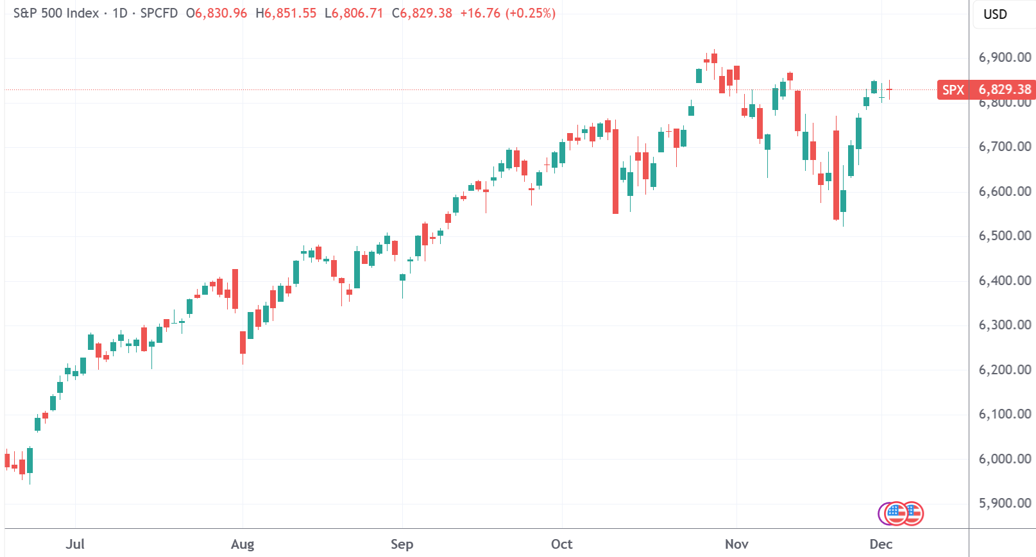
Market Overview - The cryptocurrency market has stabilized, leading to a rise in Bitcoin and tech stocks, which boosted trading sentiment and resulted in slight gains for the three major stock indices [1] - As of the market close, the S&P 500 index rose by 0.25% to 6829.37 points, the Nasdaq Composite increased by 0.59% to 23413.67 points, and the Dow Jones Industrial Average gained 0.39% to 47474.46 points [1] Market Sentiment and Predictions - The market is awaiting catalysts for a potential "Santa Rally," with more stocks declining than rising in the S&P 500 [3] - Analysts suggest that the market may need to consolidate before reaching new highs, with a mixed outlook for December [3] Stock Performance - Notable stock movements include Nvidia up by 0.86%, Apple up by 1.09%, and Boeing up by 10.15% due to expectations of returning to positive cash flow by 2026 [3][4] - Conversely, some stocks like Broadcom and Tesla saw declines of 1.17% and 0.21% respectively [3] Cryptocurrency and Related Stocks - Bitcoin's rebound of 6% positively impacted related stocks like MSTR and BMNR, while ABTC, linked to the Trump family, plummeted by 38% due to a lock-up expiration [6] - The Nasdaq China Golden Dragon Index fell by 0.65%, with Alibaba down by 1.91% and NIO down by 2.9% [6] Company Developments - Nvidia's CFO stated that the $100 billion investment in OpenAI has not yet been included in revenue guidance, as it is still in the letter of intent stage [7] - Amazon AWS launched its first 3nm AI chip, Trainium3, which boasts a performance increase of 4.4 times compared to its predecessor [8] - AWS also introduced a new large model training service, Nova Forge, allowing businesses to customize training with proprietary data [9] Philanthropic Initiatives - Dell's founders announced a donation of $6.25 billion to help establish investment accounts for 25 million American children, with each account receiving $250 [10]


Eli Lilly and Company (LLY) Presents at Citi Annual Global Healthcare Conference 2025 Transcript
Seeking Alpha· 2025-12-02 18:43
Core Insights - The company has made significant progress in its portfolio over the last few years, particularly in international markets [1] - There has been a focus on supply chain management to ensure successful product launches in various markets outside the U.S. [1] - Recent quarters have shown success in gaining traction in new markets, with multiple new product launches contributing to this growth [1] - A notable portion of the success is attributed to products related to obesity and self-pay models, with valuable insights gained from these experiences in both the U.S. and international markets [1]