
LENOVO GROUP(LNVGY)

Search documents
城市超级智能体落地河南 联想集团与郑州航空港区签署战略合作协议
Zheng Quan Shi Bao Wang· 2025-11-12 11:53
Core Insights - Lenovo Group has signed a strategic cooperation agreement with Zhengzhou Airport Economy Comprehensive Experimental Zone to establish the Lenovo Intelligent Body Factory Central China Headquarters project, aiming to create the largest intelligent innovation incubation base in China [1][2] Group 1: Strategic Cooperation - The partnership will leverage Lenovo's "1+N Intelligent Body" technology architecture to deploy intelligent applications across five key areas: cross-border trade, smart manufacturing, smart energy, smart tourism, and health [1][2] - The goal is to attract over 100 upstream and downstream enterprises related to large models and register 100 large models, referred to as the "one hundred" target [1] Group 2: Regional Development - Zhengzhou Airport Economy Comprehensive Experimental Zone plays a crucial role in China's domestic circulation, connecting various regions and actively promoting the development of the digital economy and artificial intelligence industry [1][2] - Lenovo has been focusing on artificial intelligence since 2017, proposing the "Lenovo Smart China" vision and building a comprehensive AI strategy based on a new IT architecture [1][2] Group 3: Intelligent Body Technology - The Lenovo City Super Intelligent Body integrates advanced AI technologies such as deep learning, natural language processing, knowledge graphs, and edge computing, forming a city-level intelligent system with autonomous perception, intelligent decision-making, and collaborative execution capabilities [3] - The "1" in the architecture represents a unified super intelligent body hub, while "N" signifies multiple specialized intelligent bodies trained on domain-specific large models, capable of complex scene reasoning and multi-task parallel processing [3]
IDC前瞻2026中国智能终端市场:联想(00992)等AI终端企业将迎来爆发
智通财经网· 2025-11-12 11:13
Core Insights - The article emphasizes that the Chinese smart terminal market is entering an AI-native era, where AI will reshape core values and interaction methods, driving deep innovation across ecosystems, scenarios, and categories, becoming a core engine for economic transformation and industrial upgrading [1][2] Industry Overview - IDC predicts that by 2026, the shipment volume of smart terminals in China will exceed 900 million units, with traditional AI terminal penetration expected to surpass 93% by 2027, reflecting a 4% year-on-year growth [2][3] - The transition from demographic dividends to "AI dividends" positions smart terminals as crucial carriers of new productive forces [2] - The integration of AI, computing power, and data elements, supported by policy, will drive new economic models and innovations, making AI a key tool for enterprises to enhance productivity [2][3] Company Positioning - Lenovo has established a strong competitive barrier in the smart terminal sector, leading the global PC market with a shipment of 19.4 million units and a market share of 25.5% in Q3 2025 [3] - Lenovo's AI PC business continues to lead globally, supported by its unique AI-native technology system and strong competitiveness in both consumer and commercial sectors [3] Product Innovations - Lenovo's enterprise-level super intelligent agent, launched in May 2025, has generated revenue of 1.89 billion yuan, supporting over 1 million interactions daily and significantly improving user engagement and order conversion rates [4] - The Tianxi personal super intelligent agent enhances user experience by providing proactive services and seamless collaboration across multiple devices [5] Market Trends - The demand for AI terminals is expected to drive significant growth in the smart service robot market, with a projected growth rate of 54% by 2026 [6] - Lenovo's global operations leverage a distributed manufacturing network to enhance local delivery and efficiency, significantly reducing delivery times and increasing market competitiveness [6][7] Strategic Initiatives - Lenovo is exploring new terminal forms and vertical scenarios, including AI notebooks and personalized learning agents, to capture growth in the education sector [7] - The company is also enhancing its supply chain efficiency through AI-driven quality management and intelligent supply chain control, leading to a 45% improvement in initial failure rates over five years [8] Competitive Landscape - IDC highlights that the core competitiveness of AI-native terminals will be defined by natural interaction, diverse forms, and scenario-based solutions, which Lenovo is addressing through its hybrid AI strategy [9] - Lenovo's integration of technology innovation, product deployment, ecosystem collaboration, and global capabilities positions it as a benchmark for Chinese smart terminal companies aiming for global expansion [9]
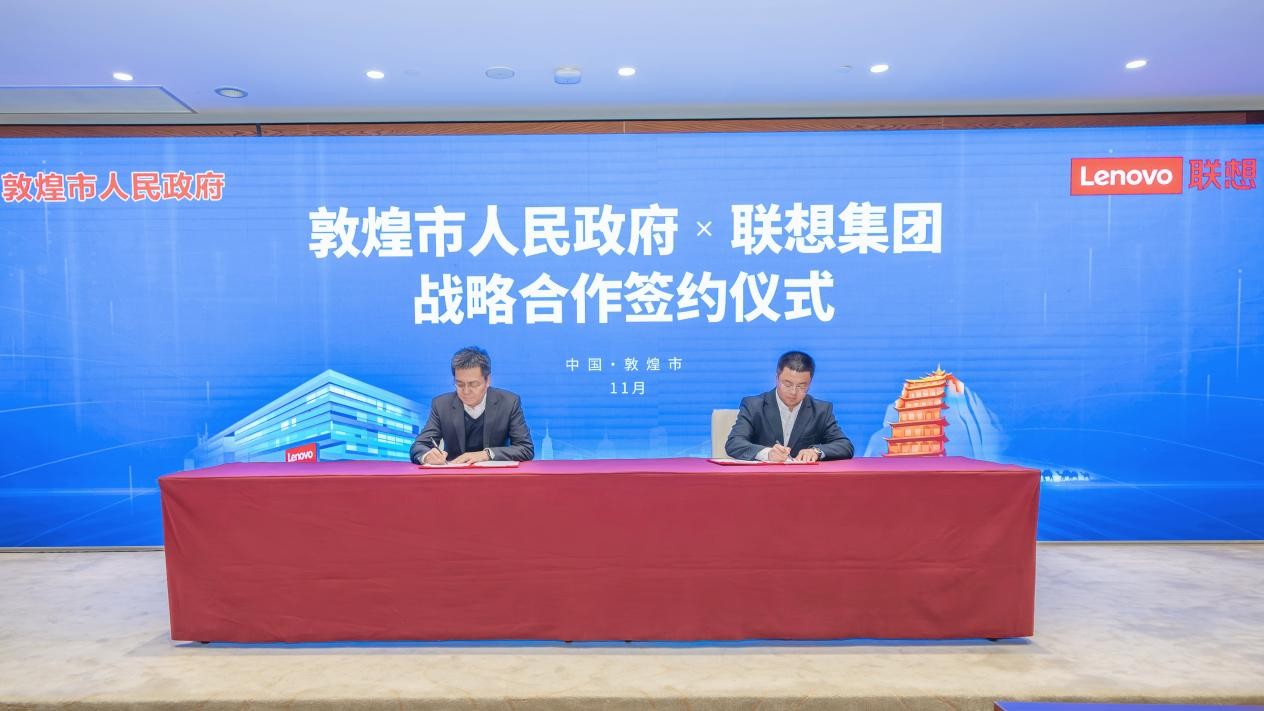
联想集团与敦煌市共建城市超级智能体,开创丝路古城智能化发展新篇章
3 6 Ke· 2025-11-10 11:22
Core Insights - Lenovo Group has signed a strategic cooperation agreement with Dunhuang City to leverage its "full-stack AI" strategy and urban super-intelligent body technology to drive intelligent transformation in various sectors including culture and tourism, agriculture, low-altitude economy, and urban governance [1][6][9] Group 1: Strategic Cooperation - The partnership aims to create a new benchmark for smart city construction along the Silk Road, facilitating Dunhuang's transition into the smart city 4.0 era [1][6] - Dunhuang, a UNESCO World Heritage site, is recognized for its rich cultural heritage and is a key city along the Belt and Road Initiative, actively promoting digital economy and smart tourism [3][6] Group 2: Technological Framework - Lenovo's urban super-intelligent body utilizes an advanced "1+N intelligent body" architecture, integrating multiple AI technologies such as deep learning and natural language processing to form a city-level intelligent system [7][8] - The "1" represents a unified super-intelligent core, while "N" denotes multiple specialized intelligent bodies trained for specific domains, ensuring knowledge sharing and collaborative capabilities [7][8] Group 3: Areas of Focus - The collaboration will enhance four core areas: cultural heritage digital protection, smart agriculture, low-altitude economic development, and modern urban governance [8][9] - AI technology will be employed to create immersive tourism experiences, optimize scenic area management, and improve agricultural production precision [8][9] Group 4: Future Directions - Lenovo plans to continue advancing large model technology across various sectors, aiming to build an open technological ecosystem that supports the digital transformation of traditional urban management [11] - The initiative is expected to provide a replicable and scalable model for intelligent development in western cultural cities [11]

指数调整红利落地:联想集团跻身MSCI权重增长阵营
Ge Long Hui· 2025-11-10 09:10
Core Viewpoint - MSCI announced changes to the MSCI China Index, adding 26 stocks and removing 20, effective after market close on November 24 [1] Group 1: Changes in Index Constituents - Nine new stocks listed in Hong Kong include China Gold International (02099.HK), Zijin Mining International (02259.HK), UBTECH Robotics (09880.HK), Ganfeng Lithium (01772.HK), Dongfeng Motor Group (00489.HK), Crystal International (02228.HK), China Nonferrous Mining (01258.HK), Rongchang Biopharma (09995.HK), and GF Securities (01776.HK) [1] - Four stocks removed from the index include China Everbright Bank (06818.HK), Beijing Enterprises Water Group (00371.HK), AVIC Trust (00696.HK), and China Resources Pharmaceutical (03320.HK) [1] Group 2: Impact on Stock Weights - The adjustment will affect the free float factors of 19 companies and the number of shares for 142 companies, leading to changes in index weightings [1] - New entrants like China Gold International, Zijin Mining International, UBTECH Robotics, and Ganfeng Lithium will see their weights increase, while Tencent (00700.HK), Alibaba-W (09988.HK), Kuaishou-W (01024.HK), and China Everbright Bank will experience the largest declines in weight [2] Group 3: Predicted Fund Flows - Expected inflows for stocks with increased weights include: - China Gold International (02099.HK): +0.129%, inflow of $187 million - Zijin Mining International (02259.HK): +0.12%, inflow of $173 million - UBTECH Robotics (09880.HK): +0.116%, inflow of $167 million - Ganfeng Lithium (01772.HK): +0.093%, inflow of $134 million - Dongfeng Motor Group (00489.HK): +0.092%, inflow of $133.6 million [2] - Expected outflows for stocks with decreased weights include: - Tencent (00700.HK): -0.231%, outflow of $334 million - Alibaba-W (09988.HK): -0.137%, outflow of $198 million - Kuaishou-W (01024.HK): -0.061%, outflow of $88.1 million - China Everbright Bank (06818.HK): -0.047%, outflow of $68.1 million [2][3]

上海国投与联想集团合作发起基金,首期规模10亿元
Xin Lang Cai Jing· 2025-11-10 08:22
Group 1 - The 2025 Lenovo Venture CEO Annual Conference was held in Shanghai on November 8, themed "Silicon-based Tide, Innovative World" [1] - Shanghai Guotou, along with Shanghai Future Industry Fund and Shanghai Pudong Venture Capital, signed an agreement to establish the Lenovo Shanghai Fund [1] - The initial scale of the Lenovo Shanghai Fund is set at 1 billion RMB, focusing on systematic investment in cutting-edge technology and future industries [1]
联想(00992)上海基金正式落地 10亿资本加码前沿科技与产学研融合
智通财经网· 2025-11-09 08:04
Core Insights - Lenovo Group has established the Lenovo Shanghai Fund with an initial scale of 1 billion RMB, focusing on cutting-edge technology and future industries to drive innovation and capital infusion for technology transformation and industrial upgrading [1][2] Group 1: Fund Establishment and Objectives - The Lenovo Shanghai Fund aims to integrate capital, industry, and research resources, enhancing Lenovo's full-chain layout in the AI industry while providing support for cutting-edge technology companies in Shanghai and nationwide [2] - The fund's core objective is to promote the integration of production, education, and research innovation, facilitating the commercialization of technological achievements [2] Group 2: AI Strategy and Developments - Lenovo's CEO, Yang Yuanqing, emphasized that future AI will center around individuals and enterprises, leading to personalized and diverse demands, which necessitates breaking through the limitations of single models and ecosystems [1] - Lenovo has already made early investments in the hybrid AI field, with its "Tianxi Personal Super Intelligence" achieving an average weekly active user rate of 40% since its launch in May 2023 [1] - The company plans to advance a "one body, multiple ends" strategy in the personal intelligence sector, developing various intelligent terminal forms and continuously enriching the application ecosystem [1] Group 3: Investment and Collaboration - Lenovo Capital has invested in over 300 innovative technology companies over nine years, with nearly 50% of these being recognized as "specialized, refined, distinctive, and innovative" enterprises [2] - More than 70 invested companies are collaborating around Lenovo's hybrid AI architecture, covering essential areas such as computing infrastructure, model development, and application implementation [2] - The establishment of the Lenovo Shanghai Fund is seen as a significant step in deepening Lenovo's hybrid AI strategy and supporting Shanghai's development as a hub for future industrial innovation [2]
联想集团与敦煌市签署城市超级智能体战略合作协议
Xin Hua Cai Jing· 2025-11-07 14:06
Core Insights - Lenovo Group has signed a strategic cooperation agreement with Dunhuang City, Gansu Province, to leverage its "full-stack AI" strategy and urban super-intelligent body technology to drive intelligent transformation in various sectors including culture and tourism, agriculture, low-altitude economy, and urban governance [2][3] Group 1: Strategic Cooperation - The partnership aims to establish a new benchmark for smart city construction along the Silk Road, assisting Dunhuang in entering the era of Smart City 4.0 [2] - The collaboration will utilize Lenovo's advanced technologies in AI, big data, IoT, and cloud computing, combined with Dunhuang's unique cultural tourism resources and geographical advantages [2][3] Group 2: Technology Framework - Lenovo's urban super-intelligent body is based on advanced large model technology and a multi-agent collaborative architecture, forming a leading "1+N intelligent body" technology system [3] - The "1" represents a unified super-intelligent core that integrates four key engines: multi-modal perception, cognitive reasoning, decision planning, and intelligent orchestration, capable of processing vast amounts of heterogeneous data in real-time [3] - The "N" signifies multiple specialized intelligent bodies trained on domain-specific large models, equipped with capabilities for understanding domain knowledge, complex scenario reasoning, and parallel processing of multiple tasks [3] Group 3: Implementation and Recognition - Lenovo's urban super-intelligent body has been implemented in various cities across China, including Wuyishan, Yichang, Hohhot, Shanghai Hongkou, Shaanxi Xixian New Area, and Shenzhen Guangming District [4] - The initiative has received recognition, winning the "2025 Digital Government Innovation Solution" award from the China Internet Association for its innovative technology architecture and extensive practical applications [4]
联想集团与敦煌市共建城市超级智能体 加速丝路古城智能化
Zheng Quan Ri Bao· 2025-11-07 12:41
Core Insights - Lenovo Group has signed a strategic cooperation agreement with Dunhuang City to promote intelligent transformation in various sectors, leveraging Lenovo's AI strategy and technology advantages [2][3] - The partnership aims to establish a new benchmark for smart city construction along the Silk Road, facilitating Dunhuang's transition into the Smart City 4.0 era [2][4] Group 1: Strategic Cooperation - The agreement emphasizes mutual benefits, compliance with laws, and the integration of smart technology with urban development [4] - Lenovo's City Super Intelligent Body will utilize advanced AI technologies, including deep learning and natural language processing, to create a city-level intelligent system [4][5] Group 2: Sector-Specific Applications - In the cultural tourism sector, AI will be used for the digital protection and inheritance of Dunhuang's cultural heritage, enhancing visitor experiences through data-driven management [5] - The agricultural sector will benefit from smart agriculture systems aimed at precision management and brand development for local products [5] - The low-altitude economy will be supported through the development of related industries in conjunction with Dunhuang International Airport [5] - Urban governance will see improvements through real-time monitoring and intelligent regulation of city operations [5] Group 3: Future Directions - Lenovo plans to continue applying large model technology across various sectors, contributing to the creation of smarter, more efficient, and livable modern cities [5]
联想集团董事长兼CEO杨元庆:以“人本智能”推动AI普惠
Xin Hua Cai Jing· 2025-11-07 12:10
Core Viewpoint - Lenovo Group's Chairman and CEO Yang Yuanqing emphasizes the importance of a "human-centered intelligence" approach in the AI era, advocating for technology goals aligned with human values, practices that bridge development gaps, and a multi-stakeholder governance system to establish "human-centered intelligence" as the foundation of a shared digital future [2][3]. Group 1: AI Innovation and Human-Machine Interaction - The current wave of AI model innovation is not only about creative functionalities like text-to-image and text-to-code but also about redefining human-machine interaction, making human-machine collaboration a new paradigm [2]. - The shift from "Internet+" to "AI+" signifies a transition from enhancing connectivity to emphasizing "human-centric power," where the ability to harness AI becomes a new productive force driving industrial transformation [2]. Group 2: Hybrid AI and User-Centric Development - Hybrid AI is seen as an effective pathway for empowering various industries, focusing on user-centered personal superintelligence and smart devices, which can evolve into "intelligent twins" for individuals and enterprises [3]. - The new human-machine relationship necessitates a fresh perspective on AI development, where technology companies are responsible for ensuring that AI innovations align with human needs and ethical standards [3]. Group 3: Initiatives for Human-Centered Intelligence - Lenovo Group, as a proponent of the "human-centered intelligence" concept, has initiated the "Human-Centered Intelligence Development and Governance Initiative" in collaboration with various organizations, aiming to create an AI ecosystem that prioritizes human welfare and ethical considerations [4]. - The initiative has already attracted participation from 50 companies and institutions, highlighting a collective commitment to promoting the "human-centered intelligence" development philosophy [4].
联想集团杨元庆:以“人本智能”推动AI普惠
Zheng Quan Shi Bao Wang· 2025-11-07 09:22
Group 1 - Lenovo Group was awarded the "Outstanding Contribution Award" at the 2025 World Internet Conference for its leadership in green and intelligent supply chain construction and its pioneering practices in empowering education and public welfare with AI technology [1] - CEO Yang Yuanqing emphasized the company's commitment to continue innovating with cutting-edge AI technology and to actively undertake corporate social responsibility, contributing to China's modernization and social economic progress [1] - Yang Yuanqing published an article in "China Cybersecurity" magazine, advocating for a human-centered approach to AI that aims to bridge the development gap and enhance governance systems, positioning "human-centered intelligence" as a foundational value for a shared digital future [1] Group 2 - The impact of "Artificial Intelligence+" on various industries is characterized by "human-centric power," where the ability to harness AI has become a new driving force for industrial transformation [2] - The current trend of hybrid AI is seen as an effective path for empowering various sectors, focusing on user-centered personal superintelligence and customized local models for enterprises [2] - Lenovo Group, along with the China ESG 30 Forum, initiated the "Human-Centered Intelligence Development and Governance Initiative," which has attracted 50 companies and organizations to commit to promoting a human-centered AI development ecosystem [2]