MP Materials(MP)

Search documents
Trump Administration Reportedly Exploring Taking Stakes In Quantum Computing Companies— IonQ, Rigetti And D-Wave Discussing Move
Yahoo Finance· 2025-10-23 21:31
Core Insights - The Trump administration is negotiating with U.S. quantum computing companies for equity stakes in exchange for federal funding [1][2] - Companies involved include IonQ Inc., Rigetti Computing, and D-Wave Quantum, with discussions led by U.S. Deputy Commerce Secretary Paul Dabbar [2][3] - Funding awards are expected to start at $10 million each, with other firms like Quantum Computing Inc. and Atom Computing considering similar arrangements [3] Government Involvement - The U.S. government previously acquired nearly a 10% stake in Intel by converting $9 billion in grants into equity [5] - The Department of Defense gained a roughly 15% stake in MP Materials, potentially making it the largest shareholder [6] Industry Developments - Microsoft has demonstrated advancements in practical quantum computing, indicating that significant breakthroughs may occur in the near future [7] - Other major players like Google and IBM are also reporting accelerated progress in quantum computing technology [7]






Trump admin not negotiating with quantum firms with equity stakes: Commerce official
CNBC· 2025-10-23 16:37
Group 1 - The U.S. government is not currently negotiating equity stakes with quantum computing companies in exchange for federal funding [2] - The denial follows reports that the Trump administration was in talks with companies such as IonQ, Rigetti Computing, and D-Wave Quantum [3] - During trading, Rigetti Computing rose by 7%, IonQ by 7%, D-Wave by 13%, and Quantum Computing by 5% [3] Group 2 - The Trump administration has previously taken equity stakes in companies deemed vital to U.S. national security, including a 10% stake in Intel and a 15% stake in MP Materials [4] - Experts note that the U.S. government's increasing interest in acquiring stakes in private companies is unprecedented in recent decades [5] - Commerce Secretary Howard Lutnick has stated that the government should benefit from a company's success, particularly when federal funds are involved [5]


MP vs. LYSDY: Which Non-China Rare-Earth Stock Has More Upside?
ZACKS· 2025-10-23 16:11
Core Insights - MP Materials and Lynas Rare Earths Limited are key players in the global rare earth supply chain, essential for high-performance magnets in EVs, defense, and high-tech applications. The renewed investor interest in rare earth stocks is driven by U.S.-China tensions, with China controlling approximately 70% of global rare earth mining and 90% of processing capacity. Both companies are positioned to support the West's efforts for critical mineral independence and reduce reliance on Chinese supply [1][2]. Group 1: Company Overview - MP Materials, based in Las Vegas, NV, is the only fully integrated rare earth producer in the U.S., covering the entire supply chain from mining to magnet manufacturing, with a market capitalization of $12.36 billion [3]. - Lynas, located in Perth, Australia, is valued at around $11.98 billion and is involved in the exploration, development, and processing of rare earth minerals in Australia and Malaysia [3]. Group 2: Financial Performance - In Q2 2025, MP Materials reported an 84% year-over-year revenue increase to $57.4 million, producing 597 metric tons of NdPr, a 119% increase from the previous year. REO production rose 45% to 13,145 metric tons [6][10]. - Lynas produced 6,558 tons of NdPr in fiscal 2025, a 16% year-over-year increase, while its revenues rose 20% to AUD 556.5 million ($362 million) due to increased NdPr production and sales [14]. Group 3: Strategic Developments - MP Materials secured a deal with the U.S. Department of Defense to develop a fully integrated domestic rare earth magnet supply chain, which includes equity investments and loan financing [8]. - Lynas achieved its first commercial production of Heavy Rare Earths outside China in decades, marking a significant milestone in its operations [10][13]. Group 4: Growth Initiatives - MP Materials is set to construct a second domestic magnet manufacturing facility, increasing U.S. rare earth magnet manufacturing capacity to 10,000 metric tons [9]. - Lynas has completed its Lynas 2025 growth initiative, focusing on increased capacity and efficiency, and is now embarking on its "Towards 2030" strategy to optimize performance and expand its resource base [15][16]. Group 5: Market Performance and Valuation - Over the past three months, MP Materials stock gained 13.4%, while Lynas saw a 63.5% increase [19]. - MP Materials trades at a forward price-to-sales ratio of 20.49X, significantly higher than the industry average of 1.45X, while Lynas trades at 19.44X, also above the industry average [20]. Group 6: Investment Outlook - MP Materials is experiencing rising costs that may pressure earnings, with expectations of a full-year loss, while Lynas is better positioned with strong growth projections and upward estimate revisions [23]. - Lynas is viewed as a more compelling investment opportunity due to its recent performance and favorable valuation, currently holding a Zacks Rank 2 (Buy), compared to MP Materials' Zacks Rank 4 (Sell) [24].
Two companies and one sector Team Trump could invest in next
Yahoo Finance· 2025-10-23 14:15
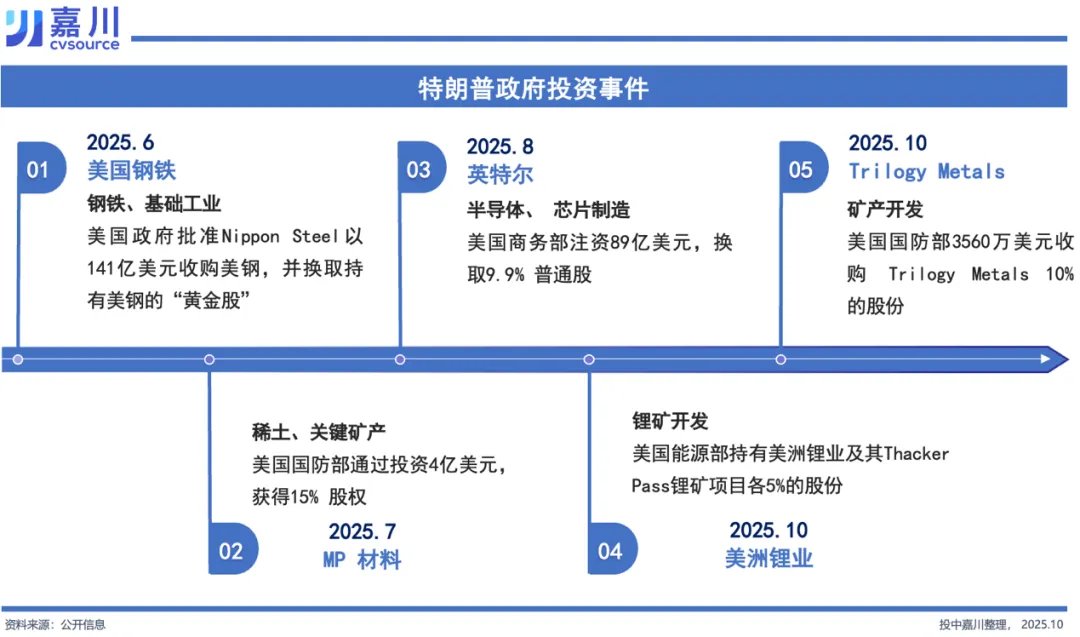
Group 1 - The Trump administration has taken ownership stakes in five publicly-traded companies, including Intel (10%), MP Materials (15%), Lithium America (10%), Trilogy Metals (10%), and U.S. Steel Corp. (golden share partnership) [1] - At least five quantum computing funds are in discussions for federal funding in exchange for equity stakes, with companies like IonQ, Rigetti Computing, and D-Wave Quantum being potential targets [2] - The U.S. government's direct equity investment in private critical mineral companies signifies a shift in industrial policy, moving away from traditional methods like grants and loans [4] Group 2 - The motivation behind the government's equity stakes is to accelerate domestic mineral production, reduce reliance on China, and rebuild critical supply chains [5] - Lockheed Martin is identified as a potential candidate for government equity investment due to its alignment with national interests and reliance on federal budgets [6]



MP Stock To $150?
Forbes· 2025-10-23 10:20
Core Thesis - MP Materials aims to transition from low-margin mining to higher-margin manufacturing, with a revenue of approximately $204 million in 2024, impacted by declining rare-earth prices and initial costs from its magnet facility [3][4] - The company is expected to see significant revenue acceleration over the next two years, with EBITDA potentially reaching $500–700 million by 2027, driven by margin expansion and operational leverage [4] Valuation and Growth Potential - MP currently trades at a high 52× EV/EBITDA, indicating that the market anticipates years of growth; if profitability objectives are met and the multiple decreases to about 40x, the enterprise value could exceed $25 billion, leading to a share price between $140 and $150 [5][8] - The stock has already factored in a significant turnaround, but not the full downstream earnings potential; if EBITDA expands as expected, a $140–150 share price is plausible [8][9] Key Growth Drivers - MP Materials possesses end-to-end capabilities in the rare-earth supply chain, enhancing profit potential beyond raw ore sales [11] - The demand from the electric vehicle and defense sectors for neodymium and praseodymium magnets positions MP at the center of a national supply chain priority [11] - U.S. government support through funding, tax incentives, and contracts from the Department of Defense aids in accelerating magnet production [11] - As production scales, gross margins could improve significantly, transitioning from mining to manufacturing is crucial for enhanced EBITDA leverage [11] Risks - Execution risk exists in scaling complex separation and magnet production processes, which could hinder profitability [11] - The capital intensity of establishing processing facilities requires substantial upfront investment, which may dilute shareholder equity [11] - Commodity price volatility poses a risk, as prices for rare-earth elements are cyclical and sensitive to China's export policies [11] - Competition from China, which dominates the rare-earth sector, could lead to price undercutting or export restrictions [11] - Following a significant stock surge, elevated expectations mean that production setbacks or cost overruns could lead to sharp declines [11]

MP Materials: Heart Of The Free World's Geopolitical 'Gold' Rush (NYSE:MP)
Seeking Alpha· 2025-10-22 13:44
Core Insights - The article discusses "new-era gold," commonly referred to as "rare earths," highlighting its significance in modern technologies and the global market size of approximately $15 billion annually [1] - China currently dominates the rare earth market, controlling around 90% of refined rare earth production, which raises concerns about supply chain dependencies [1] Industry Overview - The global rare earth market is valued at about $15 billion, indicating its critical role in supporting various technological advancements [1] - Rare earth elements are essential for numerous applications, including electronics, renewable energy, and defense technologies, underscoring their importance in the modern economy [1] Market Dynamics - China's control of approximately 90% of the refined rare earth market presents both opportunities and risks for global supply chains, as reliance on a single country for these critical materials can lead to vulnerabilities [1]

MP Materials: Heart Of The Free World's Geopolitical 'Gold' Rush
Seeking Alpha· 2025-10-22 13:44
Group 1 - The global rare earth market is approximately $15 billion annually and is essential for modern technologies [1] - China dominates the rare earth market, controlling about 90% of refined rare earth output and around 60% of the overall market [1]

Heineken N.V. (HEIA:CA) Q3 2025 Sales Call Transcript
Seeking Alpha· 2025-10-22 13:43
Group 1 - The presentation is hosted by the Chief Financial Officer, Harold van den Broek, and includes a trading update for Q3 2025 [1] - The presentation features forward-looking statements and expectations based on management's current views, which may involve known and unknown risks and uncertainties [2]

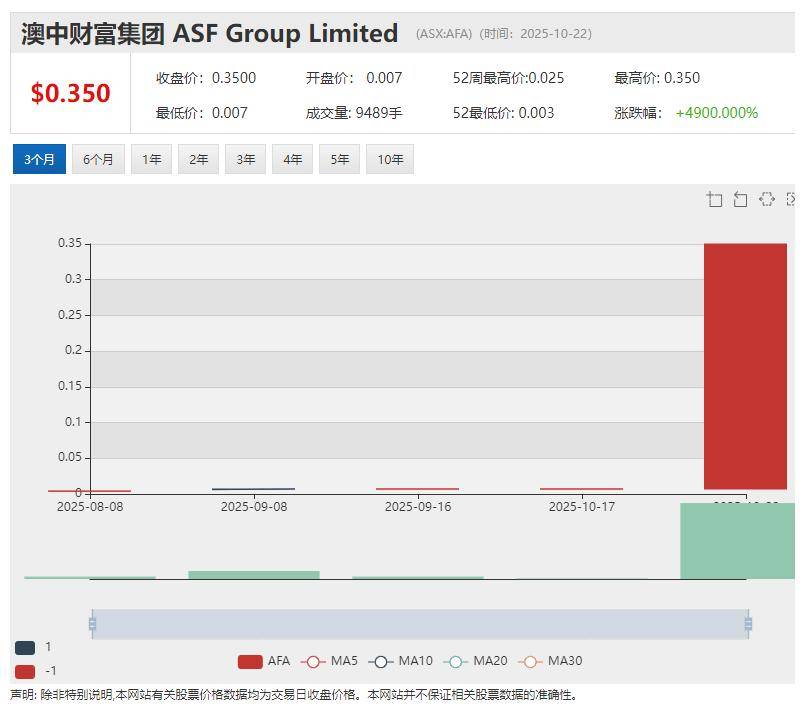
早盘拉升49倍后紧急停牌 ASF Group (ASX:AFA)宣布注册为数字货币交易所提供商
Sou Hu Cai Jing· 2025-10-22 11:52
Group 1 - ASF Group (ASX:AFA) experienced a dramatic stock price surge of 4900% before being suspended for inquiries by the Australian Stock Exchange due to unusual trading activity [3] - The registration with AUSTRAC marks a significant milestone for ASF Capital in integrating traditional financial markets with regulated digital asset services [3] - ASF Capital plans to develop secure, transparent, and compliant trading solutions for wholesale and institutional clients [3] Group 2 - Astron Ltd (ASX:ATR) received a conditional support letter from Export Finance Australia for up to AUD 80 million in financing for its Donald rare earths project [6][8] - The Donald project is set to produce rare earth elements for processing in the U.S. by Energy Fuels, with production expected to commence in the second half of 2027 [8] - ATR's stock price surged by 22.86%, nearly tripling since the end of June [8] Group 3 - Genetic Signatures Ltd (ASX:GSS) reported a 58.33% increase in stock price following a strong quarterly report, with sales revenue reaching AUD 5.4 million, a 20% quarter-on-quarter increase and a 15% year-on-year increase [10][12] - The company has successfully expanded its market presence in the U.S., including securing contracts with major healthcare institutions [12] Group 4 - Power Minerals Ltd (ASX:PNN) is gaining attention due to its Gamma rare earth project, which has seen a stock price increase of nearly 240% since June [16][18] - The company is pursuing a dual listing on the OTCQB market in the U.S. to attract North American investors [16][18] - PNN plans to accelerate exploration and permitting for the Gamma project after the acquisition is completed [18] Group 5 - Resolution Minerals Ltd (ASX:RML) saw a 34% increase in stock price after securing AUD 2 million in funding from Tribeca Investment Partners [19][21] - The funds will be used to advance the Horse Heaven antimony-silver project [21] Group 6 - Mesoblast Limited (ASX:MSB) reported a 69% quarter-on-quarter increase in net revenue for its Ryoncil® product, reaching USD 19.1 million [25][26] - The product's growth is attributed to increased clinical demand and support from U.S. insurance [26] Group 7 - Larvotto Resources Limited (ASX:LRV) received a non-binding acquisition proposal from United States Antimony Corporation, which currently holds about 10% of LRV's shares [27][29] - The proposal aims to create a vertically integrated antimony group across the U.S. and Australia [29] Group 8 - Great Northern Minerals Ltd (ASX:GNM) has seen its stock price increase over sixfold in two months following the acquisition of the Catalyst Ridge rare earth project [31][33] - The project is strategically located near the only large-scale rare earth producer in the U.S., MP Materials [33] - GNM plans to initiate drilling in 2026 and is in discussions with potential strategic partners [37]


半年出手5次,美国国资到底投了啥?
Hu Xiu· 2025-10-21 23:15
Core Viewpoint - The U.S. government, under Trump's administration, has shifted its approach to industrial policy by directly acquiring equity stakes in private companies, particularly in critical sectors like semiconductors, rare earths, and steel, as a strategic response to geopolitical challenges [2][4][17]. Group 1: Government Investments - Since January, the Trump administration has made five significant investments in key manufacturing sectors, marking a transition from traditional subsidies to direct equity stakes [4][13]. - The first transaction occurred in June, where the U.S. government approved Nippon Steel's $14.1 billion acquisition of U.S. Steel, gaining "golden shares" that provide control over critical decisions [8]. - In July, the government invested $400 million in MP Materials, acquiring 15% of the company, which is the only U.S. firm capable of rare earth mining and processing [9][14]. - In August, the government invested $8.9 billion in Intel for a 9.9% stake, aiming to bolster domestic chip production [10][11]. - In October, the government acquired 5% stakes in Lithium Americas and Trilogy Metals, focusing on lithium mining to support the electric vehicle industry [12][13]. Group 2: Funding Sources - The funding for these investments primarily comes from previously approved budgets, such as the $400 billion Inflation Reduction Act, which allocated $53 billion for semiconductor support [14][16]. - The Department of Commerce, Department of Energy, and Department of Defense have emerged as the main federal agencies facilitating these equity investments [16]. - The funds utilized are not new but rather reallocated from existing congressional appropriations, indicating a strategic shift in how government support is structured [16]. Group 3: Strategic Implications - The investments reflect a broader strategy to reduce reliance on foreign supply chains, particularly from China, by securing domestic production capabilities in critical materials and technologies [17][20]. - The U.S. aims to establish a complete supply chain for rare earths and lithium, which are essential for defense and clean energy technologies, thereby enhancing national security [18][19]. - The investment in Intel is particularly significant as it seeks to ensure that the U.S. retains control over advanced semiconductor manufacturing, which is currently heavily reliant on foreign production [19].