
Restaurant Brands International(QSR)

Search documents
单店收入仅为法国的1/10,汉堡王中国业务寻求“新主人”
Guan Cha Zhe Wang· 2025-11-03 13:08
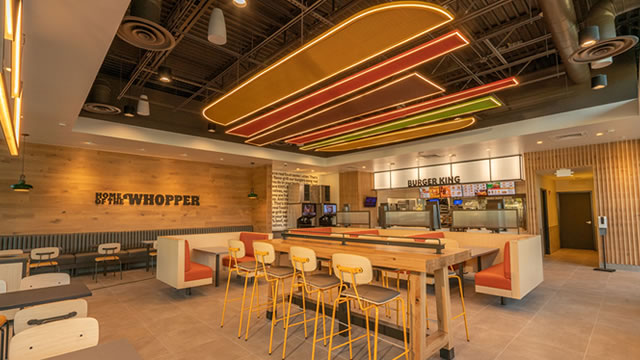
Core Viewpoint - The sale of Burger King's China operations is progressing, following Starbucks' similar move, as the company seeks new partners to revitalize its presence in the Chinese market [1][15]. Group 1: Company Background and Market Entry - Burger King was founded in 1954 in Miami, USA, and its flagship product, the "Whopper," became a significant success, selling over 210 million units annually worldwide [3]. - The brand entered the Chinese market in 2005, initially opening only 52 stores in the first seven years, but experienced rapid growth after 2012 under TFI Group's exclusive franchise rights, opening over 900 stores in six years [3]. Group 2: Market Challenges - Burger King faces increasing competition from local fast-food brands like Wallace and Tastin, as well as ongoing innovations from McDonald's and KFC, leading to a more challenging market environment [3]. - The brand's signature "flame-grilled" flavor has not kept pace with competitors in marketing and product innovation, resulting in pressure to attract younger consumers [3]. Group 3: Financial Performance - In February, RBI's CFO reported that while overall restaurant numbers grew by 3.4% in 2024, Burger King's China locations decreased by approximately 100 basis points, with lower average sales per store [4]. - Burger King's China revenue ranks eighth among RBI's international markets, with system sales around $700 million and an average annual sales per store of approximately $400,000, significantly lower than in France ($3.8 million) and Korea ($1.2 million) [7]. Group 4: Strategic Changes and Future Prospects - Despite TFI Group's franchise rights lasting until 2032, RBI decided to end the partnership early, acquiring TFI's stake for $158 million to seek new local partners for Burger King China [13]. - Recent management changes have been made to enhance local operations, including the appointment of experienced executives from other major brands [13]. - As of Q3 2025, Burger King China reported a same-store sales increase of 10.5% and a system sales total of approximately 1.224 billion RMB, indicating positive momentum under new management [15]. - The search for a new major stakeholder is ongoing, with reports of interest from private equity firms, signaling a proactive approach to revitalize the brand in China [15].



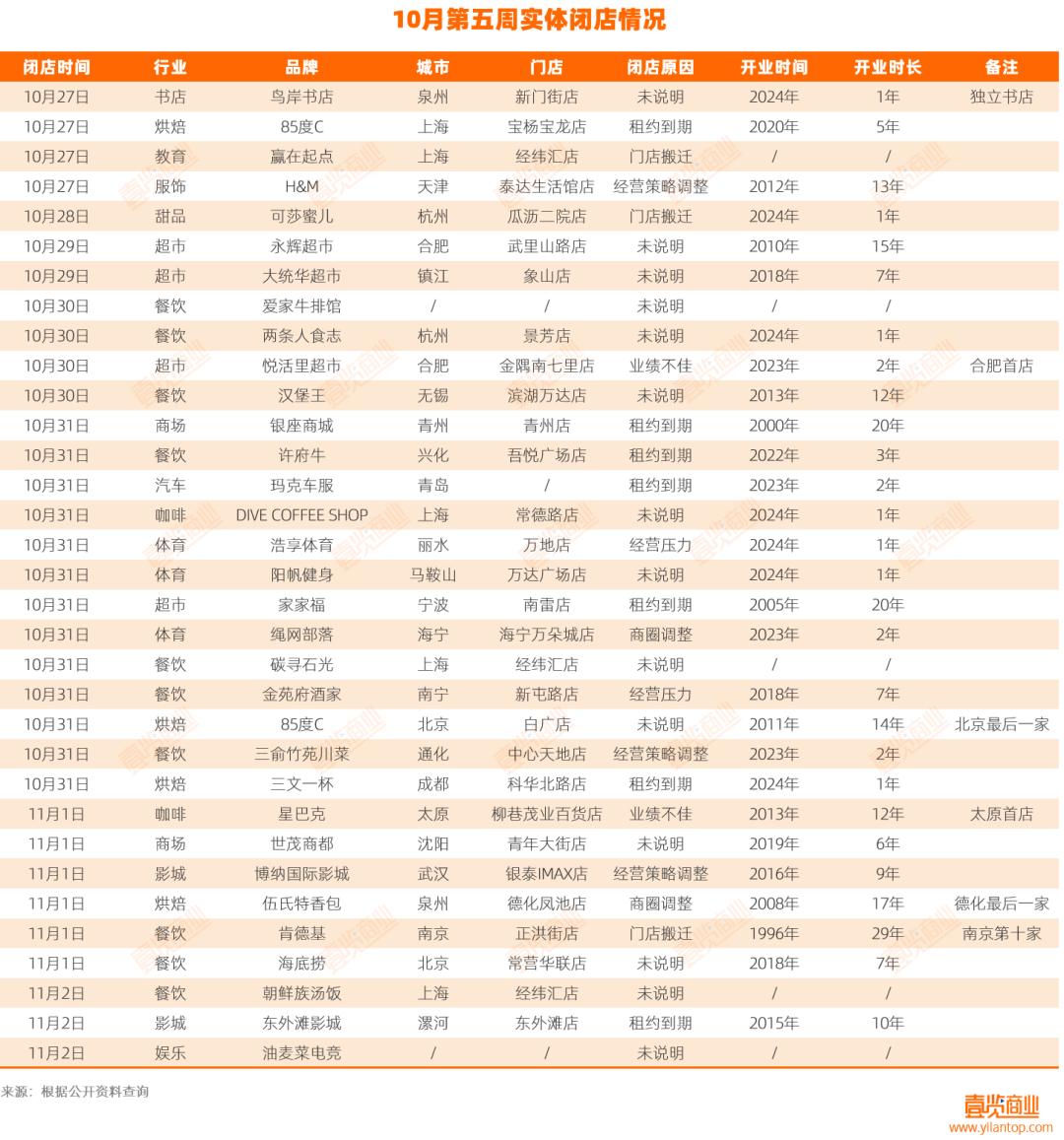
一周关闭33家店,银座、85°C、永辉持续调整
3 6 Ke· 2025-11-03 12:59
Summary of Key Points Core Viewpoint - The recent wave of store closures has predominantly affected the restaurant sector, with a total of 17 closures, accounting for 51.51% of the total closures reported. This trend highlights the challenges faced by various brands in adapting to changing consumer demands and operational strategies [2]. Group 1: Restaurant Sector - The restaurant category saw the highest number of closures, totaling 10, which includes well-known chains such as KFC, Burger King, and Haidilao [2]. - Burger King has experienced a significant reduction in its store count in China, dropping from 1,474 stores at the end of 2024 to 1,367 by mid-2025, marking a net decrease of 107 stores within six months [3]. - The KFC restaurant in Nanjing, which opened in 1996, has closed after 29 years of operation, indicating a shift in consumer preferences and market dynamics [4]. Group 2: Bakery and Coffee Shops - In the bakery segment, 85°C closed its last store in Beijing, which had been operational for 14 years, while other closures included stores from brands like Sanwen Yibei and Wushi Special Bun [5]. - Starbucks closed its first store in Taiyuan, which had been in operation for over 10 years, attributed to decreased foot traffic and changing consumer behavior in the area [5]. Group 3: Supermarkets and Malls - Four supermarkets, including Yonghui and Daitonghua, announced closures, with Yonghui's store in Hefei marking the 11th closure for the brand in the area [6]. - Two malls, including the Yinzuo Mall in Qingzhou, closed due to lease expirations, reflecting the ongoing challenges faced by physical retail spaces in adapting to market changes [6]. Group 4: Other Industries - Other sectors, including sports, education, apparel, and bookstores, collectively closed 10 stores, indicating a balanced distribution of closures across various industries without a single sector dominating the trend [6].
Restaurant Brands International reports profit growth in Q3 2025
Yahoo Finance· 2025-10-31 09:57
Core Insights - Restaurant Brands International (RBI) reported a net income of $315 million, or $0.96 per share, for Q3 2025, an increase from $252 million, or $0.79 per share, in Q3 2024 [1] - Total revenues for Q3 2025 reached $2.45 billion, up 6.9% from $2.29 billion in the same quarter of the previous year [1][2] - For the first nine months of 2025, total revenues were $6.97 billion compared to $6.11 billion in the same period of 2024 [2] Financial Performance - The net income attributable to common shareholders for the first nine months of 2025 was $663 million, down from $762 million in the same period of 2024 [3] - The company declared a dividend of $0.62 per common share [3] Business Segment Performance - The international segment saw system-wide sales increase by 12.1%, while same-store sales grew by 4% year-on-year, driven by a 4.2% increase at Tim Hortons Canada and a 3.1% increase at Burger King [2] - Popeyes experienced a decline in same-store sales by 2.4% [2] Strategic Initiatives - RBI's CEO highlighted strong performance from Tim Hortons and the international business, which together account for approximately 70% of earnings [3] - The company is on track to achieve at least 8% organic adjusted operating income growth for the year [4] - RBI reiterated its long-term targets for 2024 to 2028, aiming for more than 3% comparable sales growth and over 8% organic adjusted operating income growth on average [5] Investment Plans - Burger King is advancing its multi-year "Reclaim the Flame" program, which includes up to $700 million in investments through 2028 for advertising, digital enhancements, remodels, and kitchen equipment upgrades [5]
Restaurant Brands International(QSR) - 2025 Q3 - Quarterly Report
2025-10-30 20:01
Financial Performance - The company reported system-wide sales of $12,282 million for the three months ended September 30, 2025, representing a growth of 6.9% compared to $11,433 million in the same period of 2024[136]. - Comparable sales increased by 4.0% for the three months ended September 30, 2025, compared to a mere 0.3% growth in the same period of 2024[136]. - Total revenues for the three months ended September 30, 2025, increased to $2,449 million, up from $2,291 million, representing a growth of 6.9%[139]. - Net income from continuing operations for the three months ended September 30, 2025, was $440 million, an increase of 23.3% from $357 million in the prior year[144]. - Income from operations for the three months ended September 30, 2025, was $663 million, up 14.9% from $577 million in the same period of 2024[142]. - Adjusted Operating Income for Q3 2025 was $702 million, an increase of 8% from $652 million in Q3 2024[188]. - For the nine months ended September 30, 2025, Adjusted Operating Income was $1,910 million, up 5% from $1,824 million in the same period of 2024[188]. Restaurant Growth and Acquisitions - The net restaurant growth was 2.8% for the three months ended September 30, 2025, consistent with the 2.8% growth reported for the nine months ended September 30, 2025[136]. - The total system restaurant count reached 32,423 at the end of September 30, 2025, up from 31,525 at the end of September 30, 2024[136]. - The company completed the acquisition of Carrols Restaurant Group Inc. and Popeyes China, establishing a new segment called Restaurant Holdings[130]. - The company acquired Pangaea Foods (China) Holdings Ltd. on February 14, 2025, which is classified as discontinued operations[132]. - The increase in total revenues for the nine months ended September 30, 2025, was primarily driven by the net impact of restaurants acquired from franchisees, particularly from the Carrols Acquisition[141]. Segment Performance - System-wide sales for the BK segment increased to $2,956 million in Q3 2025, up from $2,891 million in Q3 2024, representing a growth of 2.3%[164]. - Comparable sales in the US for the BK segment grew by 3.2% in Q3 2025, compared to a decline of 0.4% in Q3 2024[164]. - Total revenues for the BK segment reached $387 million in Q3 2025, an increase of $25 million or 6.9% from $362 million in Q3 2024[170]. - System-wide sales for the PLK segment were $1,519 million in Q3 2025, slightly up from $1,509 million in Q3 2024, reflecting a growth of 0.7%[170]. - Total revenues for the PLK segment increased to $201 million in Q3 2025, a rise of $6 million or 3.1% from $195 million in Q3 2024[170]. - System-wide sales growth for the FHS segment increased by 10.7% in Q3 2025, compared to a decline of 1.3% in Q3 2024[174]. - The INTL segment reported system-wide sales of $5,447 million in Q3 2025, a 13.9% increase from $4,780 million in Q3 2024[177]. Financial Position and Cash Flow - As of September 30, 2025, the company had cash and cash equivalents of $1,206 million and borrowing availability of $1,248 million under its Revolving Credit Facility[191]. - Cash provided by operating activities increased to $1,159 million for the nine months ended September 30, 2025, up from $1,022 million in the prior year, driven by increased segment income and decreased working capital usage[207]. - Cash used for investing activities decreased significantly to $213 million for the nine months ended September 30, 2025, compared to $616 million in the prior year, primarily due to lower net payments for acquisition of franchised restaurants[208]. - Cash used for financing activities rose to $952 million for the nine months ended September 30, 2025, compared to $365 million in the prior year, mainly due to the non-recurrence of proceeds from long-term debt[209]. Debt and Dividends - As of September 30, 2025, total debt was primarily comprised of $5,942 million under Term Loan Facilities with a weighted average interest rate of 5.76%[199]. - Required debt service for the next twelve months is estimated to be approximately $345 million in interest payments and $79 million in principal payments[200]. - On October 7, 2025, the company paid a cash dividend of $0.62 per common share[202]. - The board of directors declared a cash dividend of $0.62 per common share to be paid on January 6, 2026[203]. Operational Efficiency - General and administrative expenses for the three months ended September 30, 2025, decreased to $170 million from $176 million, a reduction of 3.4%[146]. - Interest expense, net, decreased to $129 million for the three months ended September 30, 2025, down from $147 million, a decline of 12.2%[139]. - The effective tax rate for the three months ended September 30, 2025, was 17.6%, up from 16.7% in 2024, and for the nine months, it was 22.1% compared to 17.2% in 2024[157].
Here's What Key Metrics Tell Us About Restaurant Brands (QSR) Q3 Earnings
ZACKS· 2025-10-30 16:30
Core Insights - Restaurant Brands reported $2.45 billion in revenue for the quarter ended September 2025, marking a year-over-year increase of 6.9% and exceeding the Zacks Consensus Estimate by 2.47% [1] - The earnings per share (EPS) for the same period was $1.03, up from $0.93 a year ago, representing a surprise of 3% over the consensus EPS estimate of $1.00 [1] Financial Performance Metrics - Comparable Sales for Burger King (BK) globally were 3.1%, surpassing the average estimate of 2% [4] - Comparable Sales for Popeyes Louisiana Kitchen (PLK) globally were -2.4%, below the average estimate of 1.3% [4] - Comparable Sales for Tim Hortons (TH) globally were 4.2%, exceeding the average estimate of 3.3% [4] - Comparable Sales for Firehouse Subs (FHS) globally were 2.6%, slightly above the average estimate of 2.3% [4] Revenue Breakdown - Advertising revenues and other services totaled $314 million, slightly above the average estimate of $312.14 million, with a year-over-year change of +8.3% [4] - Franchise and property revenues reached $778 million, exceeding the average estimate of $764.19 million, reflecting a year-over-year increase of +5.9% [4] - Revenues from Firehouse Subs (FHS) were $60 million, compared to the average estimate of $58.05 million, representing a year-over-year change of +13.2% [4] System-wide Sales - System-wide sales for Tim Hortons (TH) were $2.03 billion, above the average estimate of $1.99 billion, with a year-over-year change of +3.9% [4] - System-wide sales for Burger King (BK) were $2.96 billion, exceeding the average estimate of $2.92 billion, reflecting a year-over-year increase of +2.3% [4] - System-wide sales for Popeyes Louisiana Kitchen (PLK) were $1.52 billion, slightly below the average estimate of $1.55 billion, with a year-over-year change of +0.7% [4] - System-wide sales for Firehouse Subs (FHS) were $332 million, surpassing the average estimate of $327.58 million, representing a year-over-year increase of +10.3% [4] - Consolidated system-wide sales totaled $12.28 billion, exceeding the average estimate of $11.98 billion, with a year-over-year change of +7.4% [4] Stock Performance - Shares of Restaurant Brands have returned -0.2% over the past month, while the Zacks S&P 500 composite has changed by +3.6% [3] - The stock currently holds a Zacks Rank 4 (Sell), indicating potential underperformance relative to the broader market in the near term [3]

Restaurant Brands International(QSR) - 2025 Q3 - Earnings Call Transcript
2025-10-30 13:30
Financial Data and Key Metrics Changes - Comparable sales increased by 4%, net restaurant growth was 2.8%, and system-wide sales grew by 6.9% in Q3 2025 [4] - Organic adjusted operating income growth was 8.8%, with double-digit nominal EPS growth [5][29] - Adjusted EPS rose to $1.03 per share from $0.93 last year, representing a nominal growth of 10.7% [30] Business Line Data and Key Metrics Changes - Tim Hortons Canada, representing roughly 44% of operating profit, saw comparable sales grow by 4.2%, outperforming the broader Canadian QSR industry by approximately three points [7] - The international business, contributing 26% of operating profit, experienced same-store sales growth of 6.5% and net restaurant growth of 5.1% [12] - Burger King U.S. achieved comparable sales growth of 3.2%, outperforming the burger QSR category [20] Market Data and Key Metrics Changes - In France, Burger King launched successful products, leading to improved market share and performance [13][88] - Burger King China saw comparable sales grow by 10.5% in Q3, driven by effective marketing and new product launches [15][16] - Popeyes in the U.K. is set to open its 100th restaurant, demonstrating strong traction in the EMEA region [14] Company Strategy and Development Direction - The company aims for at least 8% organic AOI growth in 2025, focusing on disciplined execution and innovation across brands [5][29] - There is a strategic emphasis on refranchising Burger King restaurants to simplify the business model and strengthen franchise operations [32][46] - The company is actively working to find a new local partner for Burger King China, reinforcing its commitment to long-term growth in that market [33][17] Management's Comments on Operating Environment and Future Outlook - Management expressed confidence in the company's ability to navigate a challenging consumer environment while delivering strong results [5][6] - The focus remains on improving guest experiences and operational efficiencies, particularly in the face of elevated beef costs impacting margins [34][66] - Management highlighted the importance of maintaining a disciplined value strategy amidst competitive pressures [21][70] Other Important Information - The company generated $566 million in free cash flow and returned $282 million to shareholders through dividends [31] - The adjusted effective tax rate for the quarter was 17.8%, with expectations for the full year to be in the 18% to 19% range [31] - The company is on track to refranchise approximately 5,100 restaurants in 2025 [32] Q&A Session Summary Question: Insights on Burger King U.S. turnaround trajectory - Management highlighted the importance of modernizing assets, improving operational consistency, and focusing on profitability as key drivers of the turnaround [51][52] Question: Impact of beef costs on cash flow and plans - Management acknowledged that elevated beef costs are a headwind but emphasized that franchisees view these impacts as temporary and plans remain on track [66][68] Question: Satisfaction with the launch of protein lattes in Canada - Management indicated that protein lattes are part of a broader cold beverage strategy, with positive initial results and plans for further innovation [75] Question: Share trends for Tim Hortons in Canada - Management noted that Tim Hortons is consistently outperforming competitors, with same-store sales significantly higher than other large QSRs [79] Question: Performance of the international business - Management reported broad-based improvements in international markets, particularly in France and China, with significant share gains [88][90]
Restaurant Brands (QSR) Q3 Earnings and Revenues Top Estimates
ZACKS· 2025-10-30 12:40
Core Insights - Restaurant Brands (QSR) reported quarterly earnings of $1.03 per share, exceeding the Zacks Consensus Estimate of $1 per share, and up from $0.93 per share a year ago [1][2] - The company achieved revenues of $2.45 billion for the quarter ended September 2025, surpassing the Zacks Consensus Estimate by 2.47% and increasing from $2.29 billion year-over-year [3] Earnings Performance - The earnings surprise for the quarter was +3.00%, while the previous quarter saw a surprise of -3.09% [2] - Over the last four quarters, Restaurant Brands has surpassed consensus EPS estimates two times and revenue estimates three times [2][3] Stock Performance and Outlook - Restaurant Brands shares have increased by approximately 1.3% since the beginning of the year, in contrast to the S&P 500's gain of 17.2% [4] - The current consensus EPS estimate for the upcoming quarter is $0.95 on revenues of $2.38 billion, and for the current fiscal year, it is $3.64 on revenues of $9.29 billion [8] Industry Context - The Retail - Restaurants industry, to which Restaurant Brands belongs, is currently ranked in the bottom 9% of over 250 Zacks industries, indicating potential challenges ahead [9] - Empirical research suggests a strong correlation between near-term stock movements and trends in earnings estimate revisions, which could impact Restaurant Brands' stock performance [6]

Restaurant Brands International Profit, Revenue Rises
WSJ· 2025-10-30 11:04
Core Insights - Restaurant Brands International reported a rise in third-quarter profit, driven by strong performance from Tim Hortons and its international segment [1] Financial Performance - The company's profit increased due to significant contributions from Tim Hortons, indicating robust brand performance in the market [1] - The international segment also played a crucial role in enhancing overall profitability, showcasing the effectiveness of the company's global strategy [1]
Restaurant Brands International(QSR) - 2025 Q3 - Quarterly Results
2025-10-30 10:35
Financial Performance - Consolidated system-wide sales grew by 6.9% year-over-year, reaching $12,282 million in Q3 2025, compared to $11,433 million in Q3 2024[2][3] - Comparable sales accelerated to 4.0%, with notable performances of 6.4% at Burger King International, 4.2% at Tim Hortons Canada, and 3.2% at Burger King US[2][3] - Adjusted Operating Income (AOI) increased to $702 million in Q3 2025, reflecting an organic AOI growth of 8.8%[3][12] - Net income from continuing operations rose to $440 million, with diluted earnings per share from continuing operations at $0.96[3][12] - Total revenues for Q3 2025 reached $2,449 million, a 6.9% increase from $2,291 million in Q3 2024[36] - Net income attributable to common shareholders for Q3 2025 was $315 million, compared to $252 million in Q3 2024, reflecting a 25% increase[36] - Basic net income per share from continuing operations increased to $0.97 in Q3 2025, up from $0.79 in Q3 2024[36] - Adjusted EBITDA for the three months ended September 30, 2025, was $794 million, up 6.0% from $748 million in 2024[58] - Adjusted diluted earnings per share for Q3 2025 increased to $1.03 from $0.93 in Q3 2024, marking a 10.8% rise[67] Sales Growth - System-wide sales growth for Tim Hortons was 4.8% in Q3 2025, with total revenues of $1,125 million[11][12] - Burger King's system-wide sales grew by 2.3% in Q3 2025, totaling $2,956 million[14] - System-wide Sales for Burger King reached $1,519 million in Q3 2025, reflecting a 0.7% growth compared to Q3 2024[19] - Comparable Sales in the US decreased by 2.0% in Q3 2025, while international comparable sales increased by 6.4%[21] - The FHS segment reported a System-wide Sales growth of 10.7% in Q3 2025, with Total Revenues increasing to $60 million from $53 million[20] - The INTL segment achieved System-wide Sales of $5,447 million in Q3 2025, a significant increase from $4,780 million in Q3 2024[21] Investments and Acquisitions - The acquisition of Carrols Restaurant Group and Popeyes China was completed in 2024, establishing a new segment, Restaurant Holdings[4][5] - Burger King is investing up to $700 million in its "Reclaim the Flame" plan through 2028, focusing on advertising, digital investments, and restaurant enhancements[17] - The company expects to incur additional costs related to acquisitions in 2025, indicating ongoing market expansion efforts[68] Financial Position - The company reported a net leverage ratio of 4.4x, down from 4.8x in the previous year[3] - Total assets as of September 30, 2025, were $25,669 million, an increase from $24,632 million as of December 31, 2024[38] - Cash and cash equivalents decreased to $1,206 million as of September 30, 2025, down from $1,334 million at the end of 2024[38] - Long-term debt, net of current portion, was $13,415 million as of September 30, 2025, slightly down from $13,455 million at the end of 2024[38] - The company’s total liabilities increased to $20,504 million as of September 30, 2025, compared to $19,789 million at the end of 2024[38] Cash Flow and Capital Management - Net cash provided by operating activities from continuing operations increased to $1,159 million, up 13.4% from $1,022 million in the previous year[40] - Net cash used for investing activities from continuing operations decreased significantly to $213 million from $616 million in 2024, indicating improved capital management[40] - Free Cash Flow (FCF) is calculated as net cash provided by operating activities minus payments for property and equipment, serving as a liquidity measure[55] - Free cash flow for the nine months ended September 30, 2025, was $996 million, compared to $898 million in 2024, representing an increase of 11.0%[65] Future Outlook - The company is on track for at least 8% organic Adjusted Operating Income growth in 2025[2] - For 2025, the company expects consolidated capital expenditures to be around $400 million[27] - The company anticipates achieving over 5% Net Restaurant Growth towards the end of its long-term performance period from 2024 to 2028[28] - The company plans to enhance operations and drive long-term sustainable growth through various strategies, including refranchising efforts and new partnerships in international markets[34] Tax and Regulatory Considerations - The effective tax rate increased due to the impact of OECD Pillar II guidance, affecting future tax planning strategies[68]
Restaurant Brands earnings top estimates, fueled by Tim Hortons and international growth
CNBC· 2025-10-30 10:32
Core Insights - Restaurant Brands International reported quarterly earnings and revenue that exceeded analysts' expectations, driven by growth in its international restaurants and Tim Hortons [1] - The company's shares rose by 3% in premarket trading following the earnings report [1] Financial Performance - The company reported a third-quarter net income attributable to shareholders of $315 million, or 96 cents per share, an increase from $252 million, or 79 cents per share, a year earlier [2] - Excluding transaction costs and other items, adjusted earnings per share were $1.03, surpassing the expected $1 [6] Revenue and Sales Growth - Net sales increased by 6.9% to $2.45 billion, exceeding the expected $2.4 billion [6] - Same-store sales grew by 4%, with the international segment achieving 6.5% same-store sales growth, outperforming the consensus estimate of 4.4% [3] - Tim Hortons reported same-store sales growth of 4.2%, focusing on enhancing food offerings to boost sales and traffic [3] Segment Performance - Burger King's same-store sales rose by 3.1%, indicating the success of its turnaround strategy in the U.S. through restaurant renovations and marketing of core menu items [4] - Popeyes was the only division to report a decline in same-store sales, with a decrease of 2.4%, struggling to compete for value-minded customers [5]