Rio Tinto(RIO)

Search documents
Dimensional Fund Advisors Ltd. : Form 8.3 - RIO TINTO PLC & RIO TINTO LIMITED - Ordinary Shares
Globenewswire· 2026-01-19 14:40
Key Information - Dimensional Fund Advisors Ltd. disclosed its interests in Rio Tinto PLC and Rio Tinto Limited, holding 4,625,346 shares (0.37%) in Rio Tinto PLC and 6,769,457 shares (1.82%) in Rio Tinto Limited as of January 15, 2026 [3][5][8] - The disclosure indicates that Dimensional does not have beneficial ownership of the shares and does not have discretion regarding voting decisions for a portion of the shares held [5][8] Positions - In Rio Tinto PLC, Dimensional holds 4,625,346 shares, representing 0.37% of the total relevant securities [5] - In Rio Tinto Limited, Dimensional holds 6,769,457 shares, representing 1.82% of the total relevant securities [8] Dealings - Dimensional sold 7,504 shares of Rio Tinto PLC at a price of 62.9016 GBP per unit [13] - A transfer of 3,731 shares of Rio Tinto PLC was also noted [13]



Rio Tinto-Glencore merger could face Chinese regulatory hurdles
Yahoo Finance· 2026-01-19 10:16
Group 1 - The proposed merger between Rio Tinto and Glencore may face significant regulatory challenges, particularly in China, potentially requiring asset sales for approval [1][2] - The current proposal involves an all-share acquisition, with Rio Tinto potentially acquiring "some or all" of Glencore [2] - China's regulators are expected to scrutinize the potential market dominance of a combined Rio Tinto-Glencore entity in the copper and iron ore sectors [3] Group 2 - Demand for copper assets is increasing due to their importance in the green energy transition and AI technologies, prompting both companies to shift focus towards copper [4] - The rising significance of copper is also reflected in other industry activities, such as Anglo American and Teck Resources planning a $53 billion merger, which will also require Chinese regulatory scrutiny [4] - Rio Tinto is considering an asset-for-equity swap to reduce the 11% stake held by its largest shareholder, Chinalco, with assets of interest including the Simandou iron ore mine and the Oyu Tolgoi copper project [3]

A Rio-Glencore Tie-Up Would Redraw the Map of Global Mining
Yahoo Finance· 2026-01-19 00:00
Core Viewpoint - The potential merger between Rio Tinto and Glencore could create a significant player in the mining sector, valued at approximately $260 billion, enhancing their capabilities in copper and other metals markets amid rising demand and limited supply growth [7]. Group 1: Merger Discussions - Rio Tinto and Glencore are in preliminary discussions about a possible merger, which have gained traction following BHP Group's decision to rule out a competing bid [5]. - The merger talks reflect a broader trend of consolidation in the mining sector as companies seek to manage rising costs and tighter capital conditions [2][12]. Group 2: Market Dynamics - Demand for copper is increasing due to its applications in power grids, electric vehicles, and renewable energy systems, while supply growth is constrained by underinvestment and higher development costs [3]. - Copper prices have surged over 25% in the past three months, reaching record levels above $13,000 per tonne, with low inventories and rising production costs [10]. Group 3: Strategic Advantages - Glencore's strong commodity marketing and trading operations would provide Rio Tinto with capabilities it currently lacks, enhancing its competitive position in the copper market [1][11]. - The merger could allow for the separation of Glencore's coal assets, potentially unlocking shareholder value by focusing on a cleaner metals business [8][9]. Group 4: Regulatory Considerations - Any merger would face scrutiny from regulators in Australia and Europe, particularly regarding copper concentration and Glencore's trading business [15]. Group 5: Operational Differences - The operational models of Rio Tinto and Glencore differ significantly, with Glencore focusing on trading and risk management, while Rio emphasizes long-life mining assets [16].
Rio Tinto: Up A Lot, Still A Good Outlook (NYSE:RIO)
Seeking Alpha· 2026-01-16 22:00
Group 1 - Rio Tinto Group (RIO) is one of the largest mining companies globally, benefiting from increasing demand for various commodities [1] - The company's shares have performed well over the past year but are not considered expensive [1] - The focus of Cash Flow Club is on businesses with strong cash generation, ideally with a wide moat and significant durability [1] Group 2 - Jonathan Weber, an analyst with an engineering degree, has been active in the stock market and has contributed research on Seeking Alpha since 2014 [1] - The Cash Flow Club emphasizes company cash flows and access to capital, targeting a yield of 6% or more [1] - Core features of the Cash Flow Club include community chat, a "Best Opportunities" List, and coverage of various sectors such as energy midstream and commercial mREITs [1]
Nord Precious Metals Announces Appointment of CFO
Thenewswire· 2026-01-16 22:00
Core Viewpoint - Nord Precious Metals Inc. has appointed Heidi Gutte as the new Chief Financial Officer, effective January 15, 2026, replacing Robert Suttie [1][3] Group 1: Leadership Changes - Heidi Gutte brings over 15 years of experience in corporate finance, IFRS financial reporting, and compliance within the mineral exploration and mining sector [2] - The company expresses gratitude to Robert Suttie for his contributions during his tenure [3] Group 2: Company Overview - Nord Precious Metals operates TTL Laboratories, the only permitted high-grade milling facility in Ontario's historic Cobalt Camp, linking high-grade silver discovery with strategic metals recovery [4] - The flagship Castle property covers 63 square kilometers and includes the Castle Mine, with an inferred resource of 7.56 million ounces of silver at an average grade of 8,582 g/t Ag [5] Group 3: Processing Strategy - The company's integrated processing strategy allows for multiple metal recovery streams, enhancing the economics of extracting critical minerals like cobalt and nickel [6] - The Re-2Ox hydrometallurgical process is validated at pilot scale, producing battery-grade cobalt sulfate while addressing arsenic barriers in complex ores [6] Group 4: Strategic Portfolio - Nord maintains a strategic portfolio of battery metals properties in Northern Quebec, including a 35% ownership in Coniagas Battery Metals Inc. and the St. Denis-Sangster lithium project [7]

Rio Tinto: Up A Lot, Still A Good Outlook
Seeking Alpha· 2026-01-16 22:00
Group 1 - Cash Flow Club focuses on businesses with strong cash generation, ideally with a wide moat and significant durability, which can be highly rewarding when bought at the right time [1] - Rio Tinto Group (RIO) is one of the largest mining companies globally, benefiting from growing demand for various commodities [1] - Shares of Rio Tinto have performed well over the last year but are not considered expensive [1] Group 2 - Jonathan Weber, an analyst with an engineering degree, has been active in the stock market and has shared research on Seeking Alpha since 2014, focusing primarily on value and income stocks [1] - The Cash Flow Club, co-founded by Jonathan Weber and Darren McCammon, emphasizes company cash flows and access to capital, offering features like a personal income portfolio targeting 6%+ yield and a "Best Opportunities" List [1]
【环球财经】力拓、必和必拓将合作开发西澳相邻矿区铁矿资源
Xin Lang Cai Jing· 2026-01-16 13:54
Core Viewpoint - Rio Tinto and BHP have agreed to jointly develop iron ore resources at the boundary of their mining rights in the Pilbara region of Western Australia, aiming to extract up to 200 million tons of iron ore [1][2]. Group 1: Joint Development Agreement - The companies will collaborate on the Yandicoogina and Yandi iron ore operations, including the development of Rio Tinto's Wunbye deposit [1]. - BHP will supply "wet ore" from its Yandi Lower Channel segment to be processed at Rio Tinto's facilities, enhancing operational efficiency [1][2]. Group 2: Strategic Rationale - The collaboration is seen as a way to maximize the use of existing infrastructure, extend the lifespan of their mines, and recover previously stranded ore [2]. - Analysts note that declining iron ore grades in Western Australia and the recent production start of the Simandou iron ore project in Guinea are influencing this partnership [3]. Group 3: Future Outlook - Mining operations are expected to commence in the early 2030s, pending final investment decisions and necessary approvals from regulators and Indigenous groups [2].


Rio Tinto and BHP to collaborate on Pilbara iron ore mining
Yahoo Finance· 2026-01-16 10:05
Core Insights - Rio Tinto and BHP plan to jointly mine up to 200 million tonnes of iron ore from their Yandicoogina and Yandi sites in Western Australia through non-binding memorandums of understanding [1][2] - The collaboration aims to leverage existing infrastructure to enhance production with minimal capital investment, thereby extending the life of operations and supporting local communities [2][3] Mining Operations - The initiative includes joint efforts at Rio Tinto's Wunbye deposit and the use of BHP's Yandi Lower Channel Deposit ore at Rio Tinto's wet plants [1] - A final investment decision regarding the commencement of ore extraction is expected early next decade, contingent upon regulatory approvals and consultations with traditional owners [3] Strategic Development - The mining companies have outlined a strategy that begins with a conceptual study, followed by an order of magnitude study to assess the potential of the collaboration [2] - BHP's WA iron ore asset president emphasized the importance of productivity and resource optimization in unlocking new opportunities [3] Location and Production - Yandi is located 178 km north-west of Newman and is part of a joint venture involving BHP (85%) and Mitsui and ITOCHU (15%), with significant production achievements since its inception [4] - Yandicoogina, situated around 95 km north-west of Newman, is known for producing Hamersley Iron Yandi fines for steelmaking in East Asia and southern China, and is recognized for its use of autonomous haul trucks [5] Technological Innovation - BHP and Rio Tinto have also introduced Australia's first battery-electric haul trucks at the Jimblebar mine, marking a trial for sustainable mining technology aimed at reducing greenhouse gas emissions [6]
Rio Tinto-Glencore merger may need asset sales to win over China
Reuters· 2026-01-16 05:38
Core Viewpoint - The proposed merger between Rio Tinto and Glencore may necessitate asset divestitures to obtain regulatory approval from China, which has ongoing concerns regarding resource security [1] Group 1: Regulatory Concerns - China, as a major commodity buyer, has expressed longstanding worries about resource security, which could impact the merger's approval process [1]

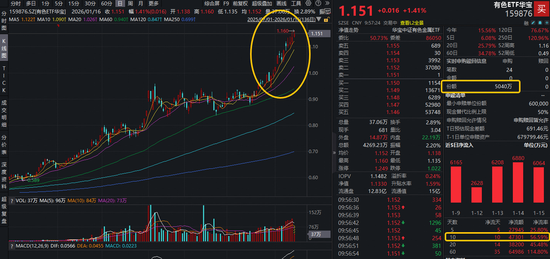
铜资源争夺加剧!力拓专供亚马逊,AI大战抢完芯片抢铜矿!有色ETF华宝(159876)再涨2.2%创历史新高!
Xin Lang Cai Jing· 2026-01-16 02:10
Core Viewpoint - The non-ferrous metal sector is experiencing a strong upward trend, with significant inflows into related ETFs, indicating robust investor interest and potential for continued growth [1][12]. Group 1: Market Performance - The popular non-ferrous ETF, Huabao (159876), saw an intraday increase of 2.2%, currently up 1.41%, reaching a new high since its listing [1][12]. - As of January 15, the latest scale of Huabao ETF reached 1.453 billion, marking a historical peak and ranking first among three ETFs tracking the China Nonferrous Metals Index [1][12]. - The ETF has attracted a net subscription of 50.4 million units, with a total net inflow of 473 million over the past ten days [1][12]. Group 2: Stock Performance - Leading stocks in the sector include Hunan Silver, which surged over 6%, along with Chihong Zn & Ge, Jiangxi Copper, and Jinchuan Group, all rising more than 5% [4][15]. - Other notable performers include Western Mining and Zhongjin Lingnan, both showing positive gains [4][15]. Group 3: Industry Outlook - Analysts predict that the non-ferrous metal sector will continue to thrive due to multiple factors, including global capital expenditure cycles, manufacturing recovery, and improved domestic macro expectations [5][16]. - The sector is expected to enter a bull market by 2026, driven by a confluence of monetary, demand, and supply factors [5][16]. - The demand for strategic metals is anticipated to rise significantly, influenced by new technologies and geopolitical factors, with a focus on metals used in military applications [3][16]. Group 4: Copper Market Insights - China Galaxy Securities suggests that copper prices have substantial upward potential, as historical analysis shows that current prices, adjusted for inflation, have not reached previous supercycle highs [3][14]. - The ongoing reshaping of the international monetary order and the low copper-to-gold ratio indicate a favorable environment for copper investments [3][14]. - The convergence of the AI technology revolution and global order restructuring is expected to create a new supercycle for copper [3][14].