Rio Tinto(RIO)

Search documents
铝周报2026/02/05:想说爱你不容易-20260206
Zi Jin Tian Feng Qi Huo· 2026-02-06 05:24
Report Industry Investment Rating No relevant content provided. Core Viewpoints of the Report - The trading logic of the aluminum market has deviated from fundamentals, with the focus on factors like the US dollar, liquidity, and precious metals. Despite some marginal changes in supply, the long - term growth logic of aluminum remains unchanged, but it is experiencing a short - term correction [4]. - The report上调s the 2026 overseas and domestic electrolytic aluminum production forecasts. However, the market is more sensitive to supply cuts than increases, and the long - term bullish view on aluminum as a hedging asset and its connection to new energy and the new economy persists [4]. - For the short - term market, it is advisable to wait for volatility to subside before making trading decisions [4]. Summaries Based on Related Catalogs 1. Week - on - Week Changes and Outlook - Since the beginning of the year, the aluminum price trend has been highly synchronized with volatility, and the trading logic has deviated from aluminum fundamentals. The focus is on the US dollar, liquidity, and precious metals [4]. - There have been marginal changes in the supply side at home and abroad, including the restart of production at some aluminum plants. The report上调s the 2026 electrolytic aluminum production forecasts for both overseas and domestic markets [4]. - The short - term decline in the number of receiving manufacturers is due to high prices screening out less - resilient downstream buyers. The market is more sensitive to supply cuts than increases [4]. - The short - term view is to wait for the volatility to stabilize before trading [4]. 2. Latest Production Launch Tables of Domestic and Overseas Aluminum Plants - **Overseas**: The production expectations of three overseas plants have been revised upwards. The Lista aluminum plant in the US has restarted 31,000 tons of idle capacity after renewing its power contract. The expected restart time of the Grundartangi aluminum plant in Iceland has been advanced, and the Mozal aluminum plant in Mozambique is expected to have a partial production cut instead of a complete shutdown [7]. - **Domestic**: A northeast domestic aluminum plant with a built - in capacity of 752,500 tons and a current operating capacity of 420,000 tons plans to restart about 300,000 tons of idle capacity in mid - to - late March [7]. 3. Overseas Aluminum Plant Power Contract Progress - The power contract of the US Lista aluminum plant has been renewed to 2035, and it restarted 31,000 tons of idle capacity in January 2026. Other plants also have different power contract situations and production statuses [9]. 4. Overseas Aluminum Plant Production Launch Schedule - In 2026 and the long - term, there are various production - related activities overseas, including new construction, expansion, and restart of production at different aluminum plants. The annual total planned new production capacity in 2026 is 1.7355 million tons [10]. 5. Expected Table of New Domestic Electrolytic Aluminum Projects in 2026 - There are different types of projects in China, such as replacement, expansion, and production restart. The total new production capacity in 2026 is expected to be 1.127 million tons, with limited net - increase capacity from replacement projects [13]. 6. Supply - Demand Balance Sheets at Home and Abroad - The report上调s the 2026 overseas and domestic electrolytic aluminum net - increase production forecasts by 120,000 tons and 195,000 tons respectively. The supply - demand balance shows a slight deficit in 2026 [16]. - The long - term growth logic of aluminum remains unchanged, and the market should tolerate short - term corrections [16]. 7. Cost and Profit - Alumina prices have been falling since mid - 2025, which is one of the reasons for the increased profits of aluminum plants. Electricity prices and pre - baked anodes are in a range - bound state [22]. - The average profit of electrolytic aluminum has dropped from about 8,700 yuan/ton last week to 7,000 yuan/ton this week, and the average cost has slightly increased to 16,200 yuan/ton due to a 0.01 - yuan/degree increase in electricity prices [26]. 8. Internal - External Price Ratio - The Shanghai - London ratio has fluctuated. After rising to a phased high on January 7, it has declined. The LME aluminum price led the decline, and the domestic market followed. The internal - external price ratio is currently range - bound [31]. - The overseas spot premiums in North America and Japan have increased week - on - week [31]. 9. Downstream and Inventory - The downstream operating rate is at a seasonal low, especially for aluminum sheets, foils, and strips. It is expected to recover after the holiday [45]. - As of Thursday, the social inventory of electrolytic aluminum has increased, while the LME aluminum inventory has decreased. The social inventory of aluminum rods has also increased [48]. - The processing fee of aluminum rods has fluctuated after reaching a high this week [54].





十年努力“功亏一篑”,嘉能可与力拓的“矿业世纪并购”最终还是没成
Hua Er Jie Jian Wen· 2026-02-06 04:01
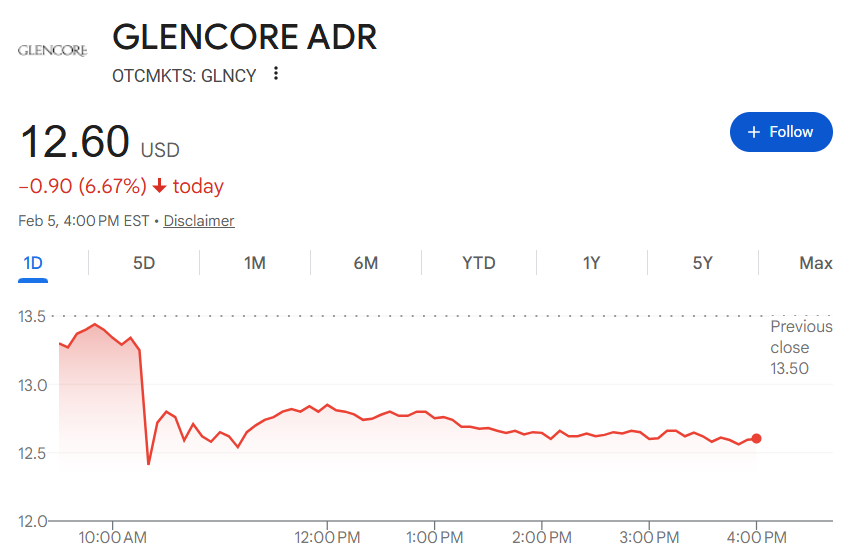
Core Viewpoint - The merger negotiations between Glencore and Rio Tinto have completely broken down, with Glencore insisting on a 40% stake in the combined company, leading Rio Tinto to terminate the discussions as they deemed further negotiations futile [1][4]. Group 1: Negotiation Breakdown - The breakdown of the negotiations represents a significant setback for both companies, with Glencore's copper production declining over 40% in the past decade, and Rio Tinto seeking to reduce its reliance on the iron ore market [1][7]. - Glencore's ADR stock price plummeted over 6% on the day of the announcement, raising investor concerns about its ability to independently develop its copper business [1][8]. - The negotiations were complicated by Glencore's insistence on a 40% ownership stake, which Rio Tinto executives recognized would not be easily negotiated down [3][6]. Group 2: Strategic Importance of the Deal - The merger was strategically significant for both companies, with Glencore aiming to prove its business transformation amidst rising copper prices, while Rio Tinto sought to unlock growth potential in Glencore's copper assets [7]. - The merger would have positioned Rio Tinto as the largest mining company globally, surpassing BHP, by integrating Glencore's substantial coal and copper operations with its own iron ore business [7]. - The potential doubling of copper production for Rio Tinto was seen as a key benefit, enhancing its status as a leading copper producer and adding 1 million tons of future capacity [7]. Group 3: Market Impact and Future Speculations - Glencore's stock drop of 7% reflects the negative impact of the failed merger on its executives and investors, leading to doubts about its independent copper business development [8]. - For Rio Tinto, the ongoing decline in iron ore prices highlights the risks associated with abandoning the largest deal in industry history, prompting speculation about potential competitive bidders [8]. - Analysts suggest that BHP may now have an opportunity to engage, but face challenges in justifying the value of Glencore to Australian investors focused on value [8].


【环球财经】分析人士称力拓与嘉能可合并谈判破裂原因为估值分歧
Xin Hua Cai Jing· 2026-02-06 03:17
Core Viewpoint - The merger negotiations between major mining companies Rio Tinto and Glencore have collapsed due to valuation disagreements [1][2]. Group 1: Merger Negotiation Breakdown - Rio Tinto announced it would no longer consider a merger with Glencore, stating that it could not reach an agreement that would create value for its shareholders [1]. - Glencore's proposal included key terms that would allow Rio Tinto to retain the positions of Chairman and CEO, but Glencore felt this undervalued its contribution to the merged entity [1][2]. - Prior to the negotiations, the overall valuation split between Rio Tinto and Glencore was 69% to 31%, with Glencore seeking a more equitable 60% to 40% distribution [1][2]. Group 2: Valuation Perspectives - Glencore argued that the 69:31 ratio did not fairly reflect its long-term value creation potential through the merger, as it was based on a short-term market snapshot [2]. - The proposed 60:40 ratio was seen as a better representation of Glencore's asset portfolio, particularly its copper resource projects, which are expected to contribute significantly in the future [2]. - Analysts noted that Rio Tinto's withdrawal from negotiations could lead to challenges in diversifying its operations, particularly in copper, while being overly reliant on iron ore [2].
估值分歧致2600亿美元并购告吹 力拓嘉能可三度终止合并谈判
Huan Qiu Wang· 2026-02-06 02:37
Core Viewpoint - The merger plan between global mining giants Rio Tinto and Glencore, valued at $260 billion, has been officially abandoned after weeks of negotiations failed to reach consensus on key terms, marking the third failed attempt at merging the two companies [1]. Group 1: Merger Details - Rio Tinto has decided not to pursue further discussions with Glencore after determining that an agreement would not create value for shareholders [3]. - Glencore criticized the proposed terms from Rio Tinto, claiming they undervalued Glencore's contribution to the merged entity and did not adequately assess the value of Glencore's copper business and growth plans [3]. - The merger discussions have been ongoing for over a decade, with initial talks dating back to the period before the 2008 global financial crisis [4]. Group 2: Market Reaction - Following the announcement, Glencore's stock price dropped by as much as 10.8% during trading, making it the largest decliner in the FTSE 100 index for that day, while Rio Tinto's stock fell by 1.4% [3]. - According to UK takeover rules, Rio Tinto is prohibited from making any acquisition offers to Glencore for the next six months without approval from the takeover panel [3]. Group 3: Industry Context - The potential merger aimed to create a leading advantage in key metals such as iron ore, copper, cobalt, and lithium, which are essential for the production of technology products and support the development of the artificial intelligence industry [5]. - The global copper market is currently experiencing significant attention due to price volatility, with copper prices recently surpassing $14,000 per ton, and analysts predicting a potential supply gap of 10 million tons by 2040 [5].
2月6日外盘头条:比特币暴跌 亚马逊预计今年资本支出将达2000亿美元 交易员料美联储将比预期更早降息
Xin Lang Cai Jing· 2026-02-05 21:31
Group 1: Middle East Negotiations - Multiple Middle Eastern countries urgently lobbied the Trump administration to resume the US-Iran nuclear talks originally scheduled for February 6, which will now take place in Oman [4][20] - The deadlock raised concerns across the Middle East about potential military actions by Trump, prompting at least nine countries to contact the White House to advocate for the continuation of the meeting [6][20] - US officials indicated that the decision to hold the meeting was made to respect allies in the region and to continue seeking diplomatic avenues [6][20] Group 2: Bitcoin Market - Bitcoin experienced a significant drop, falling below $65,000, erasing all gains made since Trump's election, with a peak decline of 11% to $64,944, marking the lowest level since October 2024 [7][21][24] - This decline has resulted in nearly half of Bitcoin's value being wiped out since its record high four months ago, affecting other cryptocurrencies and related ETFs [7][24] Group 3: Amazon's Capital Expenditure - Amazon projected its capital expenditures for 2026 to reach $200 billion, significantly exceeding market expectations of $144.67 billion, indicating continued investment in artificial intelligence [9][26] - The company's forecast for first-quarter operating profit was between $16.5 billion and $21.5 billion, lower than the market's expectation of $22.04 billion, leading to a post-market stock decline of over 11% [10][26] Group 4: Rio Tinto and Glencore Merger - Rio Tinto announced its withdrawal from negotiations to acquire Glencore due to disagreements over valuation, resulting in the collapse of a potential merger that could have created the world's largest mining company [12][28] - Following the announcement of the failed merger talks, Glencore's stock price dropped by 11% [29] Group 5: Federal Reserve Rate Expectations - Traders have adjusted their expectations for the Federal Reserve's next interest rate cut to June, earlier than previously anticipated in July, with a second cut expected before October [16][33] - This shift in expectations was influenced by weak labor market data, leading to a decline in the secured overnight financing rate (SOFR) futures yield by approximately 9 basis points [33]


Rio Tinto, Glencore end merger talks over price dispute
Proactiveinvestors NA· 2026-02-05 18:18
About this content About Angela Harmantas Angela Harmantas is an Editor at Proactive. She has over 15 years of experience covering the equity markets in North America, with a particular focus on junior resource stocks. Angela has reported from numerous countries around the world, including Canada, the US, Australia, Brazil, Ghana, and South Africa for leading trade publications. Previously, she worked in investor relations and led the foreign direct investment program in Canada for the Swedish government ...
How Glencore and Rio Tinto's core assets stack up
Reuters· 2026-02-05 17:27
Group 1 - Rio Tinto has abandoned a significant mining deal with Glencore for the third time [1]
矿业“世纪合并”告吹 力拓(RIO.US)退出收购嘉能可(GLNCY.US)谈判
智通财经网· 2026-02-05 16:04
知情人士称,历次谈判受阻的核心原因包括力拓不愿支付高额溢价,以及双方在管理文化上的差异。最 近一轮磋商虽被认为是双方距离达成交易最近的一次,但在嘉能可庞大且复杂的采矿与大宗商品交易业 务估值问题上,双方仍然僵持不下,最终未能跨越关键门槛。 随着谈判破裂,全球矿业整合版图短期内难现颠覆性变化,行业并购热潮也再度面临现实约束。 两家公司于今年1月初披露正在进行接触,此后围绕力拓需要支付的收购溢价问题展开拉锯。消息公布 后,嘉能可股价一度暴跌逾11%,截至发稿,该股跌超6.5%。嘉能可随后在另一份声明中表示,公司具 备稳健的独立发展逻辑,将继续专注于自身既定战略重点。 事实上,力拓与嘉能可合并的设想已被讨论十余年。该构想最早出现在2008年全球金融危机之前;2014 年,嘉能可曾对力拓进行非正式接触,但很快遭到拒绝;直至2024年,双方才再次认真恢复谈判。 智通财经APP获悉,全球矿业巨头力拓(RIO.US)表示,已退出与嘉能可(GLNCY.US)的收购谈判,双方 因估值分歧未能达成一致,一桩可能缔造全球最大矿业公司的超级并购随之流产。 力拓在声明中称,不打算对规模较小的竞争对手嘉能可提出收购要约。按照英国并购规则 ...
Rio Tinto Abandons Mega-Merger Talks With Glencore
WSJ· 2026-02-05 15:58
A deal would have created the world's largest mining company worth more than $200 billion. Glencore shares fell around 8%. ...
Rio Tinto and Glencore Abandon Plan for $200 Billion Merger. The Stocks Drop.
Barrons· 2026-02-05 15:49
Group 1 - The two mining companies are in discussions regarding a potential merger [1]