
Seek .(SKLTY)

Search documents
老黄开年演讲「含华量」爆表,直接拿DeepSeek、Kimi验货下一代芯片
3 6 Ke· 2026-01-07 01:35
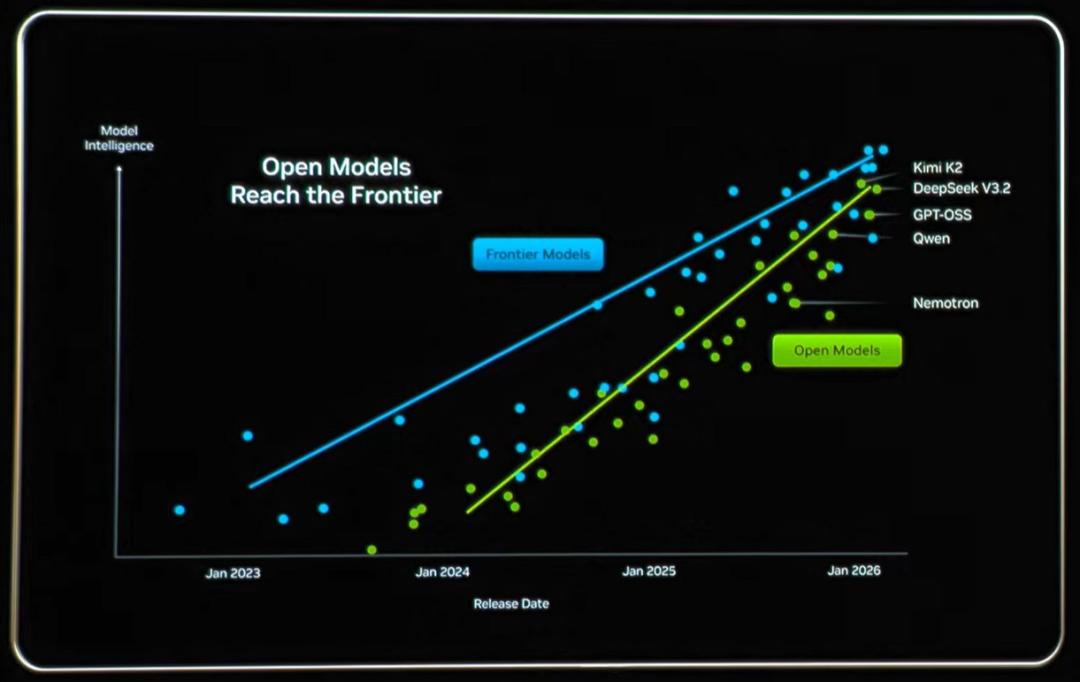
Core Insights - The presentation at CES 2026 highlighted the significant advancements of Chinese AI models, particularly Kimi K2 and DeepSeek, which are now competing closely with closed-source models in performance [1][8] - The introduction of the MoE (Mixture of Experts) architecture has become a mainstream choice, with over 60% of open-source AI models adopting this structure since 2025, leading to a substantial increase in intelligence levels [16][31] Group 1: Model Performance and Advancements - Kimi K2 Thinking's inference throughput increased tenfold, with token costs dropping to one-tenth of previous levels, indicating a shift towards a "price parity era" for AI inference [4][6] - DeepSeek-R1 and Kimi K2 represent top-tier attempts under the MoE architecture, significantly reducing computational load and memory bandwidth requirements [2][12] - The performance of Kimi K2 Thinking was validated in tests, showing a tenfold increase in performance on the GB200 NVL72 platform [9][19] Group 2: Global Recognition and Impact - DeepSeek and Kimi K2 were recognized in a rigorous benchmark test, with Kimi K2 Thinking achieving the title of "best-performing non-U.S. model" due to its low misguidance rate [21][24] - The rapid development of Chinese open-source models is closing the gap with the strongest closed-source models, providing a significant first-mover advantage [31] - The increasing international acceptance of Chinese AI models is evidenced by endorsements from prominent figures in the tech industry, indicating a growing influence in the global market [24][33] Group 3: Trends and Future Directions - The transition from high benchmark scores to practical usability is evident, with models like Qwen evolving from being known for high scores to being recognized for their quality [32] - The emergence of features such as "interleaved thinking" in Kimi K2 Thinking reflects a trend towards more sophisticated model capabilities, enhancing their applicability in real-world scenarios [34] - The rise of open-source models is pressuring U.S. closed-source giants, as the value proposition of paid models becomes harder to justify against the performance of open-source alternatives [35]



雷军回应小字营销:行业陋习,但我们改/DeepSeek开年「王炸」,梁文锋署名论文发布/马斯克立新年Flag:大规模量产脑机接口
Sou Hu Cai Jing· 2026-01-06 13:46
Group 1 - Lei Jun, the founder of Xiaomi, addressed the controversy surrounding "small font marketing," stating it is an industry habit that needs to be changed, emphasizing the importance of legal compliance while acknowledging the need for clearer communication with consumers [3][4] - Xiaomi plans to standardize product annotations using larger fonts in the future, aiming to improve clarity and consumer understanding [4] - In a recent live stream, Lei Jun revealed that Xiaomi's automotive division aims to deliver over 410,000 vehicles by 2025, with the Xiaomi YU7 model becoming the best-selling mid-to-large SUV for four consecutive months [5][7] Group 2 - BMW China announced a systematic price adjustment for 31 key models starting January 1, 2026, with the highest price drop reaching 300,000 yuan, reflecting a long-term strategy rather than a short-term price war [11][12] - The flagship electric model i7 M70L saw a price reduction from 1.899 million yuan to 1.598 million yuan, a decrease of approximately 16%, while the iX1 eDrive25L's price dropped by 24% [12] - The automotive industry is experiencing significant shifts, with multiple companies reporting their sales figures for 2025, indicating a competitive landscape [7] Group 3 - OpenAI is reportedly working on multiple AI hardware projects, including a pen-shaped device and portable audio equipment, aiming to create an ecosystem of products rather than a single offering [9][10] - The new audio model being developed by OpenAI is expected to provide more natural and expressive responses, enhancing user interaction with AI devices [10] Group 4 - Elon Musk announced that Neuralink plans to begin large-scale production of brain-machine interface devices in 2026, with a focus on simplifying the surgical process for implantation [16][18] - The company aims to enable users to control computers directly through neural signals, with previous successful trials involving a limited number of patients [18] Group 5 - Microsoft CEO Satya Nadella emphasized that 2026 will be a pivotal year for AI, marking a transition from initial exploration to widespread application, with a focus on reshaping human-AI relationships and engineering paradigms [27][29][30] - Nadella highlighted the need for AI to demonstrate tangible positive impacts in the real world to gain societal acceptance [30]

意大利结束对DeepSeek调查,涉及幻觉风险信息披露
2 1 Shi Ji Jing Ji Bao Dao· 2026-01-06 12:15
Group 1 - Italy's antitrust authority AGCM has concluded its investigation into DeepSeek, accepting binding commitments from the company to improve disclosures regarding the risks of AI "hallucinations" [2][3] - The investigation was initiated in June 2025 due to DeepSeek's failure to warn users about the potential for generating false information [2] - DeepSeek's commitments include measures to enhance the clarity, transparency, and timeliness of information related to hallucination risks [3] Group 2 - DeepSeek operates under two companies based in China and has no branches in other countries, providing AI services to non-professional users in Italy [3] - The company launched DeepSeek Chat in Italy on November 2, 2023, and plans to release the DeepSeek App globally on January 15, 2025, although the app was removed from Italian app stores due to the investigation [3] - Since its launch, DeepSeek has gained significant popularity, with 145 million monthly active users in China by Q3 2025, making it the second-largest AI application domestically [3] - DeepSeek leads globally in open-source large model usage, with a cumulative call volume of 14.37 trillion tokens from November 2024 to November 2025 [3]
黄仁勋又夸了DeepSeek,新一代“算力巨兽”正在量产,性能暴增5倍!
Feng Huang Wang· 2026-01-06 02:19
Core Insights - The keynote by NVIDIA CEO Jensen Huang at CES 2026 highlighted a significant shift in AI development from "digital intelligence" to "physical AI," emphasizing the company's ambition to build foundational elements for this new era [1][14] - NVIDIA is responding to the surging demand for AI computing power by upgrading its computing platforms, aiming to capture a substantial share of the digital world's computational base [1] Group 1: AI Evolution and Open Source - Huang emphasized that the computing industry undergoes a platform shift every 10 to 15 years, with current transitions focusing on AI-centric applications and a redefined software development paradigm [2] - The transformation of the computing industry, valued at approximately $10 trillion over the past decade, is driven by a shift in global R&D budgets towards AI and significant venture capital investments [4] - Open-source models are revolutionizing AI, with NVIDIA investing billions in supercomputing clusters to advance open-source model development, achieving breakthroughs in various scientific fields [4] Group 2: Intelligent Agents and Physical AI - The next stage in AI capability evolution involves moving from large language models to intelligent agents that can reason and act, addressing previously untrained problems [5][7] - Huang highlighted the challenge of enabling AI to understand the physical world, necessitating a complete system comprising training, real-time inference, and high-precision physical simulation [7] Group 3: Innovations in AI Models - NVIDIA introduced Cosmos, an open-source world model that learns from vast amounts of video and real-world driving data, enabling realistic video generation and causal reasoning [8] - The first end-to-end autonomous driving system, NVIDIA AlphaMio, was developed using data generated by Cosmos, featuring reasoning capabilities to explain actions to passengers [8] Group 4: Vera Rubin Chip Architecture - The new NVIDIA Vera Rubin chip architecture addresses the explosive growth in AI model size and computing demands, with a redesign of all chips to work as a cohesive system [9][12] - The Vera CPU and Rubin GPU demonstrate significant performance improvements, with the GPU's AI floating-point performance reaching five times that of the previous Blackwell architecture [11] - The architecture's design allows for a reduction in the number of systems required to train a 100 trillion parameter model to one-fourth of that needed with Blackwell, while also significantly lowering inference costs [13] Group 5: Industry Collaboration and Future Vision - NVIDIA announced a partnership with Siemens to integrate its physical AI models with Siemens' digital twin platform, aiming for a comprehensive digital transformation across various industrial processes [14] - Huang concluded that autonomous vehicles represent just the beginning of the physical AI market, with similar technologies poised to drive a robotics revolution [14]
黄仁勋新年第一场演讲,提了DeepSeek
Di Yi Cai Jing· 2026-01-05 23:45
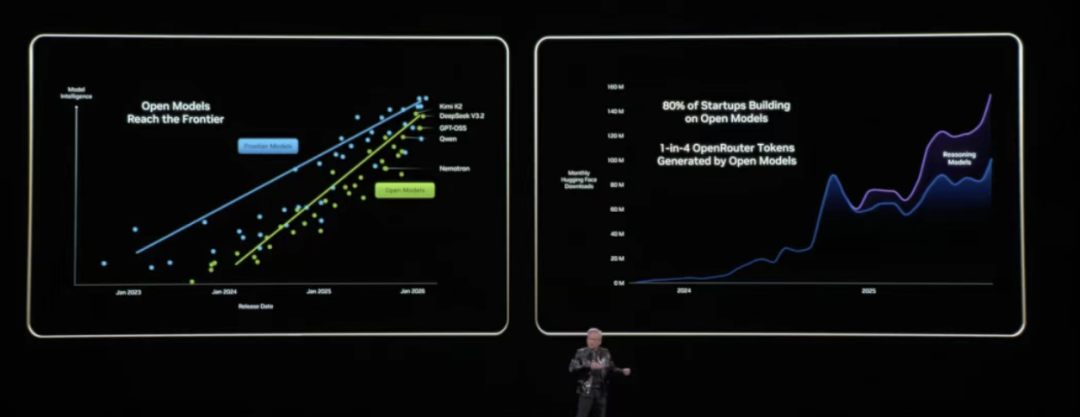
Core Insights - The rise of open-source models has become a catalyst for global innovation in the AI industry, as highlighted by NVIDIA CEO Jensen Huang during a presentation in Las Vegas [1][1] - The introduction of Deepseek R1 has unexpectedly driven transformation across the industry, showcasing the rapid advancements in open-source model performance [1][1] - Several open-source models are emerging globally, with their capabilities increasingly approaching those of leading frontier models [1][1] - The presentation featured images of multiple open-source models, including three from China: Kimi K2, Qwen, and Deepseek V3.2 [1][1]
黄仁勋新年第一场演讲 提了DeepSeek
Di Yi Cai Jing· 2026-01-05 23:17
Group 1 - The core viewpoint of the article highlights the significant progress in the AI industry over the past year, emphasizing the rise of open-source models as a catalyst for global innovation [1] - NVIDIA's CEO Jensen Huang noted that the emergence of the Deepseek R1 model has unexpectedly driven transformation across the industry [1] - Multiple open-source models are now emerging globally, with their performance increasingly approaching that of leading large models [1] Group 2 - The presentation showcased several open-source models, including three from China: Kimi K2, Qwen, and Deepseek V3.2 [1]
软件ETF(159852)涨超3%! DeepSeek近日发布论文,开启架构新篇章!
Jin Rong Jie· 2026-01-05 06:39
Market Performance - The Shanghai Composite Index has risen above 4000 points, increasing by 1.32% as of 14:05 [1] - The CSI Software Index has seen a significant increase of 3.41% [1] - Notable individual stock performances include Hehe Information rising over 7% and Keda Xunfei increasing by over 6% [1] - Popular ETFs, such as the Software ETF (159852), have also risen by 3.36% [1] Company Developments - DeepSeek has published a paper detailing a more efficient artificial intelligence development method, co-authored by founder Liang Wenfeng [1] - The proposed framework, named "Manifold-Constrained Hyperconnection" (mHC), aims to enhance scalability while reducing the computational power and energy requirements for training advanced AI systems [1] - DeepSeek's next-generation flagship system, R2, is expected to be launched around the Chinese New Year in February [1] ETF Information - The Software ETF (159852) tracks the CSI Software Service Index, with its top ten weighted stocks including Keda Xunfei, Kingsoft Office, Tonghuashun, and others, accounting for over 60.89% of the total weight [1] - The current management fee rate for the Software ETF is 0.50% annually, and the custody fee rate is 0.10% annually [1] - Investors without stock accounts can also access investment opportunities in this sector through linked funds [1]
国家发改委:长江经济带涌现DeepSeek、宇树科技等企业
2 1 Shi Ji Jing Ji Bao Dao· 2026-01-05 04:50
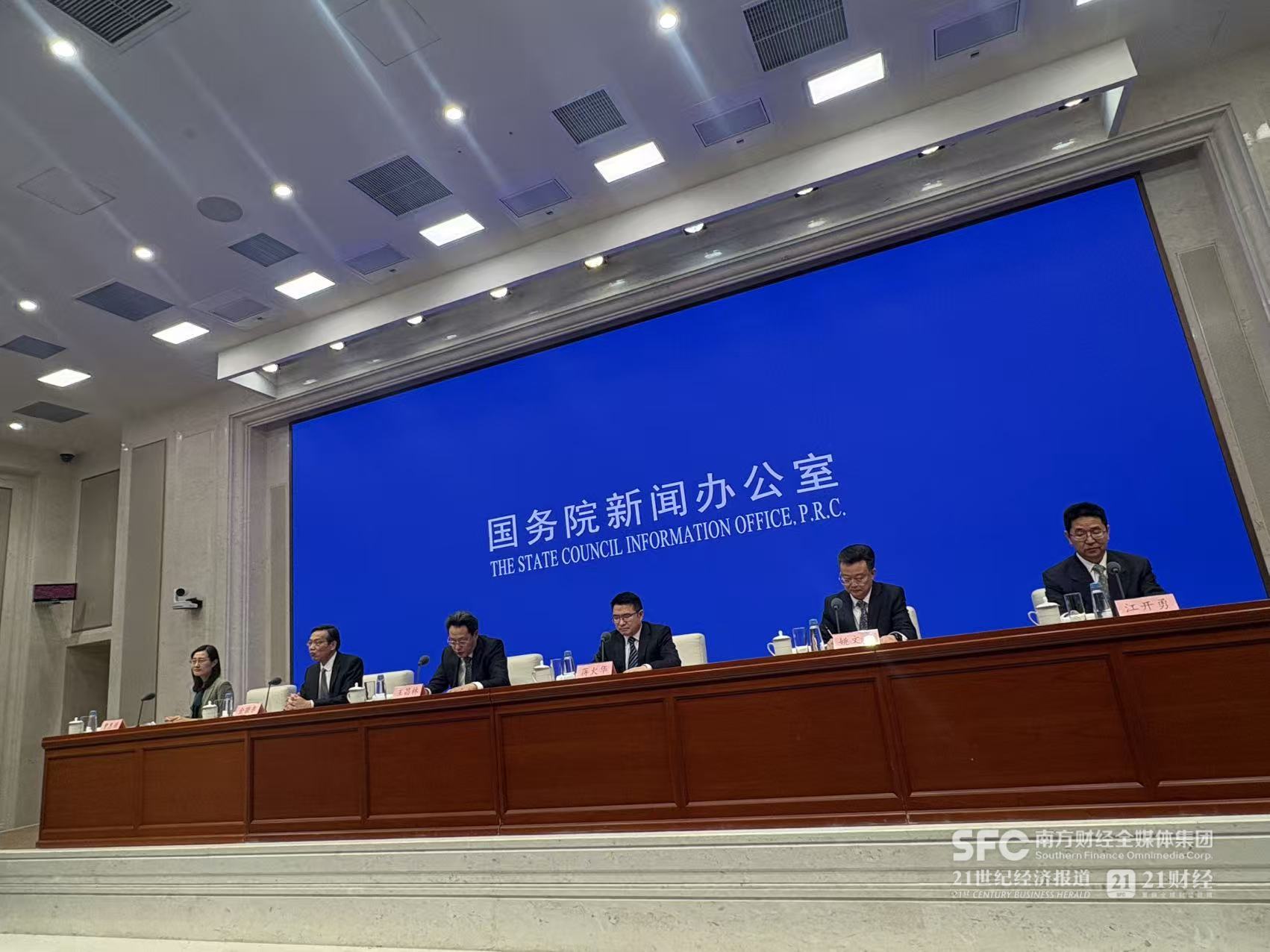
21世纪经济报道记者周慧 北京报道 "十年来,长江经济带优良水质比例从67%提升到96.5%,地区生产总值翻了一番多、占全国比重从42.2%提升到47.3%,实现了保护和发展的相互促进、相 得益彰。"王昌林表示。 图:发布会现场 拍摄:周慧 王昌林还表示,十年来,横贯东西、承接南北、通江达海的优势在长江经济带持续释放,开放长江活力更加澎湃。长江水系高等级航道由0.8万公里增加到 1.1万公里,干线港口货物吞吐量增长71%、达到42亿吨、稳居世界内河第一。推进高水平对外开放,中欧(亚)班列、西部陆海新通道高质量建设,沿江9 个自贸试验区联动发展。 1月5日,国新办举行新闻发布会介绍长江经济带发展十年工作进展和成效,国家发展改革委副主任王昌林表示,十年来,科技创新和产业创新在长江经济带 加快融合,创新长江动能更加强劲。 "我们坚持把科技创新作为主动力,持续推进上海(长三角)国际科技创新中心和武汉、成渝地区区域科技创新中心建设,积极培育壮大新兴产业和未来产 业。"王昌林表示,长江经济带创造出"人造太阳"亿度千秒运行、靶向抗癌药等一批处于世界先进水平的科技成果,涌现出DeepSeek、宇树科技等一批具有 国际竞争力的 ...
金融界财经早餐:假期中国资产全线大涨,十大券商看好牛市延续,DeepSeek又成焦点,宇树回应“绿色通道”上市(1月5日)
Jin Rong Jie· 2026-01-05 01:33
Group 1: Capital Market Insights - Global markets showed overall recovery during the New Year holiday, with Hong Kong's Hang Seng Index rising 2.7%, marking the strongest start in over a decade [2] - The Chinese yuan continues to appreciate, breaking the 7 mark, benefiting Chinese assets due to a weaker dollar and stable economic fundamentals [2] - Major brokerages remain optimistic about the A-share market, predicting a sustained bull market into 2026 [2] - A total of 71 new funds are scheduled for issuance in January, with 44 launching in the first trading week [2] Group 2: Industry Highlights - AI sector sees renewed attention with DeepSeek introducing a new AI model architecture that significantly reduces computing power requirements while enhancing efficiency [4] - The low-altitude economy is set to grow, with Shanghai aiming for a core industry scale of approximately 80 billion yuan by 2028 [4] - The film industry is projected to reach a box office of 51.83 billion yuan by 2025, with a year-on-year growth of 21.95% [4] - The real estate market in Beijing has seen increased viewing and transaction volumes since the implementation of new policies, with daily new home sales rising significantly [4] Group 3: Company Developments - Baidu plans to spin off Kunlun Chip for an IPO, with Goldman Sachs estimating its valuation at up to $16.5 billion, leading to a 10% surge in Baidu's Hong Kong shares [6] - BYD's electric vehicle sales have surpassed Tesla for the first time, with BYD selling 2.25 million units, a 28% increase year-on-year, while Tesla's deliveries are projected to decline by 8.6% to 1.64 million units in 2025 [6] - Ningde Times has repurchased 15.99 million shares for a total of 4.386 billion yuan [7] - DreamNet Technology has partnered with Shenzhou Liuhe to develop heavy-duty drone products [7]




影响市场重大事件:“十五五”开局之年,多型新火箭将首飞并挑战回收;中国“人造太阳”实验找到突破密度极限的方法;DeepSeek发布新论文,提出更为高效的AI开发方法
Mei Ri Jing Ji Xin Wen· 2026-01-04 22:25
Group 1 - In 2026, China's commercial space sector is set to witness multiple new rocket launches and recovery challenges, marking a significant development in the country's space ambitions [1] - The "Fifteen Five" plan is initiating a new phase for China's space exploration, including manned lunar missions and the Chang'e 7 mission aimed at finding evidence of water ice on the Moon [1] Group 2 - Emerging market stocks have had a strong start in 2026, reaching their highest level since 2021, driven by optimism around Asia's rising position in artificial intelligence [2] - The MSCI Emerging Markets Index rose by 1.7% on the first trading day of the year, while technology stocks surged by 2.8% due to excitement over new listings and technological advancements [2] Group 3 - DeepSeek has introduced a more efficient AI development method through a new framework called "manifold-constrained hyperconnection" (mHC), aimed at enhancing scalability and reducing computational and energy demands [3] - The next flagship system, R2, is expected to be launched around the Chinese New Year in February [3] Group 4 - The digital renminbi app has been upgraded to version 2.0, enhancing user experience and consolidating wallet access for managing digital currency assets [4] - Since its launch in January 2022, the app has undergone 54 iterations to improve functionality [4] Group 5 - China's "artificial sun" experiment has made breakthroughs in overcoming density limits in nuclear fusion, providing crucial physical evidence for high-density operation in magnetic confinement fusion devices [5] - The findings were published in the international journal "Science Advances" [5] Group 6 - CITIC Securities forecasts that the A-share bull market will continue in 2026, with expectations of a fluctuating upward trend but with slower growth rates [6] - Investors are advised to focus on fundamental improvements and sectoral shifts, particularly in resource commodities as a new investment direction [6] Group 7 - The first "embodied intelligence dataset" has been successfully listed and traded on the Jiangsu Data Exchange, marking a significant milestone in the trading of such datasets nationwide [7][8] Group 8 - In 2025, China approved 76 innovative drugs, significantly surpassing the 48 approved in 2024, setting a new record [9] - The total value of innovative drug licensing transactions exceeded $130 billion, with over 150 deals completed, also a historical high [9] - Among the approved drugs, 80.85% of chemical drugs and 91.30% of biological products were domestically developed [9] Group 9 - CITIC Securities predicts that the quantum computing industry will experience high compound growth, with the global market expected to grow from approximately $5 billion in 2024 to around $800 billion by 2035 [10] - The upstream sector is relatively mature, while the downstream sector shows significant growth potential, projected to increase from $2.7 million in 2024 to $2026.7 million by 2035 [10] Group 10 - China's largest all-vanadium flow battery energy storage station has achieved full-capacity operation, with a rated power of 200,000 kW and a storage capacity of 1 million kWh [11] - The facility is expected to enhance the utilization rate of associated photovoltaic power stations by over 10% annually, potentially generating an additional 230 million kWh of clean electricity [11]