Seek .(SKLTY)

Search documents
DeepSeek预测:黄金疯涨只是开始!这5样东西也会上涨,囤货清单来了
Sou Hu Cai Jing· 2026-01-24 17:39
Core Viewpoint - The article discusses the recent surge in gold prices and predicts that several other commodities, including silver, copper, natural gas, coffee, and cocoa, will also experience price increases due to various market factors [1][2][4][5][7]. Group 1: Gold Market Analysis - Gold prices have risen significantly, reaching over $4,000, with a year-to-date increase of 52%, marking the largest annual gain since 1979 [1][2]. - Key drivers for gold's price increase include geopolitical tensions, such as the Middle East conflicts and the ongoing Russia-Ukraine war, which have heightened market risk aversion [2]. - The expectation of two rate cuts by the Federal Reserve in 2025 is anticipated to weaken the dollar's appeal, further boosting gold prices [2]. Group 2: Other Commodities Expected to Rise - Silver is expected to rise due to strong industrial demand, particularly in the photovoltaic sector, where it accounts for 65% of industrial usage [4]. - Copper demand is projected to grow over 60% by 2030, driven by energy transition initiatives and infrastructure upgrades, with supply constraints from mining accidents [4]. - Natural gas prices are forecasted to increase by approximately 10% in Europe and 60% in the U.S. in 2025, influenced by geopolitical factors and weather conditions [5]. - Coffee prices are rising due to drought conditions in Brazil, which produces nearly half of the world's Arabica coffee [7]. - Cocoa prices are also increasing due to similar supply issues, with drought affecting production [7]. Group 3: Investment Considerations - Investment in commodities can be approached through physical assets like gold bars or coins, ETFs, or futures contracts for other commodities [10]. - The potential impact of rising commodity prices on everyday costs is acknowledged, particularly for coffee and cocoa, while natural gas price increases may affect heating costs [10]. - The article emphasizes the importance of risk management in commodity investments, suggesting that investors should allocate a reasonable portion of their assets to commodities [12].



百万台NOA上车后,轻舟智航想做智驾领域的DeepSeek
Xin Lang Cai Jing· 2026-01-24 03:08
Core Viewpoint - The announcement by CEO Yu Qian of Qingzhou Zhihang regarding the target of over 1 million vehicles equipped with the NOA (Navigation on Autopilot) system by January 2026 marks a significant milestone in the autonomous driving industry, indicating a competitive edge in data accumulation and technology enhancement [1][2]. Group 1: Company Overview - Qingzhou Zhihang, founded in 2019, initially focused on L4 autonomous driving but shifted to mass production vehicle business in 2022, aiming for L2+ advanced driver assistance systems [2][3]. - The company collaborates with major automotive manufacturers like Li Auto and GAC Group, enhancing its visibility and technological capabilities [3][4]. Group 2: Market Position and Strategy - The target of 1 million NOA-equipped vehicles is relatively small compared to China's annual car production of around 30 million, suggesting significant growth potential [2]. - Qingzhou Zhihang's strategy includes addressing the overlooked fuel vehicle market, which still holds a substantial share, and aims to leverage partnerships for engineering adjustments and algorithmic improvements [6][7]. Group 3: Technological Development - The company has developed a mass production plan for urban NOA based on the Horizon Journey 6M chip, aiming to enhance user experience with limited computational power [3][4]. - The integration of L2 and L4 business lines allows for shared technological advancements, with data from L2 assisting in L4 development [4][5]. Group 4: Future Outlook - Qingzhou Zhihang has outlined a three-year product roadmap, targeting a price drop for urban NOA vehicles to 100,000 yuan by 2026 and aiming for 3 million NOA units by 2027 [7]. - The company is also focusing on international expansion, having established a European headquarters and partnerships to support both Chinese manufacturers abroad and global companies entering the Chinese market [6][7].
2026年美中AI市场竞争态势与DeepSeek的突围-英文版
Sou Hu Cai Jing· 2026-01-22 18:44
Core Insights - The report by RAND focuses on the global competitive landscape of large language models (LLMs) between the U.S. and China from April 2024 to August 2025, analyzing website traffic data from 135 countries to understand market dynamics and the impact of the DeepSeek R1 model launch [1][12][18]. Market Growth and U.S. Dominance - The global LLM market is experiencing rapid growth, with monthly visits to major platforms increasing from 2.4 billion to nearly 8.2 billion, a threefold rise from April 2024 to August 2025 [21][58]. - U.S. models maintained a dominant market share of approximately 93% by August 2025, despite the emergence of Chinese models [21][58]. - The launch of DeepSeek R1 in January 2025 led to a 460% increase in visits to Chinese LLMs within two months, raising their global market share from 3% to 13% [21][58]. - Chinese models achieved over 10% penetration in 30 countries and over 20% market share in 11 countries, with significant growth in developing nations and those with close ties to China [21][58]. The DeepSeek Disruption - DeepSeek R1's introduction disrupted the market, as it did not cannibalize traffic from other Chinese models, which continued to grow [21][58]. - The overall market for Chinese LLMs expanded due to DeepSeek's success, indicating a shift in competitive dynamics [21][58]. Drivers of Model Adoption - Pricing is less of a factor in user adoption, as Chinese model API costs are significantly lower (1/6 to 1/4 of U.S. counterparts), but most users do not encounter these differences due to free-tier offerings [2][21]. - Multilingual support has improved, with Chinese models like Qwen expanding from 26 to 119 languages, narrowing the gap with U.S. models [2][21]. - In AI diplomacy, China has been more active, announcing 401 AI cooperation initiatives from 2015 to 2025, compared to the U.S.'s 304 initiatives, although this primarily affects government and corporate partnerships rather than individual user choices [2][21]. Regional Variations - Adoption of Chinese LLMs varies significantly by region, with substantial gains in countries like Russia, the Middle East, Africa, and South America, which are often developing nations or have strong ties to China [21][63]. - The correlation between the adoption of Chinese LLMs and GDP per capita indicates that lower-income countries are more likely to adopt these models, suggesting economic factors play a crucial role in driving adoption [21][66].

大摩眼中的DeepSeek:以存代算、以少胜多
3 6 Ke· 2026-01-22 09:09
Core Insights - DeepSeek is revolutionizing AI scalability by utilizing a hybrid architecture that replaces scarce high-bandwidth memory (HBM) with more cost-effective DRAM through an innovative module called "Engram" [1][3][5] Group 1: Engram Module and Conditional Memory - The Engram module introduces "Conditional Memory," separating static knowledge storage from dynamic reasoning, which significantly reduces reliance on expensive HBM [3][5] - This architecture allows for efficient retrieval of basic information without overloading HBM, thus freeing up capacity for more complex reasoning tasks [3][5] Group 2: Economic Impact on Infrastructure - The Engram architecture reshapes hardware cost structures by minimizing HBM dependency, potentially shifting infrastructure costs from GPUs to more affordable DRAM [5][6] - A 100 billion parameter Engram model requires approximately 200GB of system DRAM, indicating a 13% increase in the use of commodity DRAM per system [5][6] Group 3: Innovation Driven by Constraints - Despite limitations in advanced computing power and hardware access, Chinese AI models have rapidly closed the performance gap with global leaders, demonstrating "constraint-induced innovation" [6][7] - DeepSeek's advancements suggest that future AI capabilities may rely more on algorithmic and system-level innovations rather than merely increasing hardware resources [6][7] Group 4: Future Outlook - The upcoming DeepSeek V4 model is expected to achieve significant advancements in encoding and reasoning, potentially running on consumer-grade hardware like the RTX 5090 [7] - This development could lower the marginal costs of high-level AI inference, enabling broader deployment of AI applications without the need for expensive data center-grade GPU clusters [7]
大摩眼中的DeepSeek:以存代算、以少胜多!
Hua Er Jie Jian Wen· 2026-01-22 02:48
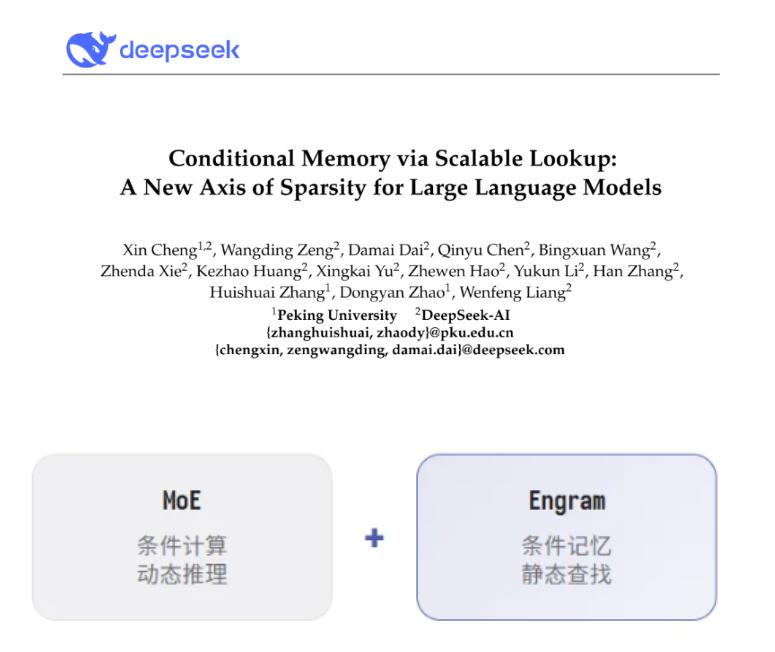
Core Insights - DeepSeek is revolutionizing AI scalability by utilizing a hybrid architecture that replaces scarce HBM resources with more cost-effective DRAM, focusing on smarter design rather than merely increasing GPU clusters [1][5] Group 1: Technological Innovation - DeepSeek's innovative module, "Engram," separates storage from computation, significantly reducing the need for expensive HBM by employing a "Conditional Memory" mechanism [1][3] - The Engram architecture allows for efficient retrieval of static knowledge stored in DRAM, freeing up HBM for more complex reasoning tasks, thus enhancing overall efficiency [3][5] Group 2: Cost Structure and Economic Impact - The shift from reliance on HBM to DRAM is expected to reshape the hardware cost structure, making AI infrastructure more affordable [5][7] - A 100 billion parameter Engram model requires approximately 200GB of system DRAM, indicating a 13% increase in the use of commercial DRAM per system compared to existing setups [5][7] Group 3: Competitive Landscape - Despite hardware limitations, Chinese AI models have rapidly closed the performance gap with leading global models, demonstrating strong competitive capabilities [6][8] - DeepSeek V3.2 achieved an MMLU score of approximately 88.5% and coding capability of around 72%, showcasing its efficiency in reasoning and performance [6][8] Group 4: Future Outlook - The upcoming DeepSeek V4 model is anticipated to leverage the Engram architecture for significant advancements in coding and reasoning, potentially running on consumer-grade hardware [8] - This development could lower the marginal costs of high-level AI inference, facilitating broader deployment of AI applications without reliance on expensive data center GPUs [8]
科技 - DeepSeek:以更少资源实现更多价值Tech Bytes-DeepSeek – Doing More With Less
2026-01-22 02:44
Summary of DeepSeek's Innovation and Investment Implications Company and Industry Overview - **Company**: DeepSeek, a China-based AI company - **Industry**: Artificial Intelligence (AI) and semiconductor technology Core Insights and Arguments 1. **Innovation in AI Architecture**: DeepSeek's Engram module reduces high-bandwidth memory (HBM) constraints and infrastructure costs by decoupling storage from compute, suggesting that future AI advancements may focus on efficient hybrid architectures rather than merely larger models [1][2][9] 2. **Efficiency Gains**: The Engram approach enhances efficiency for Large Language Models (LLMs) by allowing essential information retrieval without overloading HBM, potentially reducing the need for costly HBM upgrades [2][3] 3. **Performance Metrics**: DeepSeek's findings indicate that hybrid architectures can outperform traditional models, with a minimum requirement of around 200GB system DRAM compared to existing systems that utilize significantly more [3][12] 4. **Next Generation LLM**: The upcoming DeepSeek LLM V4 is expected to leverage the Engram architecture, particularly excelling in coding and reasoning tasks, and may run efficiently on consumer-grade hardware [4][5] Investment Implications 1. **Market Potential**: Despite China's AI market being smaller than that of the US, its growth momentum suggests that investment opportunities may be underestimated. The report favors investments in Chinese memory and semiconductor localization themes, highlighting companies like Naura, AMEC, and JCET [5][9] 2. **Strategic Positioning**: By focusing on algorithmic efficiency rather than hardware expansion, DeepSeek exemplifies how companies can navigate geopolitical and supply-chain constraints, potentially leading to a more cost-effective and scalable AI ecosystem in China [21][16] Additional Important Insights 1. **Performance Comparison**: Over the past two years, Chinese AI models have significantly closed the performance gap with leading models like ChatGPT 5.2, emphasizing efficiency-driven innovations rather than sheer parameter growth [10][16] 2. **Conditional Memory Concept**: Engram introduces a method to separate static memory from dynamic reasoning, optimizing GPU usage and enhancing long-context handling, which has been a challenge for many large models [11][24] 3. **Benchmark Performance**: Engram has shown improved performance in benchmark tests, particularly in handling long-context inputs, which enhances the utility of AI models [20][21] This summary encapsulates the key points from the conference call regarding DeepSeek's innovations, their implications for the AI industry, and potential investment opportunities in the context of China's evolving AI landscape.
DeepSeek新模型将至?创业板人工智能ETF南方(159382)上涨2.21%,国产大模型迭代加速,2026年AI成长确定性增强
Xin Lang Cai Jing· 2026-01-22 02:41
Group 1 - The core viewpoint of the news highlights the significant growth and penetration of artificial intelligence (AI) in various industries, with projections indicating that the number of AI companies in China will exceed 6,000 by 2025 and the core industry scale is expected to surpass 1.2 trillion yuan [1][2] - As of January 20, 2026, AI has penetrated over 70% of business scenarios in leading smart factories, with more than 6,000 vertical models developed, driving the large-scale application of over 1,700 key intelligent manufacturing equipment and industrial software [1] - The AI applications have covered key industries such as steel, non-ferrous metals, electricity, and telecommunications, gradually deepening into critical areas like product development, quality inspection, and customer service [1] Group 2 - The DeepSeek-R1 model has seen the emergence of a new model named "MODEL1" in the open-source community, indicating ongoing advancements in AI technology [2] - Industry experts predict that the global large model sector will continue to accelerate, with strong competitive advantages for China's AI development, as major tech companies are expected to enhance their capital expenditures to support model upgrades [2] - The Southern China AI ETF closely tracks the performance of the AI index, which reflects the stock price changes of listed companies related to the AI theme, with the top ten weighted stocks including companies like Zhongji Xuchuang and Tianfu Communication [2]
DeepSeek新模型曝光;AI产业链业绩兑现丨新鲜早科技
2 1 Shi Ji Jing Ji Bao Dao· 2026-01-22 02:30
Group 1: Technology Developments - DeepSeek has updated its GitHub repository, revealing a new model architecture "MODEL1," which is expected to be more efficient and suitable for edge devices compared to its predecessor DeepSeek-V3.2 [2] - Longji Technology announced significant progress in Co-packaged Optics (CPO) technology, with successful customer sample deliveries and testing, addressing the growing demand for high-bandwidth, low-latency optical interconnects [11] - Shanghai Yiyou Intelligent Control Technology has launched its first automated production line for robot joints in Zhangjiang, aiming to meet the increasing demand and reduce costs for humanoid robots [10] Group 2: Financial Performance and Projections - Moole Technology expects a net loss of 950 million to 1.06 billion yuan for 2025, despite launching a leading GPU product and experiencing revenue growth due to the AI industry's expansion [17] - Demingli anticipates a net profit of 650 million to 800 million yuan for 2025, representing a year-on-year increase of 85.42% to 128.21%, driven by advancements in storage solutions and AI demand [18] - Tianfu Communication projects a net profit of 1.881 billion to 2.150 billion yuan for 2025, reflecting a growth of 40% to 60% due to the accelerating AI industry and global data center construction [19] Group 3: Regulatory and Market Responses - The European Union plans to phase out "high-risk suppliers" in critical sectors, interpreted as targeting Chinese tech firms like Huawei, which has expressed concerns over the fairness of such regulations [2] - Pinduoduo was fined 100,000 yuan for failing to report tax information as required, highlighting regulatory scrutiny on internet platform companies [4] - Zhiyu Technology announced a temporary limit on the sale of its GLM Coding Plan due to high demand and resource constraints, reducing daily sales to 20% of current levels [3]
西贝获新一轮融资,新荣记张勇等入股;马斯克与奥特曼互喷;DeepSeek新模型曝光;黄仁勋:AI时代蓝领更吃香;俞敏洪开办“退休俱乐部”
Sou Hu Cai Jing· 2026-01-22 02:27
Group 1 - The Ministry of Industry and Information Technology (MIIT) has announced the establishment of a safety monitoring platform for the operation status of new energy vehicles, effective from January 1, 2027 [4] - Xibei Catering Group has completed a new round of financing, with investors including Taizhou Xinrongtai Investment and former Ant Group CEO Hu Xiaoming, although the specific amount remains undisclosed [4][5] - The financing has increased Xibei's registered capital from 89.90 million yuan to 101.68 million yuan, marking a 13.1% increase [5] Group 2 - The price of gold jewelry in China is approaching 1500 yuan per gram, with brands like Chow Tai Fook and Lao Feng Xiang reporting significant price increases [7] - OpenAI has announced plans to expand its AI infrastructure in the U.S. to 10 gigawatts by 2029, committing to cover energy costs to prevent price hikes [12] - Nvidia's CEO Jensen Huang emphasized the rising demand for skilled tradespeople in the AI era, predicting that plumbers and electricians could earn six-figure salaries due to the infrastructure needs of AI [10] Group 3 - Apple plans to upgrade Siri into a chatbot by the second half of 2026, utilizing Google's Gemini model [10] - DeepSeek has revealed a new model, MODEL1, which is designed for efficient inference and optimized for edge devices [9] - The VCSEL chip provider Raysees Technology has completed a multi-hundred million yuan Series C financing round [20]
【钛晨报】住建部:有序搭建房地产开发、融资、销售等基础制度;DeepSeek AI新模型:搭载 MODEL1 全新架构,最快2月上线;财政部:在武汉天河国际机场等41个口岸各新设1家口岸进境免税店
Sou Hu Cai Jing· 2026-01-21 23:58
Real Estate Development - The Ministry of Housing and Urban-Rural Development emphasizes the importance of accelerating transformation and upgrading for high-quality real estate development, focusing on two main areas: orderly promotion of "good housing" construction and the establishment of a new model for real estate development [2] - The construction of "good housing" involves collaboration among government, enterprises, and society, with a comprehensive deployment to enhance housing quality through standards, design, materials, construction, and operation [2] - The new model for real estate development aims to ensure a smooth transition from old to new models, focusing on a mechanism that links people, housing, land, and finance [2] Real Estate Financing and Sales - The project company system will be implemented to ensure independent legal rights and responsibilities, prohibiting headquarters from misappropriating project funds before delivery [3] - A lead bank system will be introduced for real estate financing, where one bank or syndicate will be responsible for managing project funds [3] - The promotion of a "current housing sales" system aims to mitigate delivery risks, while pre-sale funds will be regulated to protect buyers' rights [3] Market Trends - The AI technology market is expected to grow significantly, with new personal AI devices emerging and the overall market scale likely to expand further between 2026 and 2027 [3] - The integration of energy and computing networks is crucial for enhancing global competitiveness, as highlighted by industry leaders [4] Mergers and Acquisitions - Energy Fuels has agreed to acquire Australian Strategic Materials for AUD 447 million (approximately USD 300.9 million), marking a significant move to secure the supply chain for rare earth elements [7] Policy Developments - The Ministry of Finance announced the establishment of duty-free shops at 41 ports, allowing residents from Macau to purchase duty-free goods [8] - New tax policies for innovative enterprises' CDRs will be implemented from January 1, 2026, to December 31, 2027, including exemptions on capital gains tax for individual investors [9] Financial Sector Updates - The People's Bank of China is focusing on modernizing the payment system and enhancing cross-border payment capabilities [10] - The National Financial Regulatory Administration has released new regulations to improve the administrative licensing process, enhancing the efficiency of market access [10] Industrial and Technological Development - The Ministry of Industry and Information Technology is promoting humanoid robot technology and aims to strengthen the ecosystem for humanoid robots [11] - A notification has been issued to automate the monitoring of computing power resources across 31 provinces by the end of 2026 [12] Economic Performance - Beijing's GDP reached CNY 5.20734 trillion in 2025, growing by 5.4% year-on-year, with the tertiary sector showing the highest growth at 5.8% [18]